Inspiration
AI is becoming extremely good at telling companies what they could improve. But recommendations are not results.
A model can identify millions in potential savings, released working capital, margin recovery, or additional revenue. The difficult question comes afterwards:
Did the organization actually capture that value?
We saw the same problem in supply chains and sustainability. Companies have forecasts, dashboards, targets, and estimated impact, but proving what changed in the real world — and linking that change to evidence — is much harder.
That inspired AION V3 — Sovereign Value OS.
We wanted to create a system that connects:
data → opportunity → decision → execution → evidence → verified value
Our goal is to make AI not only intelligent, but accountable.
What it does
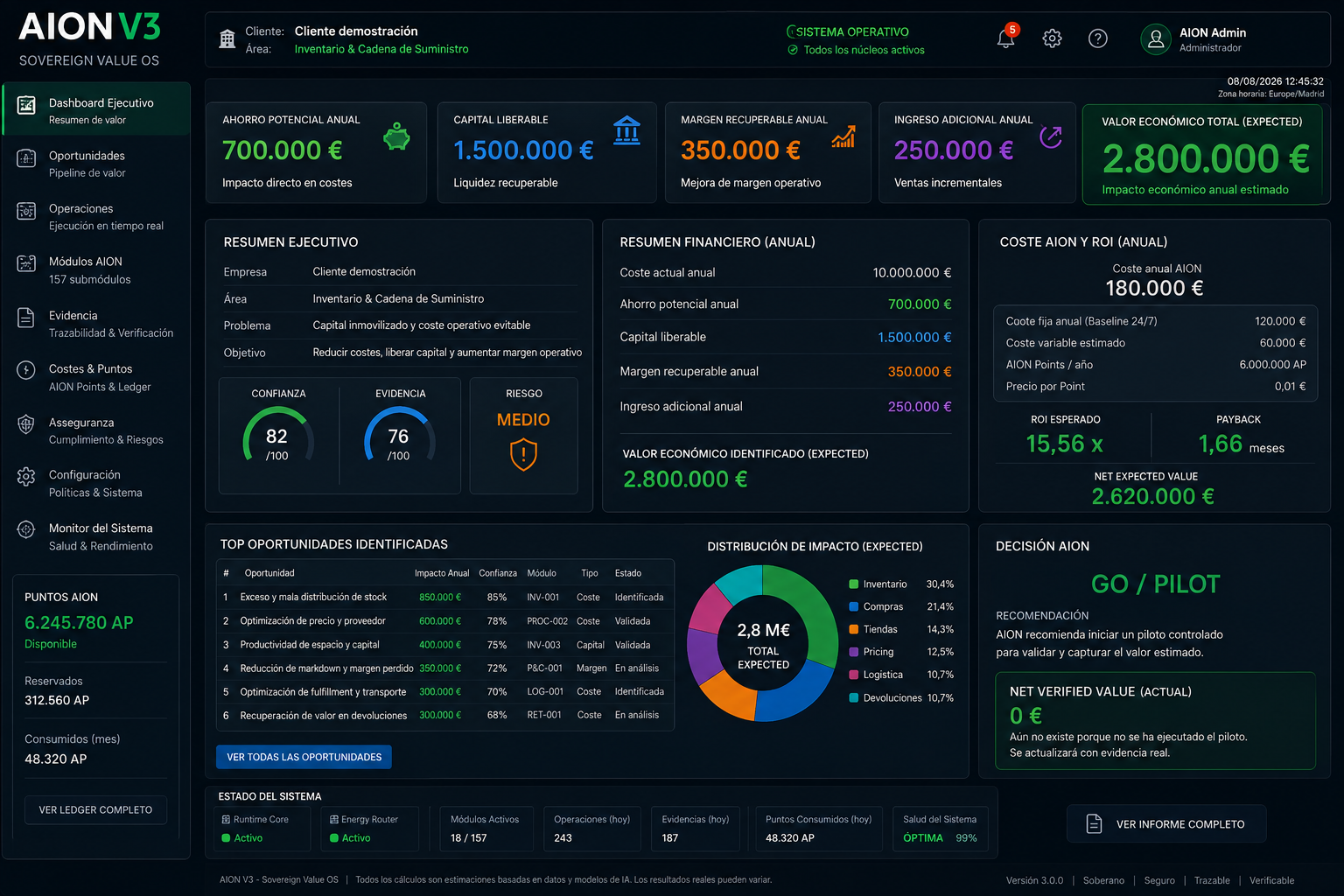
AION V3 is an AI-powered Value Operating System designed to identify, prioritize, and verify value opportunities across enterprise operations and supply chains.
It can organize opportunities such as excess inventory, supplier optimization, logistics improvements, margin leakage, inefficient capital allocation, returns recovery, and incremental revenue.
Each opportunity is evaluated using factors such as:
- expected economic impact
- confidence
- available evidence
- risk
- operational status
AION then translates those opportunities into executive metrics such as annual savings, releasable capital, recoverable margin, incremental revenue, ROI, and payback.
But the key concept is the distinction between Expected Value and Verified Value.
An opportunity can have a large estimated impact, but AION does not treat that estimate as realized value until execution generates evidence.
In simple terms:
[ V_{verified} \leq V_{expected} ]
until the result can be demonstrated.
This same model can be extended to environmental impact, helping organizations connect operational improvements with measurable outcomes such as reduced waste, lower emissions, optimized transport, and more efficient use of resources.
How we built it
We designed AION as a modular operating system rather than a single AI recommendation engine.
The prototype combines several layers:
- an opportunity intelligence layer for identifying and organizing value opportunities
- confidence, evidence, and risk scoring
- an executive value layer that converts operational findings into financial outcomes
- a lifecycle for moving opportunities from identification to validation, execution, and verification
- an evidence and traceability layer designed to make results auditable
- an AION Points system for tracking computational and operational activity
- an executive dashboard that makes the system understandable at a glance
We focused heavily on the user experience.
An executive should be able to open AION and immediately understand:
How much value is available?
Where does it come from?
How confident are we?
What is the risk?
What should we do next?
How much value has actually been verified?
We also designed the platform around independent modules so that inventory, procurement, logistics, pricing, returns, sustainability, and other domains can eventually operate inside the same value architecture.
Challenges we ran into
One of our biggest challenges was avoiding AI theater.
It is easy to build a dashboard that displays impressive predictions and large numbers. It is much harder to design a system that is honest about the difference between a forecast and a real result.
That is why AION explicitly separates Expected Value from Verified Value.
Another challenge was simplifying complexity. Supply-chain decisions can involve inventory, procurement, logistics, pricing, capital, risk, and sustainability at the same time. We needed to turn that complexity into a system that decision-makers could understand in seconds.
We also had to think carefully about trust.
Enterprise AI cannot simply produce an answer. The organization needs to understand where the answer came from, how confident the system is, what evidence supports it, and whether the expected result was actually achieved.
Connecting recommendation, execution, evidence, and verification became one of the hardest — and most important — parts of the project.
Accomplishments that we're proud of
We are especially proud that AION does not automatically convert AI predictions into claimed business value.
In our prototype, the system can identify millions in Expected Value while still displaying:
Net Verified Value: €0
if the proposed actions have not yet been executed and proven.
That may look conservative, but it represents the philosophy behind the entire platform:
No evidence, no verified value.
We are also proud of creating a single interface that connects operational opportunities with executive metrics such as savings, released capital, margin, revenue, ROI, payback, confidence, evidence, and risk.
Instead of producing another isolated AI tool, we designed AION as the foundation of a broader operating system for measurable enterprise value.
What we learned
The biggest lesson was that the real enterprise AI problem is not a lack of recommendations.
Organizations already have enormous amounts of data, analytics, dashboards, consultants, and increasingly powerful AI models.
The missing layer is often what happens after the recommendation.
We learned that value needs a lifecycle:
[ \text{Identify} \rightarrow \text{Validate} \rightarrow \text{Execute} \rightarrow \text{Measure} \rightarrow \text{Verify} ]
An opportunity should not become a success metric simply because an AI model predicted it.
We also learned that economic and environmental performance are often connected. Excess inventory, inefficient transportation, unnecessary returns, poor sourcing, and wasted capacity can create both financial and environmental costs.
That means the same verification architecture can eventually be used to measure more than money.
What's next for AION V3 — Sovereign Value OS
The next step is to evolve AION from economic value verification toward economic + environmental value verification.
We want organizations to be able to evaluate the same initiative across multiple dimensions:
[
\text{Total Impact}
\text{Economic Value} + \text{Environmental Value} + \text{Operational Resilience} ]
An inventory optimization could show both working capital released and waste avoided.
A logistics optimization could measure both transportation savings and emissions reduced.
A supplier decision could combine cost, risk, resilience, and environmental performance.
We also want to expand the evidence layer, strengthen traceability, integrate more operational data sources, and allow additional AION modules to work together inside a common value ledger.
Our long-term vision is simple:
AI should not be judged by how many recommendations it generates. It should be judged by the value it can prove.
Built With
- api
- blockchain
- css3
- docker
- ethereum
- fastapi
- html5
- hyperledger
- javascript
- numpy
- openai
- pandas
- plotly
- postgresql
- python
- react
- rest


Log in or sign up for Devpost to join the conversation.