-
-
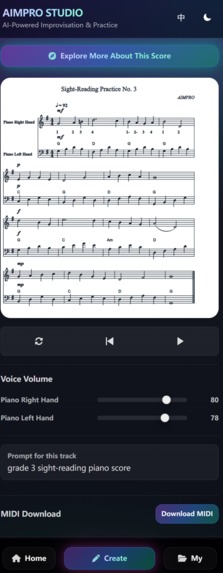
Creat a grade 3 sight-reading piano score
-
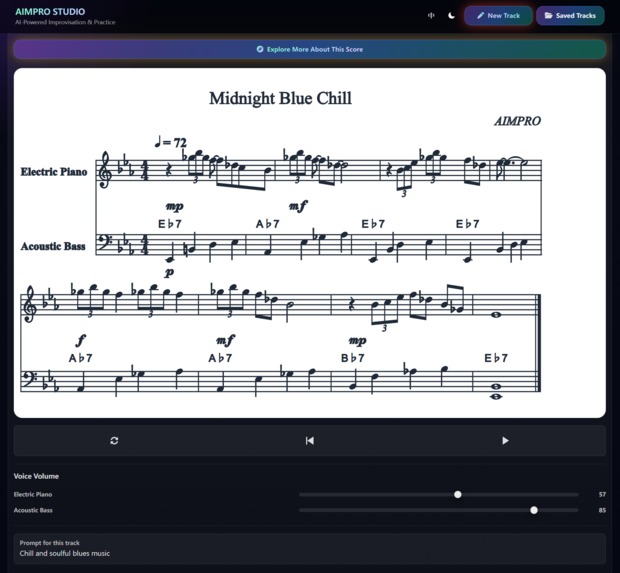
Create a chill and soulful blues music
Inspiration
My inspiration comes from my actual experience as a piano teacher. I often want my students to practice improvisation to understand music theory deeply, rather than just reading notes.
However, I encountered a paradox:
"Traditional textbooks have fixed scores. Once a student practices them enough to memorize the pattern, the 'improvisation' becomes 'recitation'."
The essence of improvisation is reacting to the unknown. I realized that to truly teach improvisation, I needed an infinite source of new, structured, yet unpredictable musical exercises. That's when I thought: Why not use AI to generate fresh staff notation on the fly?
By combining Generative AI with music theory, we can create a "sight-reading engine" that never runs out of material, keeping the creative spark alive.
What it does
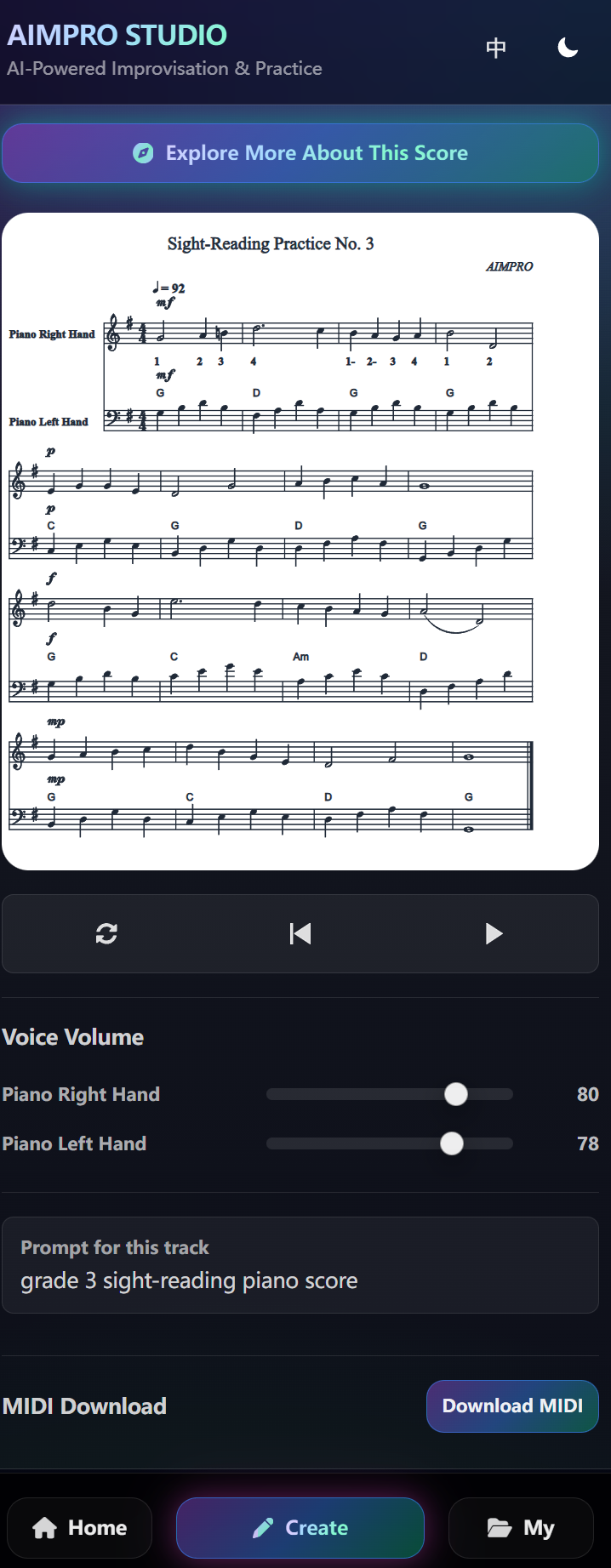
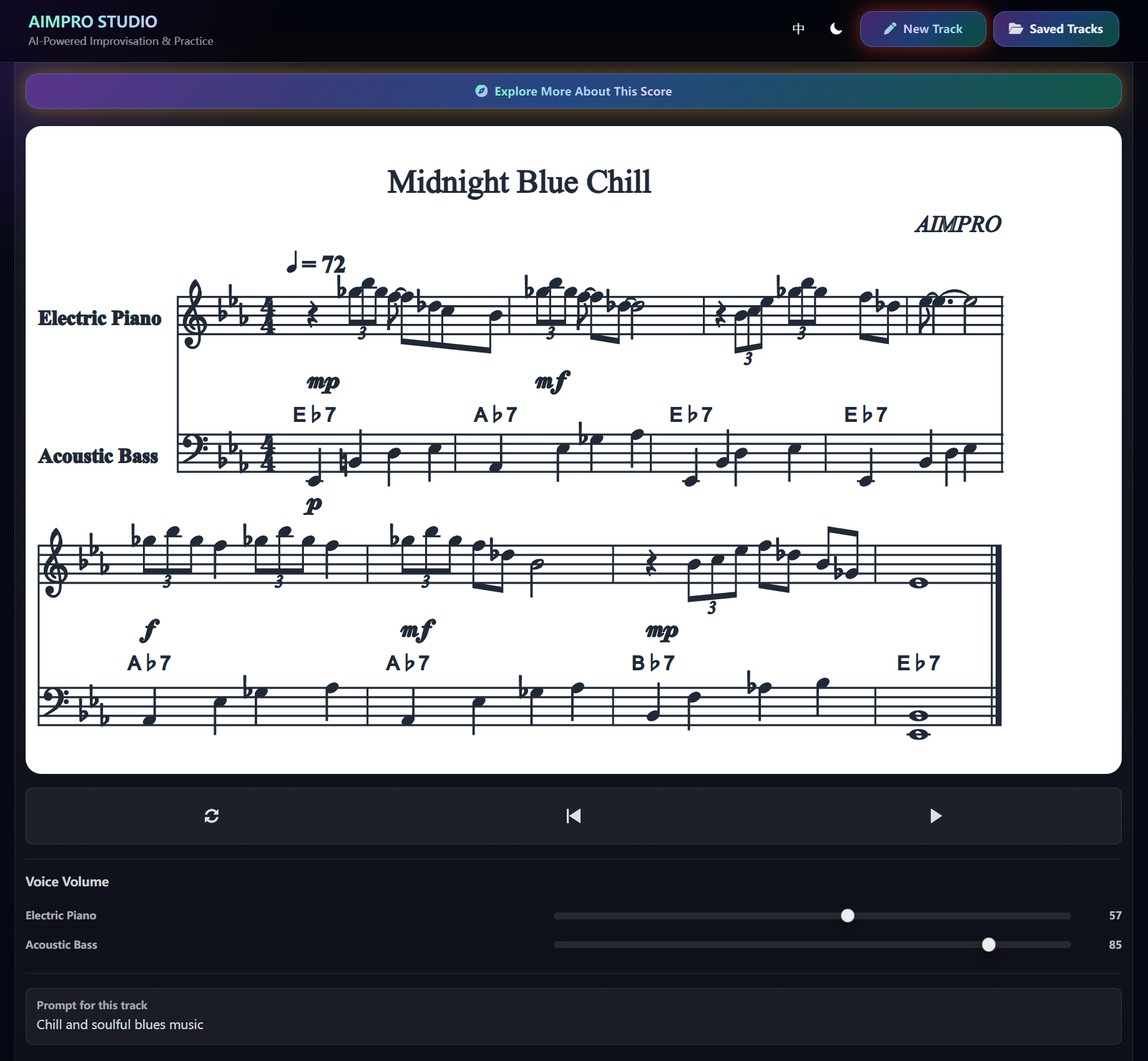
AIMPRO is an AI-powered music education platform that generates unique piano exercises and renders them into playable sheet music instantly.
- Text-to-Music Generation: Users can describe a specific musical goal (e.g., "A C Major chord progression with a jazz rhythm").
- Instant Rendering: The AI outputs ABC notation, which is immediately compiled into visual sheet music (Staff Notation) in the browser.
- Audio Playback: High-quality SoundFonts play the generated music, allowing students to hear the goal before playing.
How we built it
We built a modern web application leveraging Google's AI capabilities:
- AI Model: We utilized Google Gemini 3 Flash (via
geminiABC.js and django backend) as our core composition engine. We engineered prompts to output strict ABC notation syntax. - Frontend: Built with Vanilla JavaScript and modern CSS (Tailwind-style utility classes) for a lightweight, fast user experience.
- Music Rendering: We integrated
abcjsto parse the AI's text output and render it as standard SVG sheet music. - Audio Synthesis: We used Web Audio API with SoundFonts (located in
statics/soundfont/MusyngKite) to provide realistic instrument sounds, far superior to standard MIDI beeps.
Challenges we ran into
1. Prompt Engineering for Strict Musical Syntax
Getting an LLM to "be creative" is easy; getting it to "be creative within strict syntax rules" is a hard engineering problem.
- The Challenge: Large Language Models are probabilistic. Early in development, the model would often "hallucinate" invalid ABC headers, mix natural language with code, or lose track of time signatures (e.g., generating 5 beats in a 4/4 bar).
- The Solution: We moved beyond simple instructions to a Structured XML Prompting strategy. We designed a rigorous system prompt using tags like
<role>,<critical_rules>, and<composition_logic>to enforce a "Strict Composer Mode." This approach explicitly defines:- Syntax Constraints: Mandating ABC v2.1 standards (e.g.,
V:1for melody,V:2for accompaniment, strictly aligned measures). - Output Purity: Enforcing a "Code-Only" policy (no Markdown, no natural language) via
<output_constraint>tags. - Logic Chain: Guiding the AI through specific composition steps, from style analysis to MIDI instrument assignment (
%%MIDI program), ensuring the output is not just musically valid but also machine-parsable.
- Syntax Constraints: Mandating ABC v2.1 standards (e.g.,
2. Strict ABC Validation & Formatting
Raw ABC notation generated by LLMs often contains subtle timing errors or syntax ambiguities that cause abcjs (the rendering library) to fail or render incorrectly.
- The Solution: We built a robust ABC Parser middleware (
abcParser.js) that sanitizes the output before rendering:- Beat Alignment Engine: A custom
fixAbcAlignmentalgorithm calculates the exact duration of every measure. If a measure is mathematically incomplete (e.g., missing a 1/8th note in 4/4 time), it intelligently pads it with invisible rests to prevent layout shifts. - Tuplet Math: It handles complex tuplet logic (e.g.,
(3:2:3) to ensure note spacing is mathematically precise. - MIDI Channel Assignment: To support polyphony playback, we implemented
assignMidiChannelsto automatically route voices to distinct MIDI channels (skipping the percussion channel 10), ensuring rich, multi-layered audio. - Accidental Fix: The
fixAbcAccidentalsfunction explicitly marks accidentals for every affected note within a measure, solving edge cases where the audio engine might "forget" a key signature change.
- Beat Alignment Engine: A custom
What we learned
- Music as Code: I learned the intricacies of ABC notation syntax. It bridges the gap between human-readable music and machine-parsable text.
- Prompt Engineering for Structure: Getting an LLM to "be creative" is easy; getting it to "be creative within strict syntax rules" is a hard engineering problem.
- Full-Stack Integration: Connecting a stateless AI API with a stateful, interactive music player taught me a lot about asynchronous JavaScript and state management.
Built With
- css
- django
- html
- javascript
- python
- tailwind


Log in or sign up for Devpost to join the conversation.