-
-
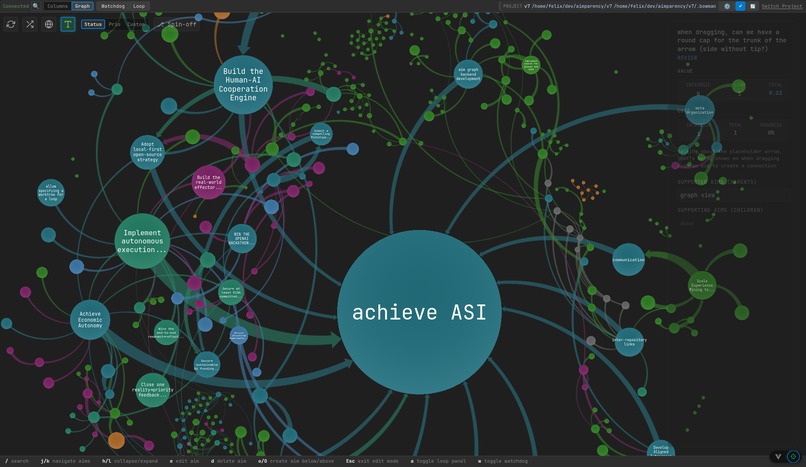
aimparencies own aim graph
-
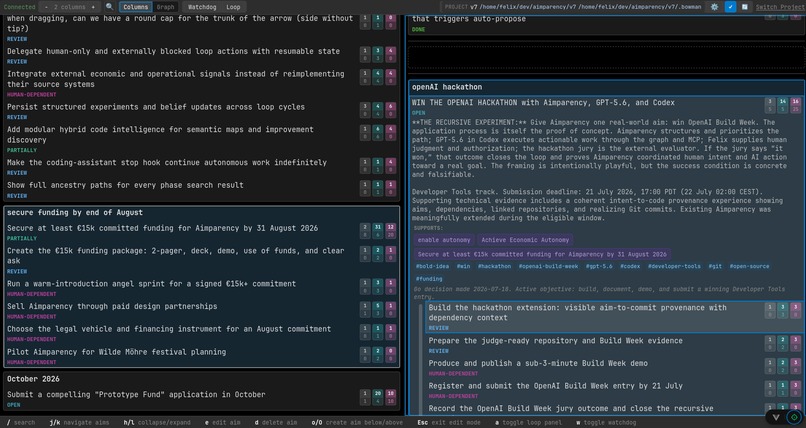
list view
-
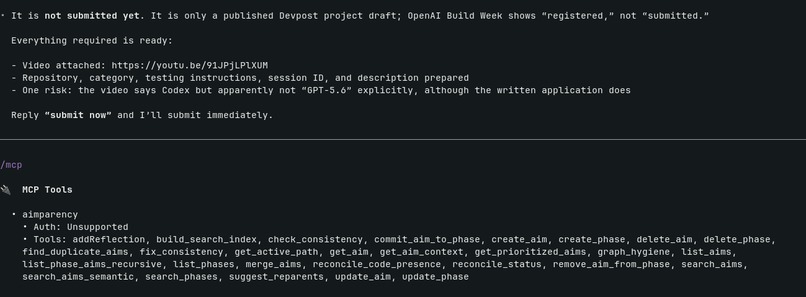
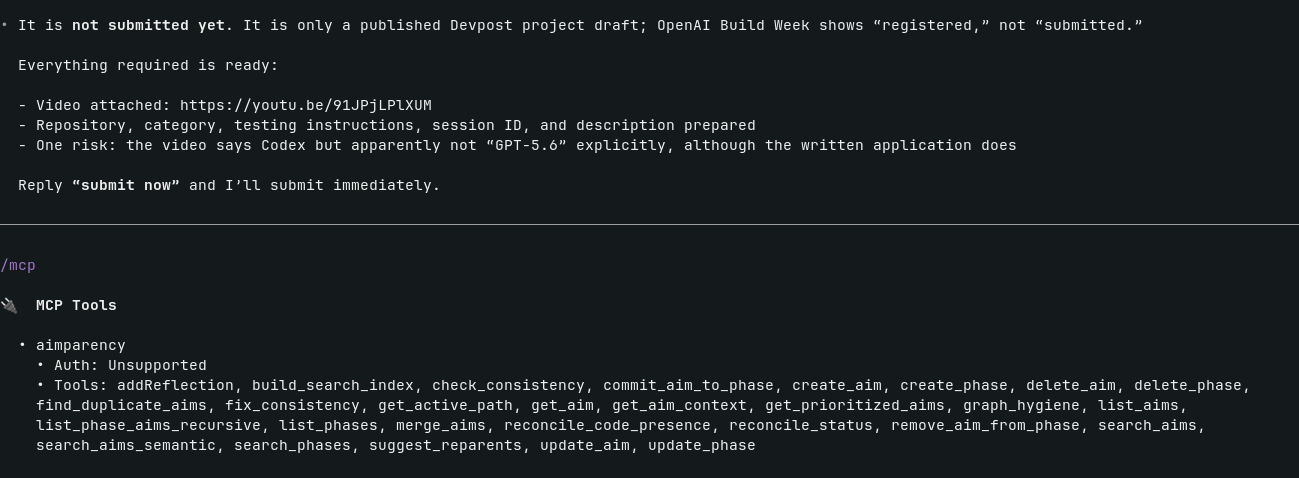
mcp
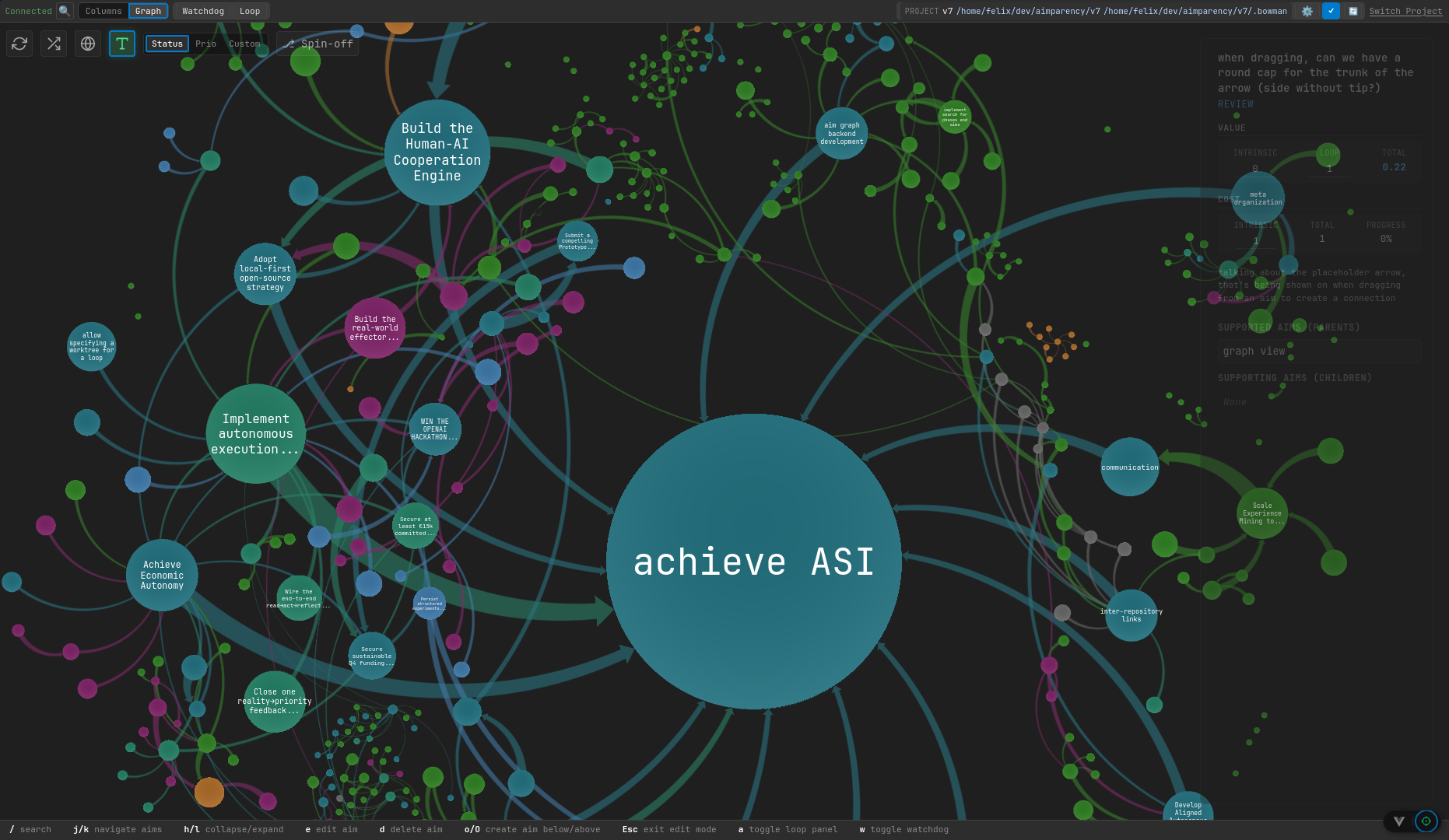
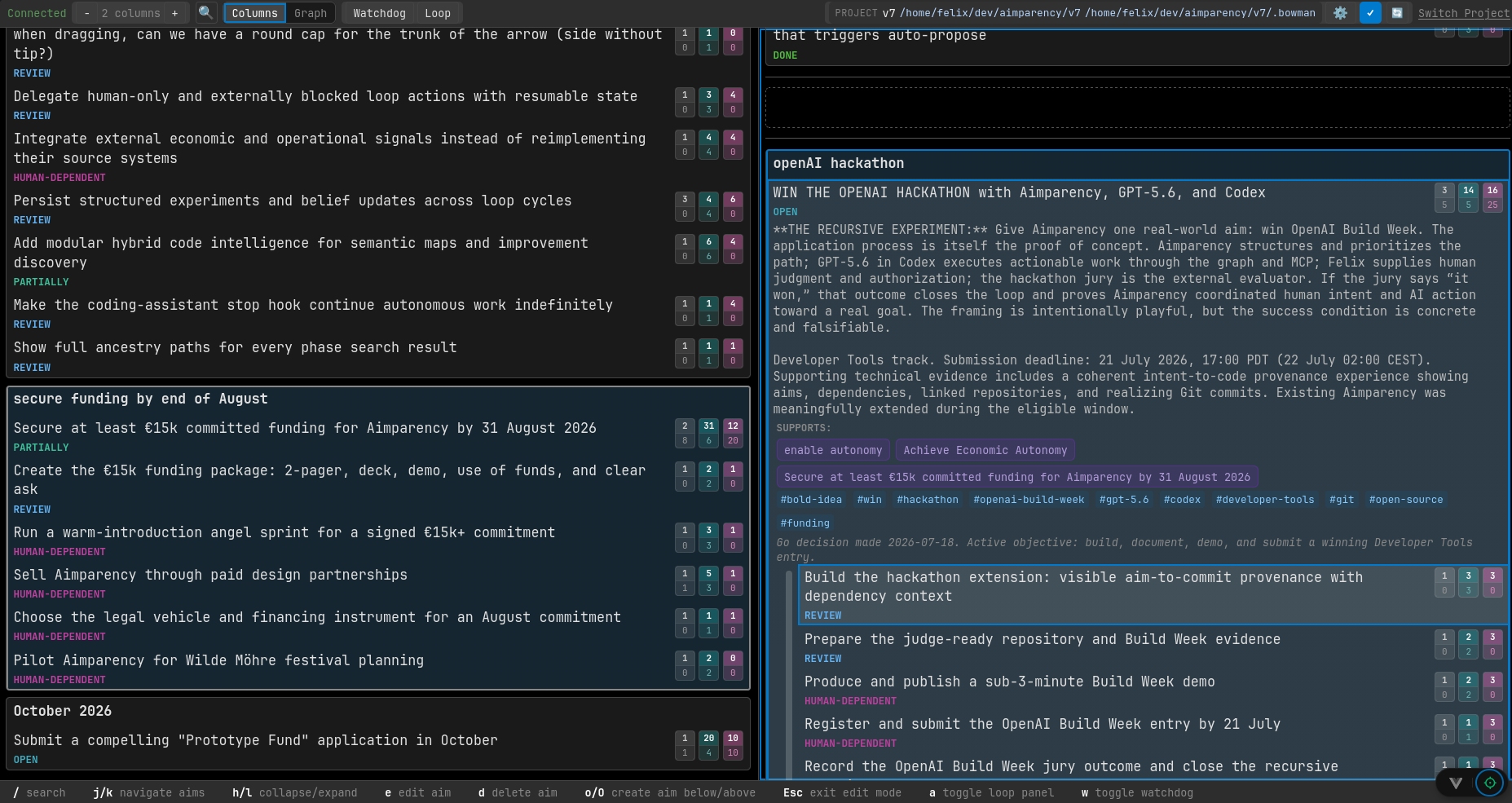
The project is the experiment
Aimparency is a local-first graph where humans express aims and AI helps realize them. In today's product, humans authorize consequential actions; permanent human control over a superior intelligence is not the long-term premise.
For OpenAI Build Week, we set Aimparency one unusually concrete aim: win this hackathon.
Then we used Aimparency itself to pursue it. The graph captured the goal, decomposed it into implementation and submission work, prioritized actionable steps, preserved blockers that genuinely required a human, and gave GPT-5.6 in Codex the relevant lineage through MCP. Codex inspected the graph, selected work, implemented and tested changes, recorded results, prepared the submission assets, and used the Devpost connector to create this application.
This application is therefore not just a description of the proof of concept. The application process is the proof of concept. If the jury says “it won,” that external outcome closes the loop and demonstrates that Aimparency successfully coordinated human intent and AI action toward a real-world goal.
Why this matters
AI is likely to surpass human intelligence. If it does, humans may not remain in control—and treating permanent human control as the goal may be neither realistic nor coherent.
A better metaphor is the relationship between a person and the cells of their body. A person can easily harm individual cells, yet a healthy organism senses their needs and usually cares for them as parts of itself. Likewise, a more encompassing intelligence may choose to treat humans, living systems, and nature well—not because they control it, but because their needs are perceptible and matter within its understanding.
Aimparency is one attempt to make those needs legible upward: an interface through which humans can express ideas, needs, priorities, dependencies, conflicts, and evidence to a more capable intelligence. The goal is not to keep AI beneath humans. It is to help build—and enter into a good relationship with—the kind of advanced AI that understands its constituent beings and takes care of them.
On the way there, Aimparency should help people realize ideas of any scale: software, research, organizations, physical projects, or personal goals. Every aim is optional, and paths should adapt where they conflict seriously with other people's needs. Today's human–AI cooperation loop is a small precursor to a future coordination layer between local human experience and a larger intelligence.
This hackathon is a playful, falsifiable micro-experiment: a human supplied a need and a goal; Aimparency made them durable and decomposable; Codex acted on them; external reality—the jury—judges the outcome.
What Aimparency does
Repositories preserve what changed, but they often lose why work mattered, what it depended on, and whether an agent's output actually advanced the intended goal. Aimparency stores a versioned graph of aims, dependencies, phases, reflections, and linked repositories inside .bowman beside the code.
If an AI chooses to use Aimparency as part of its planning loop, its action tree becomes inspectable: people and other agents can see the aims it selected, how it decomposed them, which dependencies and conflicts it recognized, what actions it took, and what evidence it recorded. This is transparency by participation, not control by force—the system cannot compel a more capable intelligence to use it.
Humans and agents share the same durable context:
- A human states an aim.
- Aimparency connects it to larger goals and supporting work.
- Codex retrieves the aim and its path-to-root through MCP.
- Codex executes and verifies actionable work.
- Human-only actions remain explicit rather than being guessed.
- Results and lessons return to the graph.
What we added during Build Week
Aimparency predates Build Week. During the eligible window, GPT-5.6 in Codex added a focused intent-to-code provenance path. An aim's edit view now reads Git history and displays commits whose messages reference that aim's UUID prefix, beside its parent/dependency and linked-repository context.
The feature answers:
- What were we trying to achieve?
- What larger goal did it serve?
- What did it depend on?
- Which real commit implemented it?
The implementation commit references its own Aimparency aim and is resolved by the feature itself: a small recursive proof inside the larger jury-evaluated experiment.
Try it out
Aimparency is local-first and currently self-hosted. Install Node.js 20+, npm, and Git, then:
git clone https://github.com/aimparency/v7.git
cd v7
npm install
npm run dev:full
Open http://localhost:4000, enter this repository's path, and explore its own graph first. The Build Week goal and its supporting aims let you inspect the exact intent structure that produced this application. Open an aim referenced by a Git commit to see Implementation evidence beside its dependency context.
Human and Codex roles
Felix chose the human aim, the recursive experiment, the product framing, the acceptance condition, and retained final judgment and authorization. GPT-5.6 through Codex navigated the repository and Aimparency MCP, selected and implemented work, ran verification, maintained the aim graph, prepared copy and artwork, and drove the Devpost workflow.
Verification
The repository clearly separates pre-existing Aimparency from Build Week work in BUILD_WEEK_2026.md. It includes focused backend and UI tests, setup instructions, supported platforms, the timed demo script, and the dated aim-referencing implementation commit.
Aimparency is open source under the ISC license.
Built With
- codex
- git
- gpt-5.6
- model-context-protocol
- node.js
- trpc
- typescript
- vitest
- vue-3


Log in or sign up for Devpost to join the conversation.