-
-
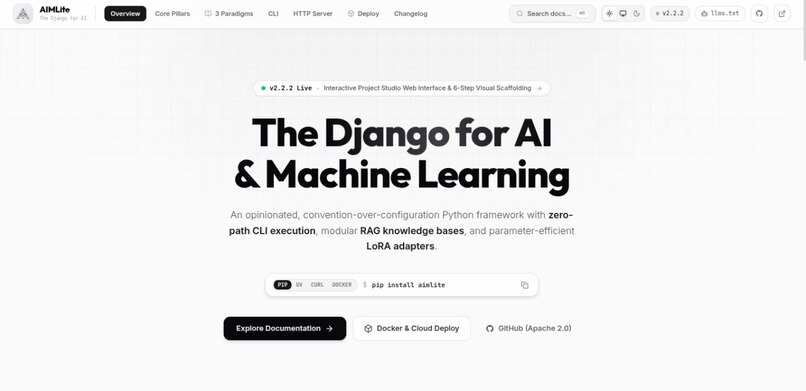
Docs website for AIMLite
-
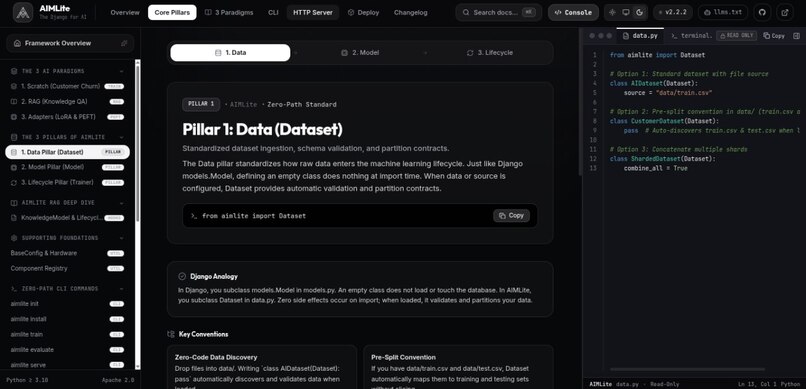
Docs website for AIMLite
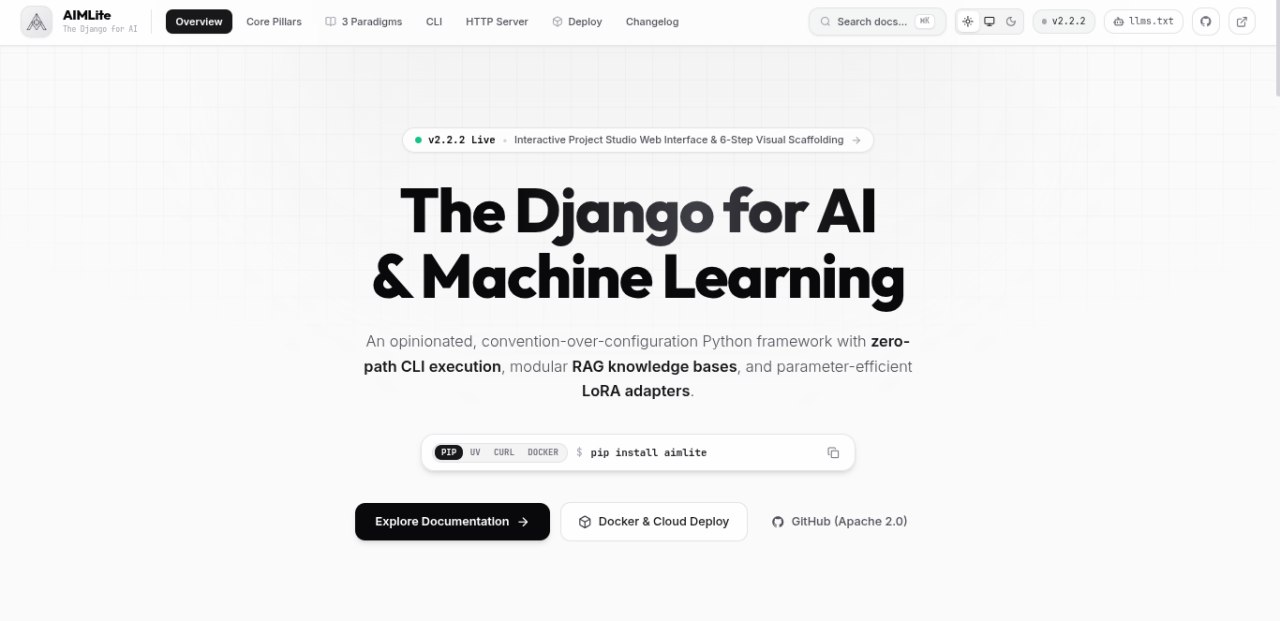
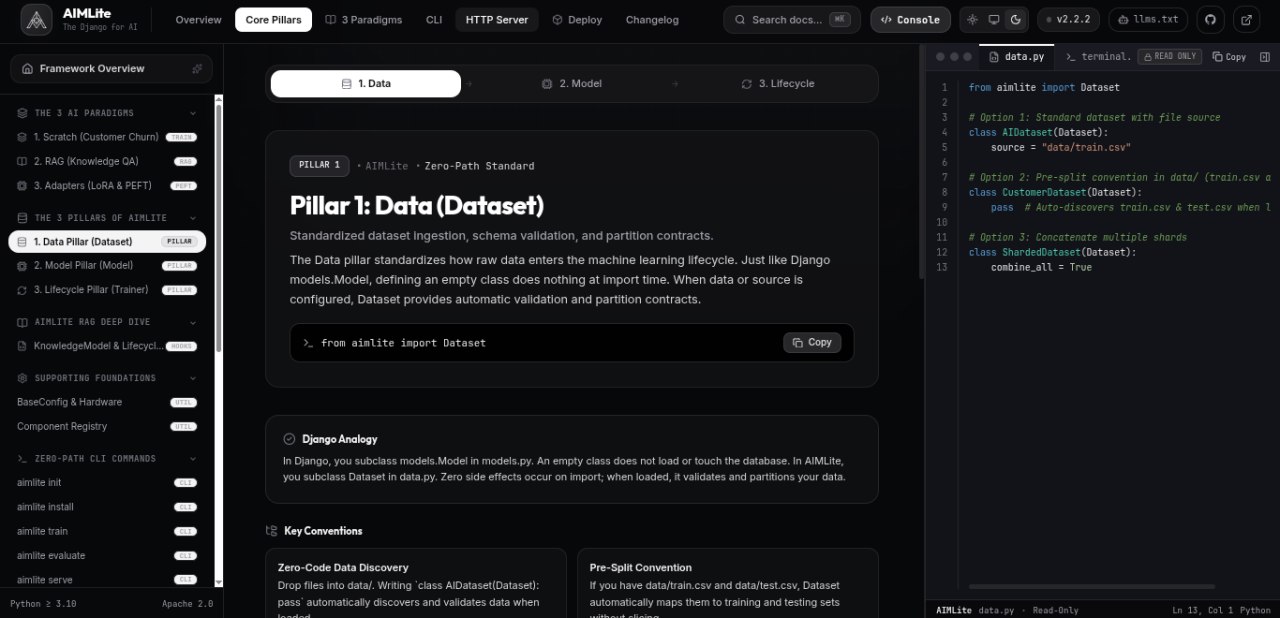
Inspiration
Building AI and machine learning applications should not require developers to spend most of their time setting up infrastructure, connecting libraries, and rewriting the same boilerplate code. Getting from an idea to a working AI application often involves managing multiple tools, configurations, and complex workflows.
That is the problem that inspired AIMLite.
We wanted to build a framework that makes AI development more approachable for developers while giving them the flexibility to work with their own models, data, and preferred tools. Instead of forcing developers to build everything from scratch, AIMLite aims to provide a structured foundation they can extend and customize.
What it does
AIMLite is an open-source Python framework designed to simplify AI and machine learning development. It provides a modular foundation for building AI-powered applications, with a focus on reducing repetitive setup and making development workflows easier to manage.
The project explores core AI development workflows, including model development, retrieval-augmented generation (RAG), and fine-tuning, while aiming to keep developers in control of how their applications are built.
Our vision is simple: make building AI applications feel more like building ordinary software.
How we built it
We built AIMLite in Python, focusing on a developer-friendly API and a modular architecture. Our goal was to create a framework that developers can integrate into their existing projects rather than another complicated platform they must learn before getting started.
Throughout development, we worked on structuring the framework, designing its interfaces, and bringing different AI development workflows under a more consistent approach. We also worked on packaging the project for distribution through PyPI and making it available as an open-source project on GitHub.
Challenges we ran into
One of our biggest challenges was balancing simplicity with flexibility. A framework can easily become overwhelming when it tries to support too many workflows, but oversimplifying it can limit what developers can actually build.
Another challenge was designing a consistent developer experience across different AI workflows, each with its own requirements, dependencies, and complexities. We also had to consider the parts of framework development that go beyond writing code, including installation, configuration, documentation, testing, and maintainability.
These challenges shaped our approach to AIMLite and reinforced an important lesson: a good developer tool is not defined by how many features it has, but by how reliably and clearly it helps developers accomplish their goals.
Accomplishments that we're proud of
One of our biggest accomplishments is turning the idea of simplifying AI development into AIMLite, an open-source Python framework that developers can explore, use, and contribute to. We built a modular foundation for AI development and made the project publicly available through GitHub and PyPI.
We're proud of creating a project that addresses a real challenge in the AI ecosystem: reducing repetitive setup and making AI development workflows easier to manage. Beyond writing code, we've established a foundation that we can continue improving through community feedback, testing, and contributions.
Most importantly, we're proud to be building something that reflects our belief that powerful AI development tools should be accessible to more developers.
What we learned
We learned that building an AI framework requires much more than integrating existing libraries. Creating a useful developer experience means making thoughtful architectural decisions, designing intuitive APIs, managing dependencies, and ensuring that features behave as expected.
We also learned that simplicity is difficult to achieve. Every abstraction must make development easier without taking away the flexibility and control developers need. Testing, documentation, and transparency are just as important as adding new features.
Above all, we learned that building a framework is an ongoing process. There is always room to improve reliability, refine the developer experience, and better understand the needs of the people who will use it.
What's next for AIMLite
Our next goal is to make AIMLite more reliable, capable, and production-ready. We plan to strengthen automated testing, improve documentation, and continue developing its AI workflows, including retrieval-augmented generation (RAG) and fine-tuning.
We also want to improve integrations with existing AI tools and libraries while keeping AIMLite modular and developer-friendly. As the project matures, we hope to attract contributors, gather feedback from early adopters, and build a community around making AI development simpler.
Our long-term vision is for AIMLite to become a dependable foundation developers can use to build, experiment with, and extend AI applications without unnecessary complexity. We want to spend less time reinventing infrastructure and more time solving meaningful problems with AI.

Log in or sign up for Devpost to join the conversation.