-
-
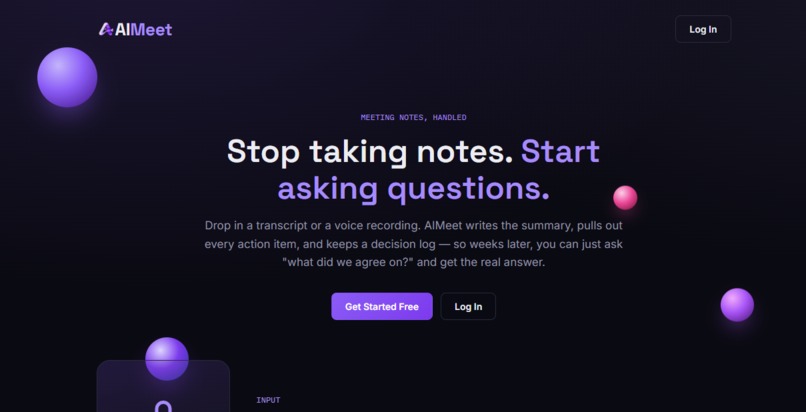
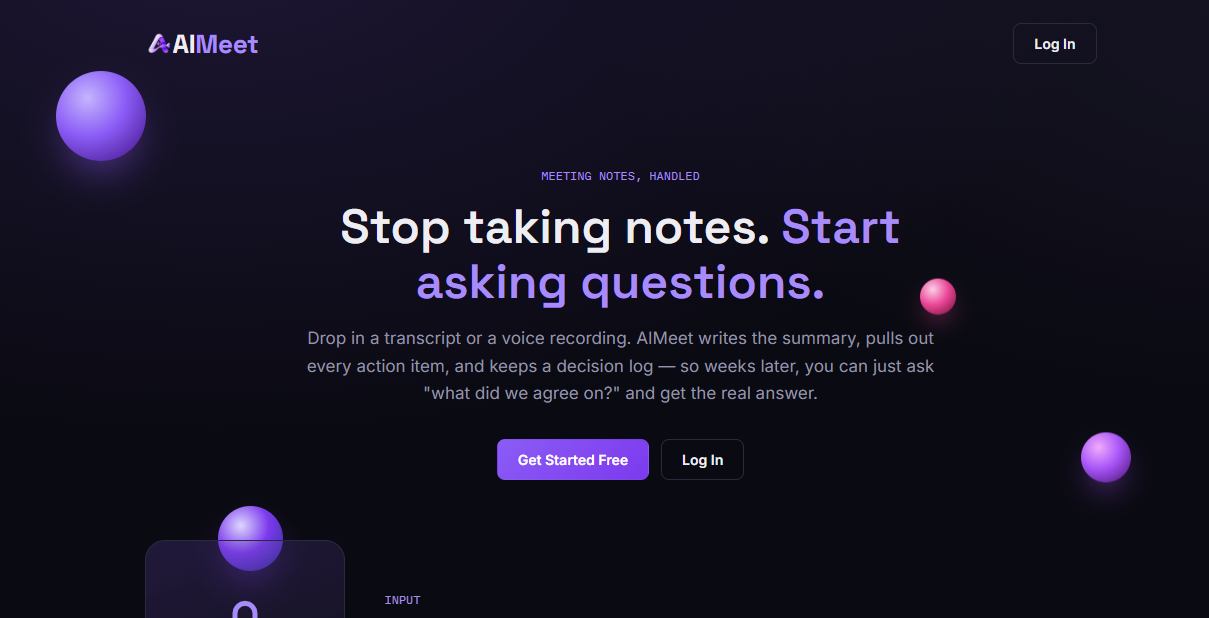
Landing page
-
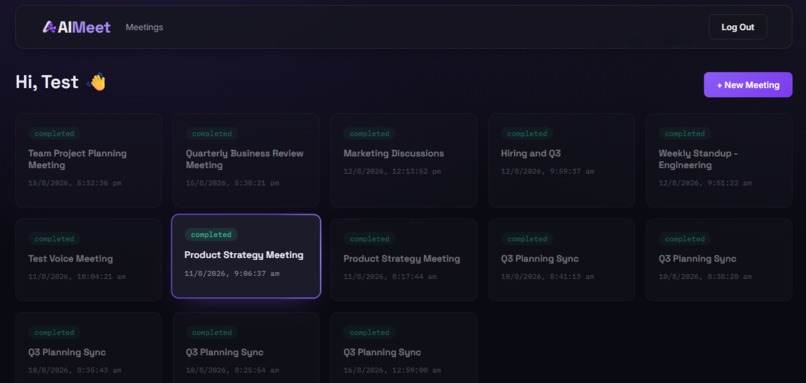
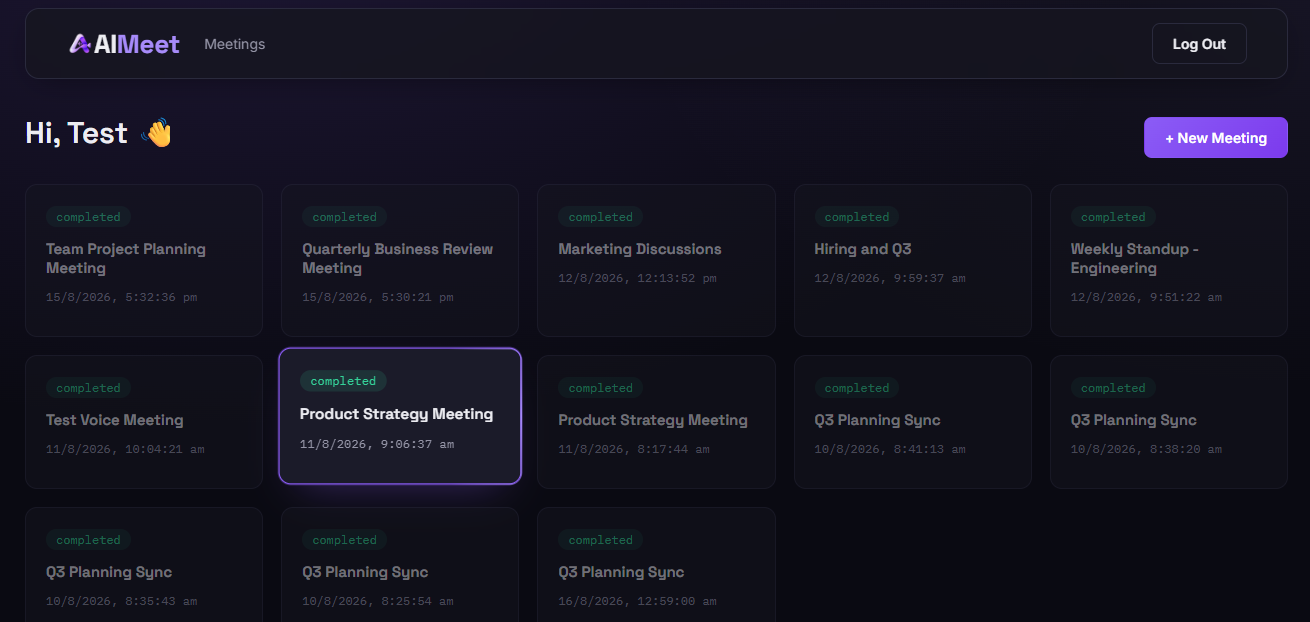
Dashboard
-
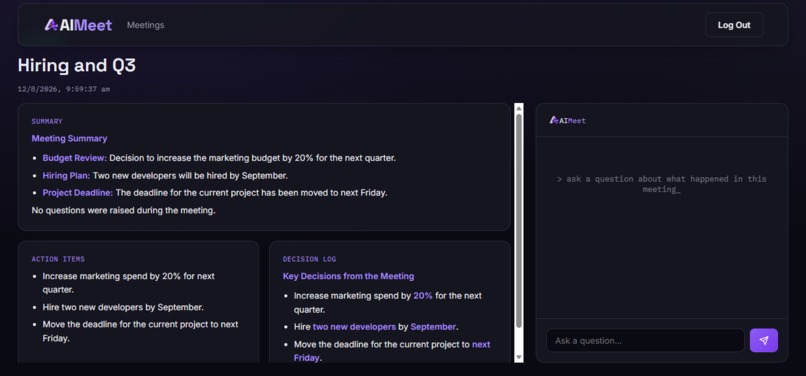
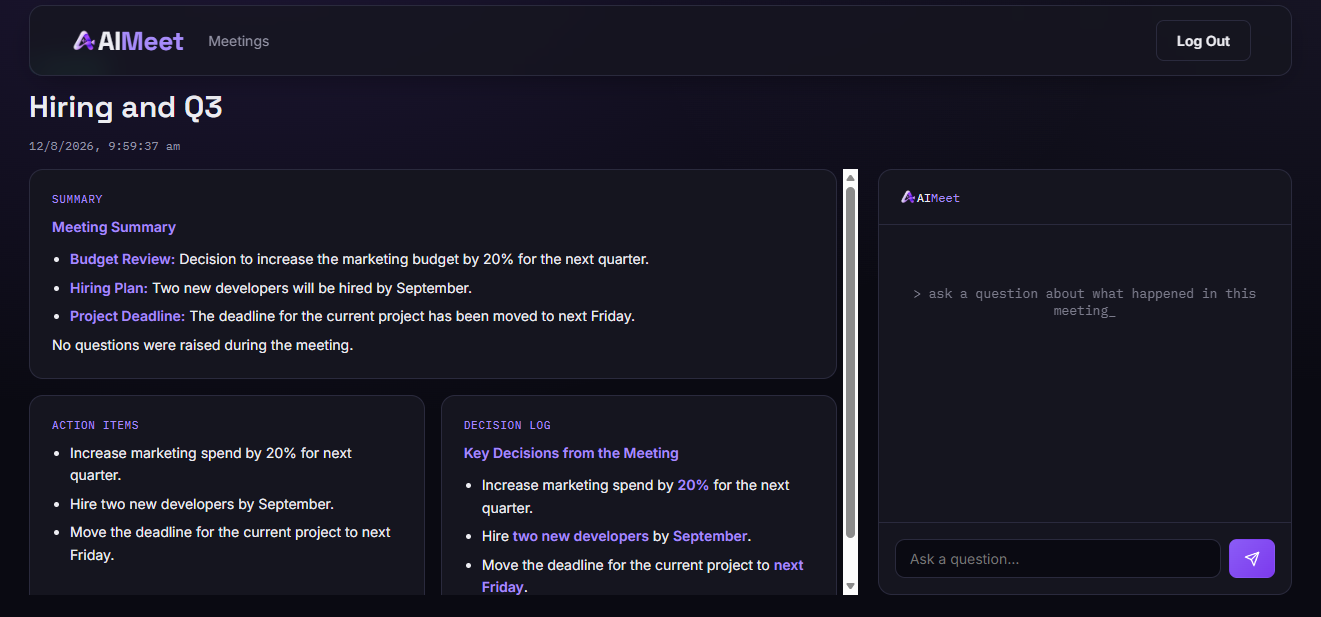
Summary, Action & Detail Log
-
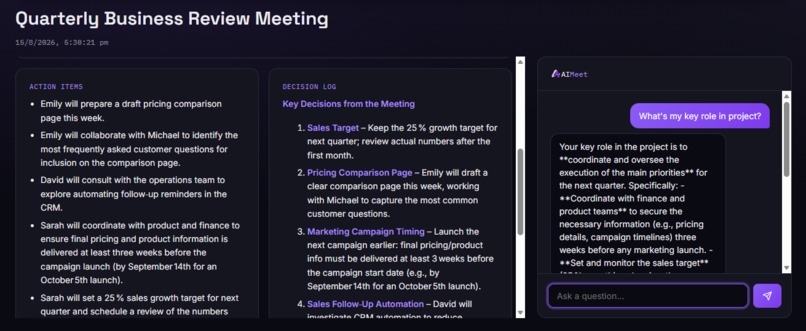
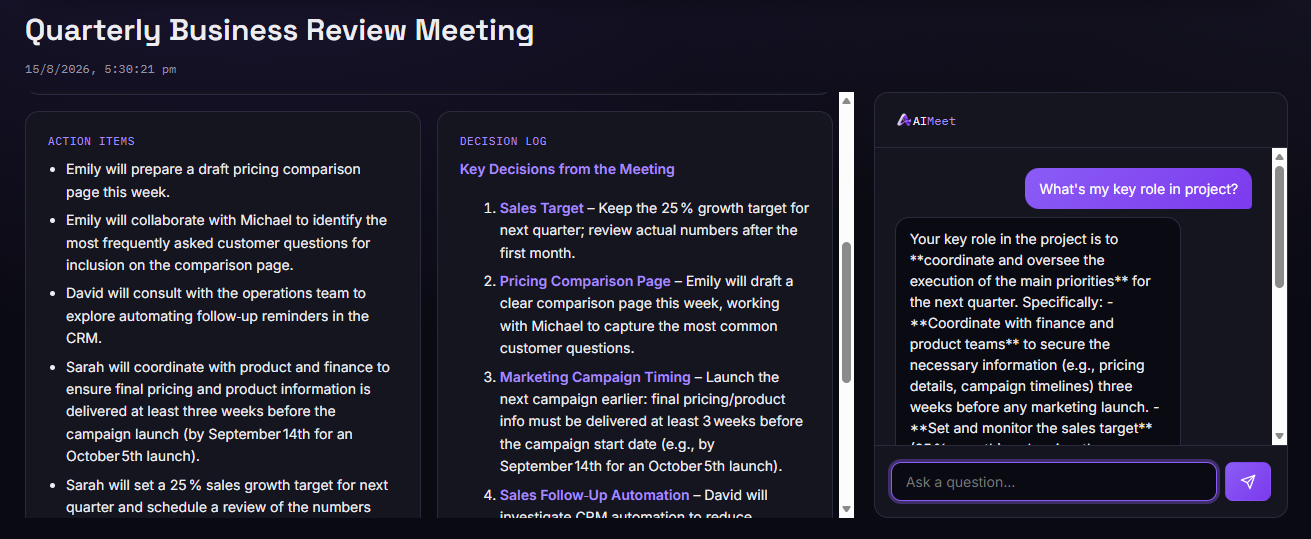
AIMeet Chat
Inspiration
Meetings create valuable information such as decisions, responsibilities, deadlines, ideas, and context. However, after a meeting ends, this information can become difficult to find because it is often buried inside long recordings, transcripts, notes, chats, or individual memory.
The main problem we wanted to solve was not simply recording or summarizing meetings, but making the important information from those conversations easy to retrieve later. Instead of replaying an entire meeting or asking another participant what was decided, we wanted users to be able to ask questions and find the relevant information directly.
This idea led us to build AIMeet, a system designed to turn conversations into structured and searchable knowledge.
What it does
AIMeet processes meeting audio or transcripts and transforms them into useful meeting information.
The main capabilities include:
- Converting meeting audio into text using speech-to-text.
- Generating AI-powered meeting summaries.
- Extracting important decisions from conversations.
- Identifying action items and responsibilities.
- Preparing meeting information for semantic search.
- Allowing users to ask natural-language questions about their meetings.
- Retrieving relevant meeting context to help generate answers.
For example, instead of manually searching through a long transcript, a user can ask:
"Who is responsible for testing the login flow?"
AIMeet can retrieve the relevant information from the meeting and provide the answer.
The goal is to move beyond basic meeting summarization and make meeting information searchable and reusable after the conversation ends.
How we built it
AIMeet is built as a web application using a React and TypeScript frontend with a FastAPI backend.
The main technologies used include:
- Faster-Whisper for speech-to-text processing.
- Groq LLM API for language-model processing.
- MongoDB Atlas for storing application and meeting data.
- MongoDB Atlas Vector Search for semantic retrieval.
- Google OAuth and JWT for authentication.
The AI workflow consists of several stages:
- Meeting audio or transcript is provided as input.
- Audio is converted into text when necessary.
- The transcript is processed by an LLM.
- The system extracts useful information such as summaries, decisions, and action items.
- Meeting content is prepared into searchable sections and represented using embeddings.
- MongoDB Atlas Vector Search retrieves relevant information when a user asks a question.
- The retrieved meeting context is provided to the LLM to generate the final answer.
This workflow allows AIMeet to combine speech recognition, language-model processing, structured extraction, embeddings, vector search, and retrieval-augmented generation.
Challenges we ran into
One of the main challenges was dealing with the unstructured nature of conversations. Meetings contain discussions, explanations, decisions, responsibilities, and unrelated information, so extracting useful information requires more than simply storing the transcript.
Another challenge was making long meeting transcripts searchable. Users may ask questions using different wording from what was actually said during the meeting. To address this, AIMeet uses embeddings and semantic vector search to retrieve relevant meeting information.
Keeping answers connected to the actual meeting context was another important challenge. Rather than relying only on the LLM's general knowledge, the workflow retrieves relevant meeting information before generating the answer.
We also had to consider scalability. AIMeet combines speech-to-text processing, LLM inference, embeddings, database storage, and vector retrieval, so each part of the system needs to work together efficiently as the amount of meeting data increases.
Accomplishments that we're proud of
We are proud that AIMeet goes beyond generating a simple meeting summary.
The project combines multiple AI capabilities into a single workflow:
- Speech-to-text processing.
- AI-based information extraction.
- Summary generation.
- Decision extraction.
- Action-item extraction.
- Embedding-based semantic search.
- Vector retrieval.
- Retrieval-augmented question answering.
We are especially proud of turning information from a conversation into structured knowledge that users can later retrieve through natural-language questions.
For example, a short conversation can contain a launch decision and multiple responsibilities. AIMeet can separate these pieces of information and make them available when a user needs them.
We are also proud of building the different components into a complete application rather than treating the AI workflow as an isolated experiment.
What we learned
Building AIMeet taught us that meeting intelligence is more than a summarization problem.
We learned that a useful meeting assistant needs multiple stages:
- Convert the conversation into text.
- Understand and structure the information.
- Prepare the information for retrieval.
- Retrieve the most relevant context.
- Generate an answer using that context.
We also learned the importance of separating information extraction from information retrieval. A summary can tell a user what happened, but a searchable knowledge system should also allow the user to find specific information when they need it.
This led to an important design principle for AIMeet:
Retrieve relevant meeting information first, then generate the answer from that context.
We also learned that building an AI application involves much more than selecting an LLM. The overall workflow, data preparation, retrieval system, backend, database, and user experience all contribute to the final product.
What's next for AIMeet
Our next goal is to expand AIMeet from an individual meeting assistant into a persistent project knowledge system.
The planned improvements include:
- Cross-meeting search so users can search information across multiple meetings.
- Improved speaker and responsibility identification.
- Better action-item tracking after meetings.
- Improved meeting history and organization.
- Integrations with existing meeting platforms.
- Calendar integration.
- Connecting decisions, action items, and discussions across multiple meetings.
- Building organization-wide searchable meeting knowledge.
The long-term vision is for AIMeet to become a persistent layer of project memory.
Instead of only answering questions such as:
"What happened in this meeting?"
AIMeet could eventually answer questions such as:
"What have we decided about this project?"
"Why did we choose this approach?"
"Who owns this task?"
"What changed over the last three months?"
Our vision is to make conversations a reusable source of knowledge rather than information that becomes difficult to access once a meeting ends.
AIMeet — Turn conversations into searchable knowledge.


Log in or sign up for Devpost to join the conversation.