-
-
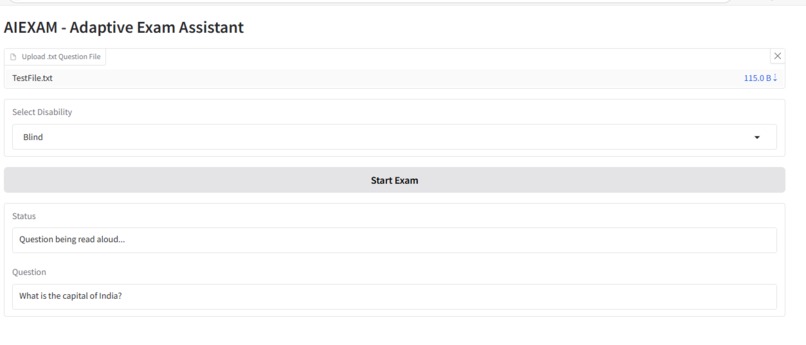
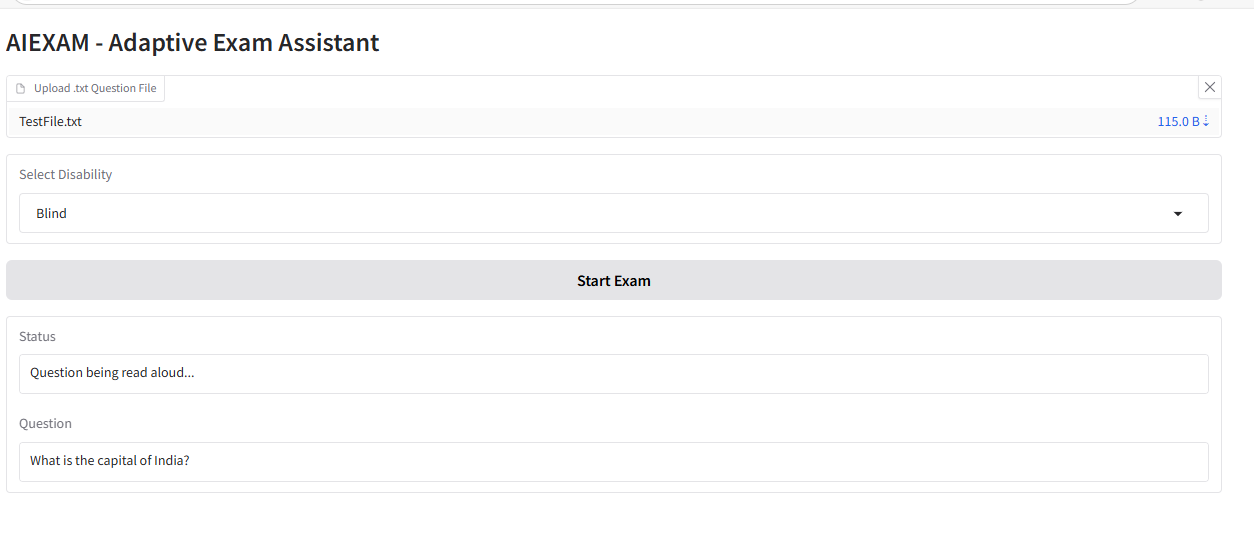
Gardio UIpage
Inspiration
This project was inspired by a simple but powerful question: What if exams didn’t exclude anyone, regardless of how they communicate? I wanted to build a solution that centered accessibility not as an afterthought, but as the foundation. That’s where AIEXAM began
How I build it
I built AIEXAM using Python, with Gradio for the user interface and FastAPI for backend logic. Each accessibility mode Blind, Deaf, and Mute was implemented as an independent agent using Microsoft's Agent Development Kit (ADK), which made it easier to separate responsibilities cleanly (text-to-speech, transcription, interface display, etc.). I used Google Cloud’s Speech-to-Text and Text-to-Speech APIs to power audio interactions. For local input/output, tools like sounddevice and pygame helped simulate behavior even without full cloud access during development.
Challenge I ran into:
- Accessibility logic: Adapting flows for each disability (e.g., audio-only mode for blind users vs. transcript-first display for deaf users) required rewiring how typical apps control state and user interaction.
- Render deployment: Deployment hit multiple snags from package incompatibility (mediapipe, pydub) to missing Python standard modules (audioop removed in Python 3.13).
- Audio handling: Ensuring consistent speech input/output across devices and environments was trickier than expected, especially around encoding and pacing for cloud APIs.
Accomplishments that I proud of
- I made an app that runs both locally and, in the cloud, with dynamic interaction modes that adjust to a user's needs.
- Modularized accessibility logic with clear multi-agent design, making it scalable and maintainable.
- Learned and implemented secure integration with Google Cloud Secret Manager for managing credentials something I hadn’t done before.
What I learned
- Designing for accessibility means rethinking assumption control flows, UI behavior, even how users perceive progress or error feedback.
- Speech APIs perform best with carefully encoded audio and deliberate pacing quality input really matters.
- The Agent Development Kit was a helpful way to model agents that coordinate tasks without stepping on each other.
What’s next for AIEXAM
- Add real-time proctoring features, such as emotion detection or camera-based invigilation (respectful of privacy).
- Support for more file formats like PDFs and Word documents.
- Create a lightweight offline mode using local ASR/TTS tools for low-connectivity environments.
- Add analytics for teachers and institutions to view accessibility metrics and adapt exam content accordingly.
Built With
- built-with-languages:-python-frameworks:-gradio
- fastapi-cloud-services:-google-cloud-speech-to-text-api-google-cloud-text-to-speech-api-google-cloud-secret-manager-(for-secure-credential-handling)-ai-platform:-agent-development-kit-(adk)-?-for-modular
- multi-agent-orchestration-nlp-tools:-spacy-audio-&-media:-sounddevice
- pygame-file-handling:-json-(answers/logs)
- scipy.io.wavfile
- txt-(exam-questions)-local-development:-vs-code
- wav-(audio)

Log in or sign up for Devpost to join the conversation.