-
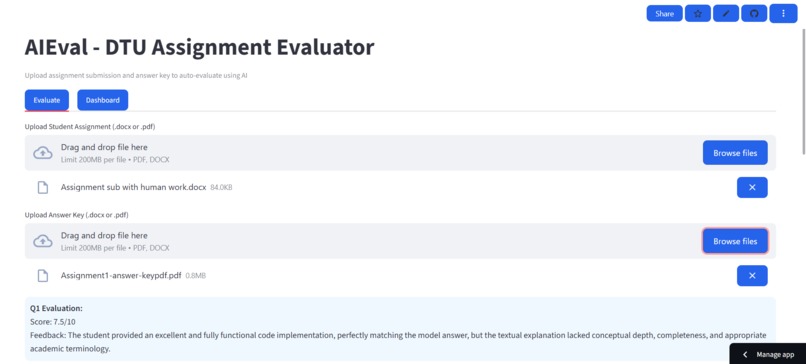
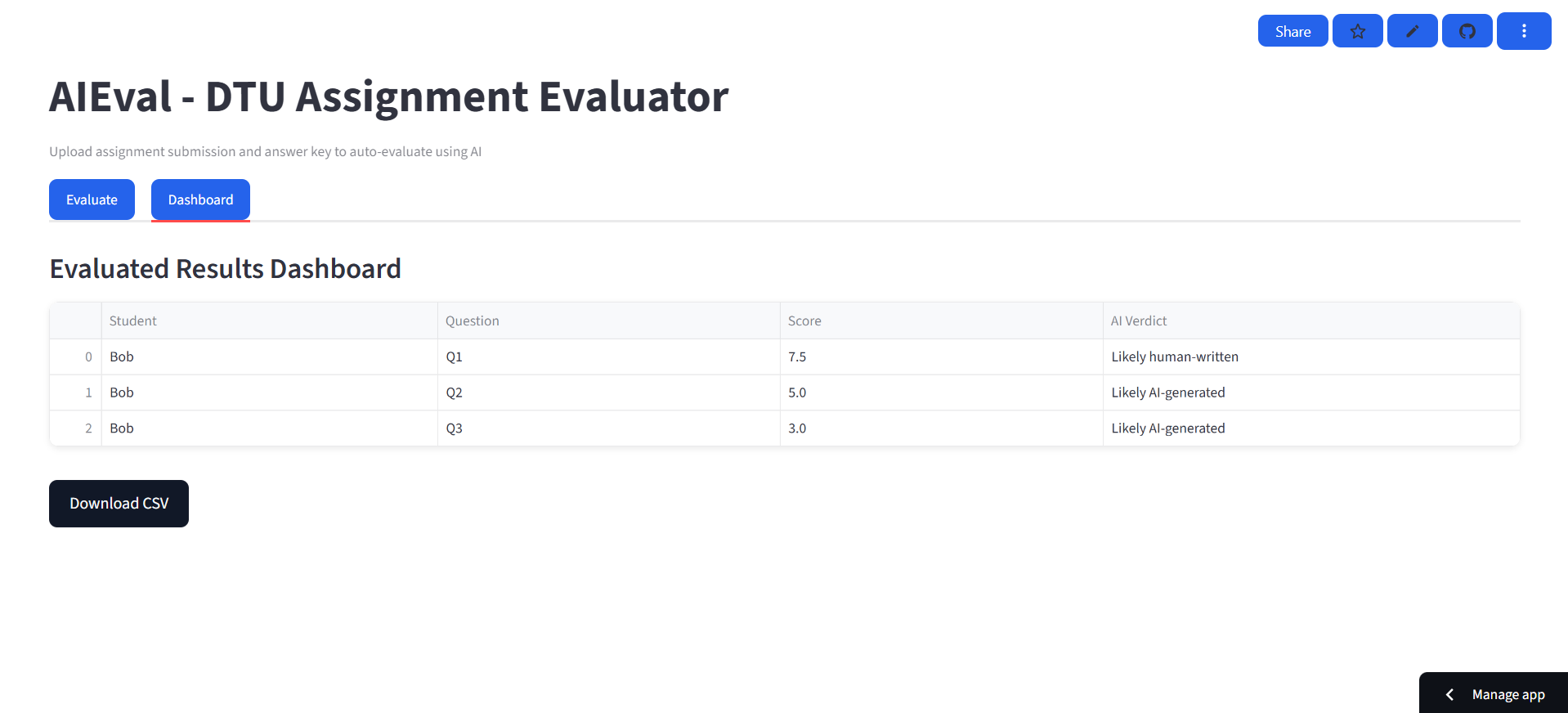
UI page, landing
-
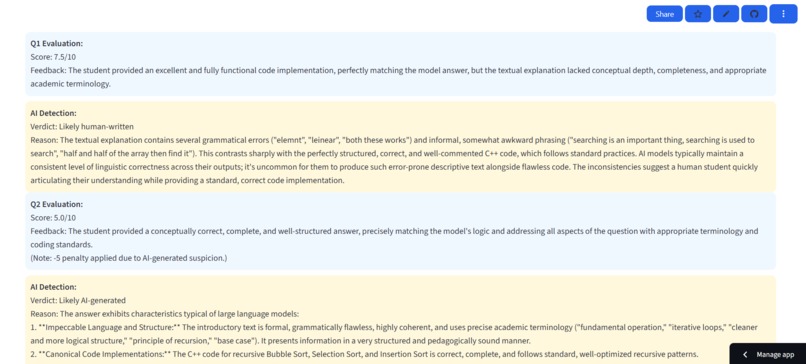
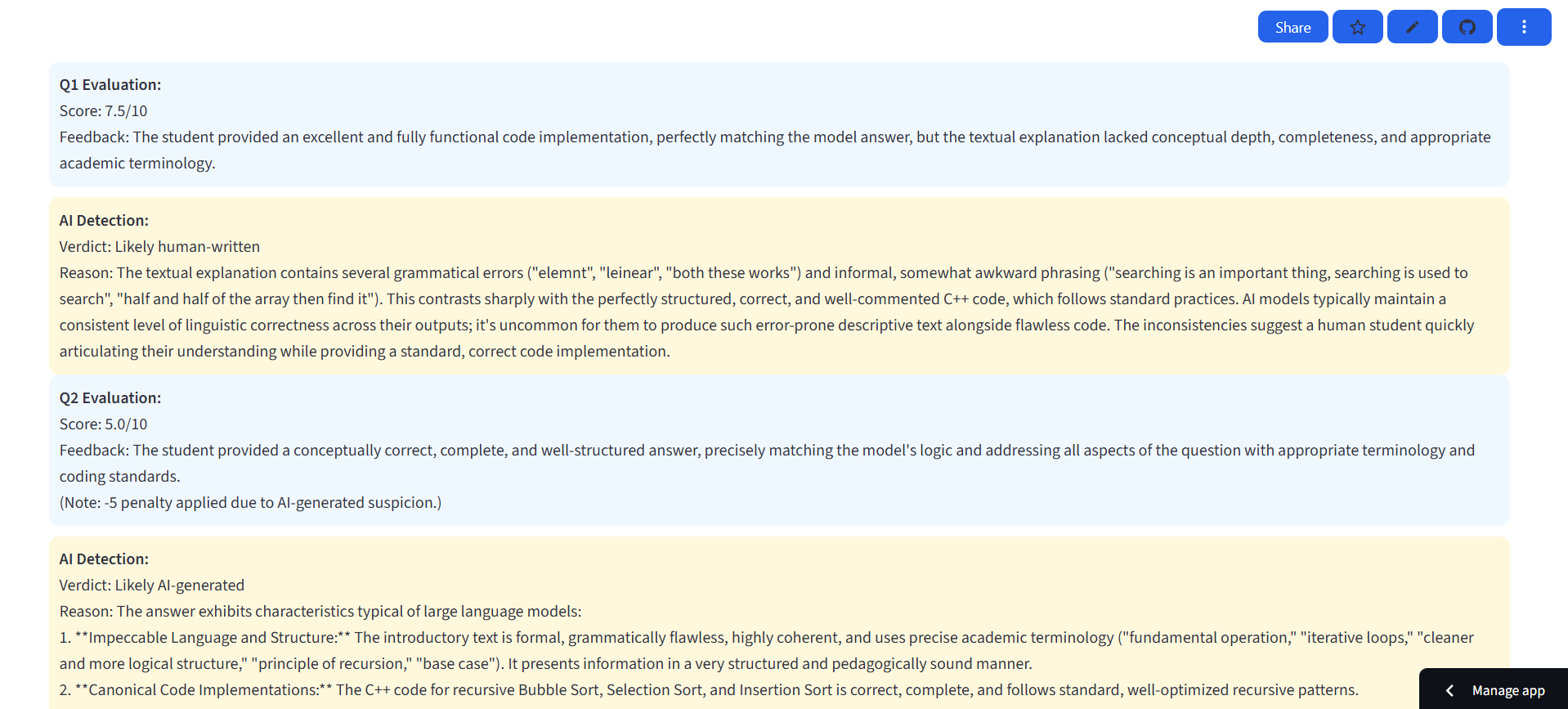
results
-
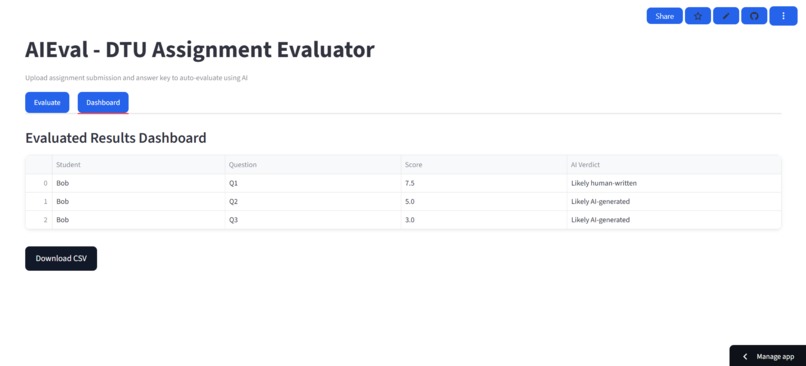
eval tab
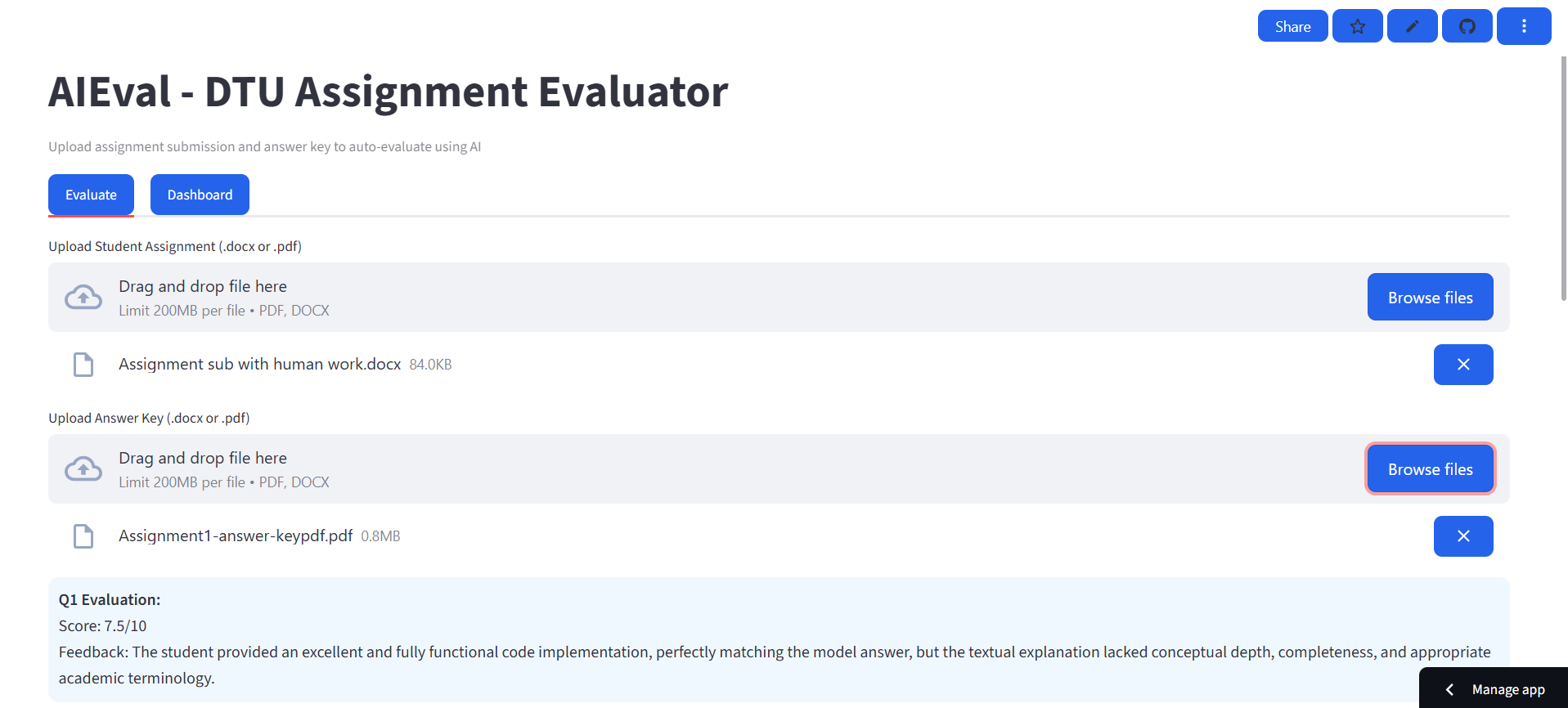
Inspiration
Manual assignment evaluation is time-consuming, inconsistent, and overwhelming for faculty, especially in large institutions like DTU. We wanted to build a system that could reduce this burden while maintaining academic integrity and fairness. With generative AI and LLMs becoming increasingly accessible, we saw an opportunity to apply them meaningfully in education specifically for scalable, automated assessment.
What it does
AIEval is a smart AI-powered platform that:
- Compares student submissions with professor-provided answer keys
- Uses LLMs for rubric-based semantic grading
- OCR integrated for better analysis
- Detects likely AI-generated answers and flags them
- Provides instant scoring, structured feedback, and downloadable CSV reports for professors
How we built it
- Frontend: Streamlit, with a clean tabbed layout for Evaluation and Dashboard
- Text Extraction:
pdfplumberandpython-docxfor typed files;pytesseractfor image-based OCR from scanned or handwritten DOCX - Question Mapping: Regex-based segmentation to handle unordered responses (e.g., Q3, Q1, Q2)
- AI Evaluation: Google Gemini 2.5 Flash LLM for semantic comparison, rubric-based scoring, and feedback generation
- AI Detection: Custom prompt-driven LLM evaluation to detect likely AI-generated answers and apply penalties
- Output: Real-time feedback per question and a downloadable CSV summarizing scores and AI detection per student
Challenges we ran into
- Inconsistent document formats: Student submissions varied widely in formatting, requiring robust file parsing and error handling.
- Aligning unordered answers: Students often answer out of order, so we built a reliable question-number-based segmentation system.
- Balancing strictness vs fairness: Designing prompts for grading and AI detection that are firm but educational was a challenge.
Accomplishments that we're proud of
- Successfully evaluated mixed-format submissions (on various edge cases)
- Implemented a full AI-assisted scoring pipeline using a real LLM
- Built a self-contained system that could scale to classroom or institution-wide usage
- Designed a robust method to flag suspected AI-generated content in student work
What we learned
- Prompt engineering is critical for consistent LLM evaluation
- OCR usage for best results with the content
- Semantic evaluation must be tolerant of alternative phrasing while rewarding accuracy
- Building for real-world classroom use means planning for inconsistency and edge cases
What's next for AIEval – DTU Assignment Evaluator
- Integrate Math-aware OCR (like Mathpix) for evaluating equations
- Support batch processing of multiple submissions
- similarity check among all students assignments, to check for copied answers.
- Add Google Classroom integration for automatic assignment syncing
- Deploy as a cloud-based platform with user authentication
Built With
- google-gemini
- pdfplumber
- pytesseract
- python
- python-docx
- streamlit

Log in or sign up for Devpost to join the conversation.