AidSync is a real-time disease prediction platform for emergency response, so this section should sell the problem, your unique solution, and why Gemini 3 makes it possible.
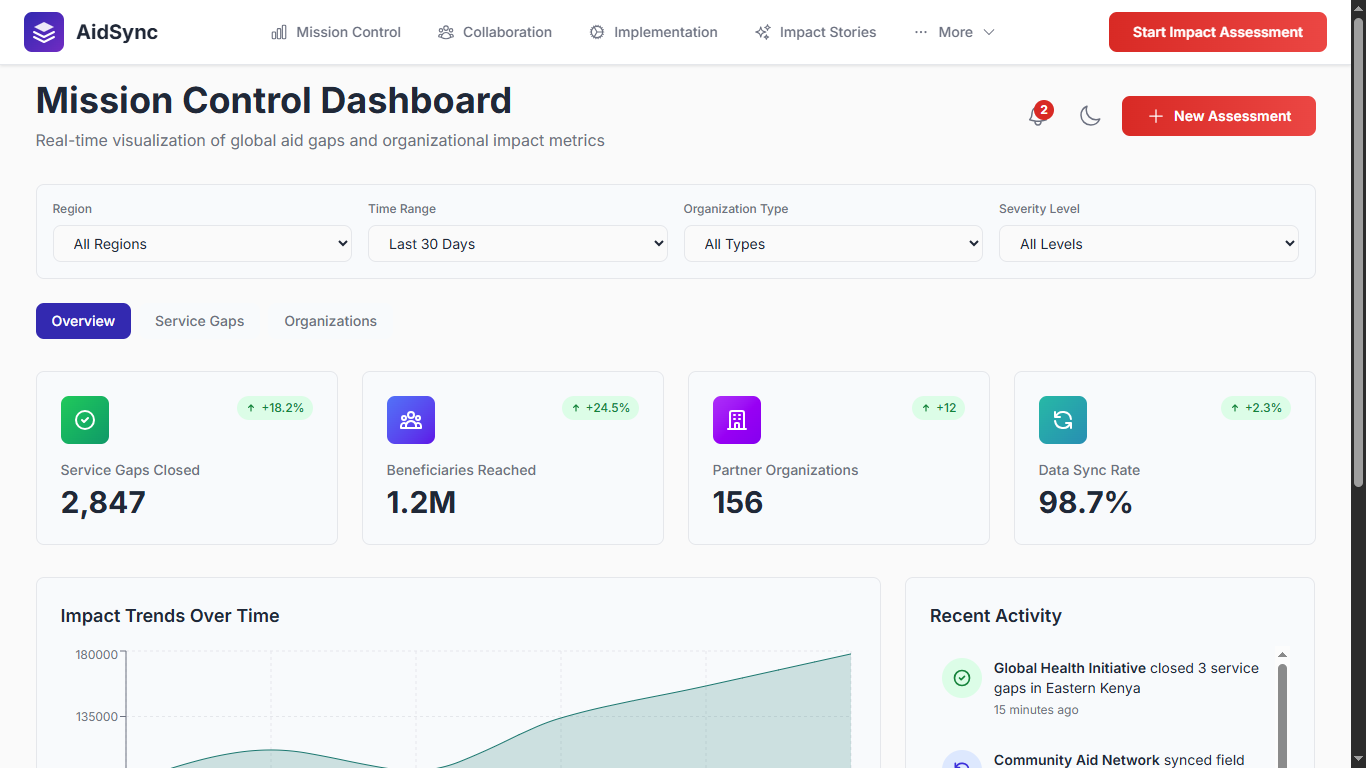
About the project Every year, thousands of emergency cases get worse not because help is unavailable, but because it is too slow and blind to what is coming next. Today’s responders often rely on manual calls, fragmented hospital systems, and static checklists, which means critical patterns of infectious disease or patient deterioration are only discovered after it is already too late. AidSync was built to answer a simple question: what if emergency teams could see the next wave of disease risk in real time, and act before it becomes a crisis? AidSync is a web app that turns noisy, real-world signals into real-time disease risk predictions for emergency responders and health coordinators. It ingests live inputs like reported symptoms, triage notes, basic vitals, and geolocation from the field, and then uses Gemini 3’s multimodal reasoning to estimate the most likely disease category and risk level for each case and hotspot. The output is a clean, actionable dashboard: color-coded risk scores, suggested differential diagnoses, and auto-generated response playbooks that help teams prioritize who to help, where to dispatch, and what to prepare for next.
The core of AidSync is an agentic workflow powered by the Gemini 3 API, aligned with the “Action Era” vision of building orchestrators instead of single-prompt chatbots. One agent focuses on understanding each incoming case (symptoms, context, location), another runs structured reasoning chains to map those signals to disease risk patterns, and a coordinator agent synthesizes everything into human-friendly recommendations and alerts. This multi-agent design lets AidSync run continuous, long-lived monitoring over an area, updating risk as new data streams in instead of treating each query in isolation.
From a technical perspective, AidSync is built as a lightweight, deployable web stack: a responsive frontend for responders, a backend service that handles data ingestion and routing, and a Gemini 3 Pro integration for reasoning and content generation. The system is designed so that data sources can evolve—from simple form-based symptom reports in a pilot, to richer integrations with hospital systems or public health feeds over time. This makes AidSync realistic for hackathon deployment today, but also credible as a path toward production-grade early warning and triage support.
During development, the biggest challenge was balancing ambition with trust: building an AI system for disease prediction without overstepping into unsafe, “doctor-replacement” territory. AidSync is intentionally framed as a decision-support and coordination tool, not a diagnostic authority; it surfaces likely risks, uncertainty, and reasoning steps so that trained humans remain in control. The project also emphasizes explainability and ethical safeguards inspired by existing research on AI for sepsis and epidemic early warning systems, so responders get transparency instead of mysterious scores.
What the team learned is that Gemini 3’s real value here is not just generating text, but orchestrating a chain of reasoning-heavy tasks: interpreting semi-structured health inputs, ranking risks, drafting action plans, and updating them as reality changes. Building AidSync showed how agentic AI can move beyond “chat with a bot” into always-on, domain-aware assistants that watch over a population and proactively support emergency teams. If extended with real health data and integrations, AidSync could become an important piece of digital infrastructure for cities and organizations preparing for the next wave of public health emergencies.
Built With
- gis
- lightweight-front-end-built-with-react-plus-a-companion-mobile-app-using-a-cross?platform-framework
- python-and-sql
- snowflake-ai-data-cloud
- snowflake-data-clean-rooms-+-differential-privacy-policies
- snowflake-native-apps-framework
- snowpark-/-snowpark-container-services

Log in or sign up for Devpost to join the conversation.