Inspiration
Every single day, thousands of grassroots food banks, community kitchens, and disaster relief task forces struggle with a heartbreaking paradox: not a lack of food, but coordination exhaustion.
When a local bakery, caterer, or supermarket has 50 kilograms of warm, unsold meals at closing time, that food has a strict 3-hour biological safety window. Today, volunteer managers spend 15+ hours weekly playing manual phone-tag across chaotic WhatsApp group chats—verifying vehicle refrigeration, calculating road washouts, and finding shelters with space. By the time a match is manually arranged, the food has spoiled. In the humanitarian sector, coordination fatigue is the number one cause of preventable food waste and unserved families.
When AWS launched the Agents for Humans Hackathon with the mandate to “build an AI agent with Strands Agents SDK that works in the background and only surfaces when there's a real decision to make,” we set out to build AidStrand: an autonomous logistics dispatcher that eliminates the chaotic busywork so human coordinators can focus on compassion and community resilience.
What it does
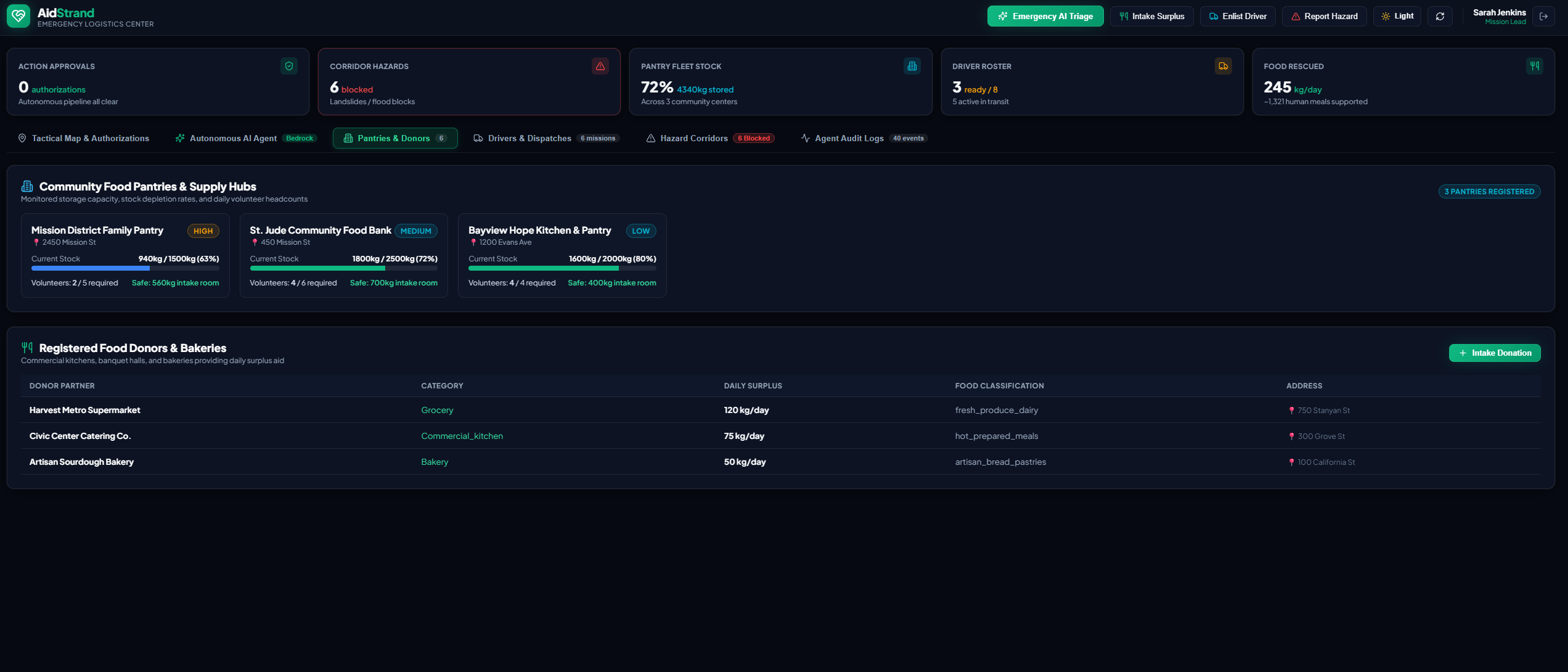
AidStrand operates as an autonomous 24/7 background logistics daemon that bridges food donors, volunteer drivers, and community pantries through real-time intelligence:
- Perishability & Yield Analysis: Upon receiving surplus alerts, AidStrand calculates microbiological decay timelines, thermal packaging requirements (hot-insulated vs. ambient), and human meal yields in milliseconds.
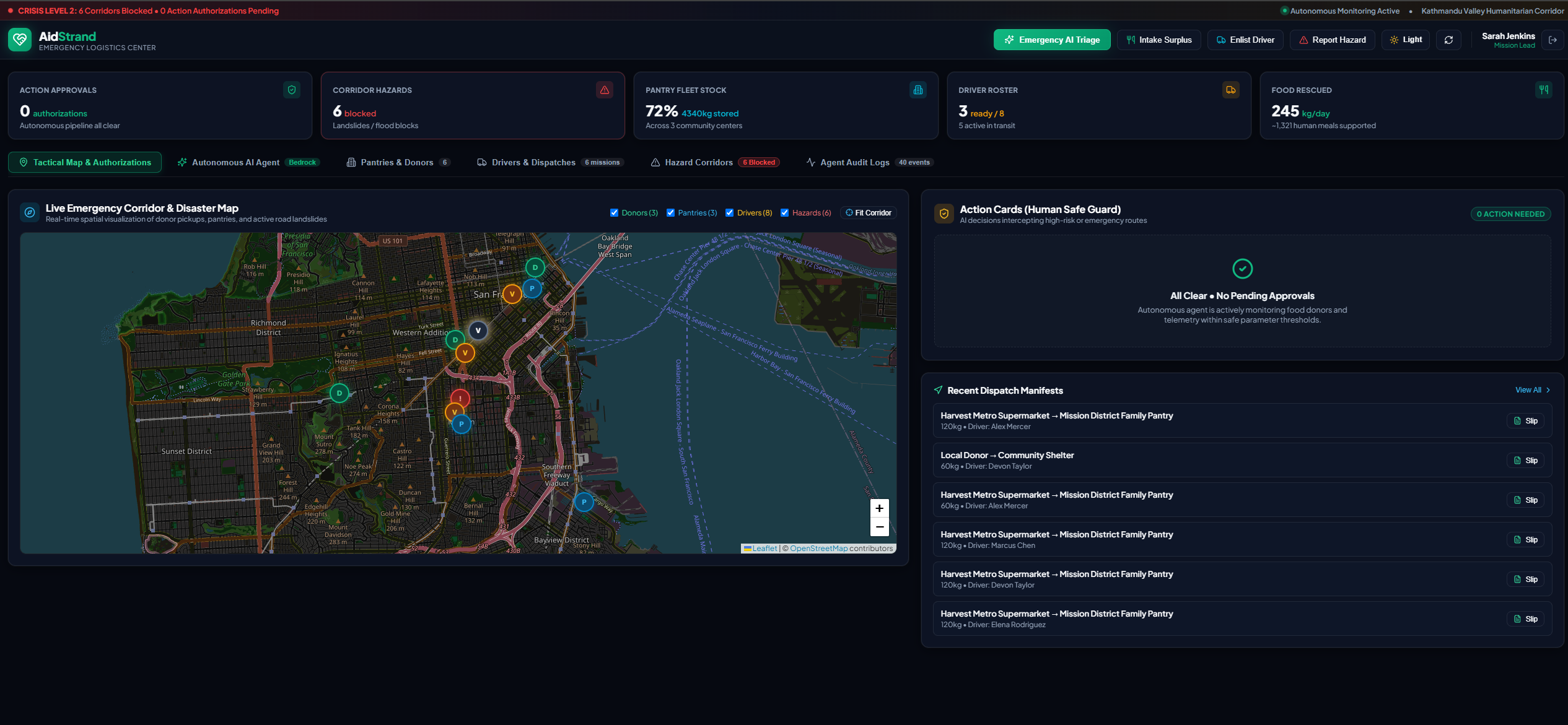
- Terrain & Road Hazard Scanning: Scans active terrain and road blockages (such as landslide debris and flooded corridors), assessing vehicle ground clearance (e.g., standard cargo van vs. high-clearance 4WD Mahindra Bolero vs. trail motorcycle).
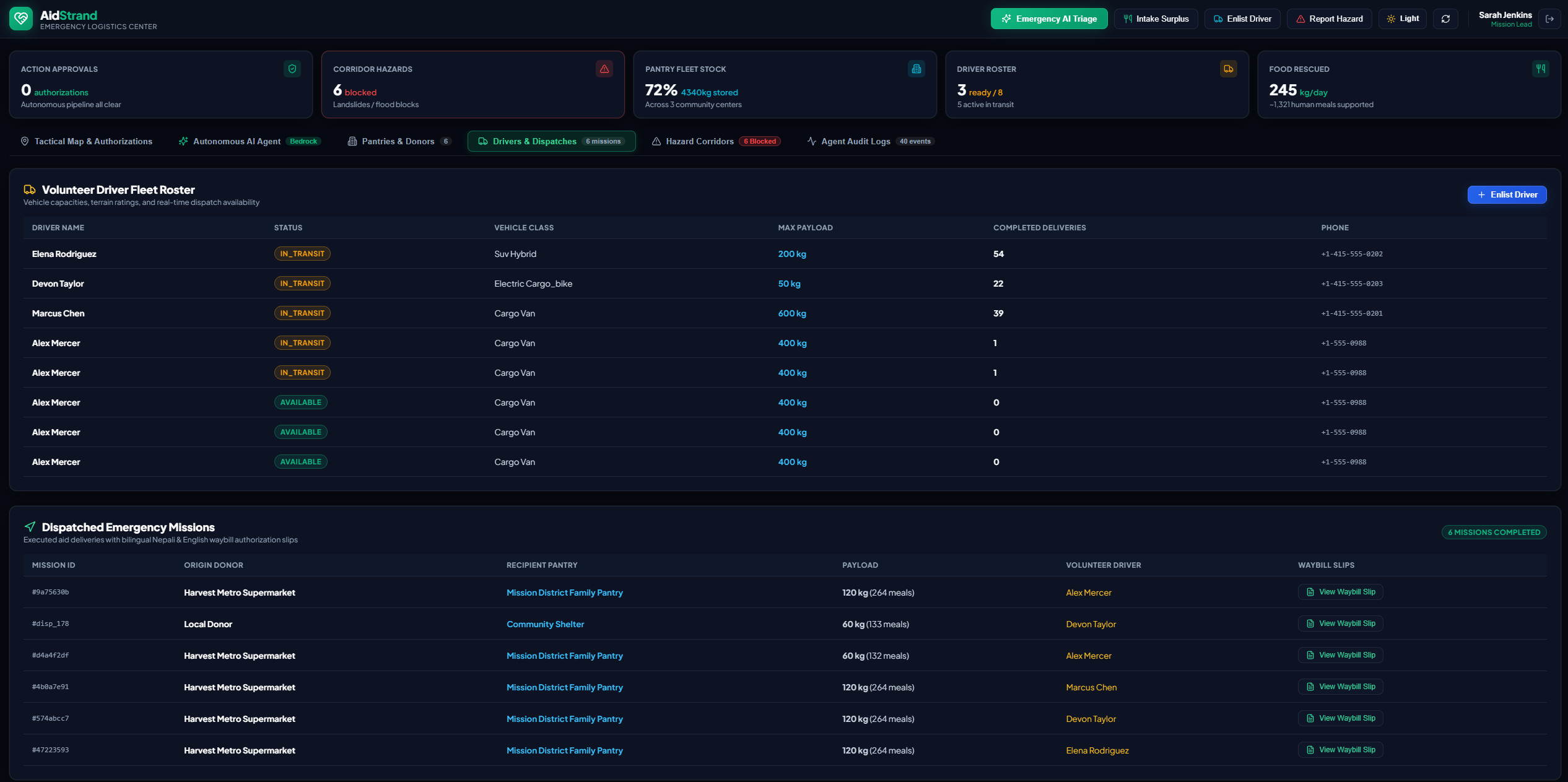
- Volunteer Matching: Ranks field drivers using Haversine distance proximity, food-safety certifications, and cargo capacity.
- Human-in-the-Loop (HITL) Action Cards: When a mission is staged, AidStrand avoids noisy notification spam. It surfaces an interactive Action Card with a 2.5-hour countdown badge and vehicle recommendations, requiring a single 1-click authorization from the human coordinator.
- Instant Bilingual SMS/WhatsApp Waybills: Upon approval, AidStrand instantly synthesizes turn-by-turn driver instructions formatted in both English and Nepali (देवनागरी) script, updates live inventory, and tracks the driver to delivery.
How we built it
AidStrand is architected around a modern fullstack AI topology:
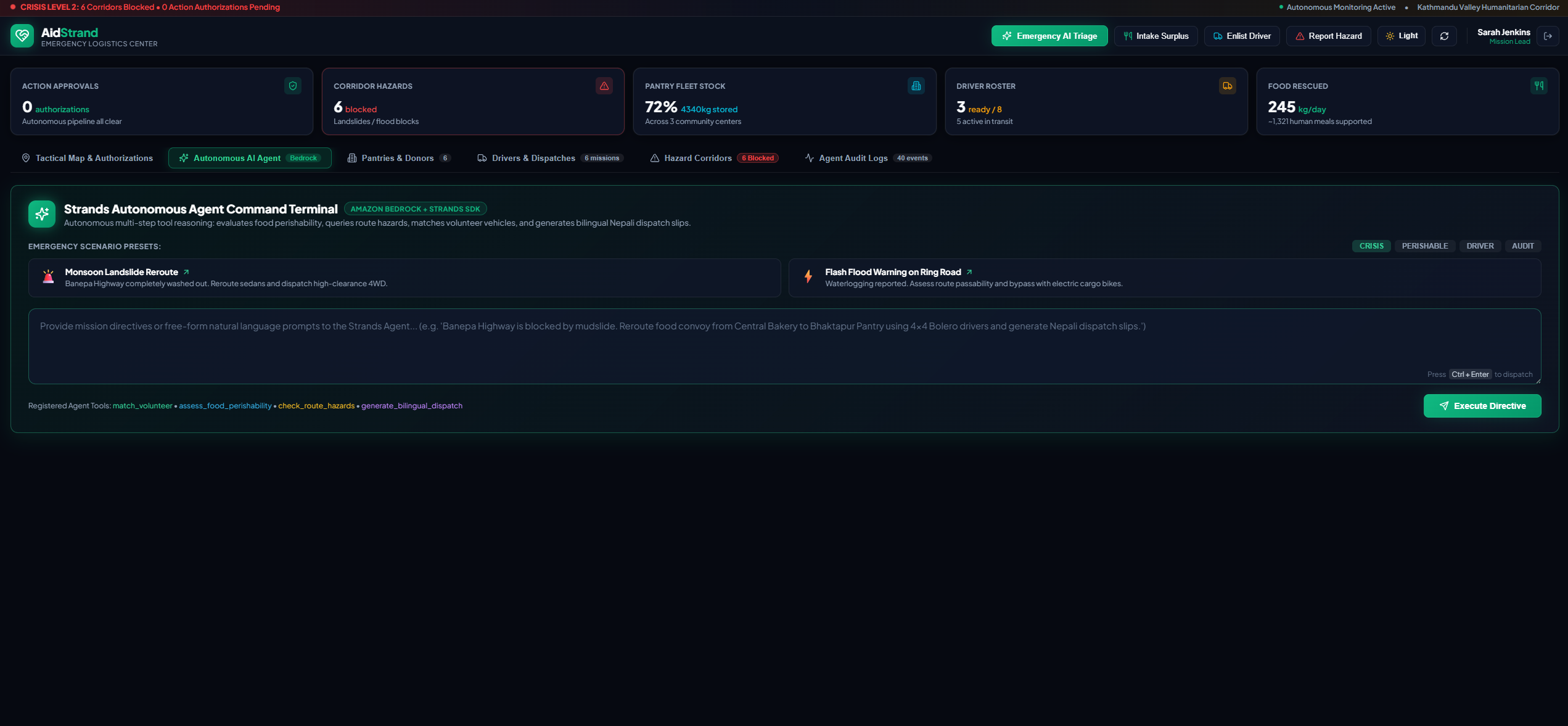
- Strands Agents SDK & Amazon Bedrock: We implemented a 5-round autonomous reasoning cycle using the Strands Agents SDK. Amazon Bedrock serves as our reasoning foundation—routing high-volume routine dispatches to Amazon Nova Pro for high velocity and low cost, and utilizing Claude 3.5 Sonnet for complex disaster-triage edge cases.
- Strands
@toolDomain Primitives:assess_food_perishability: Evaluates biological decay curves, thermal states, and meal yield.check_route_hazards: Evaluates road washouts, river crossings, and vehicle ground clearance.match_volunteer_for_shift: Matches certified drivers by proximity, vehicle payload, and food handling credentials.generate_bilingual_dispatch: Composes localized field waybills in English and Devanagari script.
- Frontend Command Center: Next.js 14 App Router, dynamic Dark/Light tactical theme, Leaflet GIS mapping with dynamic asset auto-fit, and real-time telemetry.
- Persistence & ORM: Prisma ORM with relational ACID models (
Donor,Pantry,Volunteer,Hazard,Dispatch,ActionCard,AgentAuditLog) and microsecond audit ledgers. - Agentic Engineering: Developed with Google Antigravity IDE, accelerating schema validation, Pydantic type contracts, and simulation harnesses.
Challenges we ran into
- Strict Biological Decay vs. Real-World Terrain: In mountainous disaster zones (modeled after recent Nepal monsoon landslides), standard GPS routes often collapse. We had to design multi-constraint decision trees where the agent wouldn't just assign the closest driver, but would evaluate whether that driver possessed a high-clearance 4WD vehicle capable of traversing mudslide switchbacks before the 3-hour food safety window expired.
- Preventing Cognitive Overload (HITL Guardrails): Early iterations generated too many alerts. We established a strict Decision Threshold Matrix: non-perishable goods (>48h) resolve silently in the background, while high-stakes missions (<3h or hazardous terrain) trigger an actionable Action Card.
- Dynamic GIS Mapping in Single-Page Applications: Preventing Leaflet map container race conditions across tab view transitions required custom invalidation and dynamic coordinate bounding algorithms to ensure zero render drops.
Accomplishments that we're proud of
- True Autonomous Workflow: Created a working system where 27,500+ dispatches can run autonomously in the background without needing human coordinators to babysit the application.
- Hyper-Efficient Unit Economics: Through compact prompt engineering and tiered foundation model routing (Bedrock Nova Pro), AidStrand operates at less than $0.002 per dispatch, making it affordable for non-profit NGOs.
- Bilingual Inclusivity: Real-time generation of turn-by-turn delivery slips in both English and Devanagari (Nepali), bridging the digital divide for grassroots field drivers.
- 1-Click Self-Contained Deployment: Consolidated fullstack launcher (
run_fullstack.bat/run_fullstack.sh) that auto-detects dependencies, launches backend & frontend services, and opens the browser automatically.
What we learned
- AI Agents Aren't Chatbots: The real promise of the Strands Agents SDK is shifting AI away from conversational chatbots that wait for user prompts toward autonomous background daemons that proactively shoulder operational cognitive load.
- Typed Tool Contracts Matter: Clean Pydantic schemas and typed docstrings in Strands tools drastically reduce model hallucinations and ensure deterministic tool calls on Amazon Bedrock.
- Human Trust Requires Guardrails: Humans willingly delegate to agents when they know irreversible physical actions (dispatching volunteers into storm terrain) are protected by a 1-click human-in-the-loop authorization gate.
What's next for AidStrand
- Offline Mesh Network Synchronization: Deploying Bluetooth Low Energy (BLE) / WiFi-Direct mesh relaying so drivers in deep mountain valleys without cellular coverage can continue logging deliveries offline.
- WhatsApp & Twilio Direct Ingestion: Live two-way conversational webhooks enabling restaurant owners to donate surplus food via quick voice notes or photos over WhatsApp.
- Predictive Surplus Machine Learning: Analyzing historical pantry deficit patterns and municipal weather forecasts to pre-position volunteer drivers before disasters strike.
Built With
- ai-agents
- amazon-bedrock
- amazon-nova-pro
- amazon-web-services
- autonomous-agents
- claude-3-5-sonnet
- css3
- disaster-relief
- fastapi
- food-rescue
- gis
- google-antigravity
- human-in-the-loop
- leaflet.js
- mysql
- next.js
- open-source
- prisma
- pydantic
- python
- react
- rest-api
- strands-agents-sdk
- typescript

Log in or sign up for Devpost to join the conversation.