-
-
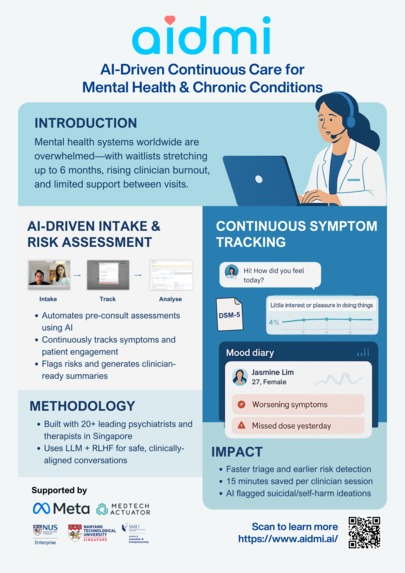
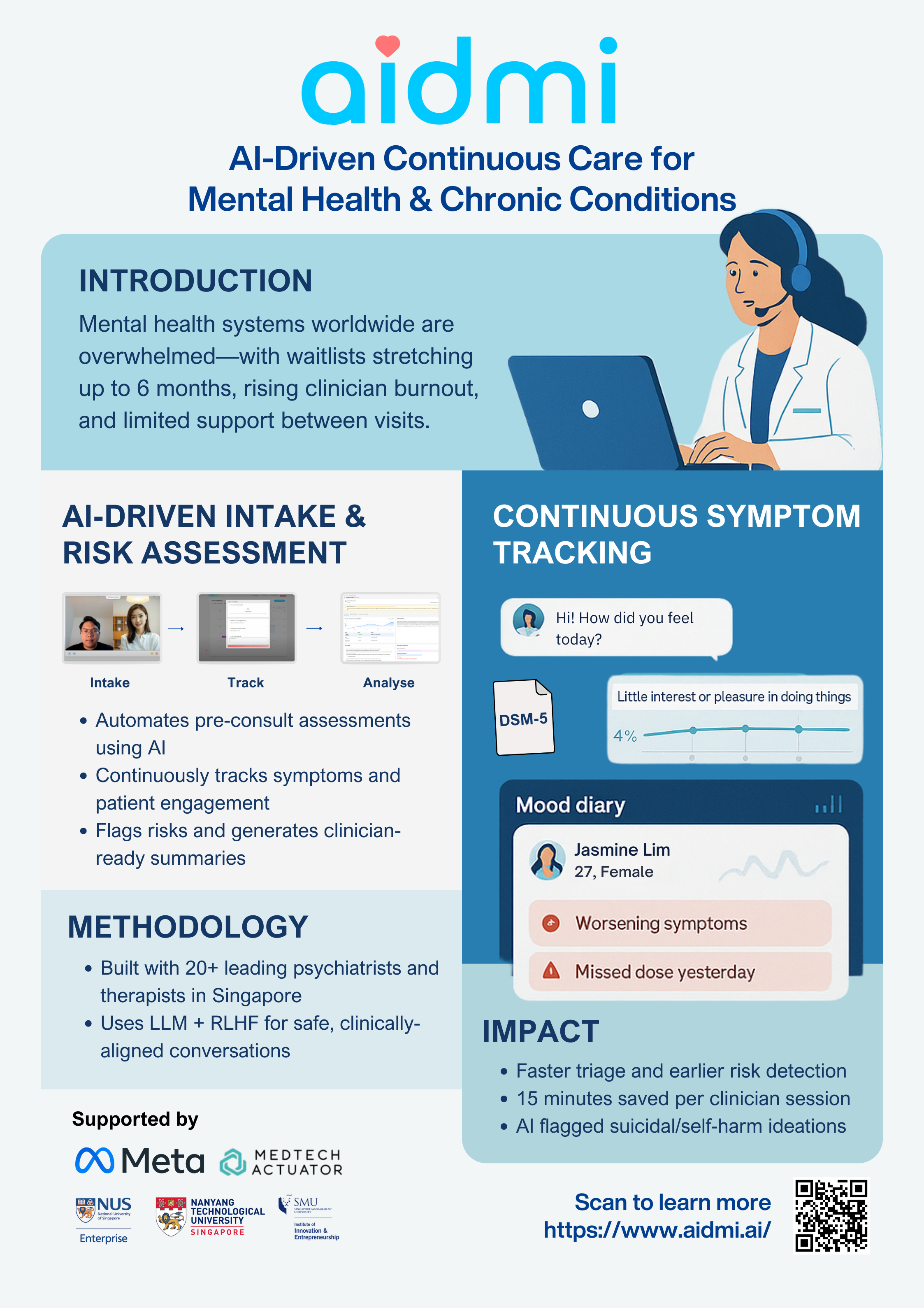
AidMi Poster for BES18SM
Inspiration
Clinicians are drowning in admin: ~54% still use manual forms, ~35% of clinician time goes to documentation, and only 16–22% of psychiatric discharges get a follow-up within 7 days. We started AidMi because that gap isn’t just inefficient—it’s unsafe. As founders with personal ties going through mental health challenges, we’re building AidMi to give the world the tools we wish existed for patients and families like ours. Our founding team and close collaborators at NTU/NUS/UC Berkeley / UCSF / Singapore hospitals pushed us to build something clinicians would actually use in the real world.
What it does
AidMi is an AI clinical agent for behavioral health that works before, during, and between visits. i) Patient Agent: Conversational intake (PHQ-9/GAD-7), symptom tracking, weekly check-ins, safe crisis escalation. ii) Clinician Dashboard: Trends, risk flags (e.g., SI/side effects/adherence), and AI note drafts to cut charting time. iii) Continuous Monitoring: Alerts for risk, plus billing support artifacts (e.g., BHI/RPM minutes packets). In pilots, clinicians report ~17 minutes saved per 60-minute session using AidMi’s pre-visit data and summaries.
How we built it
Stack: Python FastAPI backend; Vite/JS frontend; Supabase for auth/DB; GCP for backend hosting; Vercel for frontend; foundation models (gpt-4o-mini, Claude 3.7 Sonnet). Team-only code: Core product built by founders; no external contractors on core. Clinician-in-the-loop: Co-designed with ~20 clinicians across Singapore & US; iterated in live workflows. Evaluation: Time-and-motion + qualitative feedback; targeting “accept-as-is” note-draft rates while preserving clinical sign-off.
Challenges we ran into
Workflow fit vs. novelty: Embedding pre/during/between-visit tooling without adding clicks. Safety rails: Tuning risk-flag thresholds to reduce false positives/alert fatigue while never missing safety-critical events. Trust & adoption: Delivering drafts clinicians want to approve; proving day-one ROI for small practices. Go-to-market: US clinic variability; aligning with reimbursement (BHI/RPM) and procurement constraints. Globalisation: Multilingual/hybrid deployments (Singapore, ASEAN + US) with consistent quality.
Accomplishments that we're proud of
Meta (Facebook) Llama Incubator – selected (one of the first Asian startups) LSI Asia <> MedTech Actuator 2025 Grand Finalist BES (Singapore) 18th Scientific Meet – 1st Place across all three categories Silicon Valley Residency 2025 Cohort by AlchemistX and Silkroad Innovation Hub - First ever Singaporean startup NUS Social Impact Catalyst 2024 1st Place SMU BIG Jan'25 Cohort
What we learned
a) Referrals matter: Getting to the actual decision-maker in healthcare shortcuts months of sales cycles. b) US fit is strong: After extensive US interviews, needs are large (and budgets clear) —clinicians in Stanford specifically praised the Clinician Dashboard.
What's next for AidMi - AI clinical agent for mental health & chronic care
Fundraising: Raising Pre-Seed US$500K today - $100K committed from lead investor, in discussion with other early stage healthtech investors in Singapore, Thailand, Korea Clinical Validation: Complete joint research between NTU, UC Berkeley, UCSF in AI diagnostics Product: Push “accept-as-is” note-draft rate toward 60–70%; tighten risk-flag precision/recall; automate BHI/RPM documentation packets end-to-end. Security & scale: HIPAA posture + BAAs; SOC 2 path; US data residency. Integrations/GTM: Expand connectors and channels (billing/MSOs, EMR marketplaces); convert pilots to paid logos in group practices/university clinics.
Built With
- gcp
- gpt
- javascript
- python
- supabase
- vercel

Log in or sign up for Devpost to join the conversation.