Inspiration
Every year, billions of dollars in government assistance go unclaimed in the United States. According to the USDA, over $50 billion in SNAP benefits alone remain unused annually. Meanwhile, 50 million Americans are eligible for programs they don't know exist—food assistance, housing vouchers, utility help, childcare subsidies, tax credits—yet they struggle with basic needs.
Navigating the social safety net is notoriously difficult. The "Time Tax"—the administrative burden placed on individuals seeking government assistance—often discourages the people who need help the most. We realized that while eligibility rules for programs like SNAP, WIC, and Section 8 are public, deciphering them requires hours of research and calculation.
The problem isn't lack of programs. It's information asymmetry. The eligibility criteria are scattered across dozens of government websites, vary by state, depend on complex income thresholds, and require understanding multiple layers of bureaucracy. A single parent working full-time might qualify for $18,000+ in annual benefits but has no way to discover this without months of research.
We were inspired by the "Action Era" theme of this hackathon—building autonomous systems that take meaningful action. We asked: What if an AI could instantly analyze someone's financial situation and tell them exactly which programs they qualify for? Not just information, but actionable pathways to real relief.
AidMatch exists to bridge this gap using Gemini 3 Pro's multi-turn reasoning to solve what should be simple: matching people with the help they're legally entitled to. We wanted to build a bridge between complex bureaucratic criteria and human needs. We were inspired by the potential of Generative AI not just to write text, but to act as an empathetic, logic-driven caseworker that can instantly calculate eligibility and guide users through the process.
What it does
AidMatch is an AI-powered financial assistance aggregator and tracker.
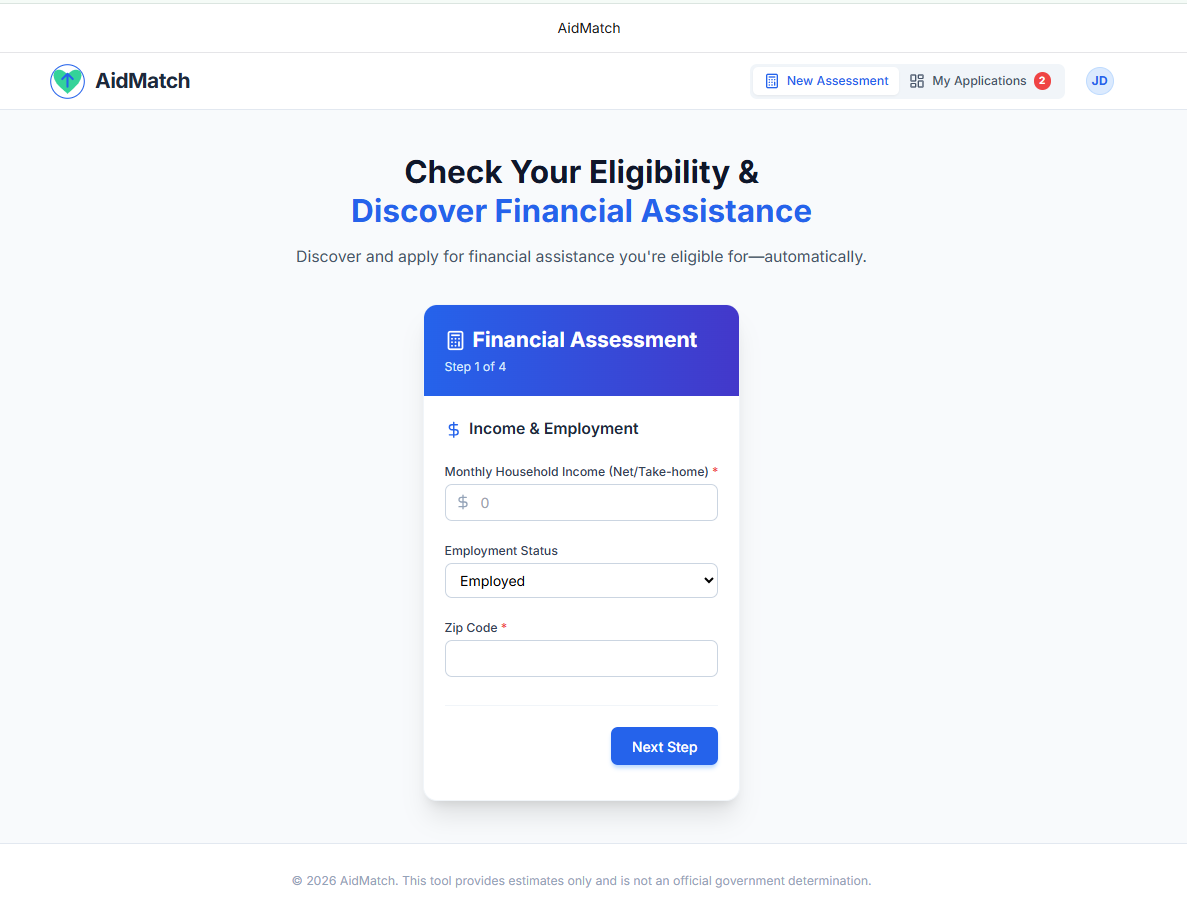
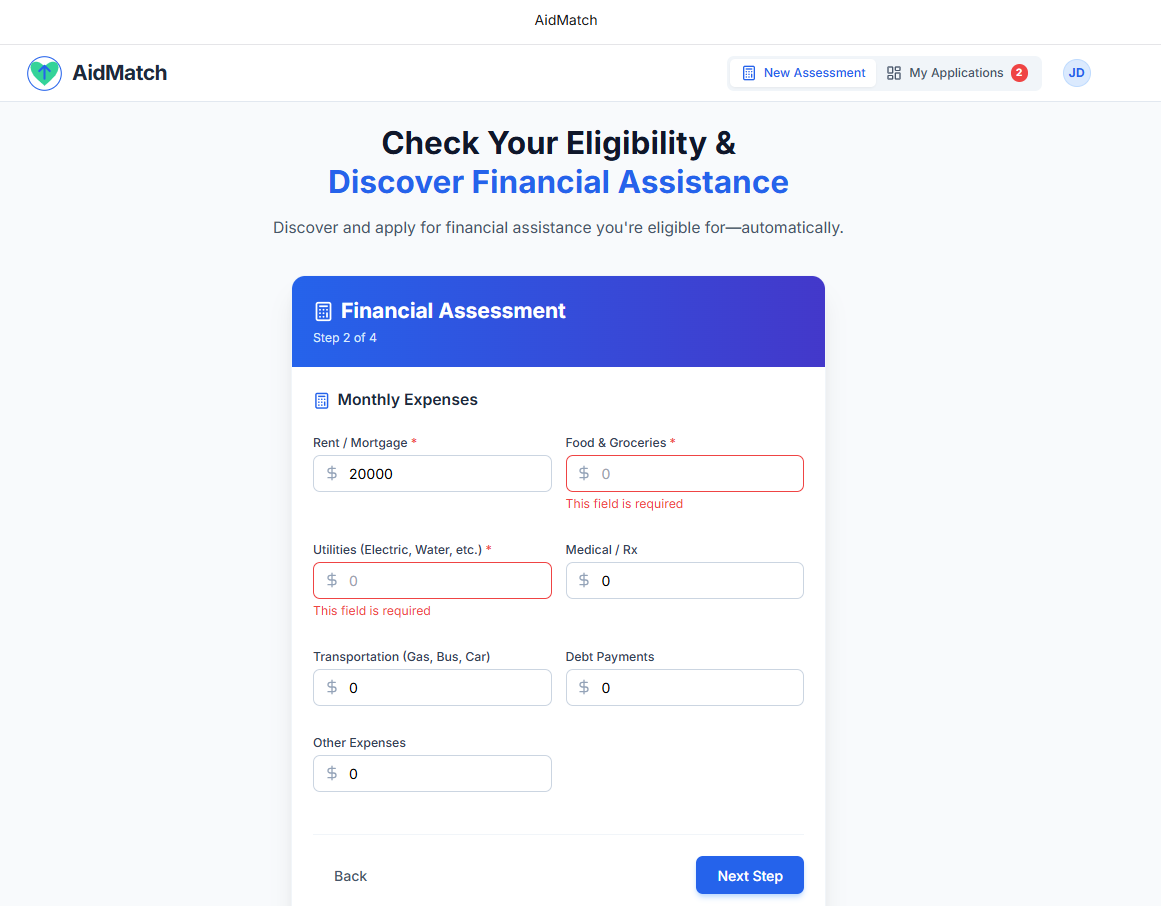
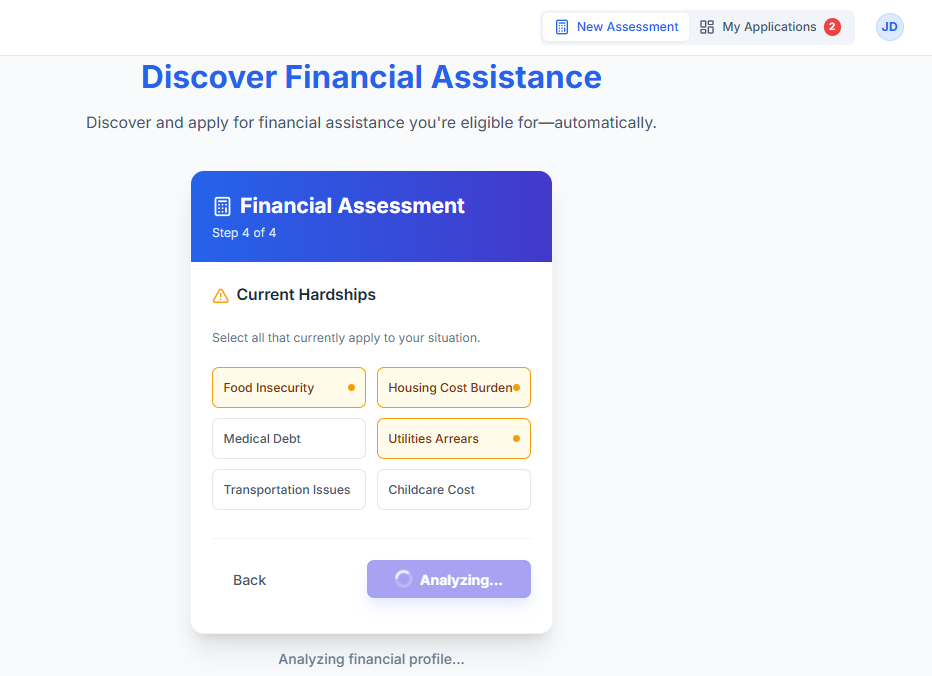
Smart Assessment: Users answer simple questions about their household, income, and expenses in a friendly, step-by-step wizard.
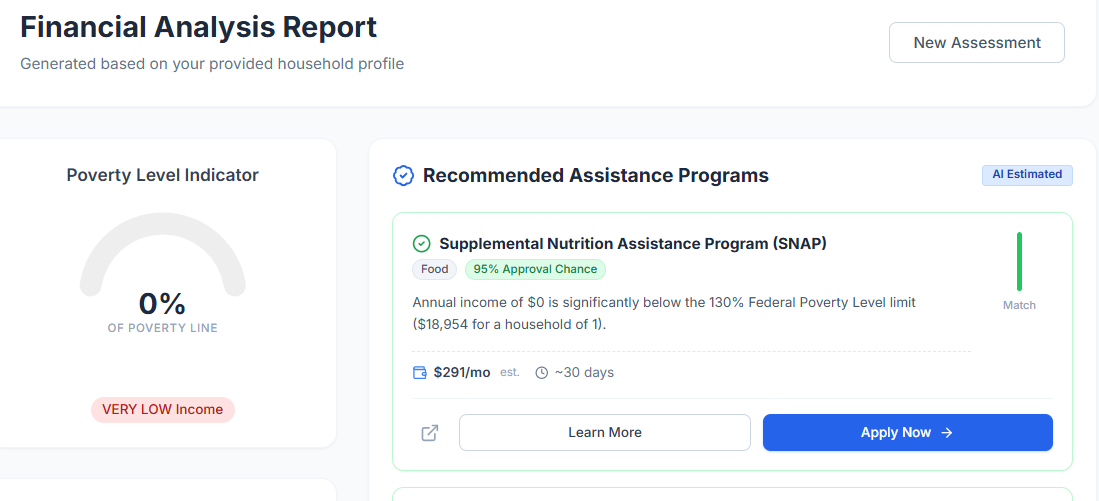
AI Eligibility Engine: We use Google Gemini 3.0 to analyze the user's financial profile against a database of federal and state aid programs. It calculates:
- Poverty Level Percentage (vs. Federal Poverty Line).
- Likelihood of approval for specific programs (e.g., "85% chance for SNAP").
- Estimated monthly benefit amounts.
The system uses Gemini 3 in two orchestrated steps:
TURN 1 - PROFILE ANALYSIS: When users submit their financial situation (income, family size, hardships, location), Gemini analyzes this contextually to create a structured profile including poverty level percentage, identified vulnerabilities, and likely program categories. This captures nuance—understanding that a single parent with three young children faces different constraints than an employed senior.
TURN 2 - ELIGIBILITY MATCHING: Gemini then matches this profile against our program database, assessing complex eligibility rules that vary by state, income level, family composition, and special circumstances. For each program, Gemini determines eligibility with confidence scores and estimated monthly/annual benefits.
Visual Dashboard: Instead of a wall of text, users see a visualized breakdown of their financial health, monthly deficits, and identified hardships.
Application Simulation: Users can "Apply" for programs directly within the interface. The app simulates the submission flow and generates confirmation numbers.
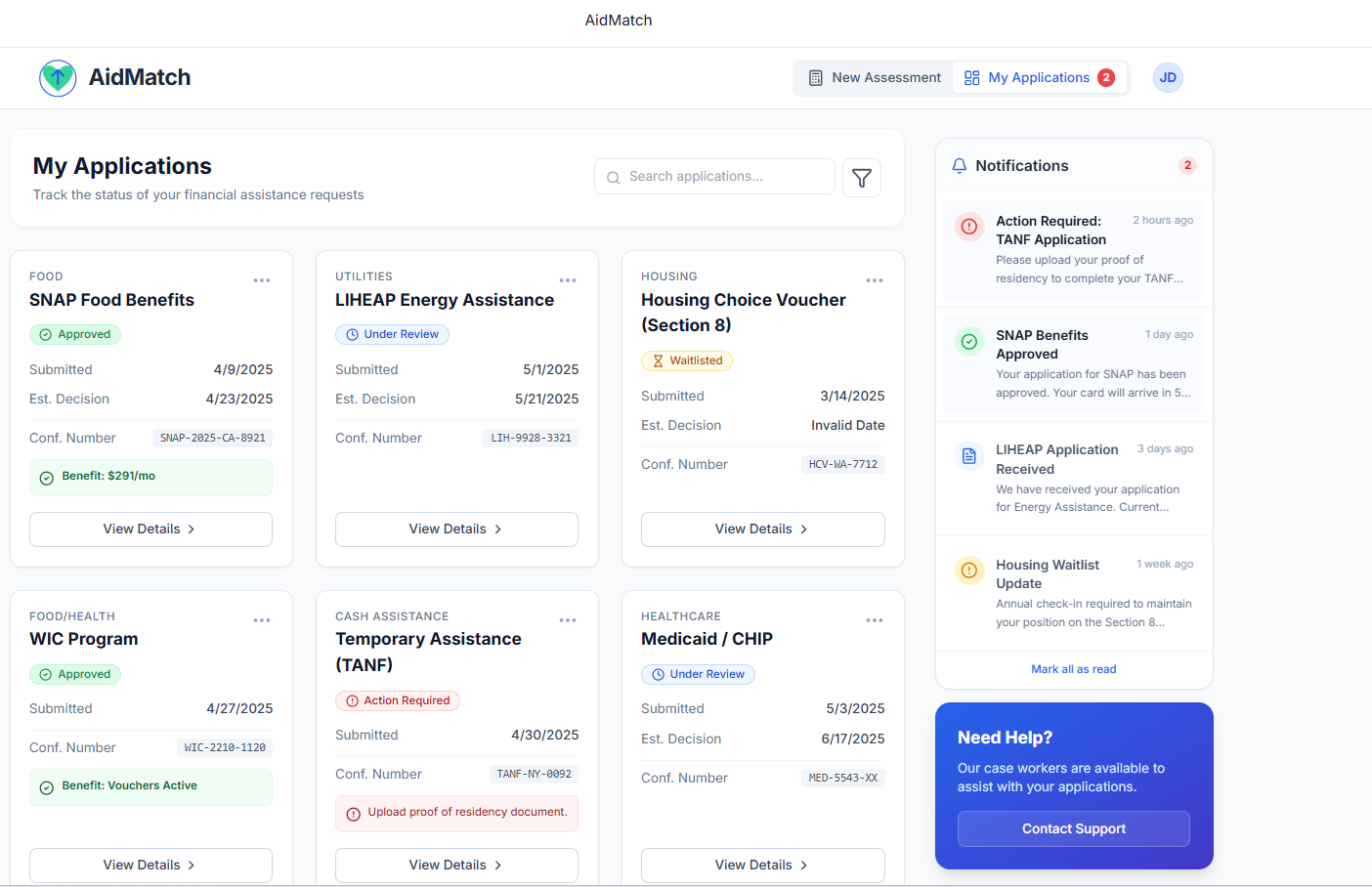
Unified Tracker: A centralized dashboard tracks the status of all applications (e.g., "Under Review," "Action Required") and provides real-time notifications for next steps, eliminating the need to log into five different government portals.
How we built it
Frontend: Built with React and TypeScript for type safety. We used Tailwind CSS to create a clean, accessible, and mobile-responsive UI, knowing that many users access these services via phone.
AI Integration: We utilized the Google GenAI SDK (specifically the gemini-3-pro-preview model). We engineered structured prompts to force the LLM to return strictly typed JSON data containing poverty calculations, eligibility boolean flags, and reasoning strings.
Data Visualization: We implemented Recharts to render radial bars for poverty indicators and charts for expense deficits, making the data digestible at a glance.
Persistence: We integrated Supabase(PostgreSQL) to store user assessments, application records, and notifications, allowing the user's journey to persist across sessions.
State Management: We used React Context and lifted state to manage the flow between the Assessment Wizard, the Dashboard, and the Application Tracker.
Challenges we ran into
Structured AI Outputs: Getting an LLM to act like a calculator and a rule engine simultaneously was tricky. We had to refine our system instructions to ensure Gemini returned valid JSON that matched our strict TypeScript interfaces, specifically for calculating poverty percentages accurately based on household size.
Race Conditions: We faced issues where the user would navigate to the tracker before the database had fully updated. We solved this by implementing optimistic UI updates while the data synced with Supabase in the background.
Complex Eligibility Logic: Programs like Section 8 have complex variables (Area Median Income). Abstracting this into a prompt that Gemini could process without hallucinating requirements took several iterations of "Prompt Engineering."
Accomplishments that we're proud of
The "Case Worker" Feel: The AI doesn't just say "You qualify." It gives a reason (e.g., "Income is < 130% of federal poverty line"). This transparency builds trust.
Visualizing Poverty: We are proud of the Poverty Level Indicator component. Seeing a visual representation of where a family stands relative to the poverty line provides immediate context that raw numbers lack.
Seamless Database Integration: The app works in a "Demo Mode" with mock data for testing, but instantly switches to a full-stack CRUD application once Supabase keys are detected, making it robust and deployable.
Solves a Real, Massive Problem: $50 billion unclaimed annually. 50 million eligible people who don't know about benefits. This isn't a toy problem. Our solution directly impacts financial wellbeing for vulnerable populations.
Beautiful, Functional UI in 7 Days: The app doesn't look like a POC. It looks like a product. Mobile-responsive, smooth animations, clear information hierarchy. Users immediately understand what to do.
What we learned
AI as a Rules Engine: We learned that Large Language Models are incredibly effective at fuzzy logic matching—taking a messy human situation and mapping it against rigid government criteria—better than standard if/else statements could cover.
Empathy in UX: Designing for financial distress requires a specific UI approach—calming colors, clear language, and positive reinforcement ("You Likely Qualify") are essential.
What's next for AidMatch
Document Analysis: We plan to use Gemini's multimodal capabilities to allow users to upload photos of paystubs or tax returns to auto-fill the financial assessment form.
Real State API Integrations: Currently, we simulate the submission. The next step is connecting to public APIs (where available) or using headless browser agents to submit the data to actual government portals.
Multi-Language Support: Using Gemini to translate the interface and the analysis reasoning into Spanish, Chinese, and other languages to reach a wider demographic.
Built With
- css3
- gemini-api
- react
- supabase
- tailwind
- typescript


Log in or sign up for Devpost to join the conversation.