Inspiration
AI agents are becoming increasingly capable at reasoning and coding, but they still struggle with one fundamental problem: actually doing things in the real world.
Connecting an agent to Gmail, Slack, GitHub, social platforms, databases, or APIs usually means configuring OAuth, managing API keys, setting up MCP servers, reading documentation, and rebuilding integrations for every new agent.
We built Aident because we wanted using a tool to be as easy for an AI agent as installing an app is for a human.
What it does
Aident gives AI agents a unified capability layer for accessing real-world tools and services.
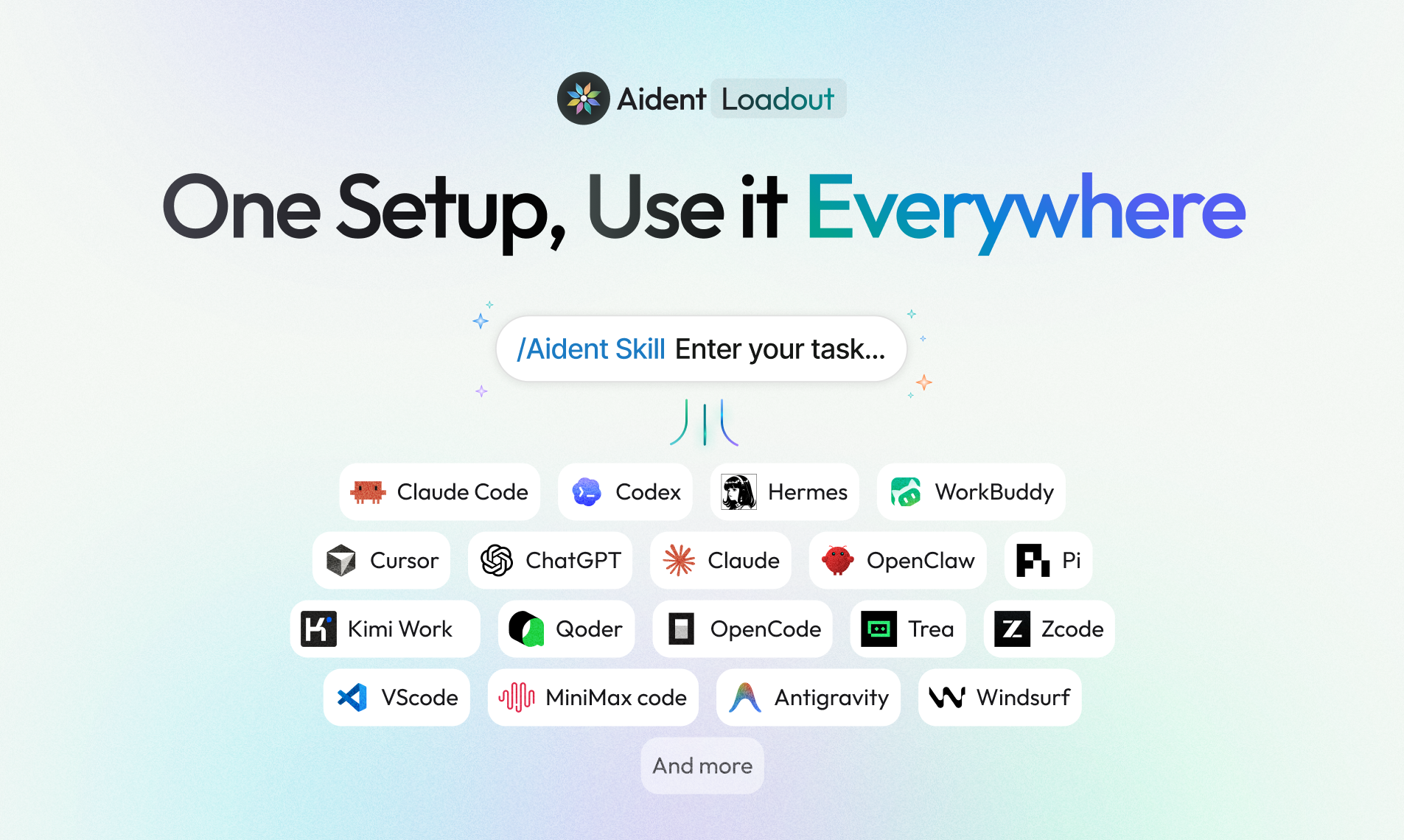
Through Aident Loadout, users can connect their accounts once and give agents such as Codex, Claude Code, Cursor, OpenClaw, and other MCP-compatible agents access to the tools they need.
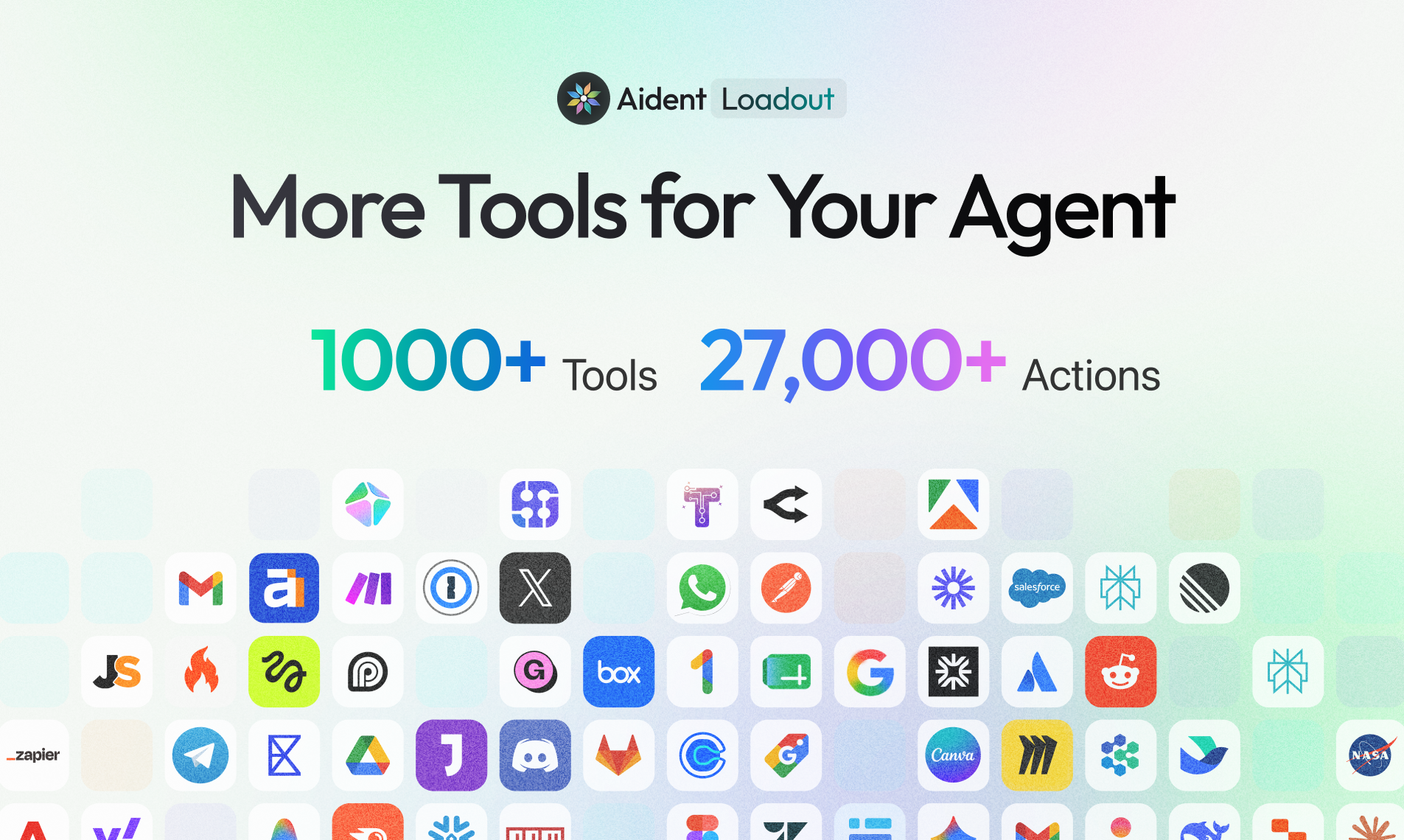
Instead of individually configuring dozens of integrations, an agent can discover and use capabilities across 1,000+ tools and thousands of actions.
Aident also provides reusable agent skills and managed tools, allowing developers to quickly equip their agents for workflows such as:
- Research and web data collection
- Email and communication
- Developer workflows
- Social media and creator outreach
- Sales and lead generation
- Marketing automation
- Data processing and productivity
How we built it
We designed Aident around a simple abstraction:
Agent → Aident → Tools
The agent shouldn't need to understand how every underlying service authenticates or exposes its API. Aident handles the tool infrastructure while presenting capabilities through interfaces agents already understand, including MCP and CLI.
We built a centralized connection layer so credentials can remain outside the agent's context and connections can be reused across different agents.
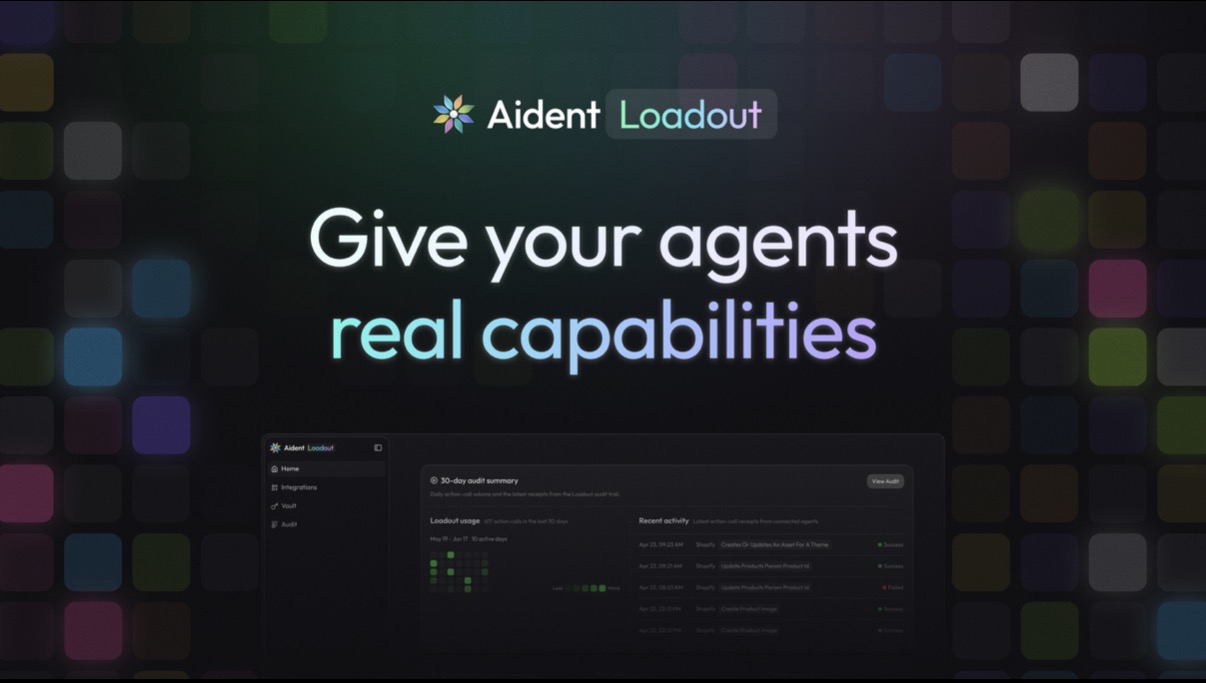
On top of this, we built tool discovery, execution infrastructure, reusable skills, usage management, and an audit layer that lets users see exactly what their agents are doing.
Challenges we ran into
The hardest part wasn't simply connecting APIs. It was making thousands of heterogeneous actions behave consistently enough for autonomous agents.
Different services have different authentication models, schemas, rate limits, error formats, and permission systems. We also had to think carefully about credential isolation: agents need enough access to complete tasks without exposing sensitive credentials directly inside their context.
Another challenge was tool discovery. Giving an agent thousands of tools isn't useful if it cannot determine which capability it should use. We therefore spent significant time improving how tools are structured, described, searched, and exposed to agents.
Accomplishments that we're proud of
We're especially proud that Aident has grown from an experiment into infrastructure used by 16,000+ users.
More importantly, we use Aident ourselves.
Our own team uses the platform for GTM, research, creator outreach, operations, and development. One of our automated creator-outreach workflows helped our content reach 1M+ views, giving us a real-world environment for continuously testing the product.
Every time our own agent gets stuck, we discover another piece of infrastructure that agents need.
What we learned
We initially thought the future of agents would primarily be about building smarter models and better orchestration.
Building Aident changed our perspective.
As models improve, access to capabilities becomes increasingly important. An intelligent agent without tools can suggest what to do. An intelligent agent with reliable tools can actually do it.
We believe the next generation of AI products will therefore need an infrastructure layer that makes software, APIs, data, and services easily accessible to agents.
What's next for Aident
Our goal is to make Aident a universal capability layer for AI agents.
We're expanding the Loadout ecosystem with more tools, reusable skills, better tool discovery, and deeper integrations with coding and general-purpose agents.
Ultimately, we want an agent to encounter a task, discover the capability it needs, securely access it, and complete the task — without the user spending hours configuring infrastructure.
Built With
- claudecode
- codex
- supabase
- typescript
- vercel

Log in or sign up for Devpost to join the conversation.