-
-
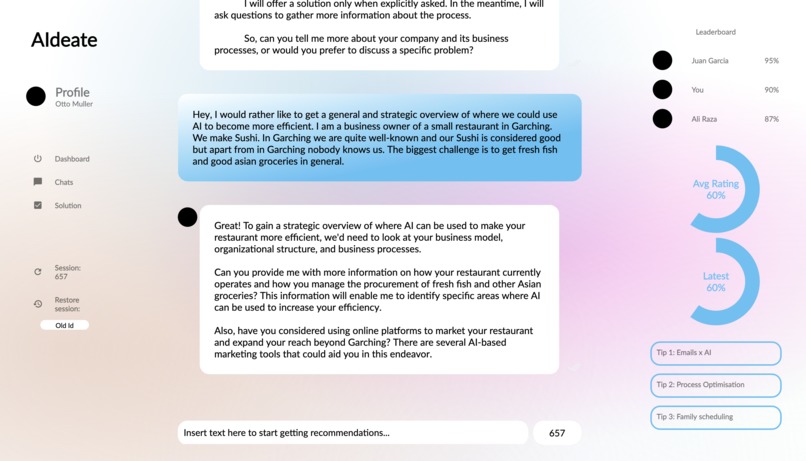
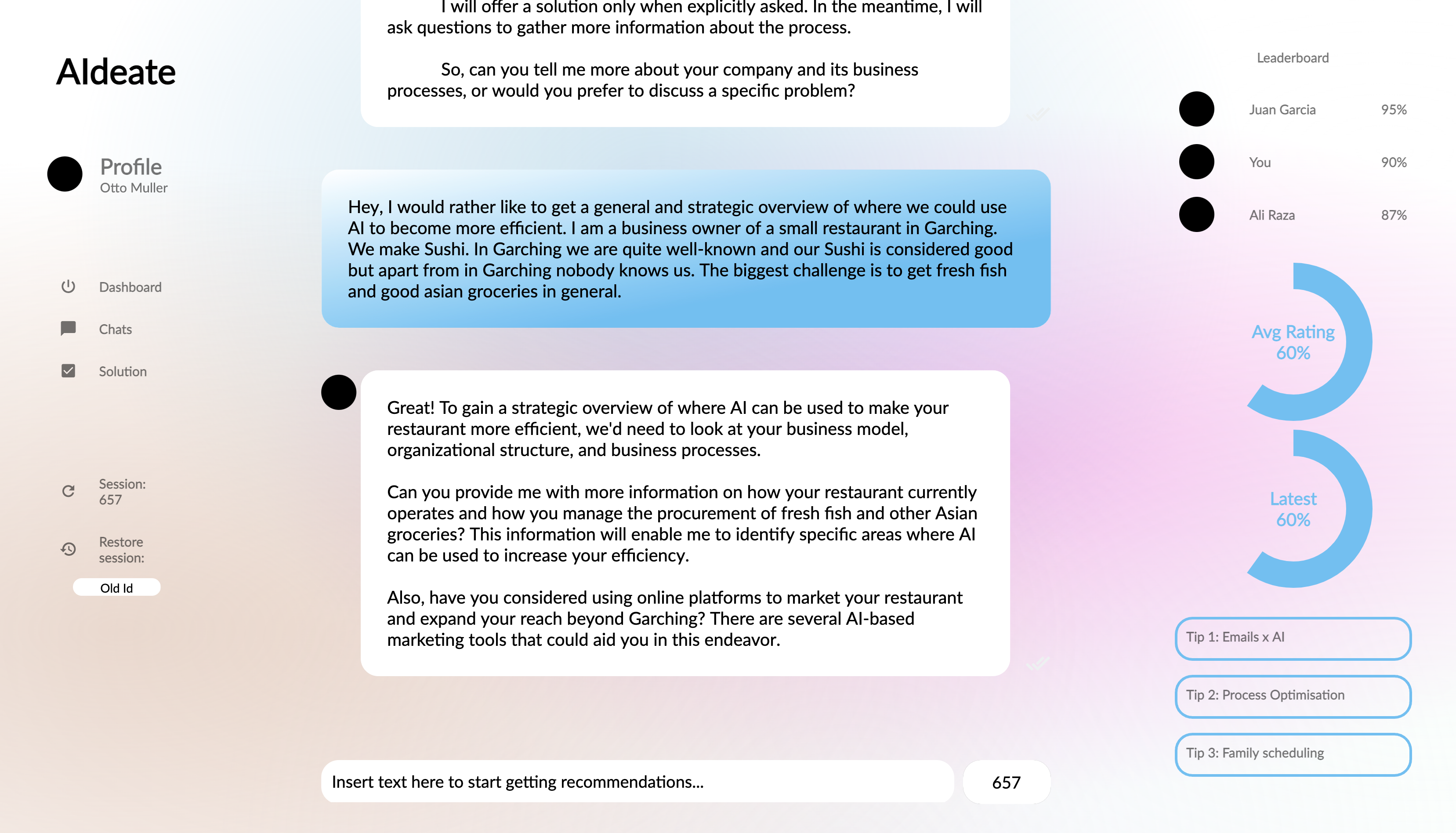
AIdeate chatbot with a 'Solution' tab, chat function, and gamification element (which rates the usefulness of the users answers)
-
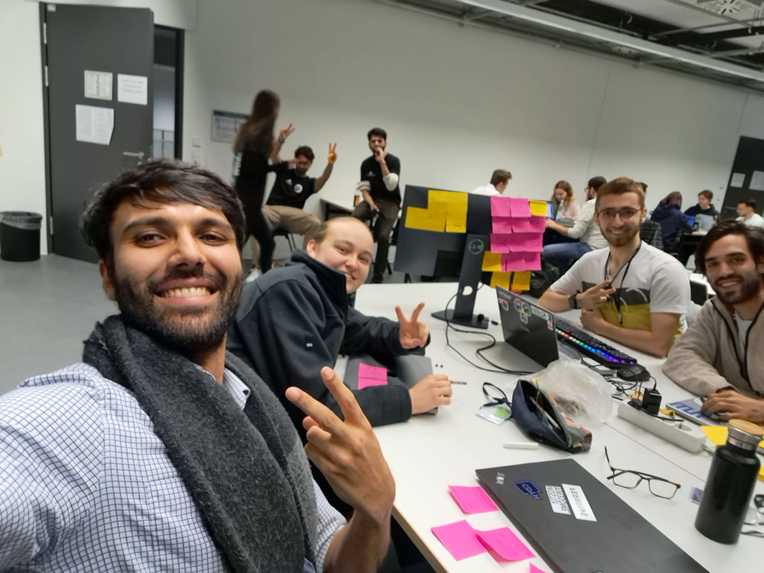
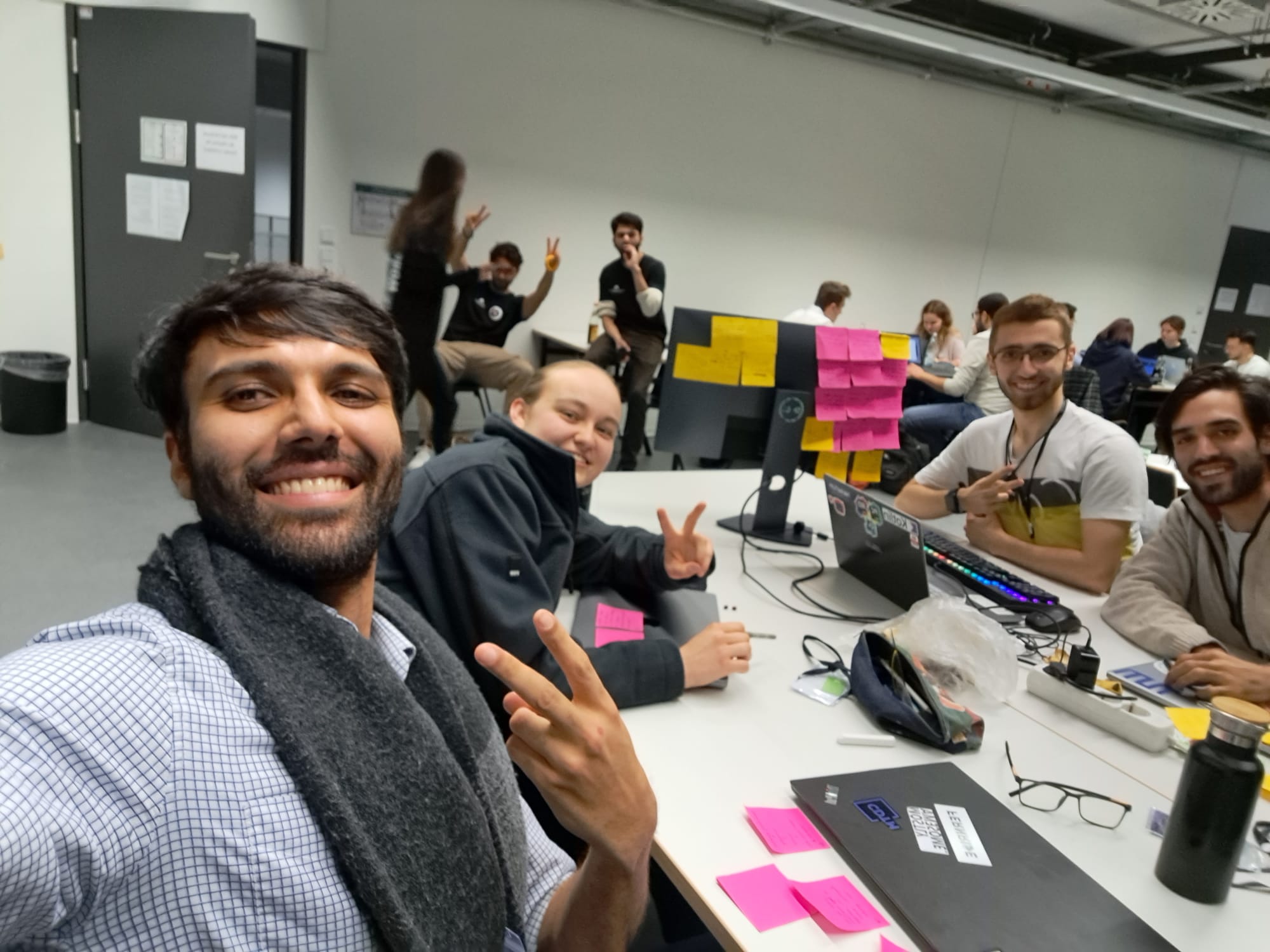
Team photo
Challenge Description
The challenge, set by AppliedAi, aimed to democratize access to AI by developing a framework that helps businesses identify valuable use cases for AI implementation. The solution should provide an interface that allows users to input their domain-specific knowledge and goals to generate potential use cases for AI implementation. The framework should analyze a company or industry and output a use case for AI implementation that includes problem description, AI application, business value, costs and risks, and required data sources.
Inspiration
Democratize the adoption of AI in the German Mittelstand by leveraging LLMs and business frameworks into an AI companion solution that is inclusive, intuitive and engaging.
What it does
We created a multimodal AI companion, that firstly allows the front-line employees to interact through either a phone call or a chat, and hold conversations about automating their daily tasks in an engaging manner that makes their work lives easier and further allows them to see meaningful interactions appreciated in a leaderboard. The same AI tool aggregates information into strategic insights, helping the upper management understand the heartbeat of the company, general sentiments of the workforce and understand which processes can be streamlined by integrating AI.
How we built it
We approached the application architectural design from a customer interaction perspective. Considering we decided to target all employees of a mittelstand company, from interns to upper management we created 2 interfaces to interact with the user. To facilitate ease of use and accessibility to low-tech affine people, we decided to create a phone call bot that interacts with users. For users that want more control and more information we also developed a web user interface arranged like a personal digital consultant. Both of these applications unify the information in our backend, which manages conversation flows, and the interaction between users and the LLM we used, GPT-3.5-turbo. The server manages connections and user information, and curates GPT prompts to better suit our use case. In order to encourage user interaction and improve quality of output, all digital expert sessions are managed by 3 instances of GPT. 1 communicates with the user, helping him understand his problem and collects data. The second one watches over the information gathered and creates possible use cases for AI applications. The last one gives feedback to the user, based on how much information the other 2 are able to extract from his prompts.
In order to encourage user interaction and improve quality of output, all digital expert sessions are managed by 3 instances of GPT. 1 communicates with the user, helping him understand his problem and collects data. The second one watches over the information gathered and creates possible use cases for AI applications. The last one gives feedback to the user, based on how much information the other 2 are able to extract from his prompts.
Accomplishments that we're proud of
General:
- Being respectful and trustworthy of each other in a highly stressful environment
- Creating a solution that can truly help a customer segment in need by empowering them with the latest advancements in AI
Technical:
- Being able to connect different forms of input (e.g., voice and chat) into one server and creating an AI that could analyse the content of each comprehensively to give a recommendation
- Implementing a beautiful and intuitive UI/UX journey which is uniquely tailored to non-digital natives
- Building a new way of rating the quality of prompts which can thus encourage people to become better prompt engineers
Business:
- Validating our solution through impromptu customer interviews from leading figures in German Mittelstand sector
Challenges we ran into
- Designing the product in a way that it is actually useful and at the same time fun to use
- Prioritising all the great feature ideas for the MVP
- Creating a working prototype in such a short amount of time
- Unterstanding German Mittelstand and their needs
- Evaluating a valid (and also the best possible) business case
What we learned
- How to use the call-API of openAI and how good it is
- How to learn new programming frameworks in a short amount of time
- How to efficiently distribute tasks
- User and expert interviews are very helpful
What's next for AIdeate
- The mission of AIdeate is to build the ultimate AI companion which enables companies to integrate AI into their processes by empowering all employees in their daily tasks.
- As such, our next steps are to continue building AI use cases for our employees. For that, we need 3 types of tasks: administrative, user research and technical implementation
Admin:
- Raise €2M pre-seed funding to support our research & development
- Build out team:
- Hire Sales representatives to onboard Mittlestand partners
- Hire NLP engineers to bolster capabilities
- Expand internationally, starting with Central Europe
User Research:
- Onboard innovative Mittelstand companies which can guide us with information on their needs and pain problems
- Keep running interviews with end-users
- Implement feedback form in our products
Technical implementation:
- Apply following features:
- Plug-ins with major communication platforms (Zoom, Teams, Notion)
- Emotional intelligence to support employees in more areas
- Development platform to integrate 3rd-party apps into software
- Document upload (more multi-modality)


Log in or sign up for Devpost to join the conversation.