-
-
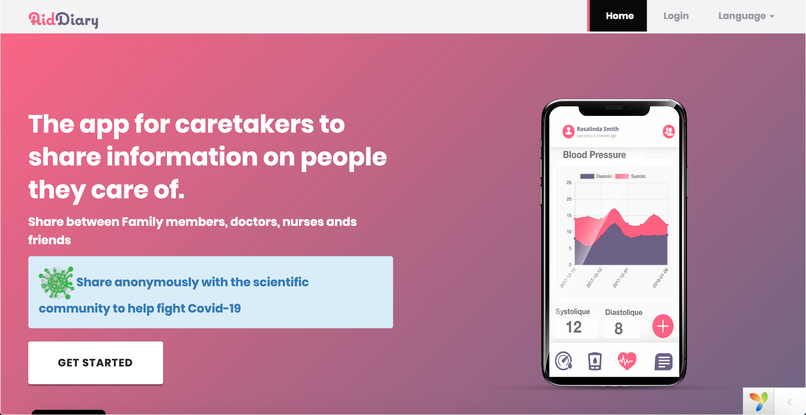
LandingPage
-
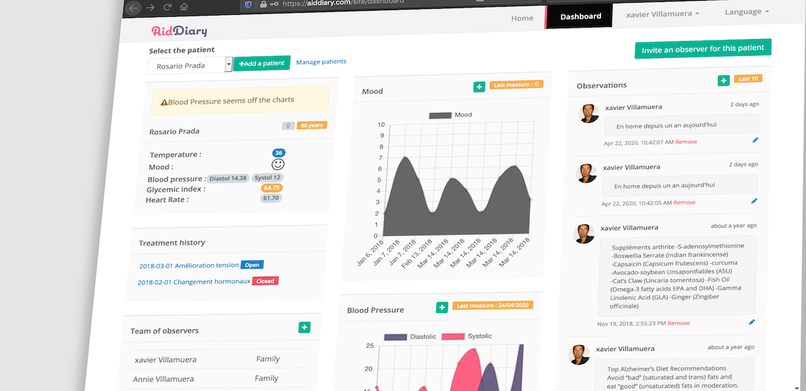
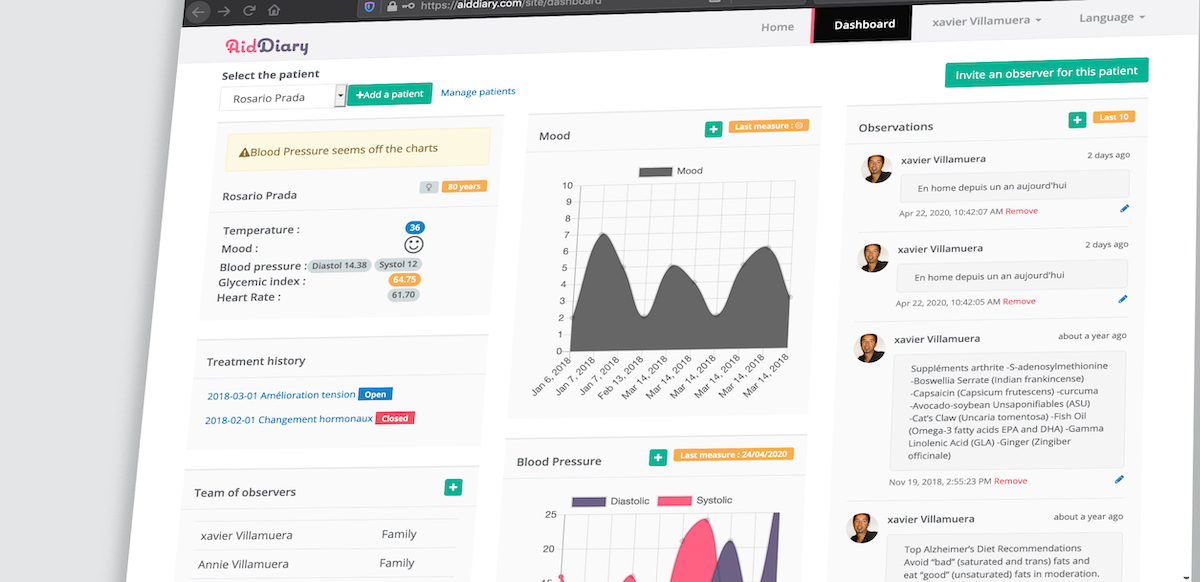
Common Dasboard
-
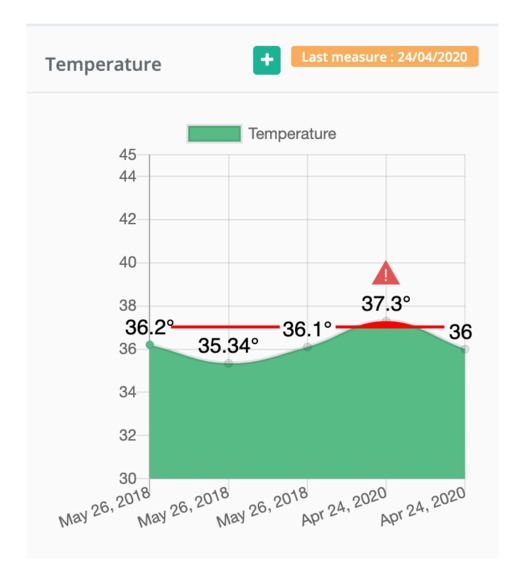
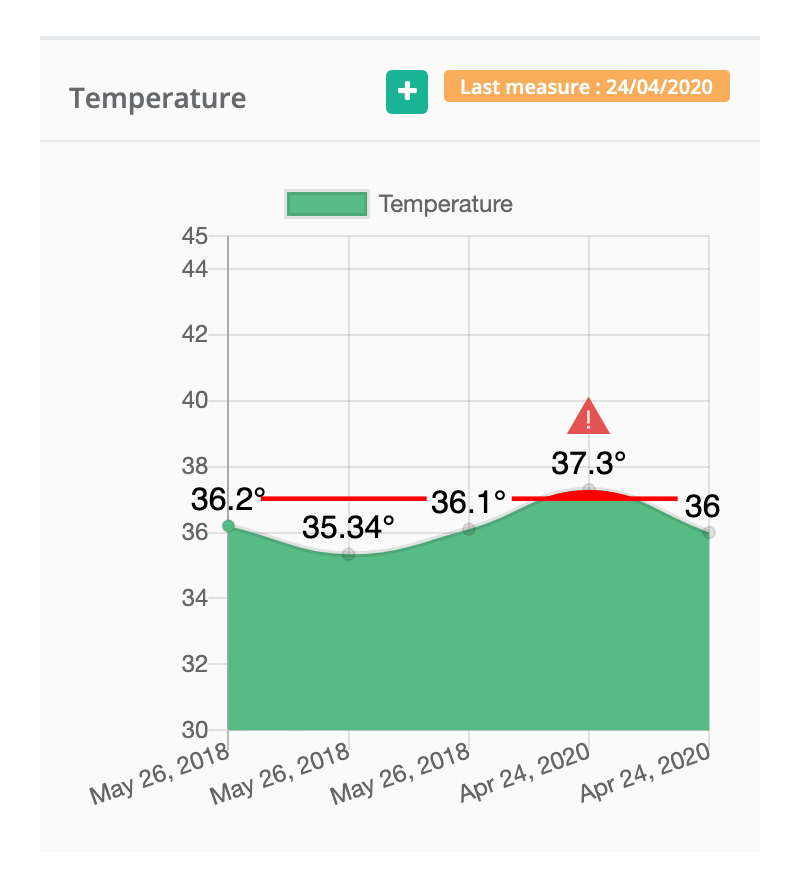
Temperature monitoring graph
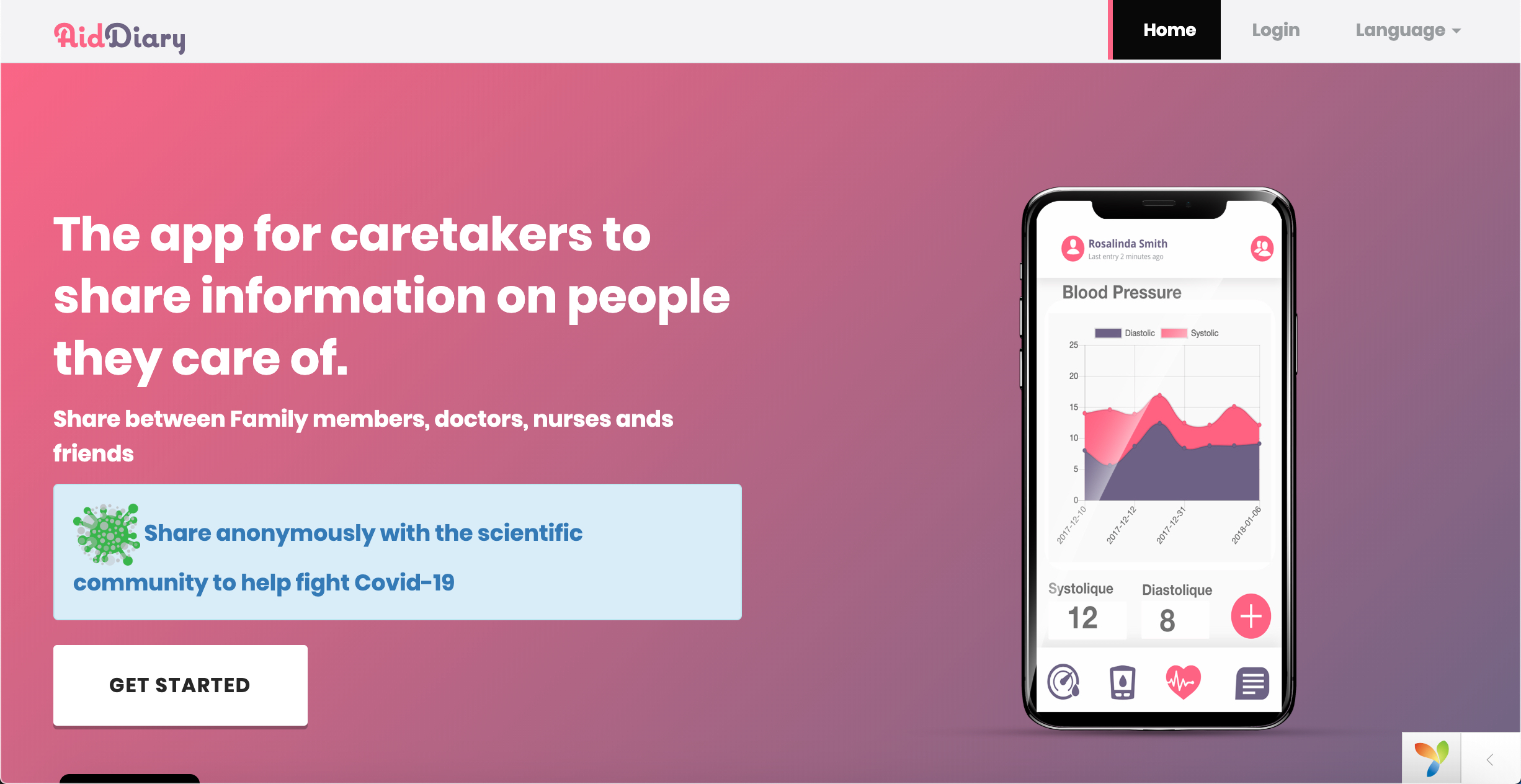
Inspiration
In he past, my mother became sick and old but wanted to stay in her house. By turns, and with the help of the nurses and the doctors, we were passing by her house to help her and be with her.
Sometimes we found a note on the the table with directives that, for example, batteries where missing, or some drug prescriptions where missing. If we knew that information beforehand we would have been more efficient for our visit.
In order to know what were her latests metrics we had to follow the handwritten logbook let in her home without having a clear overview of the situation.
When we needed clarifications, we had to call the doctor to try being on the same page. Either it was me, or my sister or a friend, and we had to communicate to each other in order to have the closest to the full view.
AidDiary is supposed to bring every care taker on the same page about the “patient”, nearly realtime, wether it is from the medical world or not. Everybody, including the patient, participates.
What it does
AidDiary is a webapp, an api and a mobile application that enables to see several metrics as an overview and available to all care takers.
The metrics are :
- Body temperature
- Blood pressure
- Mood
- Glycemic Index
- Heartbeat Rate
The system is opened to more metrics as it is developed in modules.
Besides the metrics there is also the observations. A chronologic log of all verbal observations any care taker left during their visit. Of course, the patient can report metrics and log its own observations.
The system enables to tag observations with a critical tag but also to direct an observation to a certain care taker. For example, a nurse can address a message to the doctor.
Dissemination of the information is done through the dashboard of the app, by email when someone post a metric or observation, and also by push notifications when using the mobile app.
Each metric provider can opt-in to share anonymously data with the Scientific Community.
How I built it
AidDiary has been built to answer my own need in order to propose a global solution to all caretakers. I've been using technologies which I'm familiar with : PHP at first.
Challenges I ran into
Despite the fact that the project became idle because of circumstances, the main challenge remains the acceptance of such project and way to communicate from the medical world. Nurses are overwhelmed by work (it is true now, but it was true before as well) and see it as an additional control system. At the end I managed to get acceptance but we could not get through because of the circumstances. Also, it is true that there are technologies for everything, and each sell themselves as being easy to implement. That is often not true when the project becomes complex. Ionic was chosen for a first mobile app proof of concept. But the result is a tad sluggish. Also, being alone to develop can lead to some kind of exhaustion.
Accomplishments that I'm proud of
MVP has been reached and I could, at least, test the application with my sister. I copied, by the time, the metrics in the app. My mother didn't understood anything and was conveying wrong data. After entering some metrics we could see that the situation was quite stable. It is there and running (but has to be refactored for the frontend part)
What I learned
Technology is far from being everything, in fact it can be close to nothing if the human factor is not taken into account. By human factor I mean acceptance and resistance to change. While I saw my app as an improvement some stakeholder saw it as a new control mean. Without a hint of acceptance, technology is just nothing. That is why there is a need of non technical people to enable acceptance.
What's next for Aiddiary
The mobile application has to be optimised to incorporate the latests features available in the web App. It is using Ionic/cordova right know but it does not seem to be a very efficient solution as, compared to native apps, the feeling of the user experience is a tad sluggish.
The second API to share anonymous data must be tested.
In order to provide better future technical maintenance, the backend and the frontend should be more decoupled by using the API and a fronted technology like Vuejs/Nuxt.
That frontend technology can also be used to provide a progressive web app which will bring alternatives for the mobile platform.
This decoupled architecture will enable easier maintenance and easier development.
In terms of feature: I’m still working on the possibility to output a PDF report for medical meetings (for example, between nurses). I’m still working in the ability to show more detailed graphs with chronological events that might impact the evolution of the metrics (change of drug treatment). All these metrics can maybe reveal patterns when metrics and events are combined. That is why there is an incentive (lower price) when opting in to share data anonymously. Further improvements will include IOT integrations to use data from watches or any other wearable. Specifically for non real time heart rate measurements.
Built With
- php
- vuejs
- yii2


Log in or sign up for Devpost to join the conversation.