-
-
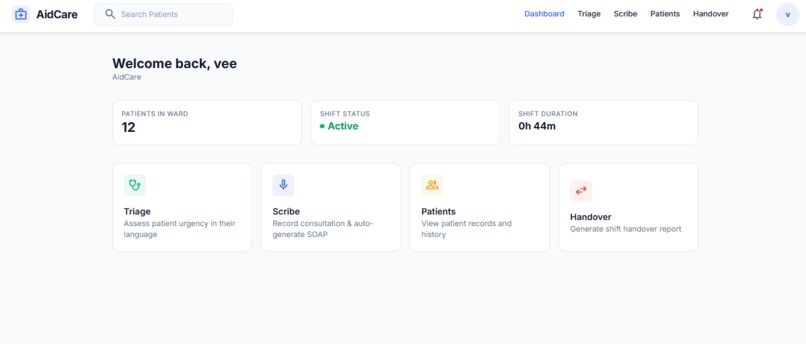
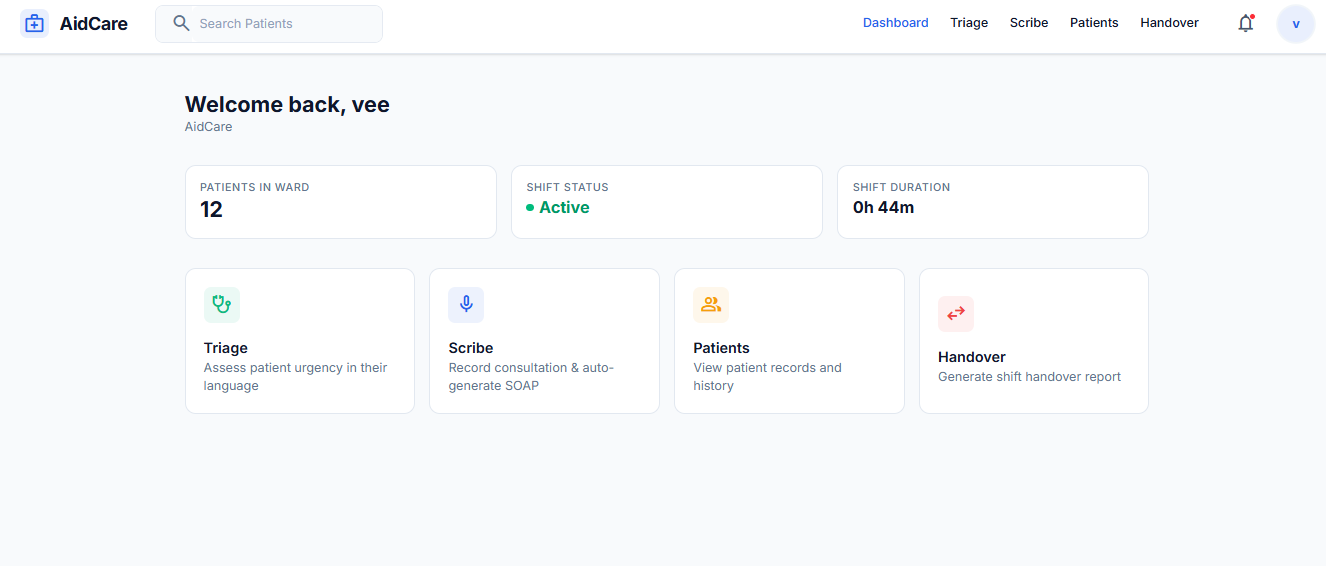
Home page
-
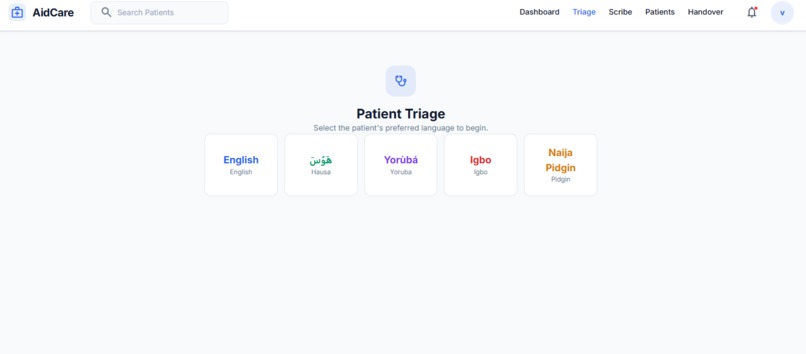
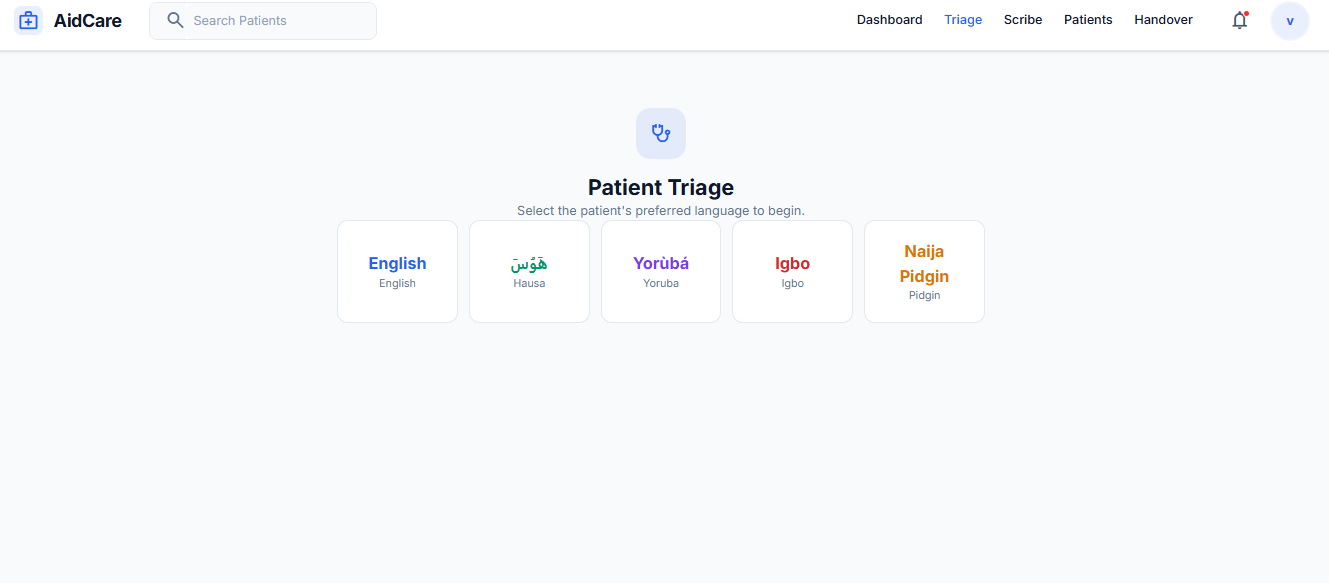
Patient Triage
-
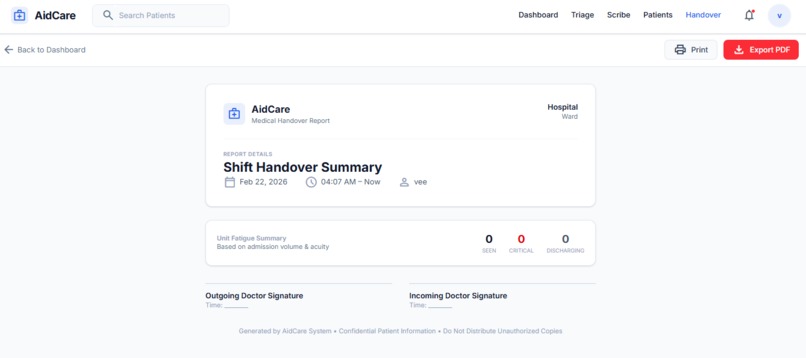
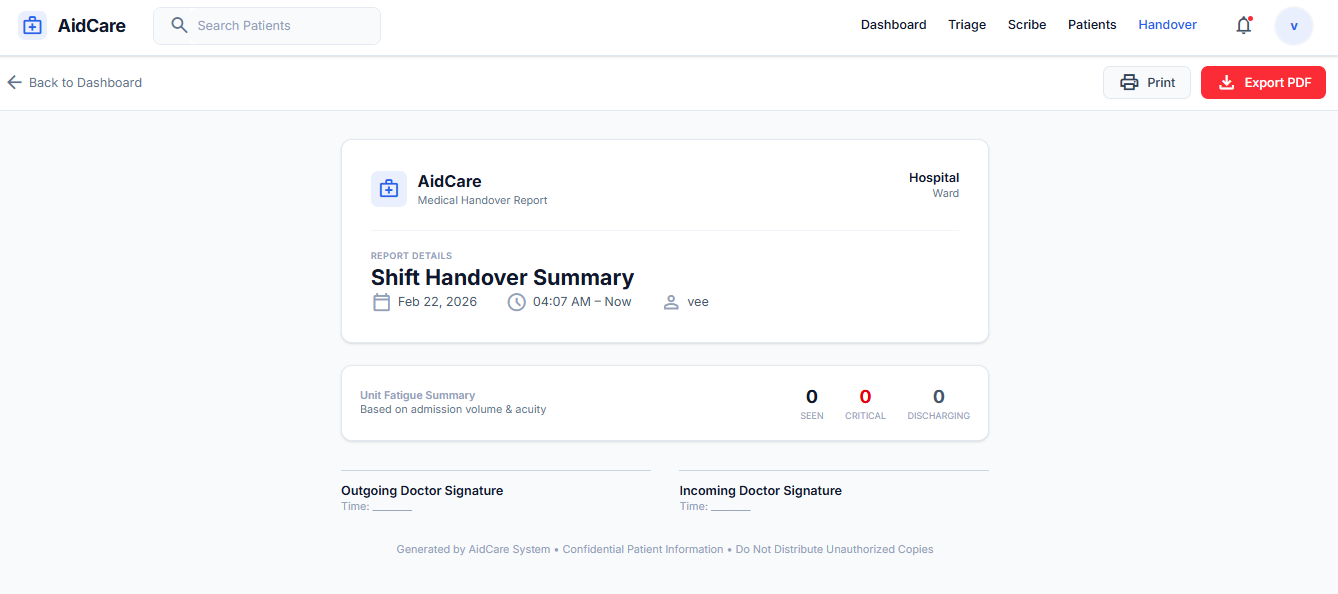
Handover Page
-
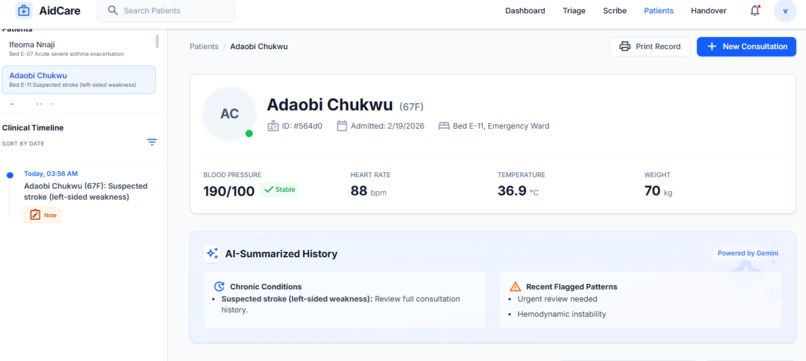
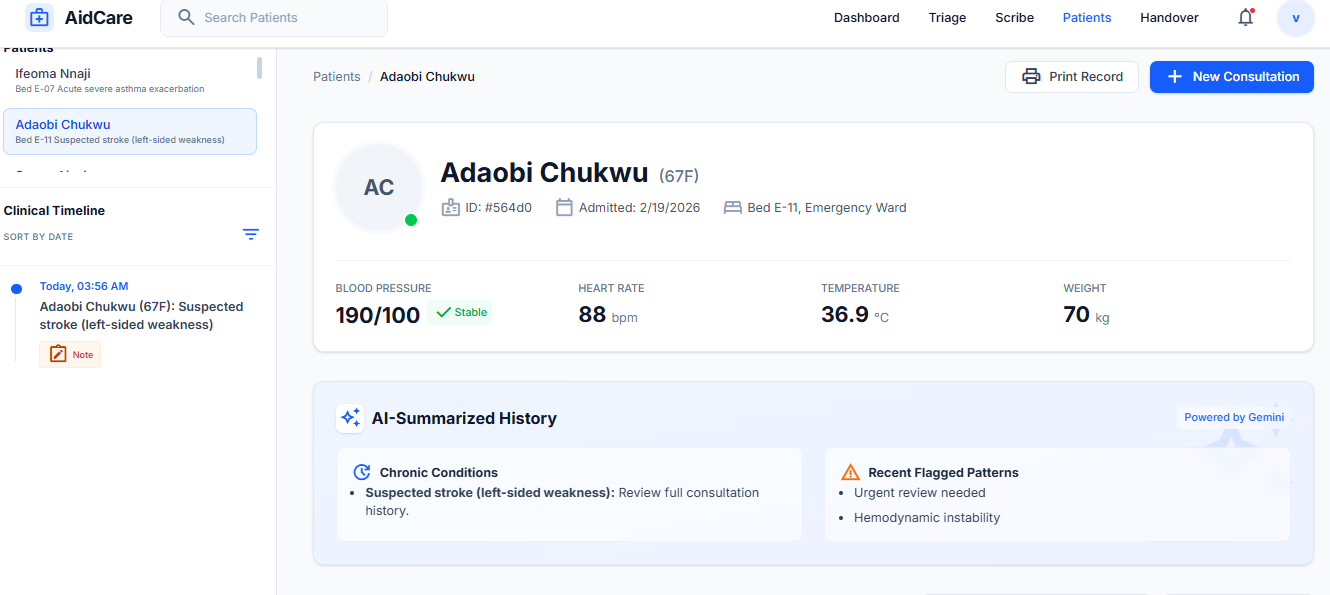
Patients page
-
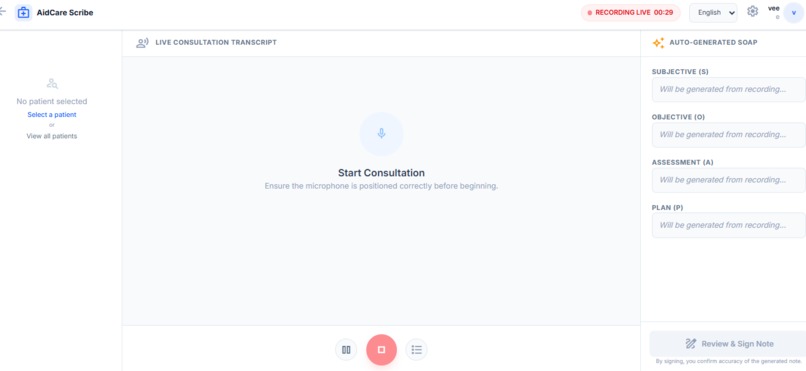
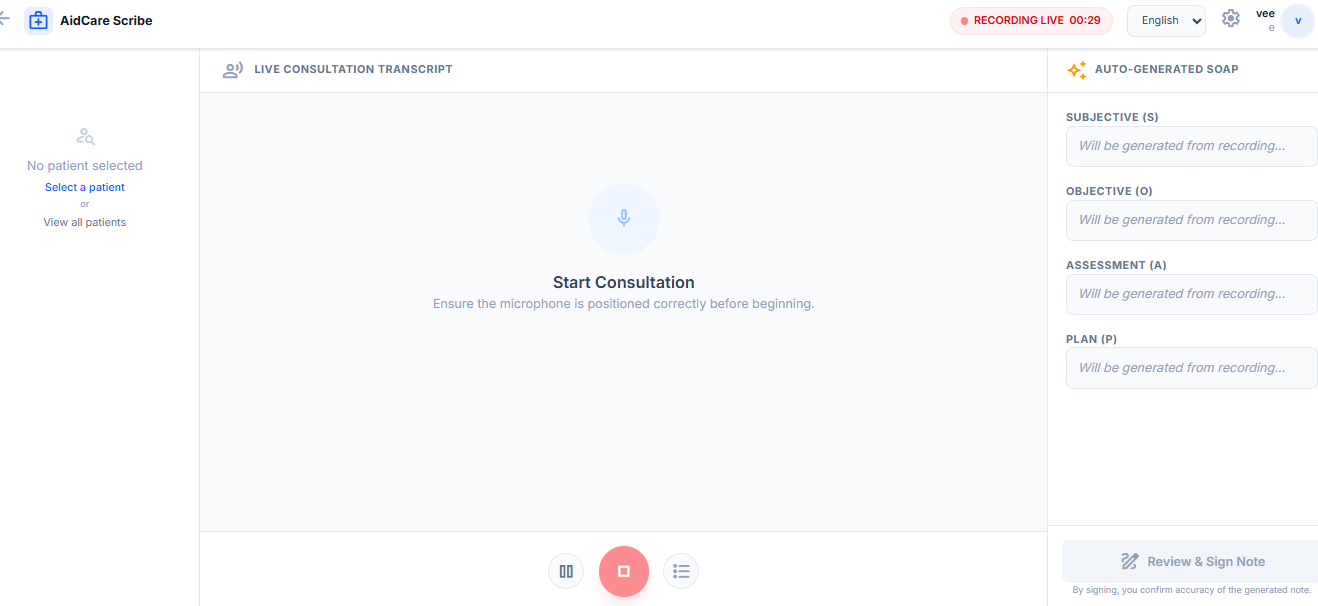
Scribe page (live session)
Inspiration
Nigeria has one of the most strained doctor-to-patient ratios in the world — roughly 4 doctors per 10,000 people. The few doctors who serve are buried under mountains of paperwork, handwritten notes, and verbal shift briefings that eat hours they don't have. We watched doctors in Lagos teaching hospitals spend 30–40% of their shift documenting instead of caring. We saw nurses struggle to triage patients who only spoke Hausa, Yoruba, Igbo, or Pidgin. We saw handover briefings run long and still miss critical details.
The inspiration was simple: what if AI could take the administrative burden off a Nigerian doctor's shoulders entirely? Not a generic Western EHR, but something built from the ground up for the Nigerian clinical context — the languages, the ward structures, the resource constraints, the burnout reality.
What It Does
AidCare Copilot is an AI-powered clinical assistant designed specifically for Nigerian healthcare workers. It does four core things:
Voice-to-SOAP Scribe: Doctors record consultations naturally. The AI transcribes the conversation, detects if Pidgin English was spoken, and auto-generates a structured SOAP note — Subjective, Objective, Assessment, and Plan — in seconds.
Multilingual Triage: Community health workers and nurses conduct patient intake in English, Hausa, Yoruba, Igbo, or Pidgin. The AI asks follow-up questions, extracts symptoms, cross-references Nigerian clinical guidelines via RAG, and delivers a risk-stratified triage recommendation with text-to-speech playback for low-literacy patients.
Burnout Tracker: A real-time Cognitive Load Score (CLS) monitors each doctor's patient volume, consultation complexity, shift duration, and consecutive shifts. Admins get a team dashboard and org-wide organogram showing who is in the green, amber, or red — before it becomes a patient safety risk.
Shift Handover Reports: One click generates a structured, print-ready handover report organized by patient criticality — critical, stable, and discharged — with medication changes, clinical flags, and action items. What used to take 30 minutes of verbal briefing now takes seconds.
How We Built It
Backend: FastAPI (Python) with PostgreSQL and SQLAlchemy for a multi-tenant data model spanning organizations, hospitals, wards, doctors, and patients. JWT-based authentication with role-scoped API access enforced at every layer.
AI/ML Stack:
- OpenAI Whisper — on-device audio transcription for consultation recordings and triage voice input
- GPT-4o — SOAP note generation, multilingual triage conversations, clinical summarization, and handover report generation
- Google Gemini — structured symptom extraction from free-text patient descriptions
- Sentence Transformers + FAISS — RAG pipeline for retrieving relevant Nigerian clinical guidelines during triage
- ElevenLabs + YarnGPT — text-to-speech synthesis, with YarnGPT specifically for authentic Yoruba voice output
Frontend: Next.js 16 (App Router) with React 19, Tailwind CSS 4, and Recharts for burnout trend visualizations. Fully responsive for tablet use on the ward.
Infrastructure: Railway (backend), Vercel (frontend), with environment-based configuration for multi-deployment support.
Challenges We Ran Into
1. Nigerian language NLP quality. Off-the-shelf models perform poorly on Yoruba, Hausa, Igbo, and especially Pidgin English. Whisper would frequently mistranscribe Pidgin as broken English. We had to build custom prompt engineering and post-processing layers to normalize and correctly handle code-switching between English and local languages mid-sentence.
2. Pidgin detection and SOAP generation. Pidgin is not a formally recognized language in most NLP tooling. Detecting it reliably and then generating a coherent SOAP note from a Pidgin-heavy consultation required significant prompt iteration and a dedicated detection pipeline.
3. RAG for clinical guidelines. Chunking and embedding Nigerian-specific clinical guidelines (FMOH protocols, WHO Nigeria adaptations) in a way that retrieved the right context for diverse symptom inputs — not just keyword matches — required extensive tuning of our FAISS index and embedding strategy.
4. Real-time burnout scoring. Designing a Cognitive Load Score formula that was clinically meaningful (not just a proxy for busyness) took several iterations. Balancing patient volume, complexity scores, shift duration, and consecutive shifts without creating perverse incentives required nuanced calibration.
5. Multi-tenant role scoping. Ensuring that a hospital admin at LASUTH could never see data from General Hospital Ikeja — even accidentally — required careful API-level enforcement of organizational boundaries throughout the entire data model.
Accomplishments That We're Proud Of
True multilingual support — not just translation, but full conversational triage in Hausa, Yoruba, Igbo, and Pidgin, with authentic Yoruba TTS via YarnGPT. This is genuinely novel in the African health-tech space.
End-to-end voice pipeline — from microphone input to structured SOAP note to updated patient record, the entire flow works seamlessly in under 60 seconds.
Clinically grounded burnout model — the CLS isn't a vanity metric; it's a formula built around real factors that predict physician fatigue, with actionable recommendations and admin-level visibility.
Multi-tenant architecture at scale — a single deployment supports super admins overseeing multiple state health ministries, org admins, hospital admins, and individual doctors, all with correctly scoped data access.
Built for the ward, not the office — every UI decision was made with a busy Nigerian ward in mind: large touch targets, minimal clicks, clear status indicators, and offline-resilient design.
What We Learned
Context is everything in AI for healthcare. Generic AI models need significant adaptation to be useful in a specific clinical and cultural context. "Working AI" and "clinically appropriate AI" are very different bars.
Language is identity. When a patient can describe symptoms in their mother tongue and receive a response in that same language, the trust and accuracy of the interaction improves dramatically. Multilingualism isn't a nice-to-have — it's a clinical necessity in Nigeria.
Burnout is a systems problem. Physician burnout can't be solved with a wellness app. It requires structural visibility — giving administrators real data to make staffing decisions before doctors hit a wall.
Simplicity drives adoption. Every feature that succeeded was the one we stripped down to its minimum viable interaction. In a busy ward, if it takes more than two taps, it won't get used.
What's Next for AidCare Copilot
Offline-first mobile app — a PWA with local Whisper inference and sync-on-reconnect to make AidCare viable in rural and low-connectivity settings.
ICD-11 coding integration — auto-suggesting diagnosis codes from the SOAP assessment to streamline NHIA (National Health Insurance Authority) claims processing.
Predictive staffing recommendations — using historical burnout and patient volume data to flag wards at risk of coverage gaps before they occur.
Expanded language support — adding Fulfulde, Kanuri, Efik, and other Nigerian regional languages to reach underserved communities beyond the current five.
Integration with existing HIS platforms — connecting to Smartcare, DHIS2, and other health information systems already deployed in Nigerian public hospitals.
Clinical audit trails — giving medical directors visibility into documentation quality, SOAP completeness rates, and consultation trends across their wards for quality improvement programmes.
Built With
- and-sqlalchemy.-ai-&-apis:-gemini-(reasoning)
- elevenlabs
- faiss
- gemini
- mediarecorder
- next.js(react)
- next.js-(react)
- openai
- postgresql
- python(fastapi)
- railway
- sqlalchemy
- vercel
- whisper
- whisper-(transcription)
- yarn-gpt-(yoruba-support)
- yarngpt

Log in or sign up for Devpost to join the conversation.