💡 Inspiration
During a disaster, two groups can struggle at the same time: local organizations trying to communicate what they need, and people who want to help but do not know where their support would be useful.
A 2023 report from the U.S. Department of Health and Human Services Office of Inspector General found that an estimated 77% of nursing homes in areas at high risk for natural hazards reported at least one challenge with emergency-preparedness activities. An estimated one in five reported difficulty coordinating preparedness activities with multiple community partners.
Source: HHS Office of Inspector General
There is also a gap between the desire to help and knowing how to participate. In the Charities Aid Foundation's current Canada data, 23% of respondents said they would like to become more involved in making positive changes to society but did not know how. This finding concerns social participation broadly, rather than disaster donations specifically.
CAF's Giving in Canada 2025 report also identifies distrust in how charities use donations as a reason some people do not give money. Together, these findings highlight the importance of clear information about where to help, what is needed, and what happens after support is provided.
Source: CAF World Giving Report — Canada · Giving in Canada 2025
Finally, good intentions can create additional work when donations do not reflect what responders can actually receive. The World Food Programme reports that unsolicited goods sent after disasters in the Pacific can occupy port and warehouse space, consume first responders' time, and obstruct essential aid. Managing these donations can cost affected countries millions of dollars, although this is not a fixed cost for every disaster.
These findings inspired AidAtlas: a system that connects disaster observations, organization-confirmed needs, and people ready to help—turning local acts of support into a global constellation of care.
🌍 What it does
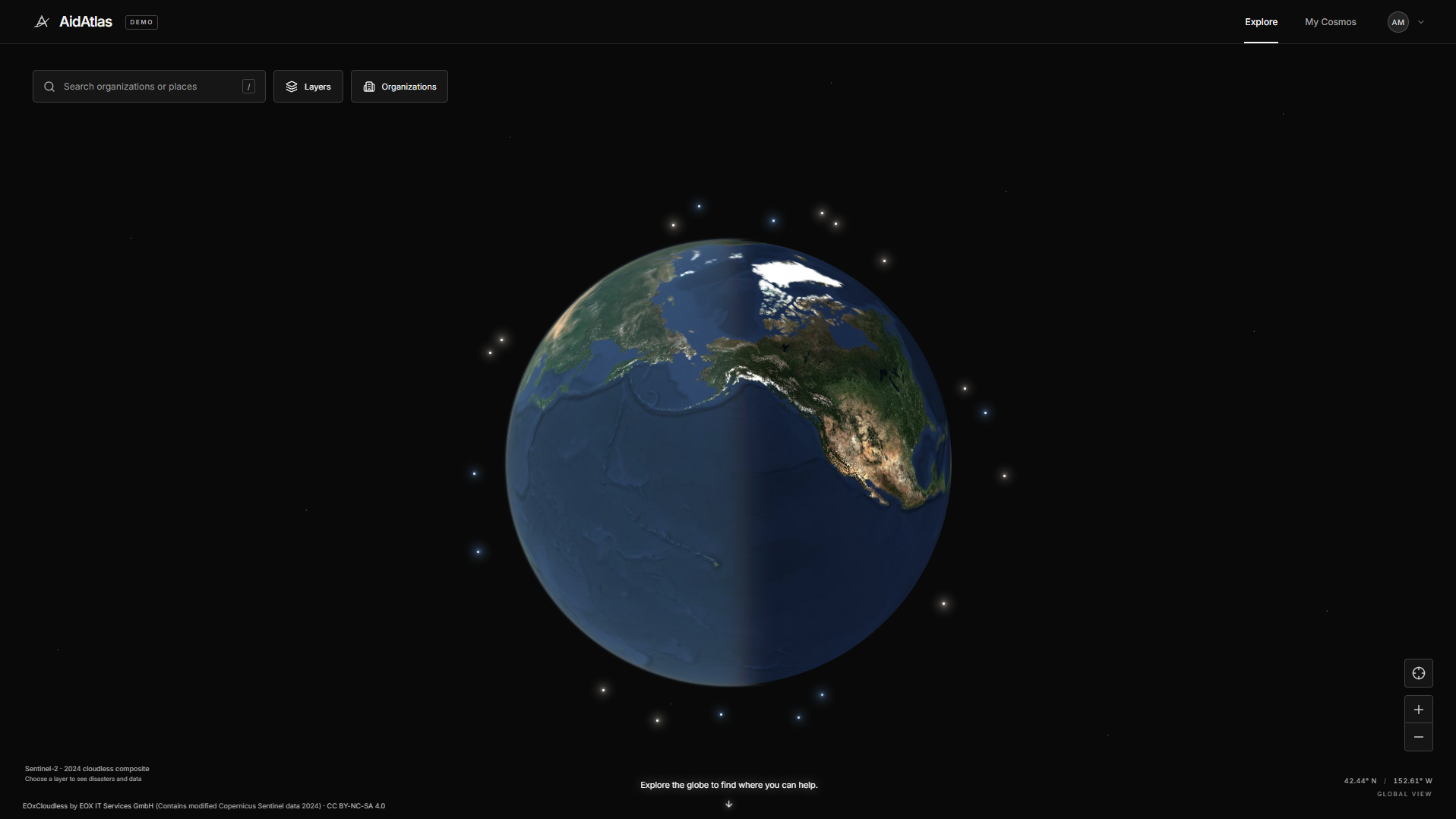
AidAtlas connects global challenges with local, organization-confirmed ways to help. Supporters can explore an interactive globe, discover organizations working on the ground, find specific requests, and revisit their contributions through a personal universe called My Cosmos.
Explore global challenges
Seven Explore layers bring different challenges into view: Wildfire, Flood, Storm, Nature, War, Education, and Violence. Users can explore satellite observations, disaster information, environmental imagery, recorded conflict events, and country-level education and intimate partner violence statistics.
Each layer provides context alongside organizations working in the relevant area or sector. Sources, observation dates, and limitations remain visible. An organization appearing on the map does not automatically mean it participates in AidAtlas or currently needs support.
Turn observations into confirmed requests
Our wildfire demonstration shows how observations can start a conversation with nearby organizations.
AidAtlas processes historical NASA FIRMS heat detections from British Columbia and groups nearby detections into events. When an event contains at least three nominal- or high-confidence detections, participating organizations within 10 kilometres of a qualifying detection receive an in-app check-in.
This is a demo contact-search radius, not a danger zone or evacuation boundary.
Staff respond with Not affected, Still checking, or Support needed. If support is needed, Gemini prepares a private draft with suggested supplies. Staff review and edit the items, quantities, urgency, receiving instructions, and official support links before explicitly publishing the request.
Satellite observations start the check-in; the organization determines its actual needs.
Find a concrete way to help
Supporters can search published requests using natural language—for example, “I want to donate winter clothes for children”—or discover them through the globe.
Each request shows:
- What is needed
- The requested quantity
- The amount confirmed received
- What remains outstanding
- The urgency and receiving instructions
- Official donation, supply, or volunteer links
Supporters can follow the official links and record a pledge. AidAtlas does not process payments, shipping, or volunteer bookings.
Contributions follow three stages:
Pledged → Supporter reports completion → Organization confirms receipt
Only organization confirmation updates the fulfilled quantity.
Build your own Cosmos
My Cosmos turns contribution history into a personal universe.
- Each impact area becomes a galaxy.
- Contributions to the same organization form a constellation.
- Each contribution becomes a star.
Stars distinguish pending contributions from organization-confirmed support and change visually with age, letting supporters revisit both recent actions and their longer history of involvement.
My Cosmos records participation and receipt status rather than assigning a financial or social-impact score. It connects each act of support to the organization behind it, giving supporters a visual story of their involvement over time.
🛠️ How we built it
We built AidAtlas with React, TypeScript, and Vite on the frontend and FastAPI, Python, SQLAlchemy, and TiDB Cloud on the backend. MapLibre powers the interactive globe, while Three.js powers My Cosmos. A shared seven-category system connects map exploration, requests, contributions, and personal galaxies.
For our wildfire demo, Python processes historical NASA FIRMS NOAA-20 VIIRS 375 m heat detections from British Columbia in August 2023. It groups nearby detections into events and creates deduplicated check-ins for participating organizations within a 10 km demo search radius when at least three nominal- or high-confidence detections qualify.
Gemini generates validated, structured drafts that staff review before publication. For semantic search, gemini-embedding-001 creates 768-dimensional request and query embeddings, and TiDB vector search ranks requests by cosine distance. Template and keyword fallbacks keep the workflow available when AI fails.
Public organization markers are separate from participating organizations. Only authorized staff can publish requests and confirm receipt. Contributions progress from pledged → supporter-reported completion → organization-confirmed receipt, with duplicate-counting protection.
Additional layers use GDACS, ECCC, satellite imagery, UCDP, UNESCO UIS, and WHO/UN data, with visible sources, dates, and limitations.
🧩 Challenges we ran into
Our biggest challenge was finding a meaningful use for satellite data. We focused on helping people understand global challenges at a glance and discover concrete ways to help. Satellite observations trigger check-ins, while organization staff confirm actual needs before publication.
We also wanted giving to feel more engaging and personal. Designing the interactive globe and My Cosmos meant balancing playful exploration and visual rewards with clear information about needs and receipt status.
✨ Accomplishments that we're proud of
We connected seven different issue areas through one consistent path from exploration to action. A user can begin with a global dataset, discover organizations working in that context, find a specific published need, support it through an official channel, and later see that contribution represented in My Cosmos.
We are also proud that My Cosmos is connected to real application state, rather than being a decorative visualization. Its galaxies come from the same seven categories used by Explore, its constellations group contributions by organization, and its stars retain whether support is pending or organization-confirmed.
Most importantly, AidAtlas demonstrates an end-to-end workflow:
Satellite observation → Nearby-organization check-in → Staff-confirmed request → Supporter pledge → Organization-confirmed receipt
📚 What we learned
We learned that satellite data is most useful when it starts a conversation.
It can help answer:
Who might we need to contact?
It cannot answer:
Who has been affected, and what do they need?
Only the organization on the ground can answer that second question.
We also learned that transparency is not a single verification badge. It comes from showing each step honestly: who published the request, what they requested, how much remains, where the official support link leads, and whether the organization confirmed receipt.
Most importantly, we learned that responsible aid should be driven by confirmed demand. Good intentions are not enough if the recipient cannot use, store, or distribute what is sent.
🚀 What's next for AidAtlas
- Send opt-in notifications through real communication channels.
- Add expiration and re-confirmation rules so requests do not remain public after becoming outdated.
- Let organizations publish delivery windows, capacity limits, and clearer receiving instructions.
- Improve multilingual support and accessibility.
- Evaluate semantic search quality across a larger set of real requests.
- Expand the use of satellite data.
