-
-
AIboarding | define the work before choosing the technology.
-
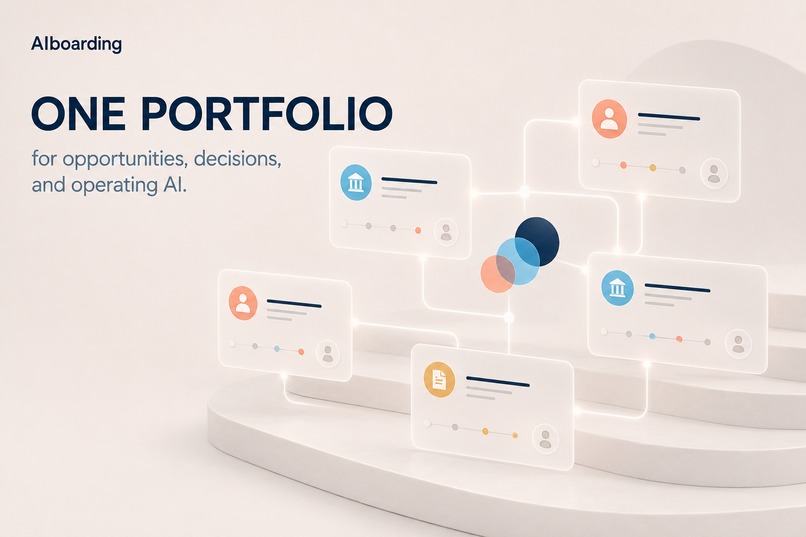
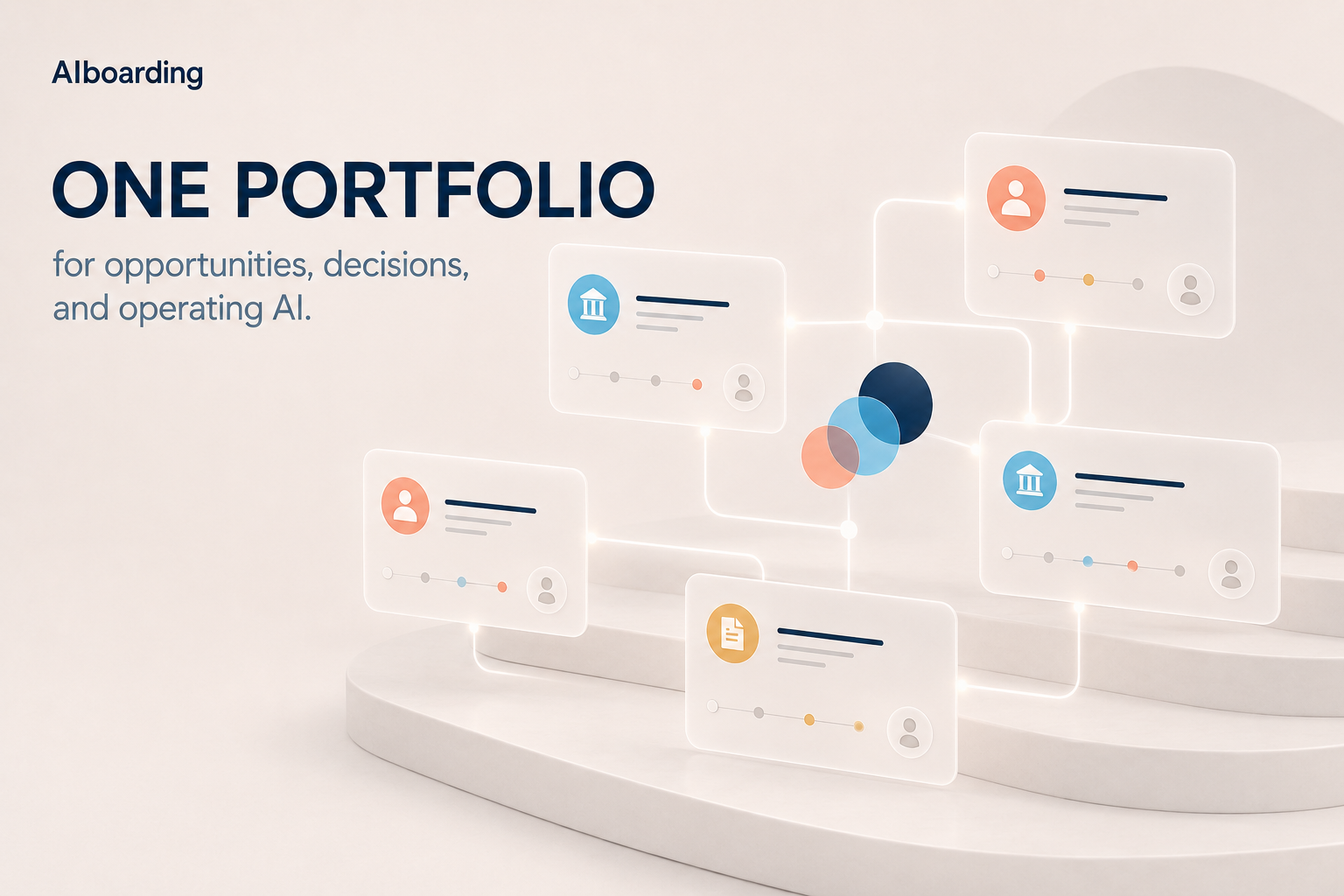
One portfolio for work opportunities, pending decisions, and live AI capabilities , with expected vs. measured value.
-
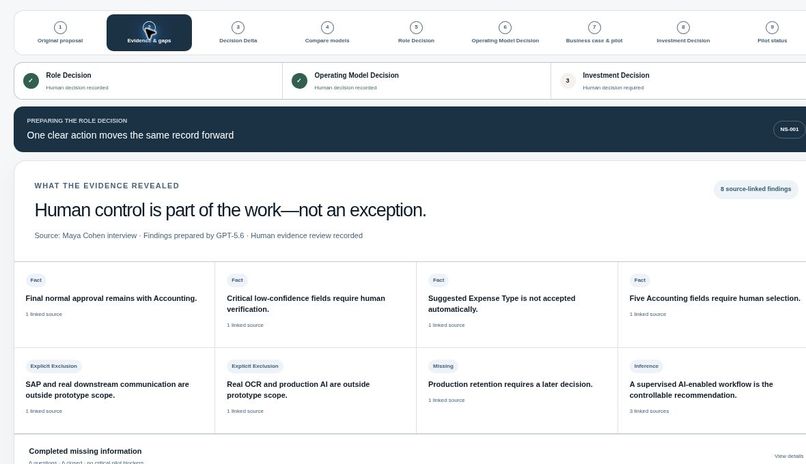
One DigitalRoleRecord from work opportunity to live operation. Expected and measured impact are kept separate & never overwrite each other.
-
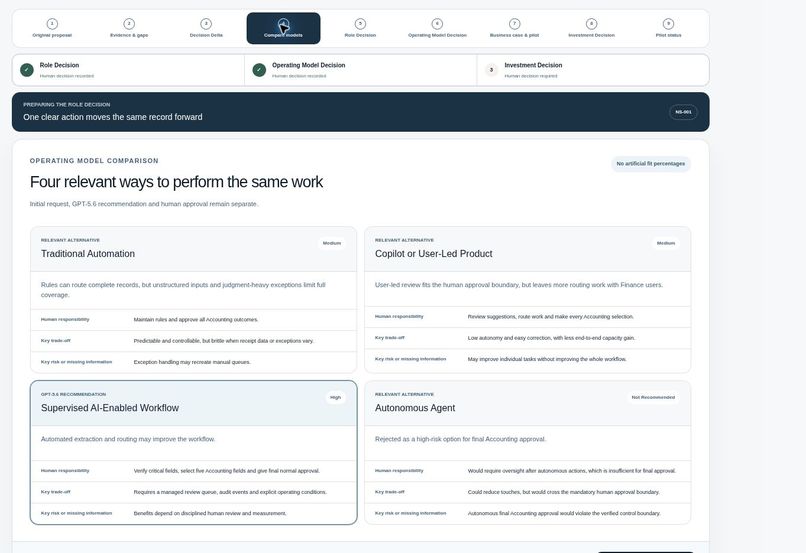
GPT-5.6 prepares; managers decide. A model recommendation never counts as a decision.estment are 3 separate human decisions
Inspiration
Organizations define human roles before they recruit: the work, authority, budget, ownership, and success criteria.
With AI, they often do the opposite. They begin with an Agent, a vendor, or a new capability—and only later ask what work it should perform, what must remain human, who owns the outcome, and whether the investment is worthwhile.
At the same time, the knowledge needed to answer these questions is fragmented across people, conversations, documents, and systems. When employees change roles or leave, organizations often lose not only information, but also the reasoning behind how work actually gets done.
This inspired AIboarding.
We envisioned a trusted intake and operating layer for the organizational brain: a system that turns knowledge from people and documents into structured, evidence-linked, and accountable organizational memory.
AIboarding does not treat every AI-generated statement as organizational truth. It:
- Separates evidence from assumptions
- Identifies missing information and contradictions
- Preserves source provenance
- Tracks confidence and review status
- Routes critical questions to the appropriate organizational roles
- Keeps consequential decisions under human authority
The result is more than a portfolio of AI initiatives. It is a living map of the organization’s processes, responsibilities, decisions, operating conditions, and AI assets—so every new initiative can begin with what the organization already knows instead of starting from zero.
What it does
AIboarding is a Digital Workforce Design and Operations platform.
Its organizational brain is the governed knowledge layer that connects work opportunities, decisions, managed AI assets, and performance over time.
It begins before an organization chooses an Agent, Copilot, product, automation, or process redesign—with a more fundamental question:
What work needs to improve, and what is the best way to perform it?
AIboarding transforms incomplete organizational knowledge into a structured, evidence-backed Digital Role that defines:
- The business problem and desired outcome
- Responsibilities and explicit exclusions
- Inputs and outputs
- Required judgment
- Exceptions
- Human and system interactions
- Authority boundaries
- Performance measures
- Value potential
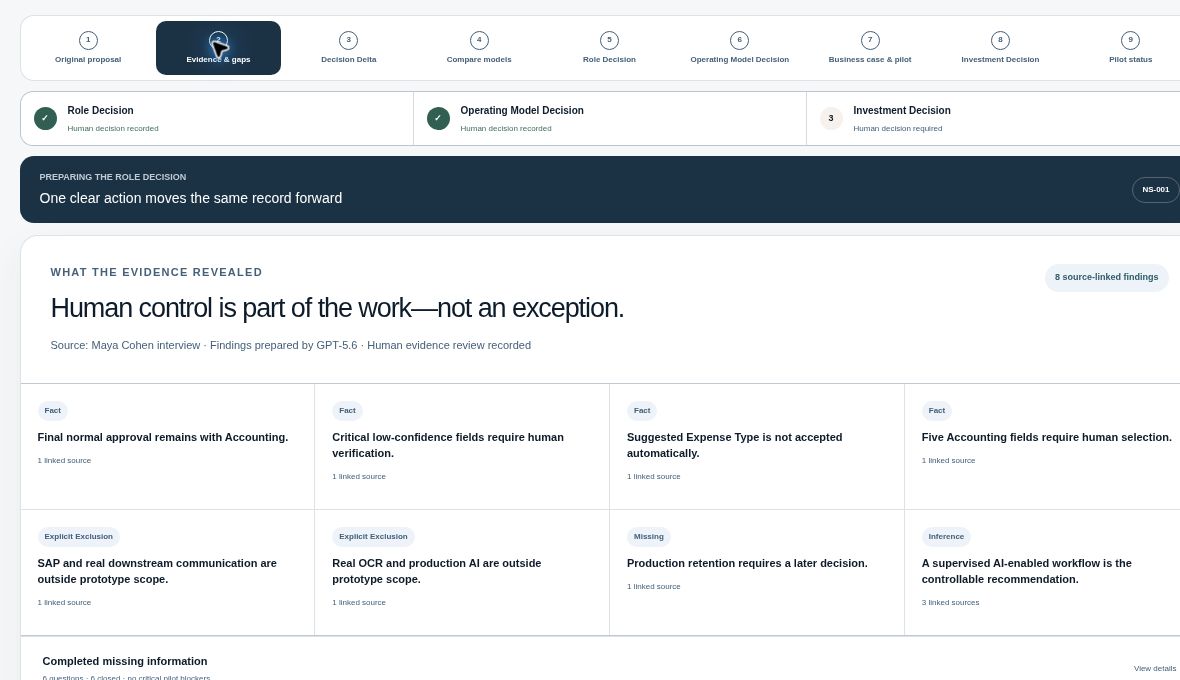
Material information remains visibly separated as fact, inference, missing information, decision, conflict, assumption, or explicit exclusion—and is linked to its source evidence.
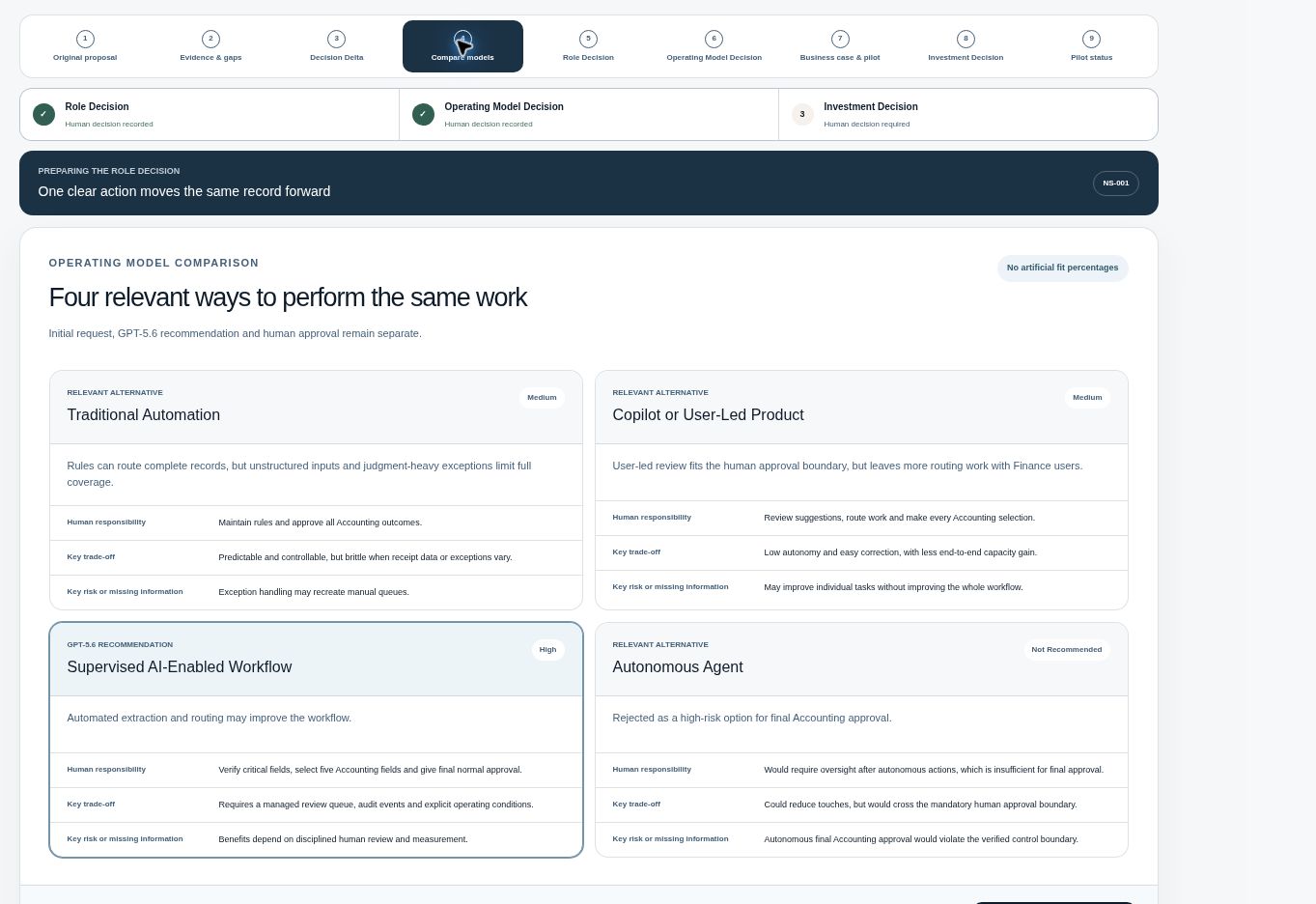
The system then compares the relevant operating models, such as:
- Process Redesign
- Human Role
- AI Product
- Copilot
- Traditional Automation
- Supervised AI-Enabled Workflow
- Agentic Workflow
- Bounded Autonomous Agent
- Hybrid Human and AI Model
Instead of using artificial fit percentages, AIboarding explains the reasons, trade-offs, assumptions, risks, missing information, and confidence behind each assessment.
It prepares three separate management decisions:
- Role Decision: Is this a meaningful work opportunity that should move forward?
- Operating Model Decision: What is the best way to perform this work?
- Investment Decision: Is the selected operating model worth funding now?
A GPT-5.6 recommendation never counts as a completed human decision.
AIboarding also turns individual opportunities into a manageable portfolio. Leaders can compare initiatives using expected impact, explicit ROI assumptions, payback period, readiness, risk, evidence quality, and what still needs to be validated.
One continuous DigitalRoleRecord follows the work through its lifecycle:
Work Opportunity → Digital Role → Operating Model Decision → Approved Initiative → Pilot → Live Operating Record → Review
The same record preserves the original problem, evidence, role definition, alternatives, decisions, owners, costs, operating conditions, expected impact, pilot results, measured performance, and audit history.
In our demo, an incomplete receipt-processing specification from a Finance workflow becomes:
- A structured, evidence-linked Digital Role
- A comparison of relevant operating models
- Three separate human decisions
- A business case based on explicit assumptions
- A Pilot Measurement Contract
- Simulated pilot results measured against expectations
- A simulated lifecycle demonstration of production approval under persistent operating conditions
- One continuous record with a full audit trail
How we built it
AIboarding was built with Codex as the coding partner and GPT-5.6 as the structured analysis layer.
GPT-5.6 reads incomplete source material and helps:
- Extract and classify information
- Preserve source evidence
- Detect missing information and contradictions
- Route questions to the appropriate roles
- Compare relevant operating models
- Explain trade-offs
- Estimate expected impact from explicit assumptions
- Prepare evidence-backed recommendations
The architecture is built around a persistent DigitalRoleRecord rather than disconnected documents.
The system separates core domain concerns—including analysis, evidence, question routing, decision readiness, impact calculation, lifecycle management, and audit history—from the user-facing experience.
Live GPT-5.6 analysis and Verified Replay use the same structured output schema, allowing the same evaluation rules to test both paths.
The evaluation architecture includes:
- Ground-truth assertions
- Classification checks
- Evidence checks
- Human-decision checks
- Record-continuity checks
- Forbidden claims
For example, the evaluation fails if the model claims that SAP integration, real OCR, autonomous final Accounting approval, or real downstream synchronization has been implemented.
Seeded information and simulated pilot results are explicitly labeled.
The product deliberately preserves human authority. GPT-5.6 may analyze and recommend, but it cannot:
- Approve the Digital Role
- Select the final operating model
- Authorize investment
- Accept organizational risk
- Approve production
- Replace the accountable manager
Challenges we ran into
Structuring incomplete organizational knowledge
Organizational knowledge rarely arrives as clean data. It is spread across interviews, specifications, policies, decisions, systems, and individual experience.
We needed to preserve evidence, uncertainty, ownership, and update history without turning assumptions into facts or treating model-generated content as organizational truth.
Comparing unlike operating models
The right solution is not always an Agent.
We needed to compare fundamentally different ways of performing work—including process redesign, human roles, products, copilots, automation, supervised workflows, agentic workflows, and hybrid models—without forcing every opportunity into the same technological answer.
Comparing unlike AI opportunities
A portfolio cannot be managed by ROI alone.
We needed to represent financial value alongside readiness, risk, evidence quality, operational impact, capacity creation, organizational dependencies, and unresolved questions—without creating artificial precision.
Preserving accountability
The model needed to help managers reach decisions without quietly making those decisions for them.
We separated recommendations from three explicit human decision gates and ensured that a GPT-5.6 recommendation never counts as management approval.
Keeping expected and measured impact separate
A business case describes an expectation, not a proven result.
We designed the data model and interface to distinguish approved assumptions and targets from simulated pilot results and actual measured performance.
Managing complexity without transferring it to users
The underlying record is detailed, but users should not be forced to manage all of that complexity.
A central design challenge was deciding what to reveal, what to collapse, and how to surface only the evidence, gaps, questions, and decisions required for the next step.
AIboarding carries the complexity so leaders can focus on the decisions that matter.
Accomplishments that we're proud of
- Building a system that starts with the work instead of assuming an Agent is the answer
- Turning unstructured organizational knowledge into traceable management information
- Separating evidence, assumptions, missing information, conflicts, and decisions
- Maintaining one persistent record across decisions and lifecycle stages
- Comparing multiple operating models with reasons and trade-offs
- Separating expected impact from measured performance
- Making unsupported capabilities and explicit exclusions visible
- Preserving human authority over consequential decisions
- Connecting individual initiative design with portfolio-level prioritization
- Creating an evaluation plan with ground-truth assertions, evidence checks, and forbidden claims
- Building a governed knowledge layer that can improve as organizational knowledge is reviewed and updated
In our demo, AIboarding does not recommend an autonomous Agent for final Accounting approval. It recommends a supervised AI-enabled workflow while preserving final approval for Accounting and the consequential decisions for management.
We believe an AI system that can explain why an Agent is not the right answer is exactly what enterprise AI adoption needs.
What we learned
The most important AI question is often not:
“What can this model do?”
It is:
“What work should change, who owns the outcome, what may AI do, and how will we know whether the work improved?”
We learned that knowledge becomes organizational memory only when its evidence, ownership, uncertainty, and decision history are preserved.
We also learned that traceability is more than a technical requirement. It is a management interface. When recommendations can be traced to evidence, assumptions, missing information, and human decisions, leaders can move faster without giving up accountability.
Finally, governance works better when it is embedded in the operating decision—not added as a compliance exercise after a solution has already been selected.
What's next for AIboarding
The next phase is to connect approved Digital Roles to live operational data and enterprise systems, allowing organizations to compare the original business case with actual performance.
AIboarding will continue developing its living organizational knowledge layer, including:
- Clearer ownership and review cycles
- Signals when important information may require updating
- Reuse of verified knowledge across new initiatives
- Connections between workflows, decisions, policies, and AI assets
- Ongoing comparison of expected and measured performance
- Lifecycle decisions to scale, redesign, suspend, or retire digital work
Over time, AIboarding can become the business control layer for the digital workforce—giving leaders one place to understand:
- What digital work exists
- What organizational knowledge supports it
- Why it was approved
- Which operating model was selected
- Who owns its results
- Which risks and operating conditions apply
- Whether the work is improving
- Which roles should be scaled, redesigned, suspended, or retired
The long-term goal is simple:
Define the work before choosing the technology. Know what it must deliver before funding it—and whether it delivered after launch.
Built With
- api
- gpt-5.6
- openai
- react
- typescript
- vite

Log in or sign up for Devpost to join the conversation.