-
-
App Prototype
Inspiration
As able-bodied people, it is relatively simple to regulate our fitness routine. Whether through fitness apps, a fitbit, or simply going to the gym down the street, we have a myriad of options at our fingertips. But what about people with disabilities? Specifically, people with disabilities that deal with physical mobility?
All the videos and routines available on fitness apps assume the user is able-bodied. Furthermore, many gyms lack accessible equipment, all of which completely excludes this huge community. That's why we decided to design Aibly, a fitness app specifically made for people with reduced mobility. We believe that just because people have reduced mobility does not mean they should be excluded. With Aibly, everyone will have a chance to show off their unique bodies and pursue their fitness dreams.
What it does
Aibly is a fitness app made specifically for people with reduced mobility. Not only will users be able to access training that is tailored towards their physical needs, but they will also be able to directly interact with certified physicians and find accessible gyms nearby.
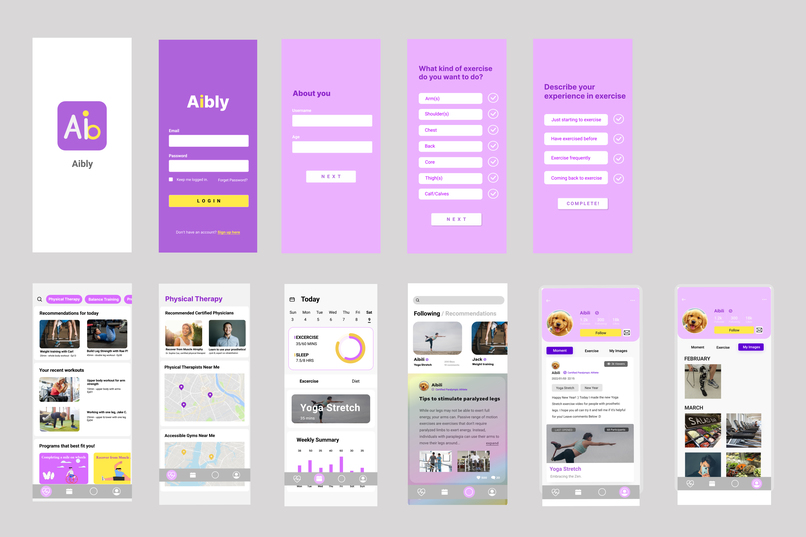
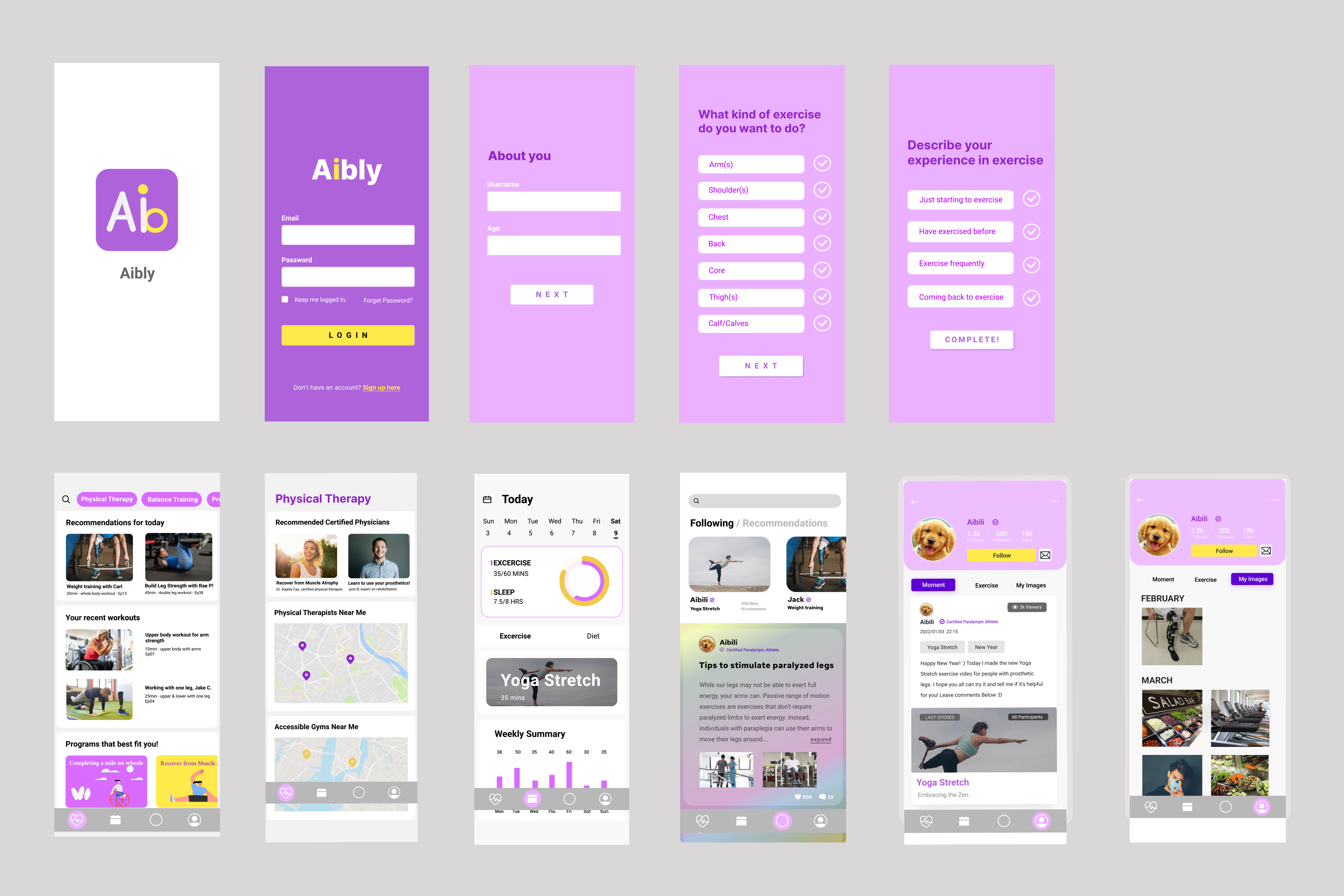
After we log in, users enter some information and go to the initial survey. From the very beginning, we seek to empower people with disabilities by focusing on what they are able to do instead of what they have lost. We do not ask for weight and height like most fitness apps do because of the special circumstances of our users.
After we complete the survey users are brought to the fitness page, as indicated by the icon at the bottom. Here, users will be able to search for categories of fitness that suits them. Apart from the regular categories of cardio or yoga, we incorporated filters specific to the needs of this community such as physical therapy, balance training for people that may have cerebral palsy, and prosthetic usage. Here, we will recommend series based on the user’s initial survey. Their most recent workouts will also be featured as well as programs that best fits their needs, such as recovering from muscle atrophy.
If the user searches for physical therapy, the certified physicians registered with Aibly with be recommended to them. Furthermore, physical therapists and related offices near them will be recommended, along with gyms that offer accessible options.
In the weekly summary section, we can see how close we are to completing our goals on any given day. We use minutes to measure fitness goals instead of calories or other units to be as inclusive as possible. The exercises done every day will be featured, with a place to record your diet, as well as a weekly summary.
In order to create an uplifting community, we created the community section where users can post their successes, offer tips specific to our users needs, as well as ask questions. Recommended profiles as well as followed channels will appear at the very top along with their posts. Only certified channels will have the special icon to differentiate between professional medical advice and general tips.
Lastly, there is the profile page. Here, users can access their moments, a culmination of their exercise hours, and a collection of posted images, where they can see their physical progress and be proud of their own bodies. Direct messages are also accessed here.
How we built it
We first brainstormed our target users and the potential problem statement of the app, where we found that the fitness resources for people with disabilities is astonishingly limited. All the fitness apps are built for able-bodied people, completely excluding this community.
According to our research from the CDC, the six most common types of disabilities are as follows:
- Mobility (serious difficulty walking or climbing stairs)
- Cognition (serious difficulty concentrating, remembering, or making decisions)
- Hearing (serious difficulty hearing)
- Vision (serious difficulty seeing)
- Independent living (difficulty doing errands alone)
- Self-care (difficulty dressing or bathing)
The most common disability is the disability related to physical mobility. That's why we decided to make a fitness app for people with disabilities related to physical mobility.
After deciding on the problem we wanted to solve, we drew out sketches of the functionalities that we want the app to include. Then we divided ourselves to different frames of the app and built the prototype in Figma. We chose to use large areas of purple because of its recent connotation with the empowerment of people with disabilities.
Challenges we ran into
We spent a large amount of time thinking about how to make our product welcoming to our target users, since we as designers do not have personal experiences with disabilities. We were especially mindful about the language we used in our app, trying to choose empowering terms. For instance, in the starting survey, we do not ask the user "what disability do you have”, but rather "what kind of exercise are you able to do" in order to emphasize what they can do instead of what they have lost. Furthermore, we chose to phrase the recommended gyms as "accessible gyms" instead of "disabled-friendly gyms" to keep from equating their identities to their disabilities. We also needed to conduct intensive research on what fitness exercises people with disabilities need most.
Accomplishments that we're proud of
We were able to make a high-fidelity prototype with original designs for every screen, something that is most important to our user experience. We are proud that with our app, people with disabilities can feel heard and pursue the same fitness goals as everyone else.
What we learned
We further explored a lot of functionalities of Figma, and practiced various aspects of design fundamentals including visual hierarchy, white space, alignment, and color theory.
Built With
- figma

Log in or sign up for Devpost to join the conversation.