AI Agent Factory
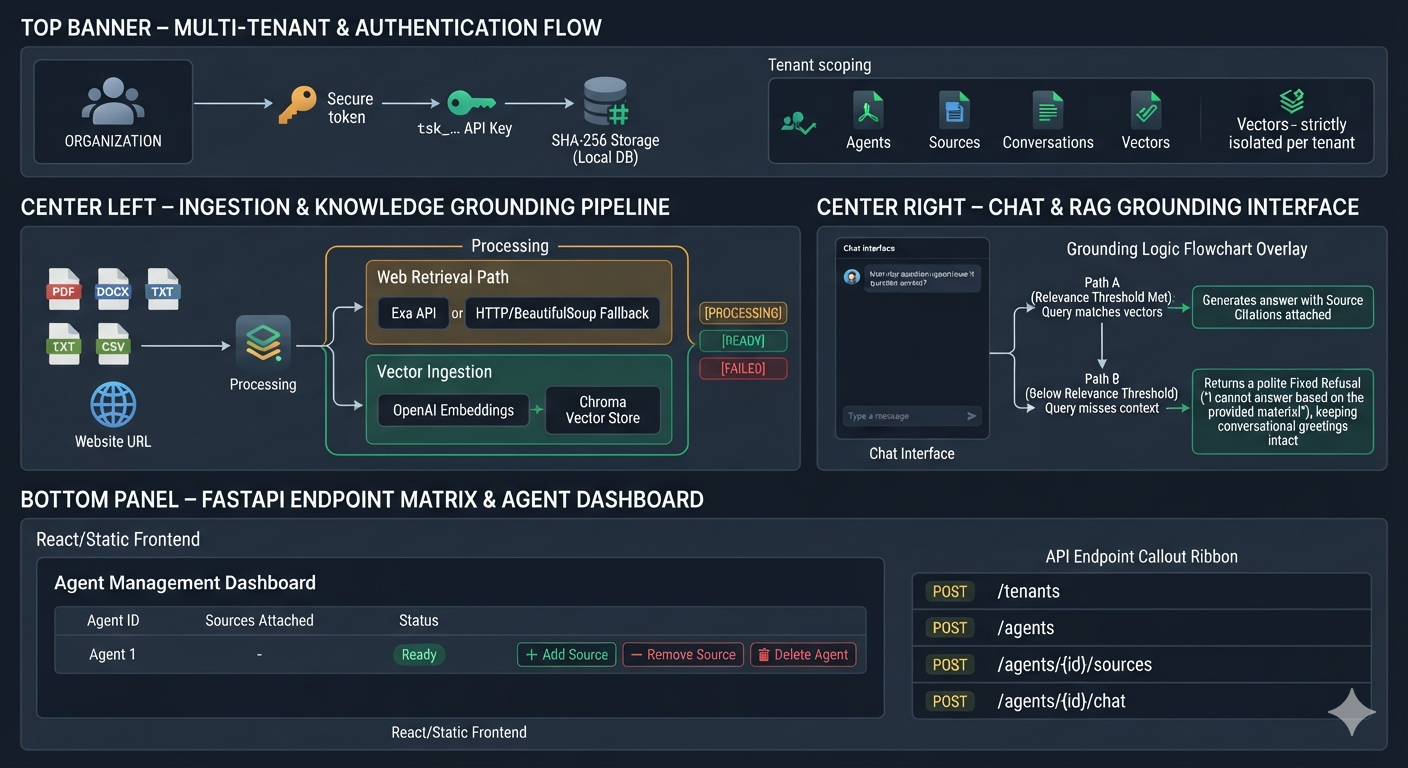
AI Agent Factory is a multi-tenant FastAPI application for creating knowledge-grounded AI agents. An organization registers once, receives an API key, provides documents and a website for an agent, then chats with that agent using answers grounded in the ingested material and accompanied by source citations.
This repository contains the backend, a static frontend, project documentation, and an isolated pytest suite. The application code was not changed as part of the documentation and test-suite completion.
Capabilities
- Creates tenants and returns a one-time
tsk_API key; only its SHA-256 hash is stored. - Scopes agent, source, conversation, message, and vector operations to the authenticated tenant.
- Accepts PDF, DOCX, TXT, and CSV documents, plus website content.
- Processes sources in the background, tracks
processing,ready, andfailedstates, and generates a per-agent system prompt after successful ingestion. - Uses OpenAI embeddings with a Chroma vector store and a relevance threshold to ground answers.
- Returns a fixed refusal when a knowledge question has no relevant retrieved content, while keeping greetings and brief acknowledgements conversational.
- Supports adding and removing individual sources and deleting an agent with its local file and vector data.
Requirements
- Python 3.10 or newer
- An OpenAI API key
- An Exa API key if you want Exa-backed website retrieval (the HTTP/BeautifulSoup fallback is used when it is not configured)
Setup
- Create the local environment and install dependencies.
Windows:
scripts\setup.bat
Bash-compatible shell:
bash scripts/setup.sh
- Copy
.env.exampleto.envand set your credentials:
   OPENAI_API_KEY=...
   EXA_API_KEY=...
- Start the backend on port 8001.
Windows:
scripts\run_backend.bat
Bash-compatible shell:
bash scripts/run_backend.sh
FastAPI's interactive API documentation is then available at http://127.0.0.1:8001/docs. The current health-style response is at http://127.0.0.1:8001/.
- Optionally serve the static frontend at
http://127.0.0.1:8080.
Windows:
scripts\run_frontend.bat
Bash-compatible shell:
bash scripts/run_frontend.sh
The frontend's API base URL is http://127.0.0.1:8001 by default.
API overview
| Method | Endpoint | Authentication | Purpose |
|---|---|---|---|
GET |
/ |
No | Current health-style response. |
POST |
/tenants |
No | Create a tenant and receive an API key. |
POST |
/agents |
X-API-Key |
Create an agent from documents and a website URL. |
GET |
/agents |
X-API-Key |
List the caller's agents. |
GET |
/agents/{agent_id} |
X-API-Key |
Get one caller-owned agent and source status. |
DELETE |
/agents/{agent_id} |
X-API-Key |
Delete one caller-owned agent and related data. |
POST |
/agents/{agent_id}/sources |
X-API-Key |
Add a document or website source. |
DELETE |
/agents/{agent_id}/sources/{source_id} |
X-API-Key |
Remove one source. |
POST |
/agents/{agent_id}/chat |
X-API-Key |
Send a message to a ready agent. |
For field-level request and response details, see the API reference.
Testing
Run the isolated test suite with either wrapper:
scripts\run_tests.bat
bash scripts/run_tests.sh
Both commands run pytest tests -v only (with the cache provider disabled for restricted workspaces) and write the full output to tests/test_log.txt. The default suite does not make live OpenAI, Exa, Chroma, or backend-server calls.
The repository also includes an opt-in end-to-end smoke test migrated from the former Bash test script. It creates real tenant and agent data, so start a configured local backend first and opt in explicitly:
RUN_E2E=1 AGENT_FACTORY_BASE_URL=http://127.0.0.1:8001 python -m pytest tests/test_e2e_smoke.py -v
The default validation run currently reports 28 passed, 1 skipped. The skipped test is the live workflow above when RUN_E2E is unset.
Repository layout
backend/       FastAPI application, database models, ingestion, RAG, and services
frontend/      Static browser client
docs/          Architecture, API, ingestion, testing, and operating documentation
scripts/       Setup and cross-platform launch/test wrappers
tests/         Unit/API-contract tests, fixtures, and the opt-in live smoke test
Documentation
- Documentation index
- Architecture
- API reference
- Ingestion and retrieval
- Testing guide
- Operation notes and current limitations
Notes
- The checked-in assignment brief asks for
/health; the current implementation exposes its simple health-style response at/. See operation notes for this and other source-verified limitations, including process-local chat retrieval history and local SQLite/filesystem persistence. - Local Testing & Configuration: The
.envtemplate is currently undergoing a refactor to better support smooth localized testing (including upcoming toggles forsimilarity_searchon/off and cleaner grouping for retrieval/model settings).
Built With
- batchfile
- css
- html
- javascript
- jupyter-notebook
- python
- shell

Log in or sign up for Devpost to join the conversation.