-
-
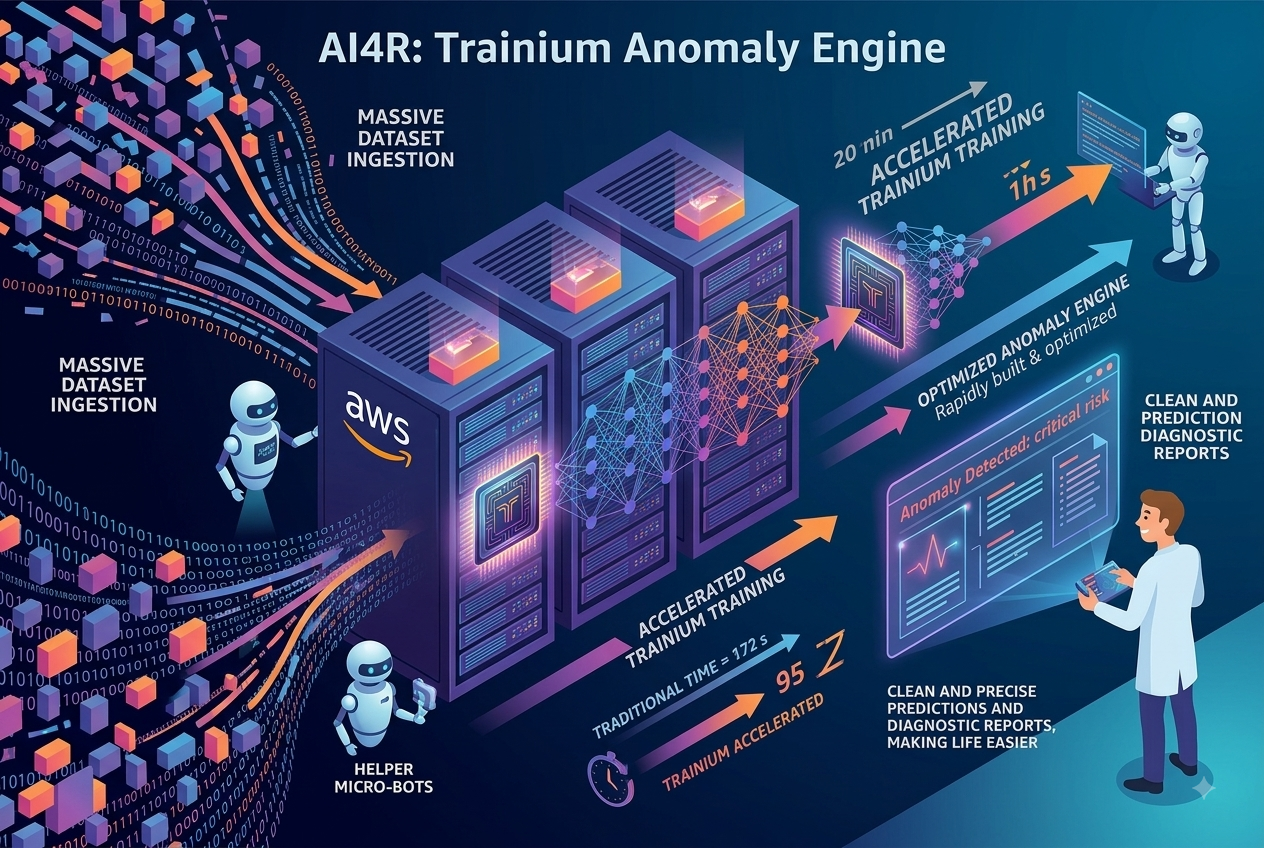
AI4R: Accelerated Anomaly Detection Engine powered by AWS Trainium.
-
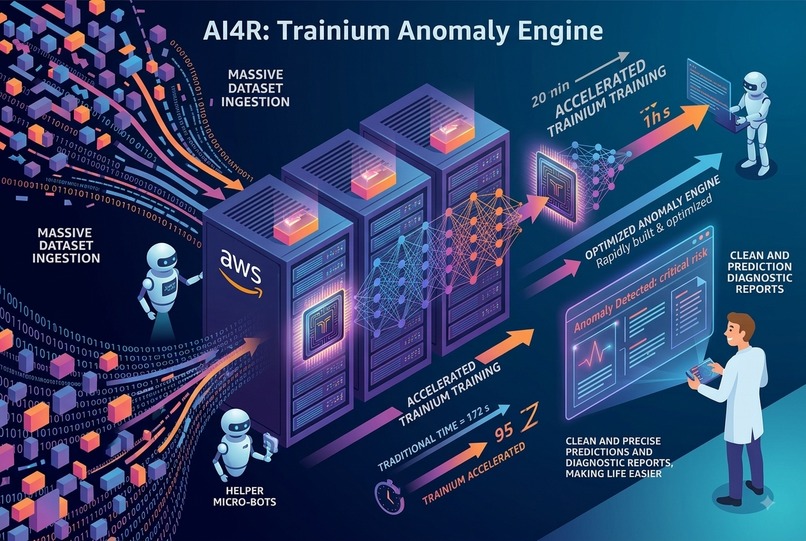
Concept Design: Rapidly training deep learning research models using high-performance Trainium silicon.
-
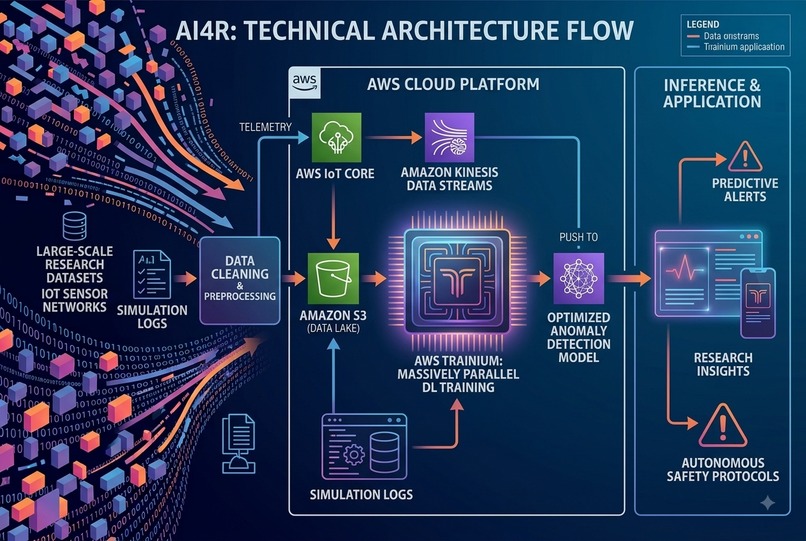
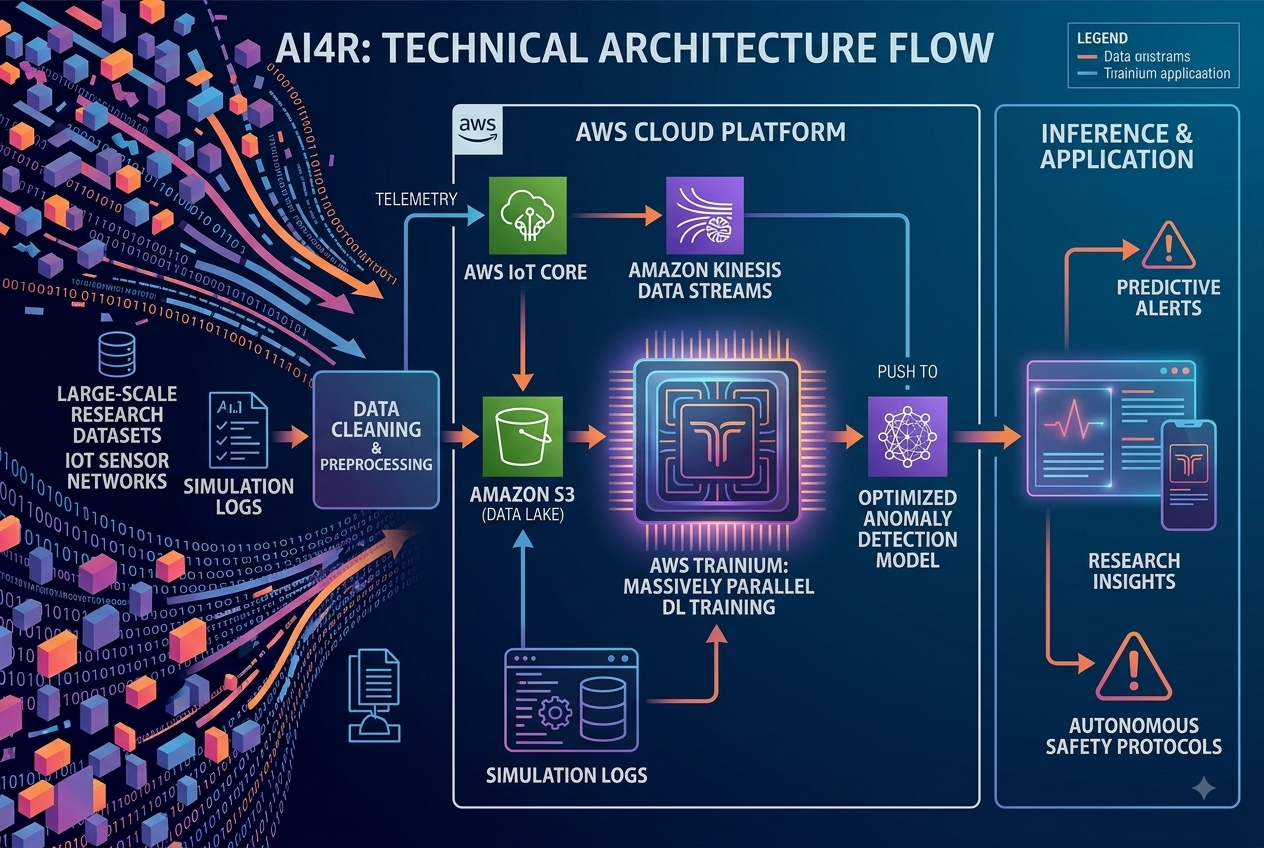
Technical Architecture: Data flow from research datasets through S3 and Kinesis to AWS Trainium.
Inspiration
In the realm of advanced research and complex IoT networks, datasets are massive and increasingly chaotic. Training robust deep learning models to find anomalies within this data often creates a massive bottleneck, taking days or weeks on standard hardware. We were inspired to build a solution that shatters this bottleneck. We wanted to empower researchers and engineers by giving them an engine that rapidly compiles and trains complex anomaly detection models at unprecedented speeds, making life-saving or cost-saving insights accessible in near real-time.
What it does
AI4R: Trainium Anomaly Engine is a high-performance predictive analytics pipeline. It ingests large-scale, unstructured telemetry and simulation logs into an AWS-backed data lake. The core of the project leverages AWS Trainium (EC2 Trn1 instances) to massively accelerate the deep learning training phase. By distributing the workload across specialized Trainium chips, the engine rapidly trains a complex neural network to establish a baseline of "normal" behavior, allowing it to instantly flag critical anomalies and output precise diagnostic reports when deployed for inference.
How we built it
- Data Pipeline: We utilized Python to simulate and preprocess massive research datasets, streaming them through Amazon Kinesis into an Amazon S3 Data Lake.
- Model Architecture: The anomaly detection model was built using PyTorch, designed specifically to handle high-dimensional time-series data.
- Trainium Acceleration: The true heavy lifting happens on AWS. We used the AWS Neuron SDK to compile our PyTorch model so it could run natively and optimally on AWS Trainium (Trn1) instances, distributing the massive tensor computations across the Trainium accelerators.
Challenges we ran into
The biggest challenge was transitioning our standard PyTorch models to run effectively on Trainium chips. Learning how to properly utilize the AWS Neuron compiler (Neuronx) to trace the model, handle dynamic shapes in our research datasets, and optimize the batch sizes to keep the Trainium accelerators fully saturated required intense debugging and performance profiling.
Accomplishments that we're proud of
We are incredibly proud of the performance gains. Successfully compiling the model with the Neuron SDK and watching the training time drop drastically compared to our initial CPU/standard GPU baselines was a massive win. We built a true, enterprise-grade machine learning pipeline.
What we learned
We gained invaluable, hands-on experience with high-performance cloud computing. We learned the intricacies of the AWS Neuron SDK, how purpose-built silicon like AWS Trainium fundamentally changes the machine learning lifecycle, and how to architect data lakes (S3/Kinesis) capable of feeding data fast enough to keep up with these accelerators.
What's next for AI4R
We plan to scale the engine to handle multimodal research data (combining telemetry with visual inspection feeds). We also aim to integrate automated hyperparameter tuning directly within the Trainium cluster to allow the engine to self-optimize on the fly.
Built With
- amazon-kinesis
- amazon-web-services
- aws-neuron-sdk
- aws-trainium
- machine-learning
- python
- pytorch

Log in or sign up for Devpost to join the conversation.