-
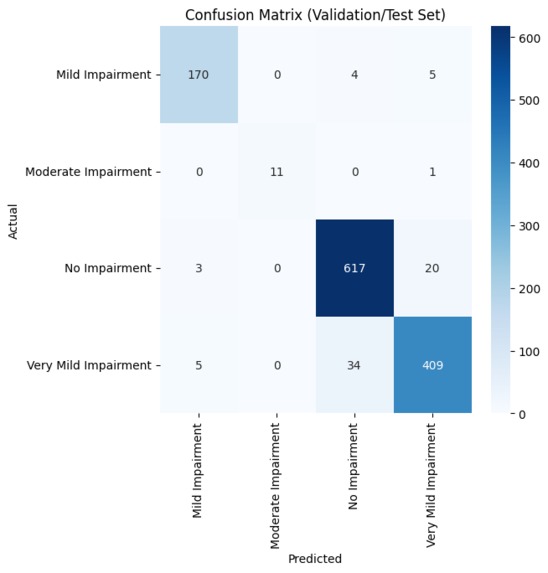
Confusion Matrix
-
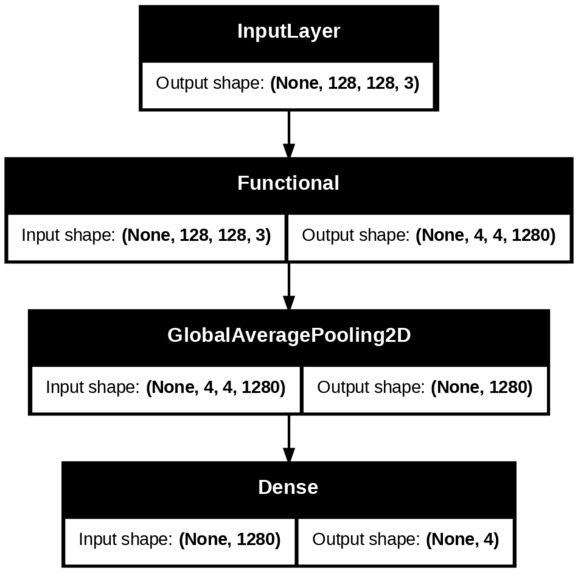
Model Structure
Inspiration
Alzheimer’s disease is a progressive neurological disorder where early diagnosis can significantly improve patient care, yet it often goes undetected until later stages. While studying medical imaging and deep learning, we were inspired by the idea that machine learning models could identify subtle patterns in brain MRI scans that are difficult to detect through manual inspection. This motivation led our team, MindTrace, to explore how AI can act as a supportive tool for clinicians by providing faster, consistent, and data-driven insights.
The idea is being presented at Ai4Alziemer, which serves as the main platform for sharing and validating this work.
What it does
The solution developed by MindTrace classifies brain MRI scans into different stages of Alzheimer’s disease, including Non-Demented, Very Mild Demented, Mild Demented, and Moderate Demented. The system analyzes MRI images and predicts the most likely disease stage, demonstrating how deep learning can assist in early-stage analysis and clinical decision support.
How we built it
The project was built using a labeled Alzheimer MRI dataset sourced from Kaggle. MRI images were preprocessed by resizing and normalizing pixel intensities to ensure consistent input to the model. A Convolutional Neural Network (CNN) was designed to learn hierarchical spatial features through convolution and pooling layers, followed by fully connected layers for classification.
At the core of the network, feature extraction is performed using discrete convolution:
(I * K)(x, y) = ∑∑ I(x + i, y + j) · K(i, j)
where I denotes the input MRI image and K represents a learnable convolutional kernel.
Non-linearity is introduced using activation functions such as ReLU:
ReLU(z) = max(0, z)
The model is trained using supervised learning by minimizing the categorical cross-entropy loss:
L = − ∑(i = 1 to C) yᵢ · log(ŷᵢ)
where yᵢ is the true label and ŷᵢ is the predicted probability for class i.
Parameter optimization is performed using gradient-based methods, with parameter updates defined as:
θ(t+1) = θ(t) − η · ∇θ L
where η is the learning rate and θ represents the network parameters.
To improve generalization, regularization concepts were considered, such as L2 regularization:
L_reg = L + λ · ||θ||²
which penalizes overly large weights and helps reduce overfitting.
Challenges we ran into
One major challenge was an unexpected runtime disconnection during training, which resulted in the complete loss of loaded data and intermediate model progress. This was particularly costly due to long training times on large image datasets. To address this, we implemented model checkpointing, enabling the model’s weights to be saved periodically and training to resume from the last saved state.
Additional challenges included class imbalance across disease stages, high visual similarity between adjacent stages, and instability during optimization caused by limited medical imaging data.
Accomplishments that we're proud of
We successfully built an end-to-end deep learning pipeline capable of processing medical images and producing meaningful multi-class predictions. As MindTrace, we are proud to have combined mathematical modeling, optimization theory, and neural network design to solve a real-world healthcare problem and to present this work at Ai4Alziemer.
What we learned
This project deepened our understanding of convolutional neural networks, optimization dynamics, and the mathematical foundations of deep learning. We learned how gradient descent, regularization, and feature hierarchies interact to influence model performance. Equally important, we learned the importance of robustness, reproducibility, and careful evaluation when applying AI to sensitive domains like healthcare.
What's next for MindTrace
Going forward, MindTrace plans to explore more advanced architectures, including transfer learning and attention-based models, and to incorporate explainability techniques grounded in gradient-based attribution methods. The long-term vision is to develop a transparent and clinically relevant system that builds upon the ideas presented at Ai4Alziemer.

Log in or sign up for Devpost to join the conversation.