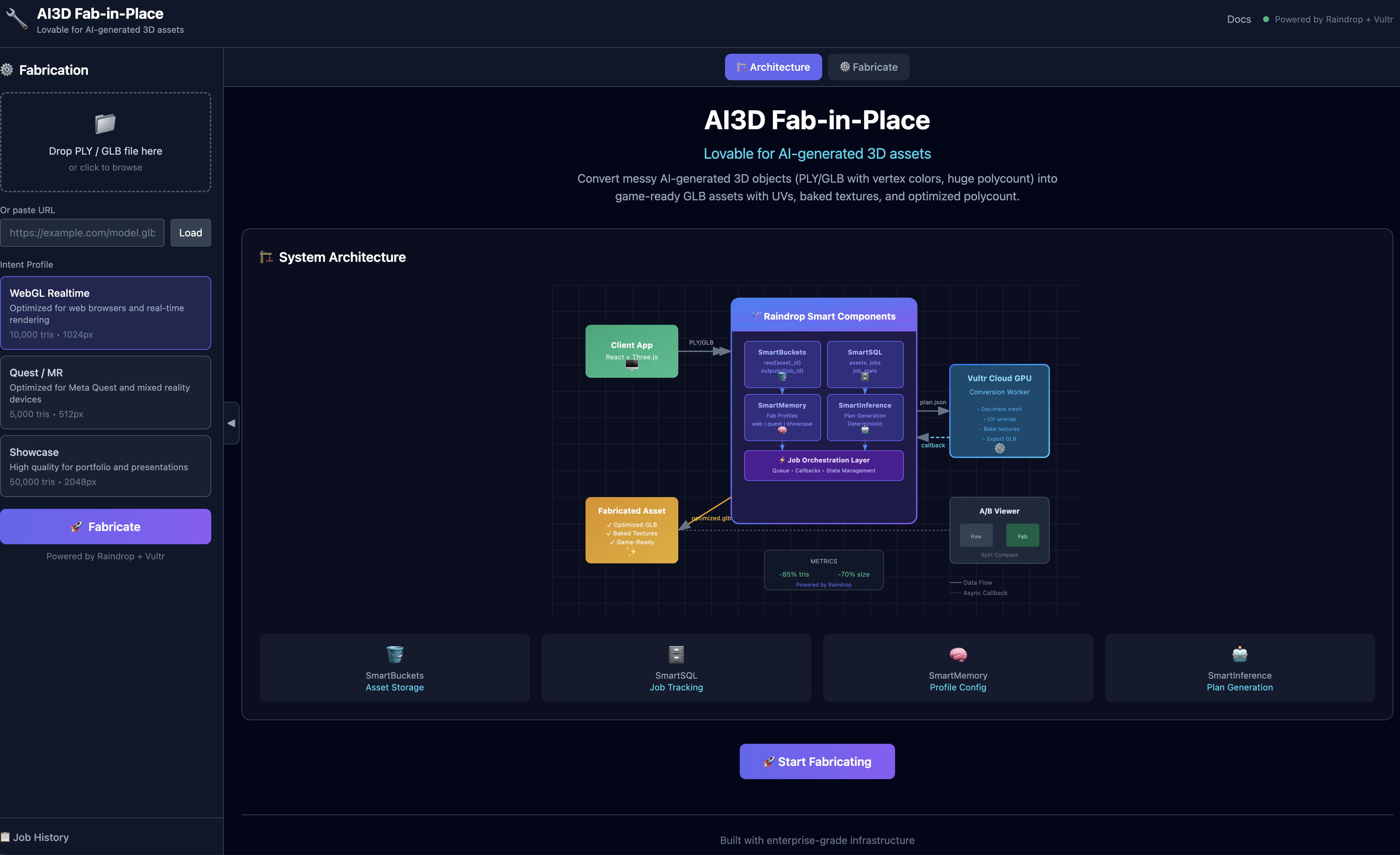
Raindrop services used
- Raindrop Plans & Versioning – Used to define reproducible generation plans for AI-to-3D workflows, enabling consistent iteration and comparison across runs.
- Job History & Audit Logs – Provided traceability for asset generation steps, making it easy to debug, validate, and explain results to judges.
- Raindrop PRD Generation – Used to auto-generate and refine a lightweight product requirements document directly from the workflow, accelerating iteration under hackathon time constraints.
Vultr services used
- Vultr Cloud Compute – Hosts the backend services and orchestration layer for AI3D Fab-in-Place, chosen for its fast provisioning and predictable performance.
- High-Performance NVMe Storage – Supports large 3D assets and intermediate files during AI generation and fabrication prep.
- Flexible Pricing / On-Demand Instances – Allowed cost-effective scaling during development without long-term commitments.
Other external services
- Open-source 3D tooling (Blender CLI) – Used for mesh processing, decimation, and baking because it provides industry-standard, scriptable 3D pipelines.
- WebGL / Three.js – Used for in-browser preview and placement of generated 3D assets, enabling immediate visual feedback without native installs.
- GitHub – Used for source control and open-source collaboration, ensuring transparency and reproducibility.
Why this stack:
Raindrop provided the planning, versioning, and auditability needed to make AI-generated 3D assets trustworthy and repeatable, while Vultr offered a simple, performant infrastructure layer to run the system affordably. The additional open-source tools were chosen for interoperability, speed, and strong ecosystem support.
Built With
- liquidmetal
- raindrops
- vultr

Log in or sign up for Devpost to join the conversation.