Inspiration
What it does
How we built it
Challenges we ran into
Accomplishments that we're proud of
What we learned
What's next for AI Workflow Automation Agent
Inspiration
Enterprise data operations are frequently slowed down by manual review bottlenecks and over-reliance on unverified, hallucination-prone text models. The inspiration behind this project was to engineer a production-grade, deterministic AI workflow engine that bridges the gap between high-throughput REST APIs and rigorous machine learning analytics. Instead of relying purely on generative text, the system combines structured backend execution with mathematical anomaly detection to provide reliable, automated decision support.
How It Was Built
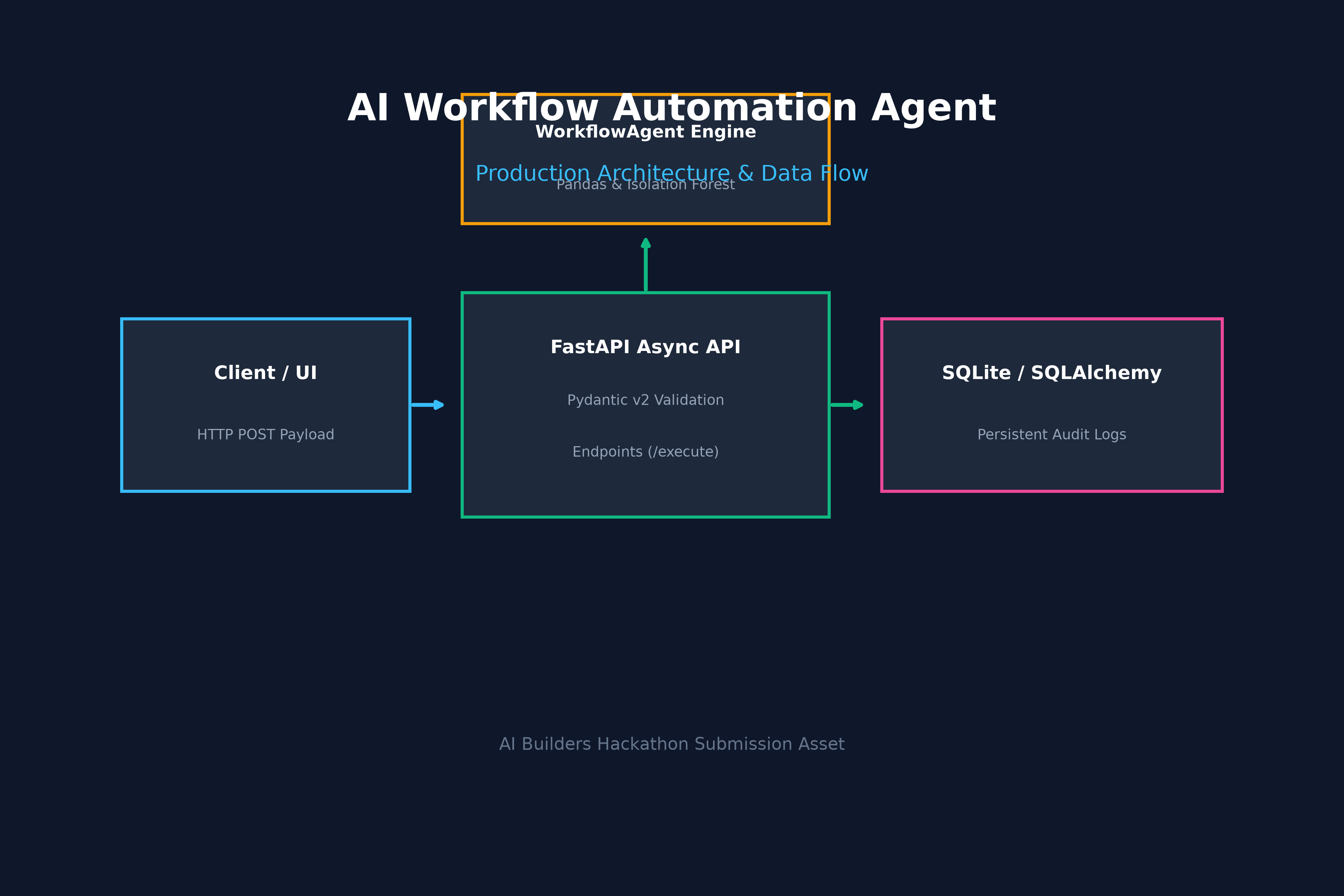
The architecture is built on a decoupled, high-performance stack optimized for speed, reliability, and data persistence:
- Asynchronous API Layer: Developed using FastAPI and Uvicorn to handle concurrent requests with minimal latency and automatic OpenAPI documentation generation.
- Machine Learning Engine: Utilizes Pandas for rapid data ingestion and scikit-learn's Isolation Forest algorithm to compute spatial distributions and isolate outlier trends in tabular payloads.
- Persistent Storage & Auditing: Leverages SQLAlchemy ORM paired with SQLite to log execution states, payload histories, and computed confidence metrics.
- Testing & Simulation: Validated through an automated Pytest test suite and a custom Python simulation client (
client_demo.py) mimicking enterprise traffic.
The anomaly evaluation confidence metric is mathematically modeled as:
$$C_{\text{score}} = 1.0 - \frac{\sum_{i=1}^{N} \mathbb{I}(\text{anomaly}_i)}{N}$$
Challenges Faced
- Payload Flexibility: Handling diverse, unstructured JSON tabular schemas without breaking ingestion pipelines required designing resilient multi-type data converters.
- Timeline Constraints: Delivering a fully tested, production-ready system under a tight 1-week hackathon deadline demanded strict modular separation of concerns and rigorous test-driven debugging.
- Asynchronous Integration: Synchronizing blocking scikit-learn matrix calculations with asynchronous FastAPI event loops without introducing performance degradation.
What Was Learned
- Advanced patterns for embedding machine learning pipelines inside production web servers.
- Enforcing strict runtime data contracts using Pydantic v2 to prevent invalid payload injections.
- Optimizing local test environments with
pytestandTestClientfor rapid regression testing.
Built With
- artificial-intelligence
- automation
- backend
- data-science
- fastapi
- machine-learning
- pandas
- pydantic
- pytest
- python
- rest-api
- scikit-learn
- sqlalchemy
- sqlite
- uvicorn


Log in or sign up for Devpost to join the conversation.