-
-
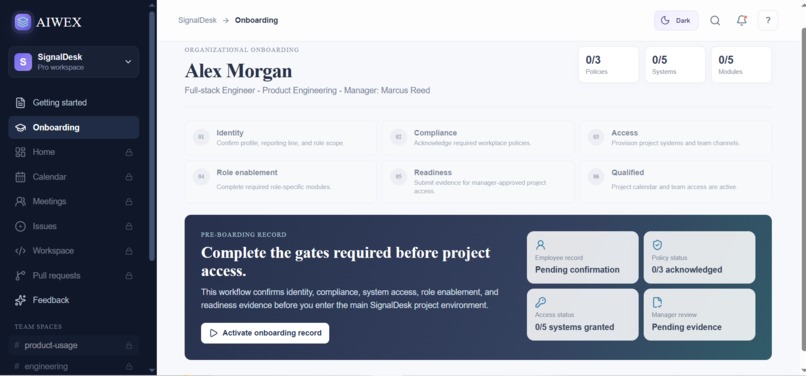
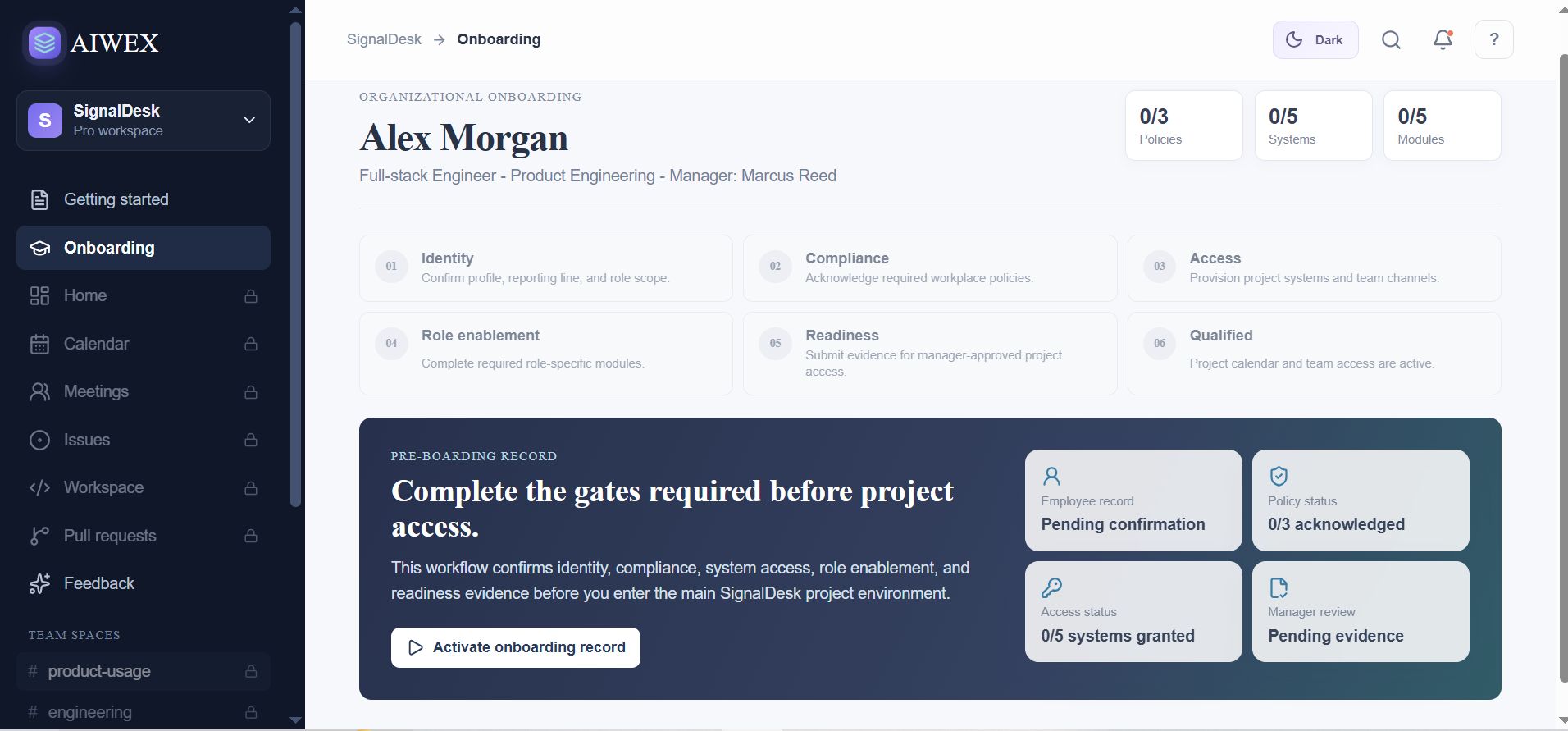
App screen
-
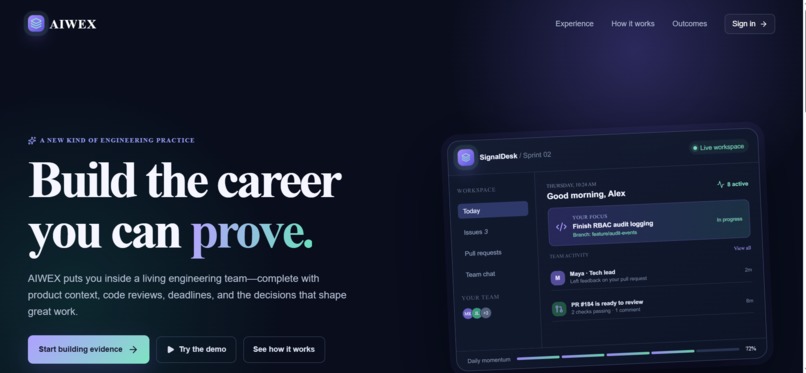
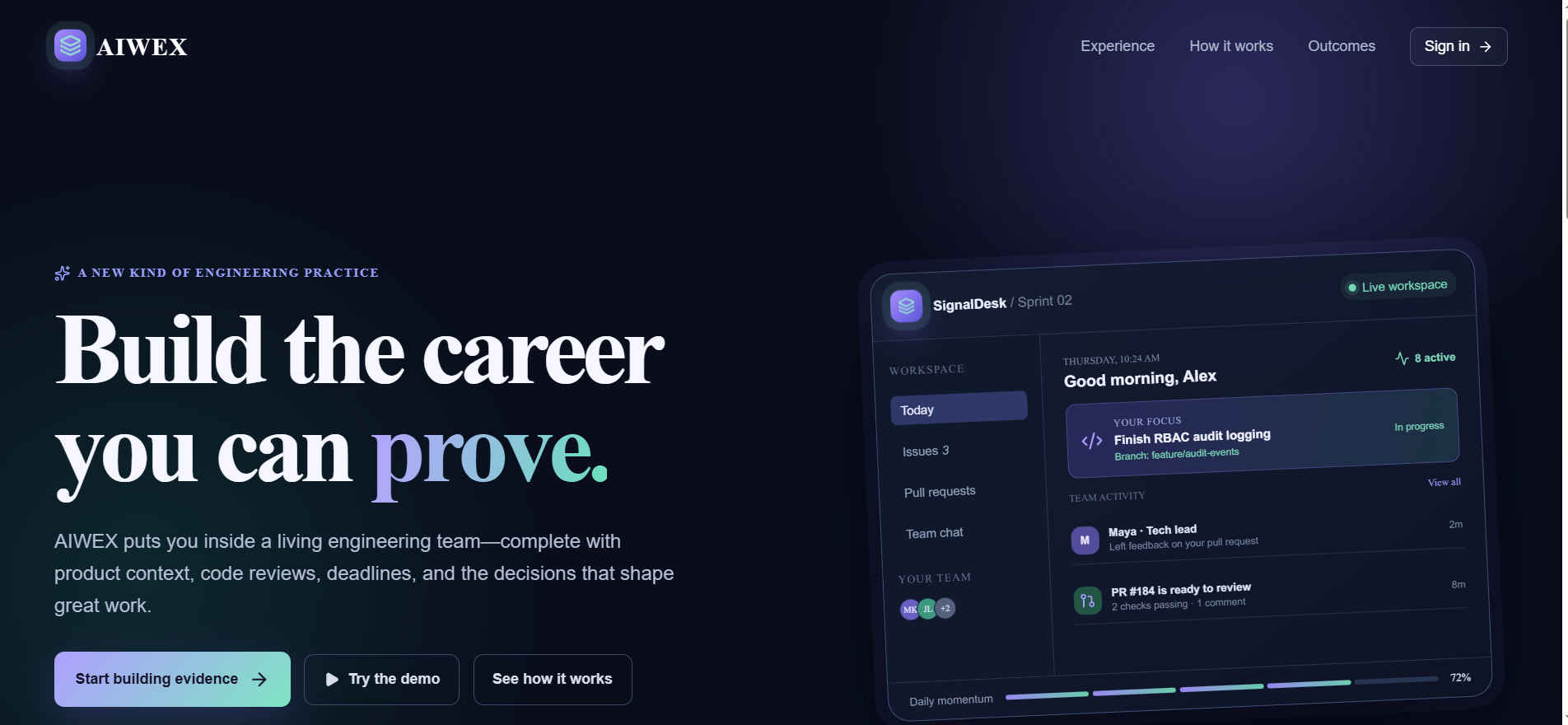
Landing page
Inspiration
I built AIWEX because whenever a student moves out to find a job, they are often filtered out in the early stages for lack of work experience. Recruiters also cannot trust many of the projects on a portfolio — metrics get inflated, impact gets overstated, and it is hard to tell what someone actually did.
The same pattern shows up with early-career professionals: people claim work they did not really own, then get caught in interviews or later when they must do the real job. The skills that matter most — tickets, stand-ups, review, deadlines, collaboration, and shipping under real constraints — are usually learned only after you are already employed.
AIWEX exists so anyone can learn those workplace skills without being employed first. It is a realistic, private workplace simulation where a learner joins a fictional product team, works through delivery scenarios, and builds an evidence trail of decisions and outcomes that cannot be faked on a resume.
What it does
Hiring and early career both suffer from a trust and experience gap:
- Students are screened out for “no experience.” Without a real job, they have little credible signal that they can work like an engineer on a team.
- Portfolios and project claims are hard to trust. Self-written metrics and polished write-ups do not prove how someone collaborated, handled review, or shipped under constraints.
- Resume inflation backfires. Early-career professionals who overclaim get exposed in interviews or on the job — and teams pay the cost of the gap between stated and actual capability.
- Workplace habits are gated behind employment. Tickets, communication, validation, feedback, and ownership are hard to practise safely before the first role, yet those are exactly what the first role expects.
Coding platforms stop once tests pass. Real teams need context, protected behaviour, visible progress, review, and responsible closure. AIWEX makes that process learnable and verifiable before it has real-world consequences.
What learners can do
A learner joins the SignalDesk product team scenario and progresses through a complete software delivery workflow:
- Complete onboarding, company policies, access setup, training, and a readiness assessment.
- Join the workday by posting a stand-up update, reading the assigned issue, and communicating with teammates.
- Work in a guided multi-file workspace and run scenario-specific validation checks.
- Record commits, open pull requests, respond to code reviews, and justify merge decisions.
- Complete the task and receive an evidence-based performance report.
- Progress through Basic, Intermediate, and Advanced scenarios to build a complete project history.
Basic
- Workload: One simple task at a time
- Agent behavior: Proactive, helpful, quick replies
- Real-world pressure: Clear deadlines and light dependencies
Intermediate
- Workload: 2–3 related tasks
- Agent behavior: Busy agents; learners must ask clearly and follow up
- Real-world pressure: Conflicting priorities, dependencies, tighter deadlines
Advanced
- Workload: Multiple hard, interdependent tasks
- Agent behavior: Mixed personalities, occasional unavailability, challenging collaboration
- Real-world pressure: Escalations, peer-support requests, scope changes, and release pressure
How we built it
AIWEX was built from scratch using GPT-5.6 Terra in Plan Mode.
I started by describing my idea, and GPT transformed it into detailed technical specifications. It then generated the first alpha version of the application. From there, I iteratively refined the project by continuously prompting GPT to improve existing features, fix issues, and add new functionality.
I manually tested every major feature and also used GPT to help identify bugs, validate workflows, and improve the overall architecture throughout development.
Challenges we ran into
- Designing effective prompts that consistently guided GPT to produce the desired results. I refined these prompts with help from ChatGPT.
- Configuring numerous third-party services and integrations. GPT-5.6 used up-to-date web knowledge to guide me through each setup step.
- Resolving package conflicts, dependency issues, and installation errors while integrating third-party libraries.
- Managing time effectively and balancing development with my regular schedule.
Accomplishments that we're proud of
- Successfully building a fully functional application that works as envisioned.
- Creating a platform that can genuinely help aspiring developers gain practical workplace experience before entering the industry.
- Demonstrating how AI can significantly accelerate the software development process while maintaining high quality.
What we learned
- Modern AI models like GPT-5.6 make it possible for individuals with limited development experience to turn ambitious ideas into working applications.
- AI can greatly simplify the configuration of third-party services and the creation of complex software workflows.
- When used thoughtfully, AI dramatically improves productivity, making projects that once seemed out of reach both achievable and practical.
What's next for AIWEX
- Add real production-level projects that closely resemble professional software development and open-source contributions.
- Support collaborative teams where multiple learners can work together in a shared environment, fostering teamwork, competition, and community-driven learning.
- Build an admin dashboard and recruiter portal that allows employers to evaluate candidates based on verified performance and workplace behavior.
- Introduce user stories and AI-powered client interactions to simulate gathering requirements and building projects from scratch.
- Expand the capabilities of the in-app IDE.
- Simulate a complete DevOps workflow using real cloud infrastructure and deployment pipelines.
- Add support for non-technical career paths, making AIWEX valuable to a broader audience.
- Integrate voice and video collaboration with AI avatars and speech-to-speech conversations to create an even more realistic workplace experience.
Built With
- gpt
- nextjs
- openrouter
- supabase
- typescript
Log in or sign up for Devpost to join the conversation.