-
-
thumbnail
-
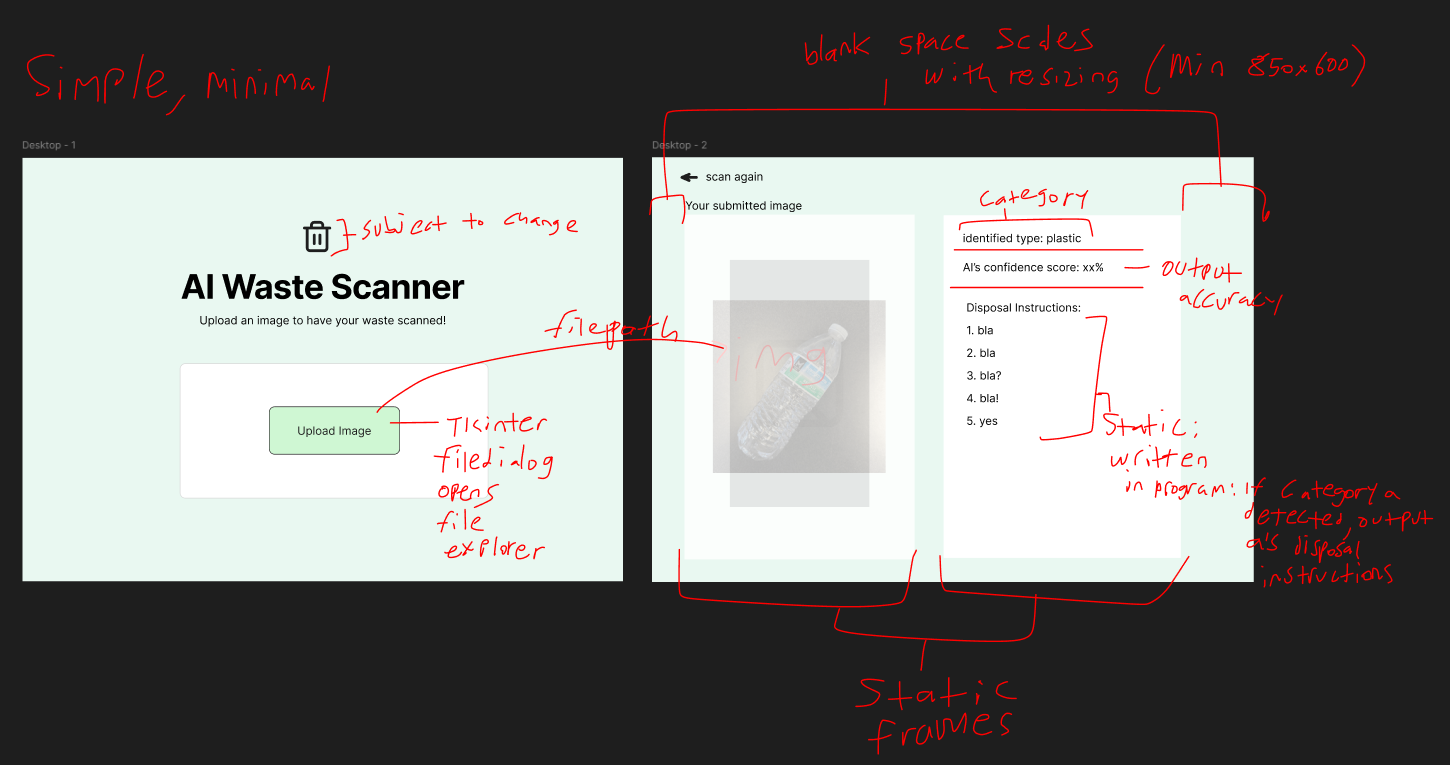
figma mockup
-
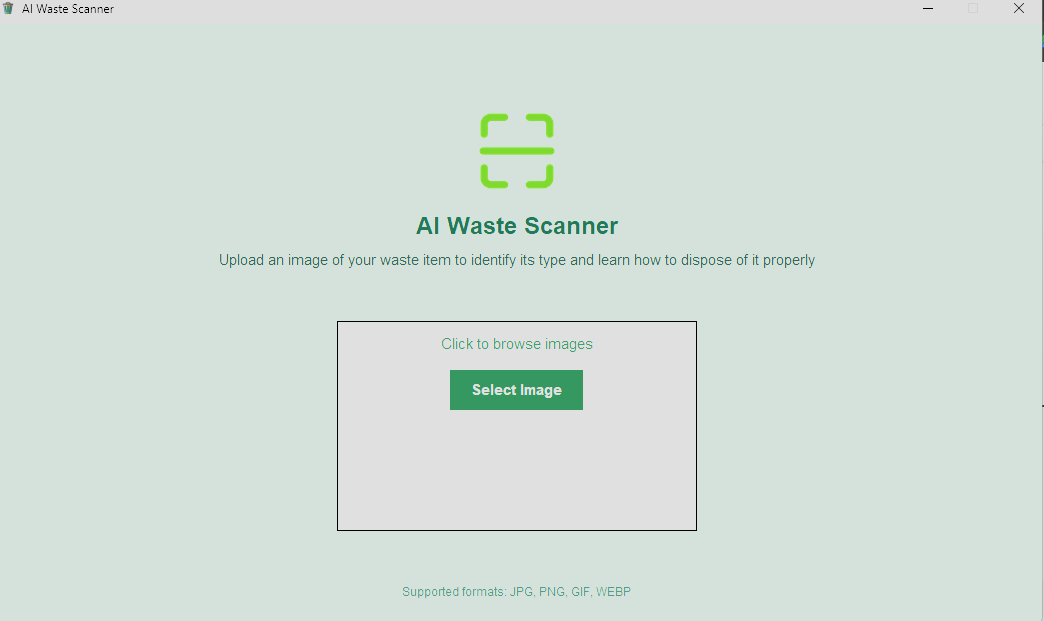
sample screen 1
-
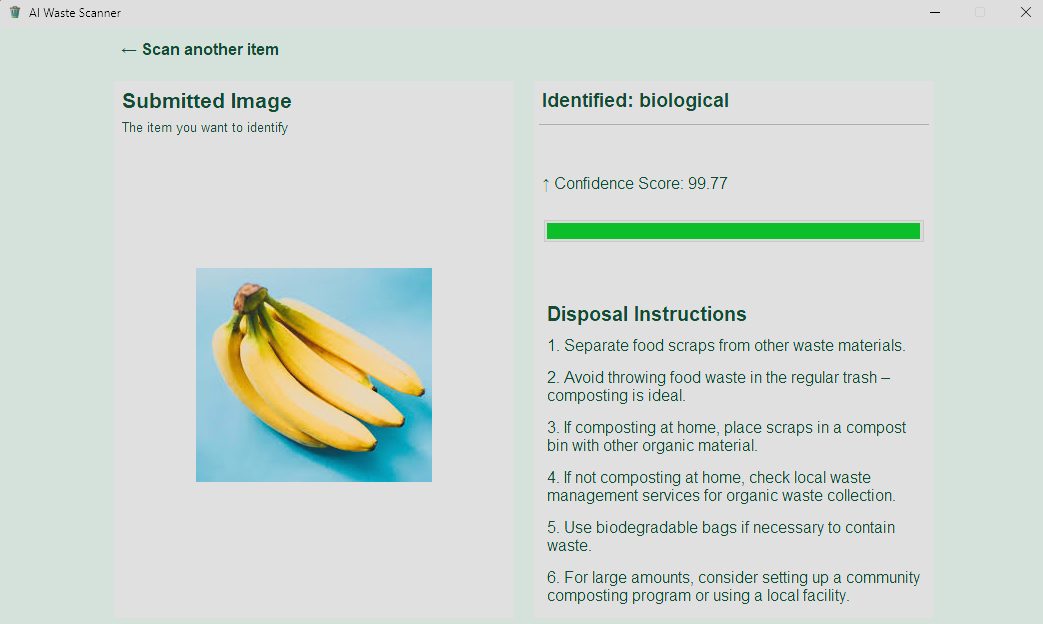
sample screen 2
Inspiration
While we were brainstorming for a project idea, we were eating snacks from the main room. After eating all of them and seeing our empty bags of chips and Chobani, we started thinking about waste and how to dispose of it. We thought about other forms of waste, like e-waste, and how many people find it difficult to determine how to dispose of it.
What it does
AI Waste Scanner helps users correctly identify the type of waste they’re about to dispose of.
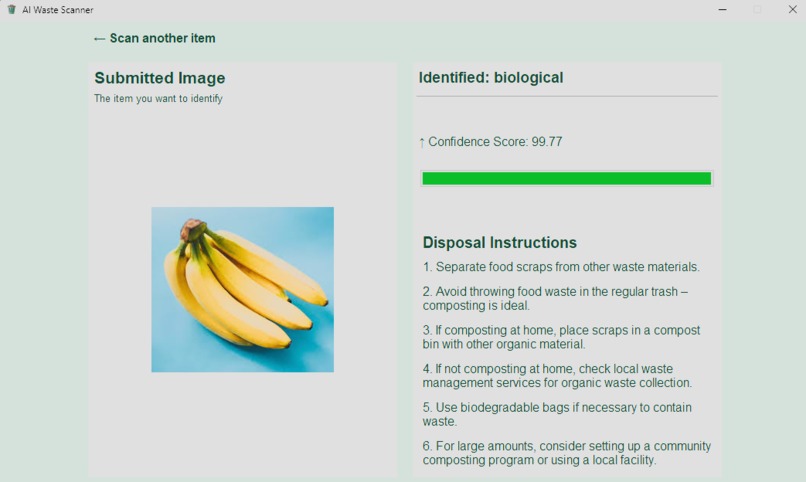
It uses a trained AI model to classify waste items (e.g., plastic, metal, paper, organic, etc.) from an uploaded photo.
Once identified, the app provides disposal instructions to promote proper recycling and waste management.
(Disclosure: Currently, the disposal steps are generated by AI)
How we built it
It was developed using Python and PyTorch to build and train a CNN (Convolutional Neural Network) model based on publicly available labeled datasets of waste images.
The task was image classification (assigning a single label to an image) rather than object detection (detecting and locating multiple items), to reduce complexity.
We chose PyTorch over TensorFlow/Keras for its flexibility and smaller setup overhead for our dataset size.
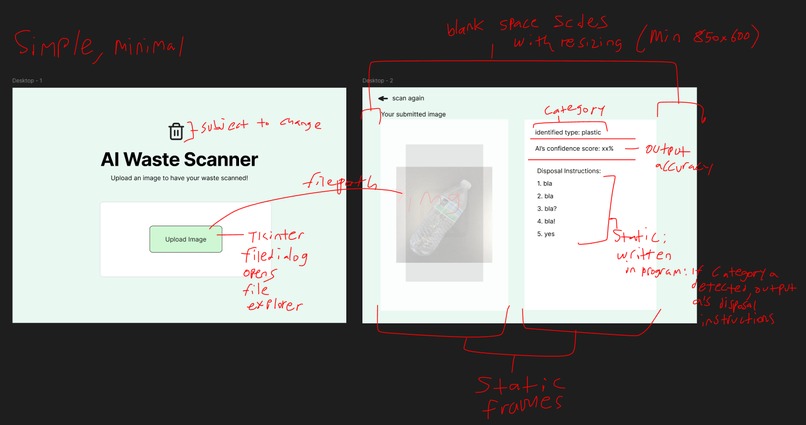
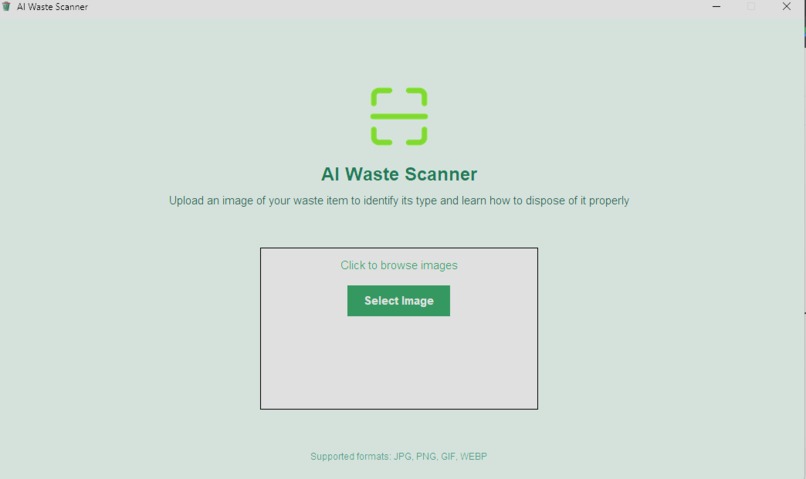
After training through supervised learning (on pre-labeled datasets), the model was saved and integrated into a Tkinter desktop application for user-friendly use.
Challenges we ran into
Hardware limitations:
NVIDIA GPUs are typically required for fast AI model training because of their CUDA cores, of which AMD has no comparable architecture due to it being proprietary technology. Instead, AMD has ROCm, AMD's software platform for GPU computing. However, no one in our group has an NVIDIA GPU nor do we have an AMD GPU that supports ROCm, so we had to run and train the models on our CPUS, resulting in significantly longer training times.New Concepts We were introduced to CNNs and had to learn how they work. AI models are outside of everything we have learned before, and it was a first time for all of us.
Datasets:
Finding high-quality and sufficiently diverse labeled datasets of waste images was difficult. Wrong or weird datasets led to a lack of accuracy and repeated training did not help.Model accuracy:
Ensuring the trained model generalized well to real-world images
Accomplishments that we're proud of
This was our first venture into CNNs and building a working model was a great learning experience for us, as we each trained our own models to understand what we had to work with. We are also proud of our minimal UI design this time, as we are usually terrible at it.
What we learned
Our biggest takeaway from this project was learning how AI models are trained. We explored both Tensorflow and PyTorch to have a hands-on experience with training and evaluating our models. We also learned how to build a simple GUI using Tkinter and how to connect the UI to the AI's functionality.
What's next for AI Waste Scanner
Scalability
- Port the app to web and mobile platforms.
- Integrate with phone cameras for instant image capture and scanning.
- Host the AI model on a server, allowing any device to access it online.
Upgrade the AI
- Move from image classification to object detection (identifying objects and positions with bounding boxes) to be more specific and identify not by just categories, but by objects too.
- Train with larger, merged datasets for more robust performance.
- Improve recognition accuracy and confidence scoring.
Upgrade Features
- Allow batch uploads for multiple waste items at once.
- Add a history feature to track previously scanned items.
- Add an “Incorrect” feedback button for users to help us train the model further.
- Include a manual search to look up disposal methods.
- Add a map showing local recycling or drop-off points.
- Include an info page explaining different waste categories and disposal methods.
- Add environmental statistics such as “You’ve helped recycle 15 items this month” to gamify sustainability.
Resources: https://www.kaggle.com/datasets/sumn2u/garbage-classification-v2/data
United Nations Environment Programme (2024). Global Waste Management Outlook 2024: Beyond an age of waste – Turning rubbish into a resource. Nairobi. https://wedocs.unep.org/20.500.11822/44939
Solid Waste Landfills: Decision-Makers’ Guide Summary. Thurgood, Maggie. 1999(?) Joint publication of the World Bank, Swiss Agency for Development and Cooperation (SDC), World Health Organization Regional Office for Europe, and the Swiss Centre for Development Cooperation in Technology and Management (SKAT). Washington, D.C. and Copenhagen, Denmark. Pp. 31.

Log in or sign up for Devpost to join the conversation.