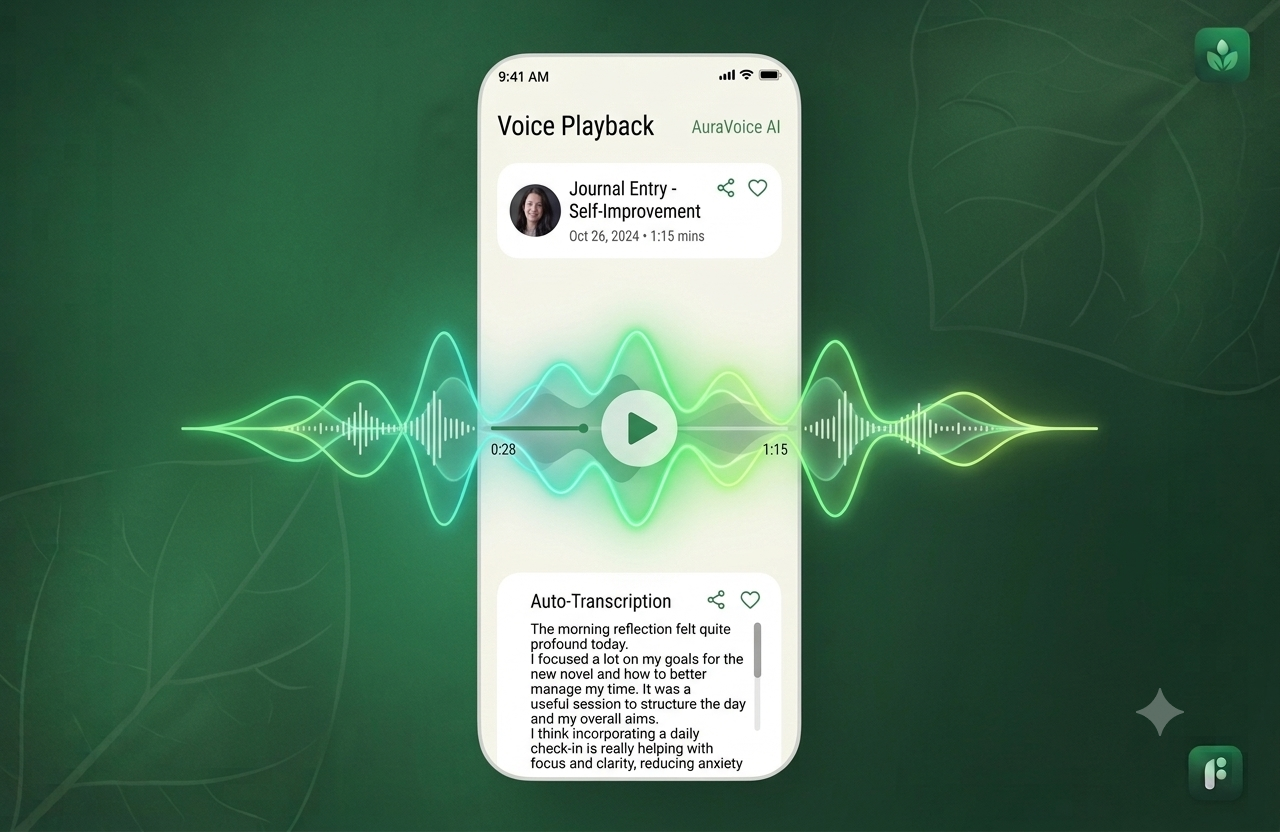
Inspiration Traditional journaling often feels like a chore. Typing out long entries on a phone keyboard or facing a blank page after an exhausting day creates friction that ruins consistency. While basic voice memos make capture effortless, unstructured audio files quickly become unsearchable digital noise.
We built AuraVoice (AURA) to solve this dilemma. Inspired by the vision of a truly empathetic, context-aware companion, AuraVoice bridges the speed of speaking out loud with the analytical depth of multi-agent AI. It converts raw, spoken thoughts into structured insights, emotional reflection trends, and a conversationally searchable personal memory system.
What it does AuraVoice is an AI-powered voice journal and emotional reflection platform designed to make self-care and mental clarity seamless across mobile and web platforms:
Asynchronous Audio Capture & Transcription: Users tap to record and speak naturally. Audio is streamed and processed asynchronously without freezing or slowing down the client interface.
Multi-Agent Analysis Pipeline: Specialized AI agents process the transcript in parallel to extract key themes, generate summaries, and map mood sentiment.
Sentiment & Emotion Analytics: Features interactive visual dashboards (mood charts, emotion tags, and energy levels) to help users visualize their emotional well-being over time.
Semantic Context Retrieval: Replaces basic keyword search with a vector memory engine. Users can ask conversational questions about their past entries—such as "What was stressing me out last week?" or "What goals did I set for myself earlier this month?"
Privacy-Conscious Storage: Isolates user data using secure database storage and local-first vector indexing to protect intimate personal thoughts.
How we built it We architected a decoupled, high-performance system to handle heavy ML inference, voice transcription, and vector search concurrently:
Frontend Client: Built with Flutter / React and Tailwind CSS, providing responsive, cross-platform UI components, real-time waveform audio visualization, and interactive analytics charts.
Backend API Gateway: Developed using FastAPI (Python) and Express.js (Node.js) to handle secure client REST requests, WebSocket audio streams, and user session authentication.
Asynchronous Task Processing: Utilized Celery with Redis as a distributed message broker to queue heavy audio processing and model inference jobs off the main application thread.
Speech Recognition & Natural Language Processing: Integrated OpenAI Whisper / faster-whisper for speech-to-text accuracy, paired with spaCy and fine-tuned Hugging Face models (e.g., RoBERTa) for emotion classification and zero-shot query routing.
Database & Vector Store: Managed user documents and metadata using MongoDB / Supabase, combined with Qdrant / ChromaDB vector stores for fast embedding-based semantic retrieval.
Challenges we ran into Asynchronous Latency & UI Responsiveness: Audio transcription and multi-agent LLM analysis can take several seconds. Establishing background job handling using Celery and Redis while updating the UI via real-time WebSockets/polling was vital to keeping the client interface responsive.
Speech Artifacts & Unstructured Text: Spoken stream-of-consciousness input contains frequent filler words, background noise, and irregular pauses. Prompt-engineering strict JSON schemas and cleanup rules ensured the downstream NLP pipeline generated consistent UI cards.
Vector Indexing & Data Privacy: Designing a semantic search engine across personal logs required balancing retrieval speed with strict tokenization and per-user data isolation to protect privacy.
Accomplishments that we're proud of Low-Friction User Experience: Created a seamless end-to-end workflow where a user taps record, speaks freely, and receives a clean transcript, emotional breakdown, and summary in seconds.
Robust Multi-Agent Architecture: Successfully decoupled the frontend API from heavy background background workers, allowing task queues to scale without crashing the gateway.
Conversational Memory Search: Enabled semantic search over personal history, transforming a simple voice recorder into a context-aware memory assistant.
What we learned Distributed Task Queue Optimization: Gained deep experience configuring Celery workers, managing Redis message broker queues, and handling async task states under tight execution windows.
Audio Engineering & Model Inference: Learned how audio sampling rates, chunking, and background noise filters directly affect Whisper transcription accuracy and model throughput.
Agentic Workflows & Schema Enforcement: Mastered forcing unstructured LLM/NLP outputs into deterministic JSON schemas for reliable frontend rendering.
What's next for AuraVoice / AURA Offline On-Device Inference: Integrate lightweight, on-device Whisper models and quantized LLMs for complete offline accessibility and privacy.
Longitudinal Wellness Insights: Expand the sentiment engine to generate weekly and monthly emotional reflection reports, helping users track long-term habits and stressors.
Bidirectional Voice Companion: Implement a real-time, interactive voice agent that can ask gentle follow-up questions at the end of an entry to guide deeper self-reflection.
Built With
- artificial-intelligence.
- celery
- chromadb
- docker
- express.js
- fastapi
- flutter
- huggingface
- javascript
- mongodb
- natural-language-processing
- node.js
- openai-api
- openai-whisper
- python
- pytorch
- qdrant
- react
- redis
- rest-api
- spacy
- speech-recognition
- speech-to-text
- vector-database
- websockets

Log in or sign up for Devpost to join the conversation.