Inspiration
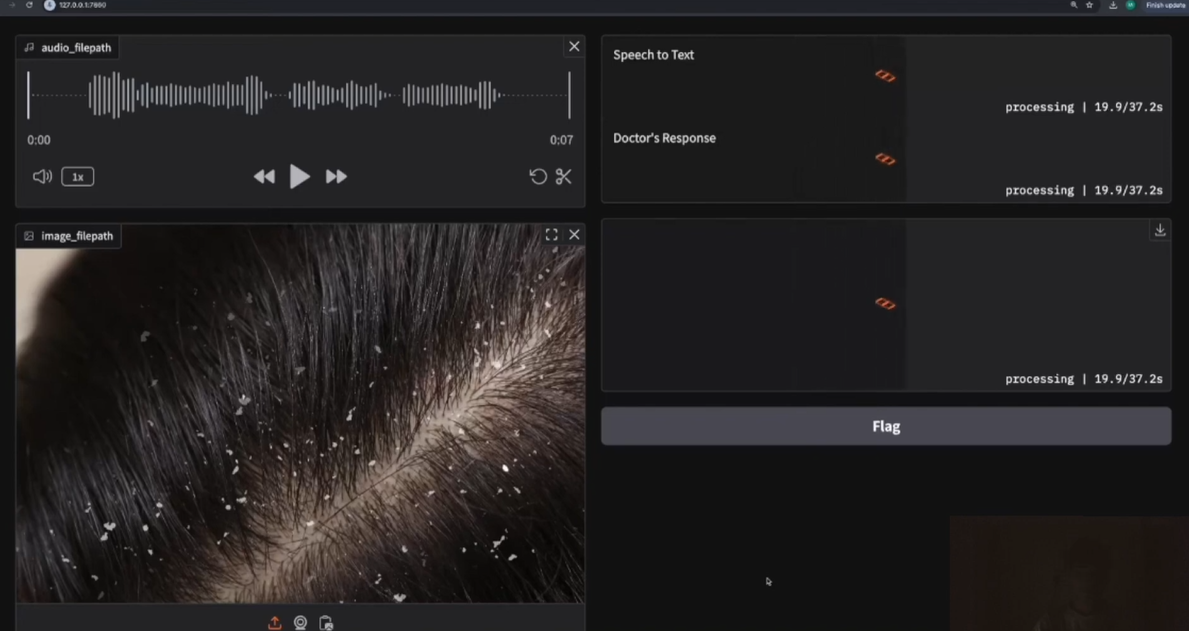
The idea behind AI Virtual Voice Doctor sprouted from the real-world challenge patients face: getting timely, clear medical guidance when a human doctor isn't immediately available. Voice-based assistants offer a natural, hands-free way to communicate—especially helpful for elderly or visually impaired users. By fusing voice technology with AI, we aimed to craft an assistant that listens like a doctor and speaks like one too.
What It Does
AI Virtual Voice Doctor is a conversational voice assistant built to:
- Understand spoken symptoms from the patient via speech-to-text.
- Provide immediate health insights and preliminary guidance using AI (e.g., possible causes, next steps, reassure when urgent care is needed).
- Seamlessly suggest medication reminders or schedule checkups if relevant.
- Offer an empathetic, human-like voice interaction that feels personal and trustworthy.
How I Built It
- Speech-to-Text: Used OpenAI Whisper (or similar) for accurate voice input.
- Conversational AI: Powered by GPT-4 (or custom LLM) fine-tuned for medical conversational context.
- Text-to-Speech: Leveraged a voice engine optimized for clarity and trust—e.g., using ElevenLabs-style doctor voice.
- Frontend: Clean web interface (React/TypeScript + Tailwind) with a simple "Talk Now" button.
- Backend: Node.js/Express or Flask to manage the speech pipeline and AI integration.
- Data & Ethics: Ensured anonymized handling of input; encrypted sessions and user consent for privacy.
Challenges I Faced
- Voice Accuracy: Tuning models to handle accents, background noise, and medical terminology.
- Tone of Voice: Selecting a TTS solution that’s authoritative yet empathetic.
- Advice vs. Diagnosis: Ensuring the assistant is informative, not a substitute for professional medical help—uses disclaimers properly.
- Trust-Building: Making the interface feel welcoming and easy for users with low tech literacy.
What I Learned
- Real-world voice data requires robust fallback: misheard words, ambient interference.
- Trust in healthcare AI depends as much on tone and clarity as accuracy.
- Combining speech, AI, and healthcare requires nuanced design and ethical foresight.
- Streamlining voice-based UX can significantly lower the barrier for user adoption.
What’s Next
- Voice-driven symptom triage flows with direct recommendation for telehealth services.
- Integration with medical wearables (e.g., temperature, heart rate) to make interactions richer.
- Multilingual support to serve diverse patient groups.
- Doctor dashboard to review patient interactions and insights securely.
Built With
- control
- deployment-on-vercel-or-render
- elevenlabs-style-voice-tts
- encrypted-https
- for
- github
- gpt-4-conversational-ai
- node.js-or-python-(flask)
- openai-whisper-(speech-to-text)
- postgresql/supabase-(optional)
- react
- rest-api
- tailwind-css
- typescript
- version


Log in or sign up for Devpost to join the conversation.