-
-
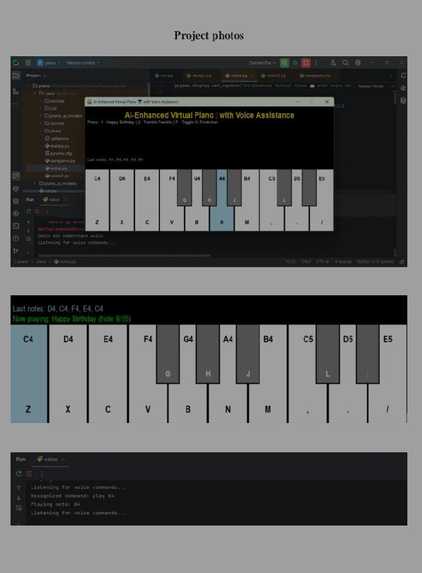
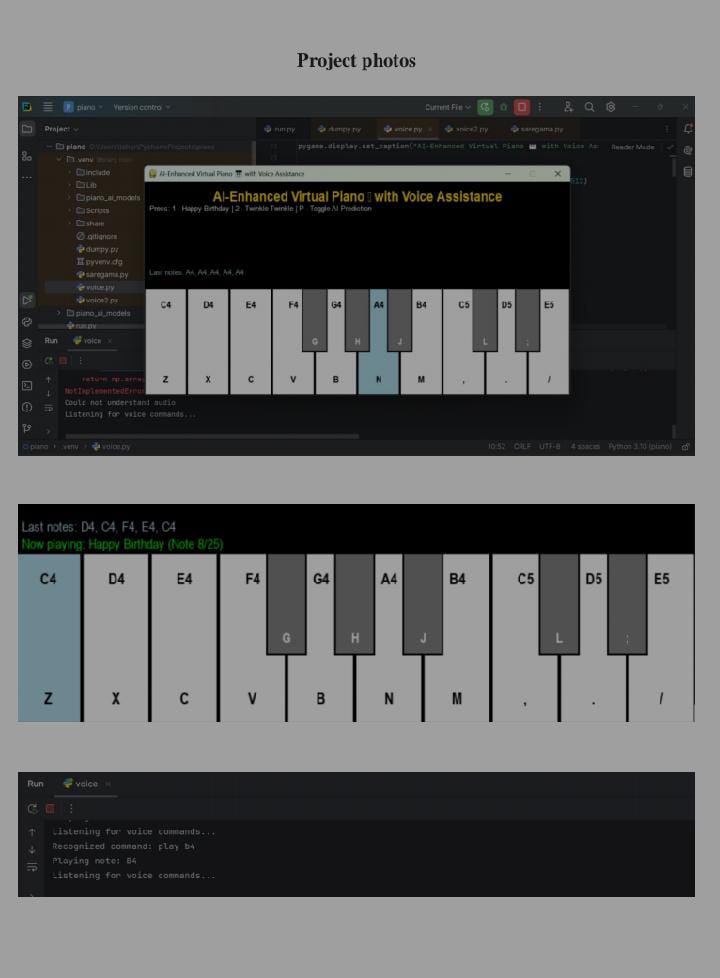
Play piano via keyboard, auto songs, voice ("Play B4"), or gestures—touchless experience shown in demo.
Inspiration
We wanted to create a musical experience that is easy to use, touch-free, and powered by AI. Inspired by gesture control and voice-assist technologies, our goal was to rethink how a piano could be played. There would be no physical keys, just your hands and voice.
What it does
AI Virtual Piano detects hand gestures using a webcam and translates them into piano key presses. It also supports keyboard typing and voice commands, like "Play B4." Users can see recent notes, hear sounds, and even play a full song, such as "Happy Birthday."
How we built it
We used:
- Python for scripting
- OpenCV and MediaPipe for real-time hand tracking
- PyAutoGUI for simulating keypresses
- SpeechRecognition and Pyttsx3 for voice input and output
- Tkinter for the GUI with a visual keyboard
Challenges we faced
- Ensuring proper hand tracking in different lighting
- Syncing gesture input with real-time sound playback
- Integrating voice input without lag
- Smoothly handling various inputs (gesture, voice, keyboard)
Accomplishments we're proud of
- Built a fully touchless, interactive piano system
- Successfully integrated gesture and voice control
- Played actual melodies using only hand gestures
- Created a clean GUI with real-time feedback
What we learned
- Fine-tuning hand landmark data for specific tasks
- Combining multiple AI interfaces in one workflow
- Designing for usability and responsiveness in real-time apps
What's next for AI Virtual Piano
- Add multi-hand chord recognition
- Improve the voice assistant to support song requests
- Deploy as a web-based app using Flask
- Integrate MIDI support and custom sound banks
- Enable recording and playback features for users

Log in or sign up for Devpost to join the conversation.