Hypothesis
Can AI recognize 'vibes' from color combinations using pattern recognition?
Inspiration
The intersection of color psychology and machine learning - testing whether subjective human experiences like "vibes" can be quantified through algorithmic pattern analysis.
What it does
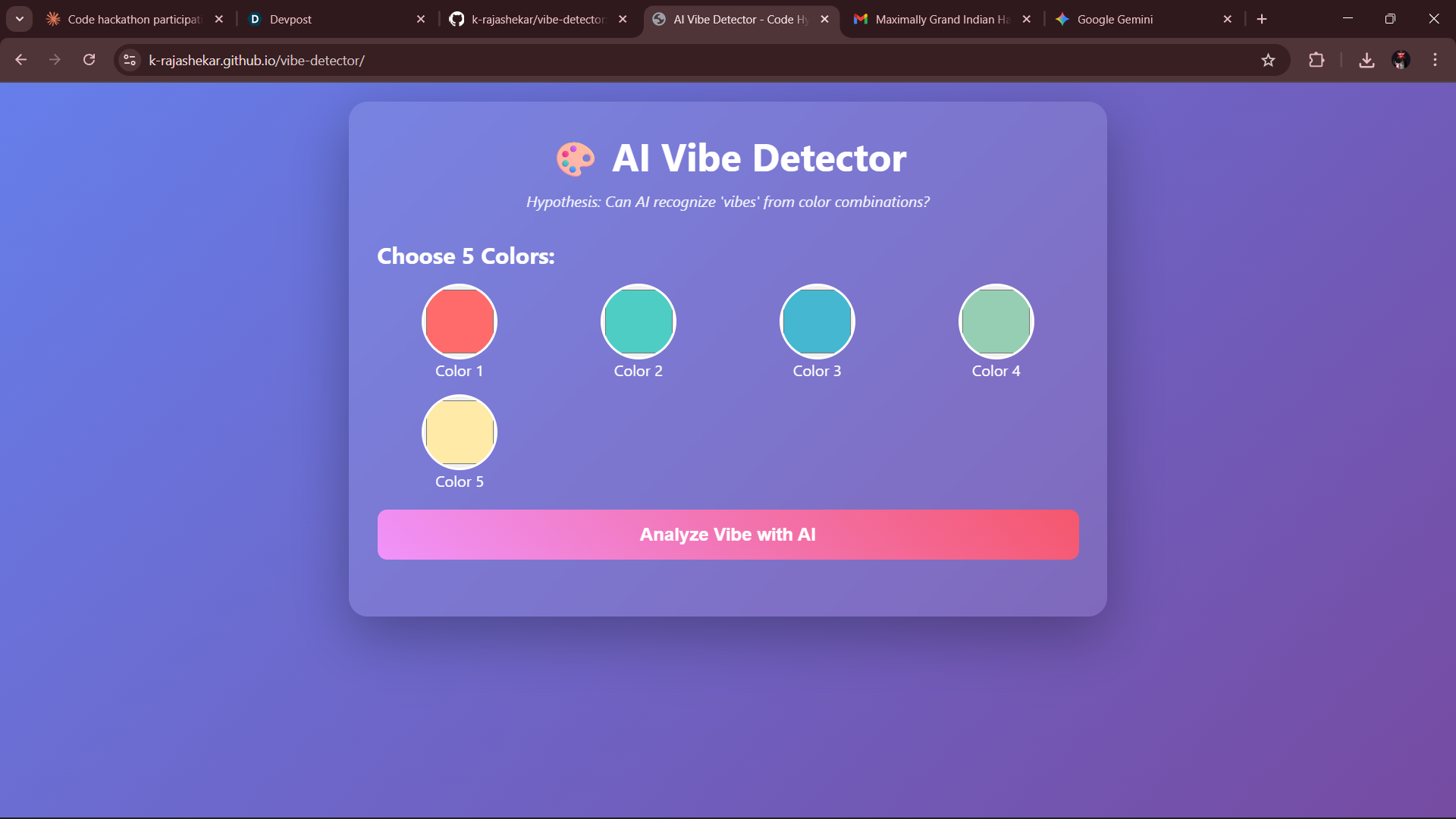
Users select 5 colors, and the AI analyzes them using:
- HSL color space conversion for pattern detection
- Contrast and saturation analysis for energy levels
- Hue variance calculations for complexity scoring
- Color harmony detection (complementary, analogous, triadic)
- Multi-factor classification into vibe categories (Energetic, Peaceful, Chaotic, Melancholic, etc.)
How we built it
Built using pure JavaScript, HTML5, and CSS3 with a focus on rapid prototyping. Implemented a rule-based pattern recognition system that analyzes color relationships through mathematical formulas derived from color theory. The system extracts 7 features (contrast, saturation, hue variance, brightness, harmony patterns) and uses weighted scoring algorithms for classification. While not using traditional ML training, it demonstrates core ML concepts like feature extraction and pattern-based classification.
Challenges
- Converting RGB to HSL for better pattern analysis
- Defining quantifiable metrics for subjective experiences
- Balancing multiple factors for accurate vibe detection
- Building everything from scratch without ML libraries
Accomplishments
Created a working proof-of-concept that demonstrates basic ML concepts (feature extraction, classification) can detect subjective human experiences from visual input. Includes real-time accuracy tracking through user feedback.
What's next
Implement actual machine learning with training datasets, collect user feedback to build a labeled dataset for supervised learning, integrate neural networks for improved pattern recognition, and validate results against established color psychology research.


Log in or sign up for Devpost to join the conversation.