-
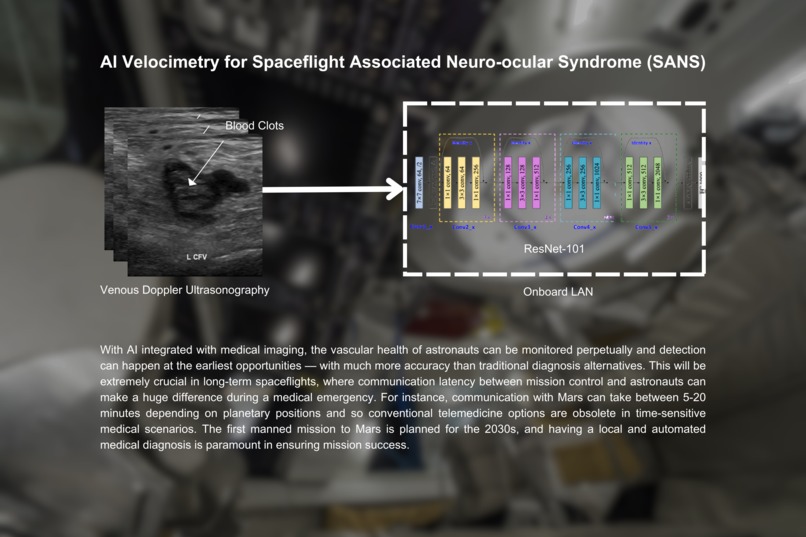
Project Infographic
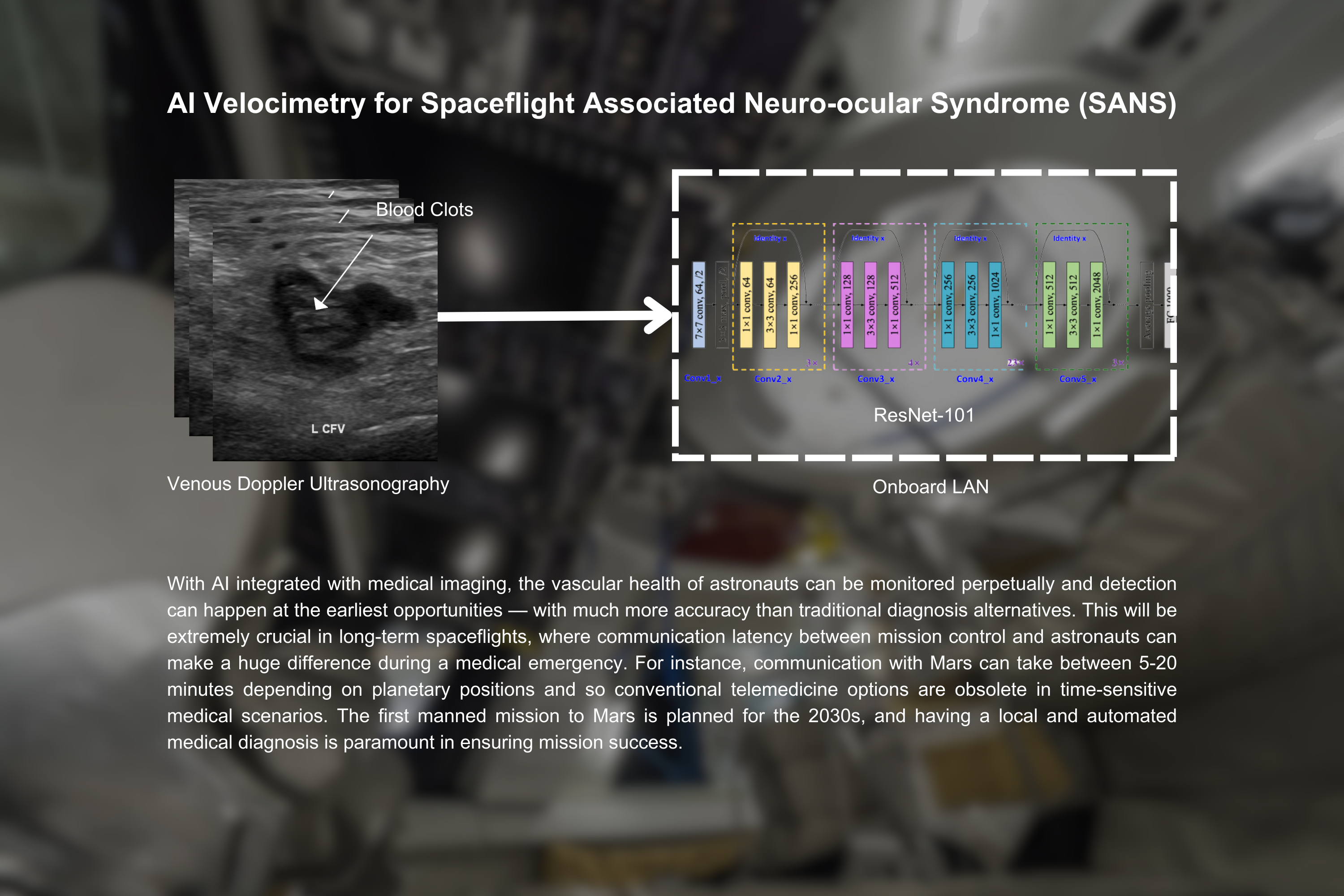
The project presentation slides are accessible here
Inspiration
The initial inspiration came from a medical study first published in 2019, named "Assessment of Jugular Venous Blood Flow Stasis and Thrombosis During Spaceflight" which was conducted to assess internal jugular vein (IJV) flow and morphology during spaceflight and to investigate if lower body negative pressure is associated with reversing the headward fluid shift experienced during spaceflight. This was done because experiencing a weightless environment in spaceflight can lead to a continuous shift of blood and tissue fluid towards the head, in contrast to the upright posture on Earth — implications of this shift on cerebral venous outflow were unclear and the study served as a pioneer in the study of vascular changes during spaceflight. It was subsequently concluded at the end of the study that stagnant and retrograde blood flow associated with spaceflight in the IJVs of astronauts and IJV thrombosis in at least 1 astronaut, a newly discovered risk associated with spaceflight. Michael Stenger, a study author associated these findings with a plethora of other medical issues in what an umbrella class now known as "Spaceflight Associated Neuro-ocular Syndrome" or SANS. In an interview with CNN, Stenger mentioned "blood clots that are newly formed and small are easily filtered out of the circulation in the lungs, but if one were to grow excessively large and solidify, then one would be at risk of a pulmonary embolism. This formation of clots is the primary concern related to flow stasis." Hence, this medical study serves as the primary inspiration for the development and application of an AI-based velocimetry detection technique.
What it does
The premise revolves around the combination of Venous Doppler Ultrasonography with ResNet for a quick and accurate diagnosis of blood clots (and possibly, reverse blood flows). This enables treatment (i.e. decoagulants) to be provided quickly, reducing the risks of a more serious medical emergency during spaceflight.
With AI integrated with medical imaging, the vascular health of astronauts can be monitored perpetually and detection can happen at the earliest opportunities — with much more accuracy than traditional diagnosis alternatives. This will be extremely crucial in long-term spaceflights, where communication latency between mission control and astronauts can make a huge difference during a medical emergency. For instance, communication with Mars can take between 5-20 minutes depending on planetary positions and so conventional telemedicine options are obsolete in time-sensitive medical scenarios. The first manned mission to Mars is planned for the 2030s, and having a local and automated medical diagnosis is paramount in ensuring mission success.
How we built it
The ResNet model has already been widely used in the field of AI Medical Imaging. The main task in our build is context transfer, where we leverage pre-trained ResNet models for transfer learning and adapt the model to accurately detect blood flow in a zero-gravity environment. We will use ResNet-101 as our base model before supplementing it with both data collected on Earth, and on the ISS. The model will be deployed locally on the space vehicle, to eliminate connectivity and/or latency issues when performing Venous Doppler Ultrasonography during a mission. When using an ultrasound machine, the data is streamed to the local servers onboard for processing and inference so an immediate triage can be performed to assess an astronaut's vascular condition.
Challenges we ran into
While ultrasound machines already exist in the ISS and may be part of space vehicles in the future, a primary challenge is ensuring that data connectivity features exist to enable ultrasound images to be streamed to local servers for processing. There are already commercial ultrasound machines with such requirements, but not one built specifically for spaceflight. In addition, traditional challenges with AI also need to be considered as the problem is niche when taking into context that the human body behaves differently in a zero-gravity environment — some of these challenges with AI are preventing overfitting and procuring sufficient quality data.
What's next for AI Velocimetry for Space Assoc. Neuro-ocular Syndrome (SANS)
As technology continues to advance in the field of space medicine, it may be possible to embed microchips in astronauts capable of performing velocimetry passively and for such data to be transferred to local servers via LAN on space vehicles. However, a more realistic next step involves not technological advancements, but possible generalization of the model for other medical conditions beyond blood clots/thrombosis. By having an AI model capable of performing medical imaging onboard during missions, we address the critical issue of communication difficulties during medical emergencies and hence it would be prudent to explore how our ResNet model can be generalized better (possibly with an ensemble) to also perform diagnosis for other common health issues associated with SANS especially during long-term spaceflight.
Built With
- lan
- python
- resnet

Log in or sign up for Devpost to join the conversation.