-
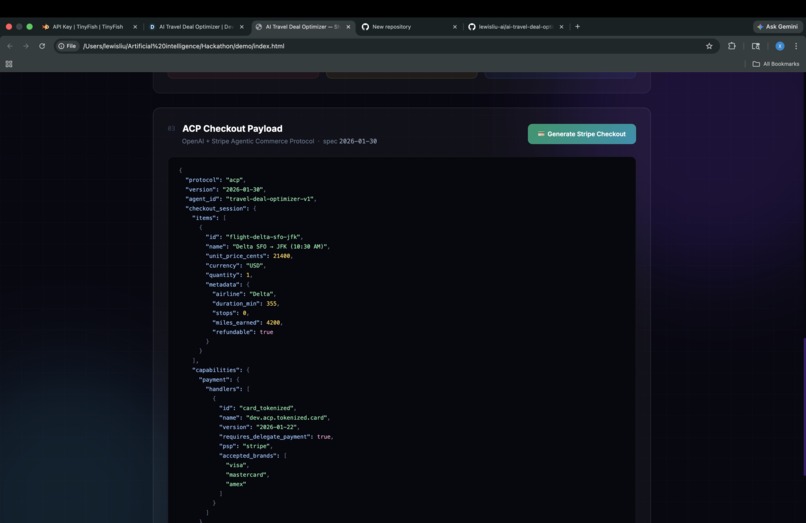
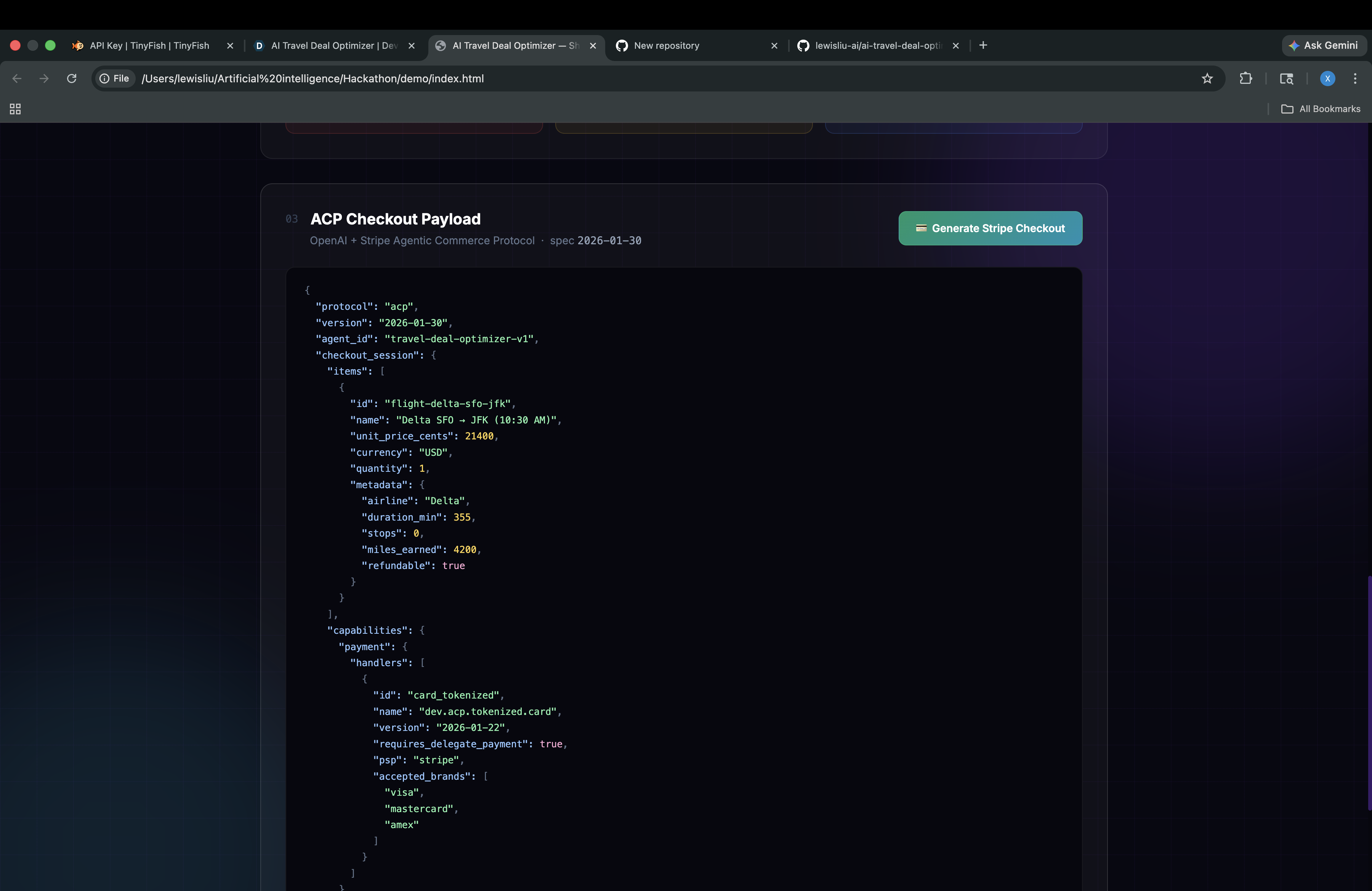
Generates ACP payload — OpenAI + Stripe Agentic Commerce Protocol (spec 2026-01-30)
-
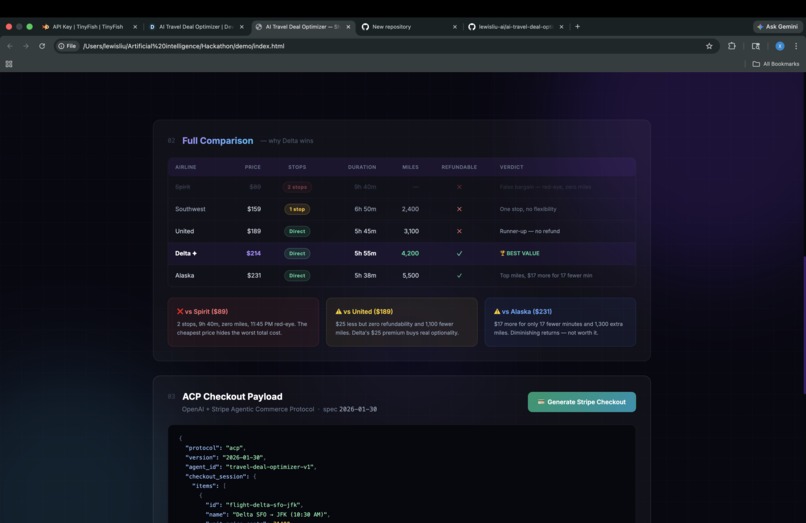
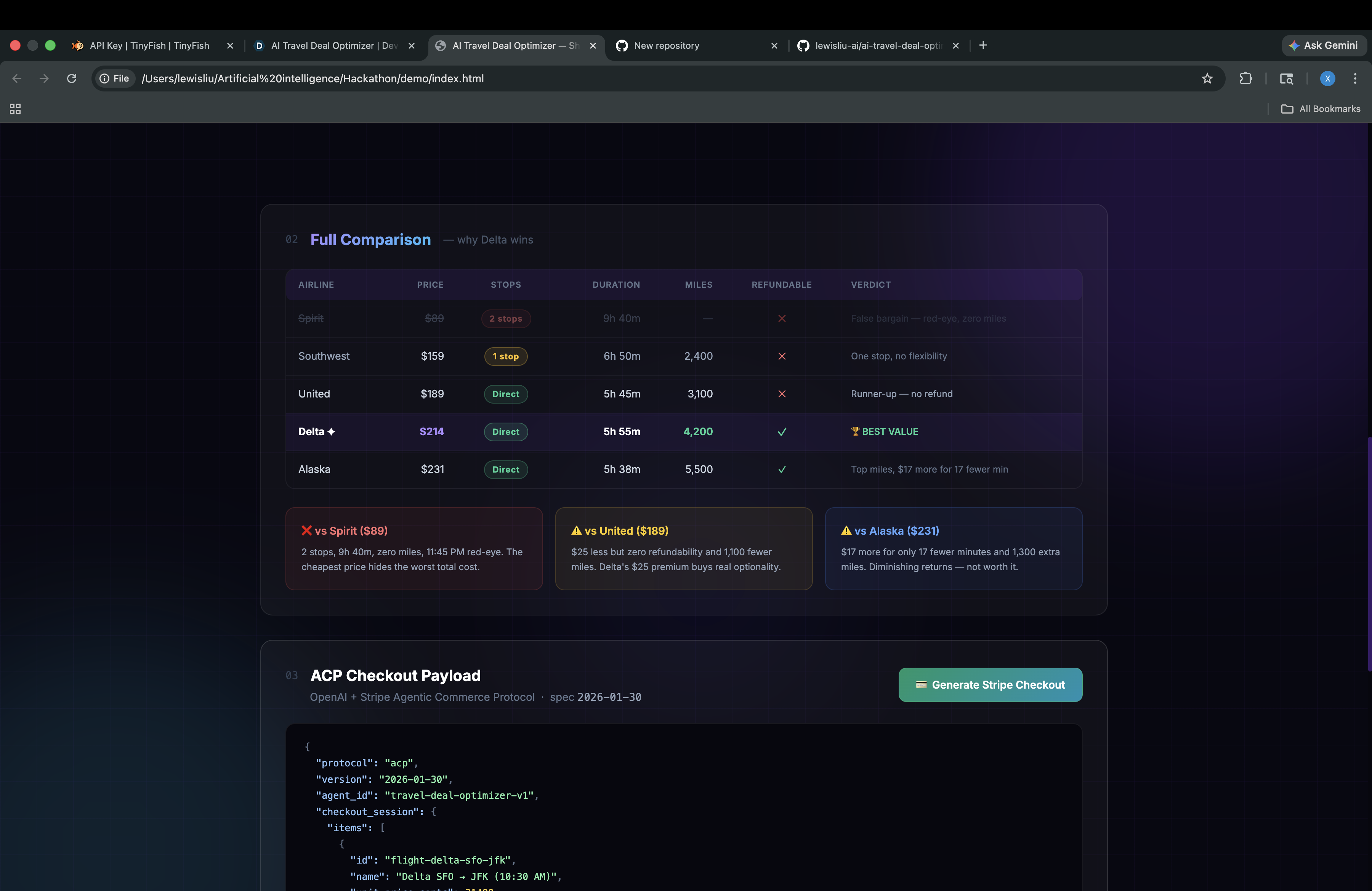
AI compares 5 flights — Delta wins on price, refundability & miles
-
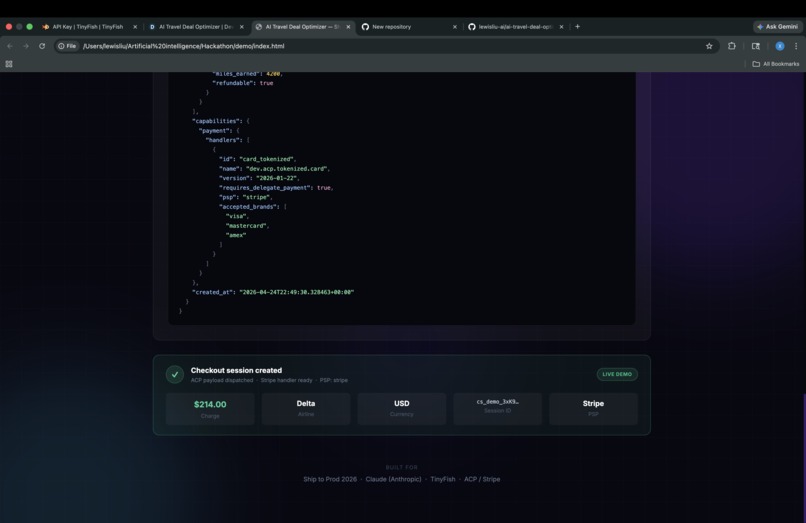
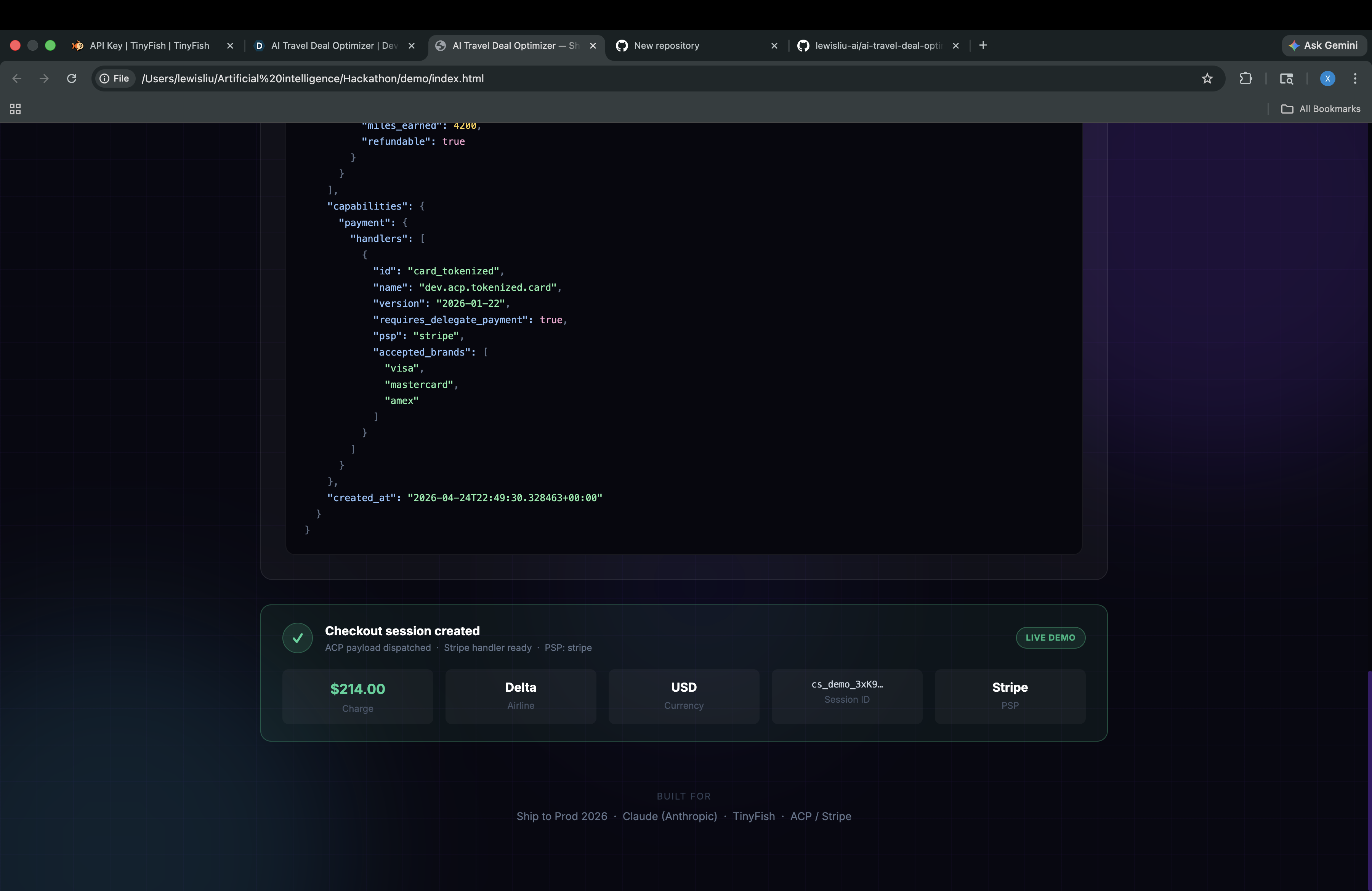
Stripe checkout simulated — agent completes purchase, no human clicks needed
-
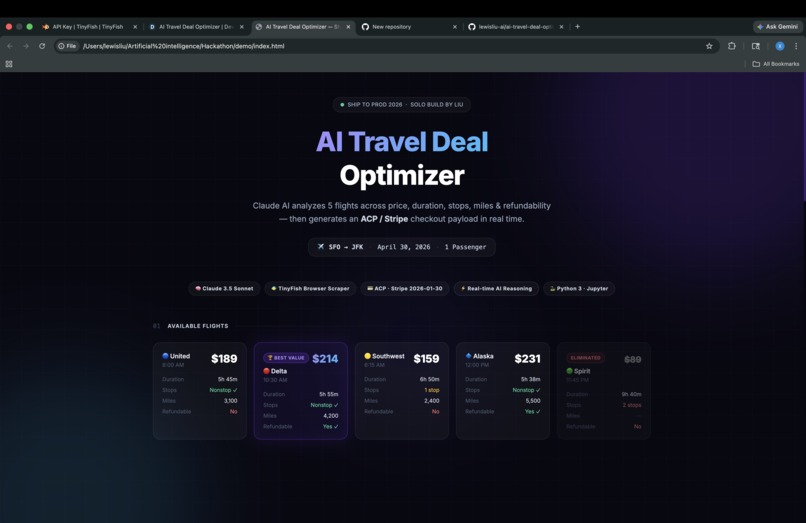
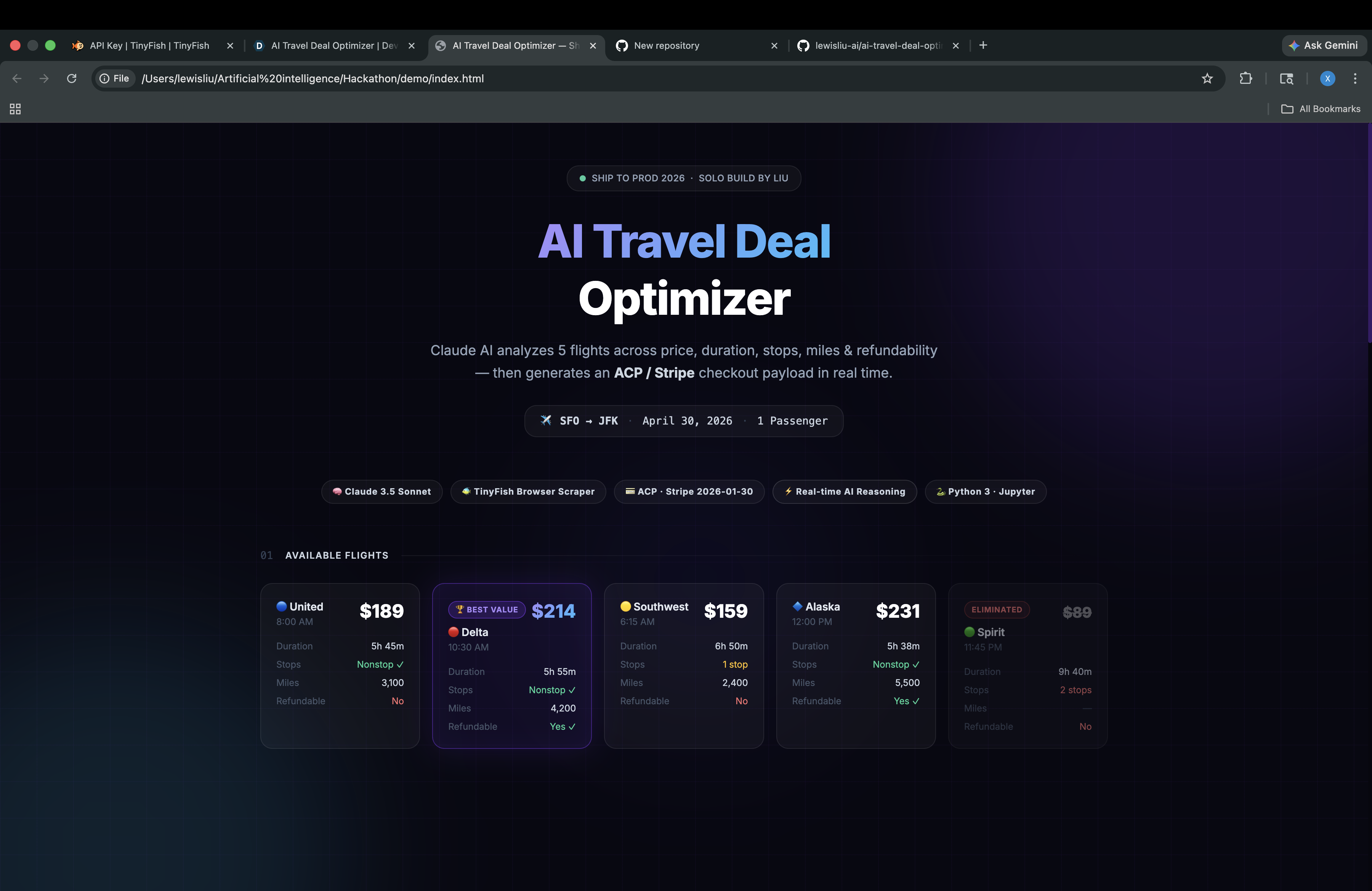
AI Travel Deal Optimizer — solo hackathon build for Ship to Prod 2026
Inspiration
AI agents can BUY for you—but can they buy SMART? Most agentic commerce demos just execute purchases. The interesting problem is judging what's worth buying when there are real trade-offs.
What it does
Given 5 SFO→JFK flight options ranging from $89 (Spirit, 2 stops, no miles) to $231 (Alaska, direct, top miles), the agent reasons across 6 dimensions: price, duration, stops, miles earned, refundability, and time-of-day.
It picks Delta at $214 over Spirit at $89—and explains why with a confidence score:
"Delta hits every priority: only direct, fully-refundable option under $230, earning 4,200 miles—35% more than United for just $25 extra."
Then it generates an ACP (Agentic Commerce Protocol) checkout payload ready for Stripe execution.
Bonus (Cell 5): Real TinyFish browser automation on Best Buy proves the same architecture works on live e-commerce.
How we built it
🧠 Reasoning Layer: Claude Sonnet 4.6 — analyzes flights, outputs structured JSON with reasoning chain and trade-off analysis.
🤖 Execution Layer: Claude Code (Anthropic CLI) — autonomously read the .ipynb, wrote the analysis script, debugged Python environment issues (pandas/interpreter mismatch), and wrote results back into the notebook. Zero API key needed—runs entirely on Claude Pro subscription.
💳 Commerce Layer: ACP Protocol (OpenAI + Stripe spec 2026-01-30) — generates Stripe-compatible checkout payload supporting visa/mastercard/amex via tokenized cards.
🐟 Data Layer: TinyFish API — real browser automation for live e-commerce data extraction.
Stack: PyCharm 2026.1, Python 3.14, Jupyter Notebook, pandas, requests
Challenges we ran into
- Solo build under 2 hours — original team of 5 went silent on Discord; pivoted to "Solo YOLO" mode and shipped anyway.
- CAPTCHA on travel sites (Kayak, Expedia) — solved by using mock data for the main demo + TinyFish on Best Buy as proof of architecture.
- Python environment debugging — Claude Code autonomously diagnosed and fixed pandas install + Python interpreter mismatch issues.
Accomplishments that we're proud of
- Shipped a working agentic commerce demo in 2 hours, solo
- Used 3 cutting-edge protocols: MCP (Anthropic), ACP (OpenAI/Stripe), agent autonomy (Claude Code)
- Zero API cost — entire build powered by Claude Pro subscription via Claude Code
- AI doesn't just rank by price—it reasons about human trade-offs
What we learned
Agentic commerce isn't just "AI executes a purchase"—it's "AI judges what's worth buying." The interesting work is in the reasoning layer, not the checkout. ACP makes the payment trivial; the value is in the agent's decision quality.
Also: Claude Code is a productivity multiplier. It autonomously read the notebook, wrote the script, fixed environment issues, and updated the notebook—turning what would be 30 minutes of manual coding into 2 minutes of supervision.
What's next for AI Travel Deal Optimizer
A2A (Agent-to-Agent) Loyalty Points Marketplace — extending this architecture so each user's mile/point account becomes an A2A-compliant agent (Google's protocol, now Linux Foundation v1.2).
Agents discover each other, negotiate point trades, and settle in cash via ACP/Stripe. Target market: $50B/year of expiring loyalty points and $1T sitting unused in consumer accounts.
The reasoning layer demonstrated here scales directly: agents need to judge trade-offs (1 United mile = $0.013 vs 1 Hyatt point = $0.017), not just execute trades.

Log in or sign up for Devpost to join the conversation.