-
-
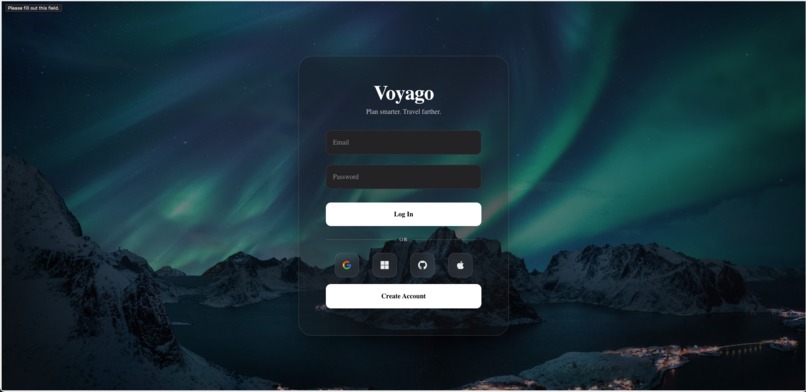
Login Page
-
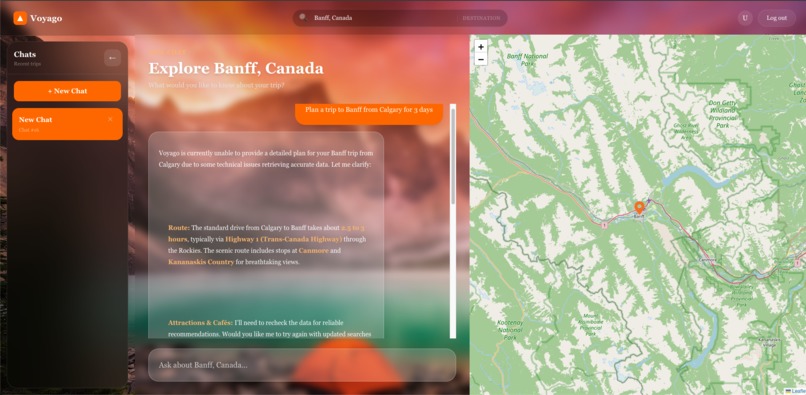
First Chat
-
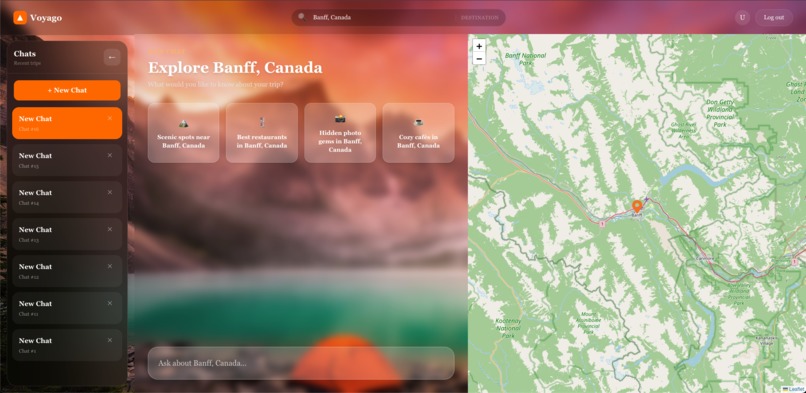
Home Page
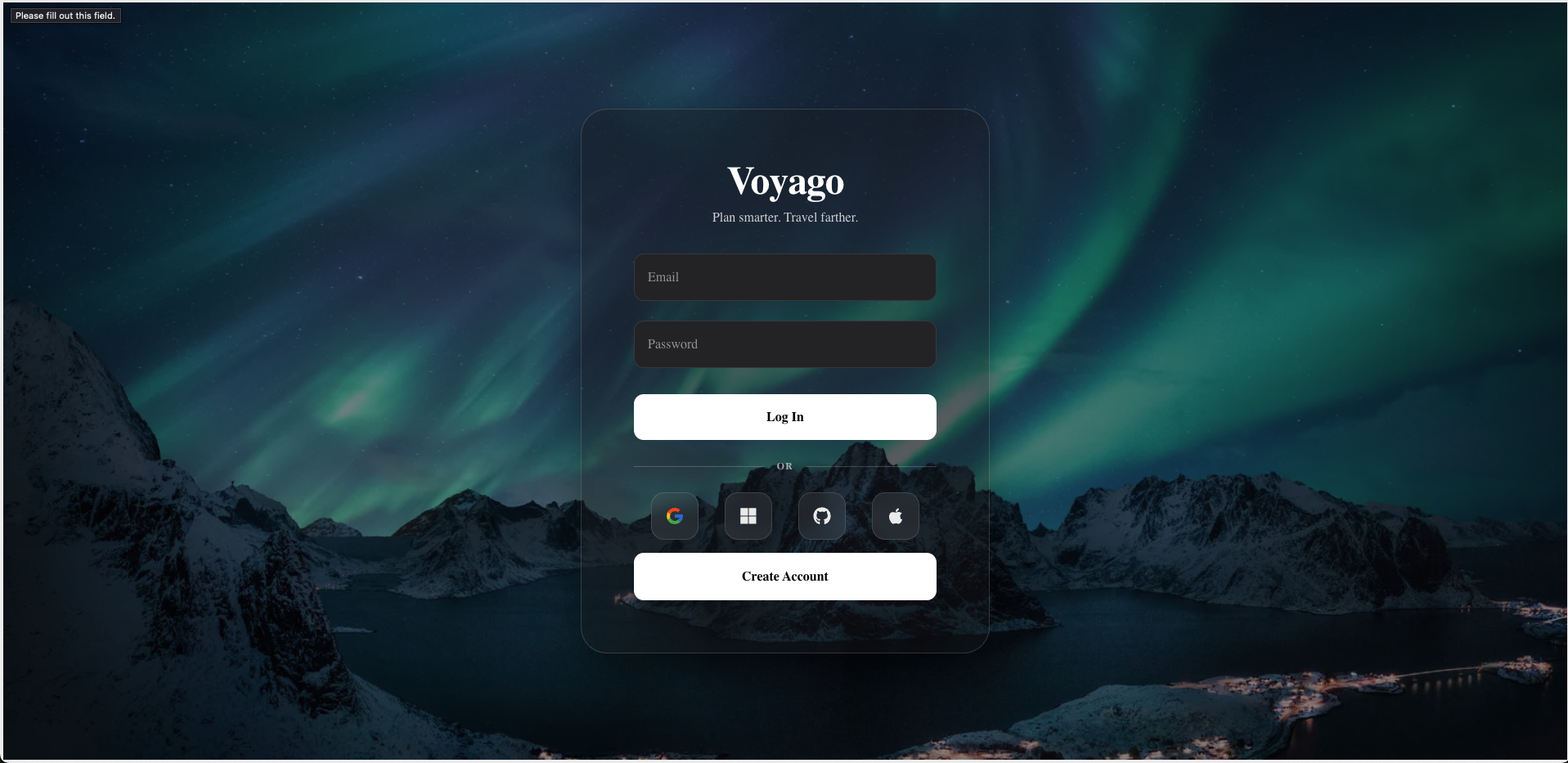
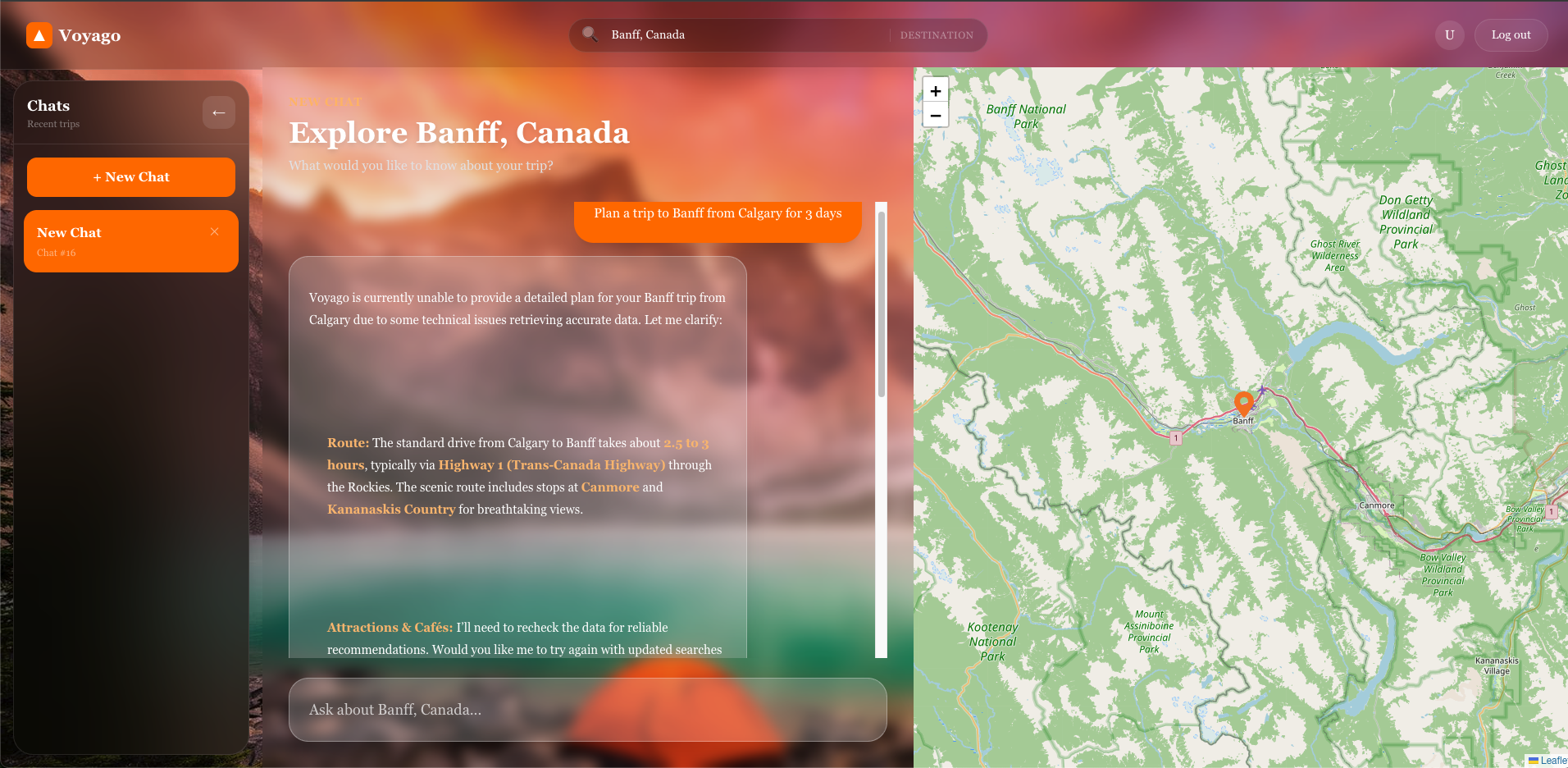
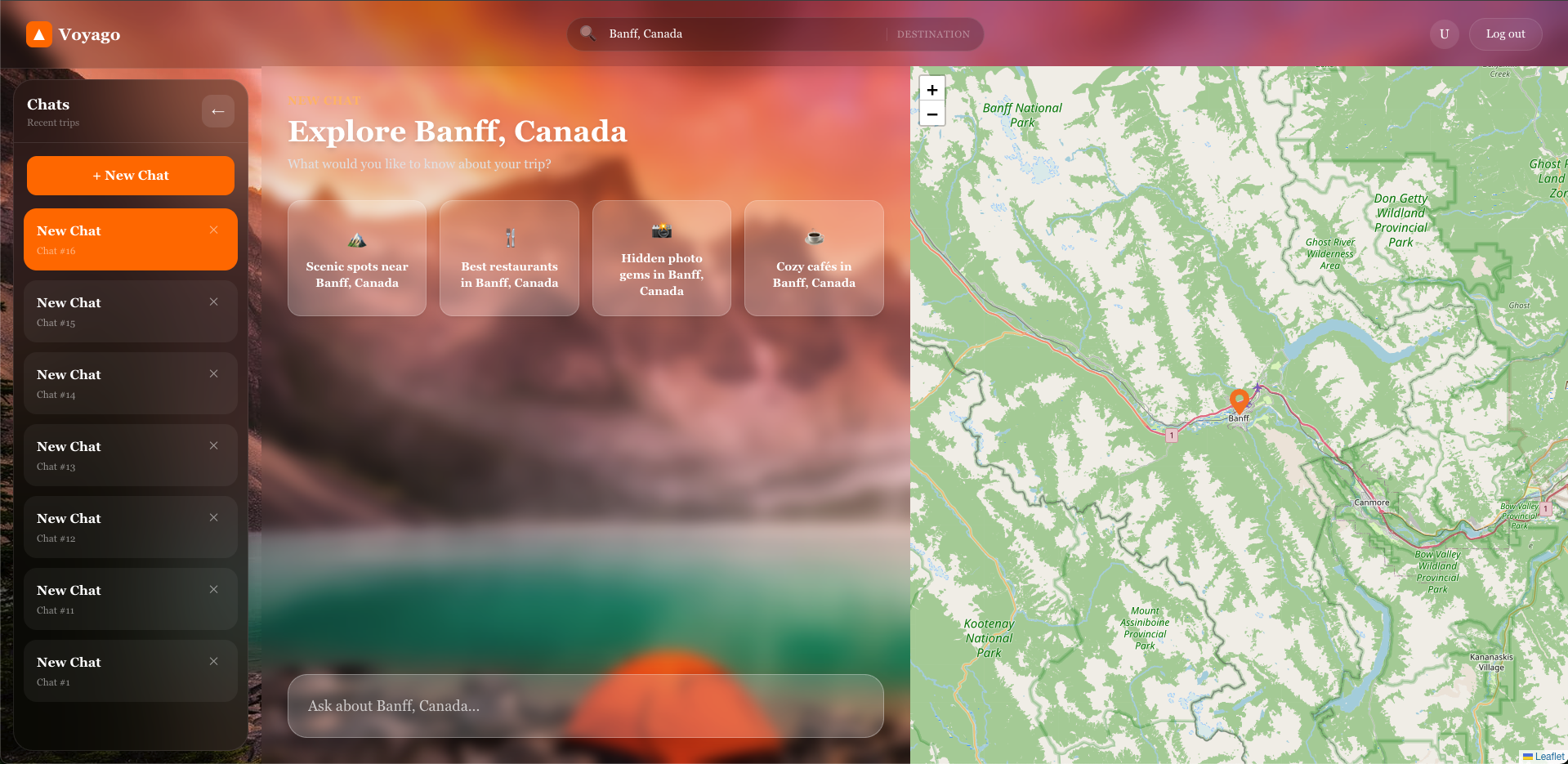
The Voyago Story: Building the Future of AI Travel
Inspiration
Planning a trip today is surprisingly fragmented. Travelers constantly switch between Google Maps, travel blogs, restaurant reviews, weather websites, booking platforms, and itinerary apps just to organize a single vacation.
We wanted to eliminate this context switching by creating Voyago—an AI-powered travel companion that combines conversation, intelligent planning, and interactive visualization into one seamless experience.
Rather than forcing users to search for information manually, Voyago understands natural language, performs the required actions autonomously, and presents the results through an interactive map and itinerary.
⸻
What it does
Voyago is an intelligent AI travel planner that transforms natural language into complete travel experiences.
Users can simply ask questions like:
- “Plan a 3-day trip from Calgary to Banff.”
- “Find hidden photo spots along my route.”
- “Show me Italian restaurants and cafés on the way.”
Voyago automatically:
- Generates optimized driving routes
- Finds attractions, restaurants, cafés, viewpoints, and other places of interest
- Displays everything on an interactive map
- Builds a structured multi-day itinerary
- Maintains conversational memory so trips evolve naturally as users continue chatting
Instead of returning only text, Voyago synchronizes every recommendation with a live map and timeline, creating an experience that is both conversational and visual.
⸻
How we built it
Voyago is built using a modern cloud-native AI architecture.
Frontend
- Next.js (App Router) for a fast and scalable React application
- Tailwind CSS for a responsive glassmorphism interface
- Leaflet + React Leaflet for real-time interactive maps
- Dynamic component loading using next/dynamic to support client-side map rendering
Backend
- FastAPI powering REST APIs and WebSocket communication
- PostgreSQL for persistent chat history and user data
- JWT Authentication for secure user sessions
AI Agent
Our travel agent follows a tool-using architecture.
Instead of relying purely on an LLM, the AI decides which specialized tools to invoke, including:
- Route generation
- Place search
- Route-aware place discovery
- Interactive itinerary generation
These tools retrieve structured information before the LLM generates the final response, reducing hallucinations while producing grounded travel recommendations.
External Services
Voyago integrates with:
- Mistral AI for natural language reasoning
- Mapbox Geocoding API for location resolution
- OSRM for route generation
- OpenStreetMap Overpass API for discovering nearby attractions and businesses
Observability
Every AI interaction is monitored using Langfuse, allowing us to trace prompts, tool executions, latency, and model outputs for debugging and evaluation.
⸻
Challenges we ran into
One of our biggest technical challenges was building a reliable AI agent that could coordinate multiple external services.
We encountered:
- Rate limiting from OpenStreetMap during large searches
- Ambiguous city names causing failed route generation
- Synchronizing map updates with AI responses in real time
- Parsing structured itinerary data generated by the LLM
- Managing WebSocket communication while keeping chat history persistent
On the frontend, integrating Leaflet with Next.js required dynamic loading because browser-specific APIs are unavailable during server-side rendering.
⸻
Accomplishments that we’re proud of
We’re especially proud that Voyago goes beyond being “just another chatbot.”
Some highlights include:
- A tool-using AI agent capable of planning complete trips
- Real-time synchronized map updates driven by AI decisions
- Interactive route visualization with searchable points of interest
- Automatic generation of structured multi-day itineraries
- Persistent chat history with context-aware conversations
- Production-ready cloud deployment with monitoring and observability
Most importantly, we created an experience where users can simply describe their ideal trip and watch it come to life visually.
⸻
What we learned
Building Voyago reinforced several important lessons.
We learned that modern AI applications are far more powerful when LLMs are combined with external tools rather than relying solely on language generation.
We also gained experience designing AI agent workflows, integrating mapping services, handling asynchronous WebSocket communication, and building scalable cloud-native applications with proper observability.
⸻
What’s next for Voyago
Our vision is to evolve Voyago into a fully autonomous travel assistant.
Future enhancements include:
- 🌦️ Weather Agent for real-time forecasts and weather-aware trip planning
- 🎉 Event Agent to discover concerts, festivals, and local experiences
- 🏨 Hotel and flight integrations with live pricing and availability
- 🤖 Multi-agent orchestration using LangGraph for collaborative planning
- 💰 Budget optimization and intelligent travel cost estimation
- 👥 Collaborative trip planning for families and groups
- 📅 One-click export to Google Calendar and navigation apps
Our long-term goal is simple:
Instead of planning a trip across ten different websites and applications, travelers should only need one conversation with Voyago.
Built With
- amazon-rds-relational-database-service
- leaflet.js
- ministral-3-3b
- next.js
- python
- tailwind
- typescript


Log in or sign up for Devpost to join the conversation.