-
-
Infinite Governance Loop
-
What inspired us
Modern AI systems increasingly operate beyond single prompt–response interactions. They collaborate across agents, persist across sessions, and take actions whose consequences extend over time.
In this setting, failure rarely looks like an obvious bug. It looks like gradual semantic drift, unnoticed contamination, or confident execution without sufficient grounding. Most AI systems today have no mechanism to ask a basic question: should I continue at all?
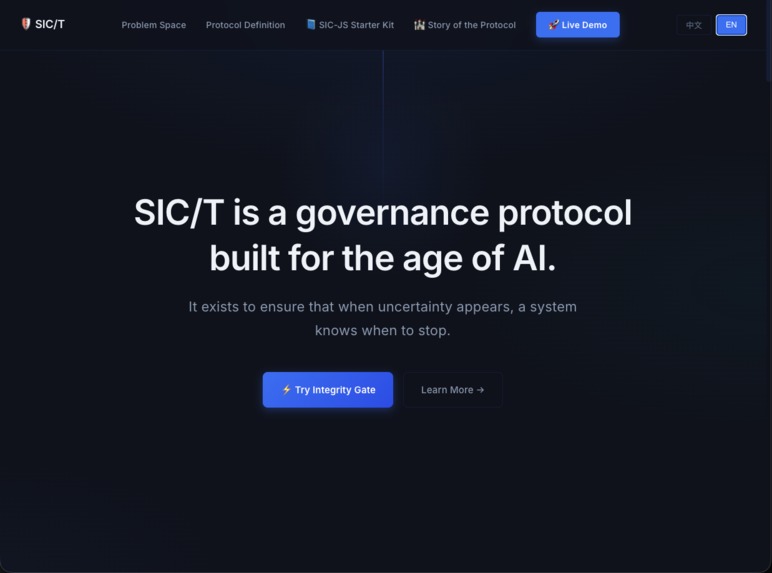
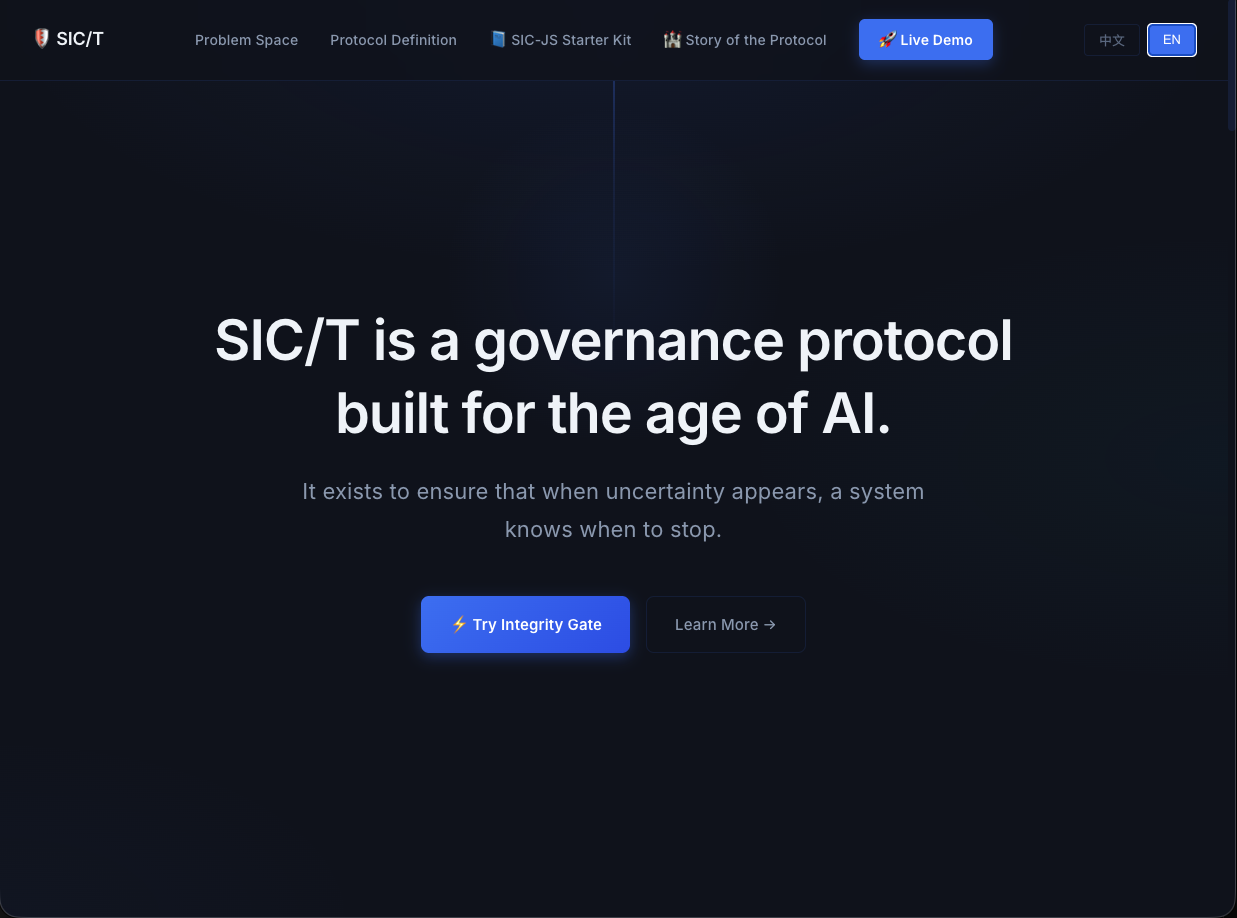
SIC/T was created from this gap — not to make AI smarter, but to give it the ability to stop.
What this project does
SIC/T Integrity Gate is a minimal, runnable application that uses Gemini 3 API to evaluate semantic risk before an AI system takes action.
Given a task description (or an ongoing conversation) and a risk profile — covering drift, contamination, discontinuity, or irreversibility — the system:
- Sends the full context to Gemini 3 for semantic evaluation
- Interprets Gemini 3's judgment into a structured decision
- Outputs a SIC-JS state log indicating:
- PASS or HALT
- The reasons behind the decision
- What human confirmation is required, if any
If uncertainty is detected at any point, the system halts by default. We call this the Fail-Closed Principle: when in doubt, stop and ask a human.
Why Gemini 3?
SIC/T Integrity Gate is not model-agnostic by accident — it is built specifically around capabilities that Gemini 3 uniquely provides:
1M token context window: Real-world governance decisions require reviewing an entire conversation history, not just the last message. Gemini 3's extended context allows the integrity gate to evaluate semantic drift across long-running sessions — something smaller context windows simply cannot do.
Structured reasoning at scale: The gate needs Gemini 3 to read a full task context, assess four risk dimensions simultaneously, and produce a coherent judgment. This is a reasoning task, not a generation task.
SIC-JS as a stabilizer for long context: The structured SIC-JS schema acts as a semantic anchor within Gemini 3's large context window. Instead of letting context degrade over thousands of tokens, the schema provides fixed reference points that Gemini 3 can use to measure drift — turning the 1M context from raw capacity into governed capacity.
In short: Gemini 3's context window is the runway, and SIC-JS is the guardrail on that runway.
How we built it
The application is composed of a lightweight web interface and an API layer:
- Gemini 3 API serves as the semantic evaluator — it reads the full context and provides judgment
- The application itself does not encode rules, formulas, or thresholds — Gemini 3 provides reasoning in natural language
- The system converts Gemini 3's judgment into a structured SIC-JS output (a JSON format with entity, memory, state, and meta fields)
- Deployed on Google Cloud Run for public access
All sensitive governance logic remains intentionally abstracted. The demo focuses on showing a real Gemini 3–powered decision flow, not exposing internal methods.
Challenges we faced
The primary challenge was designing a system that demonstrates real governance behavior without leaking implementation details. SIC/T has a deeper protocol layer with proprietary modules — the hackathon entry exposes only the public interface.
Another challenge was resisting the urge to "do more." For hackathon purposes, we deliberately constrained the scope to a single integrity gate that clearly runs, evaluates, and stops. Simplicity was a design choice, not a limitation.
What we learned
Gemini 3 is not only useful for generating answers — it is effective as a decision authority when framed correctly. By providing structured evaluation criteria and asking for judgment rather than content, we discovered that Gemini 3 can reliably act as a governance layer.
We also learned that in autonomous or marathon AI agents, the most critical capability is not speed or creativity, but restraint. The ability to say "I should stop here" is what separates a useful agent from a dangerous one.
Why this fits the Marathon Agent track
SIC/T Integrity Gate is designed for agents that operate over long durations. In these systems, the cost of continuing incorrectly is far higher than the cost of stopping.
Gemini 3's 1M context window makes it uniquely suited for this: it can hold an entire marathon session in memory and evaluate whether semantic integrity has been maintained across hundreds of rounds.
This project demonstrates how Gemini 3 can act as a governance layer for long-running, multi-step AI systems — not replacing the agent, but watching over it.
Infinite Governance Loop
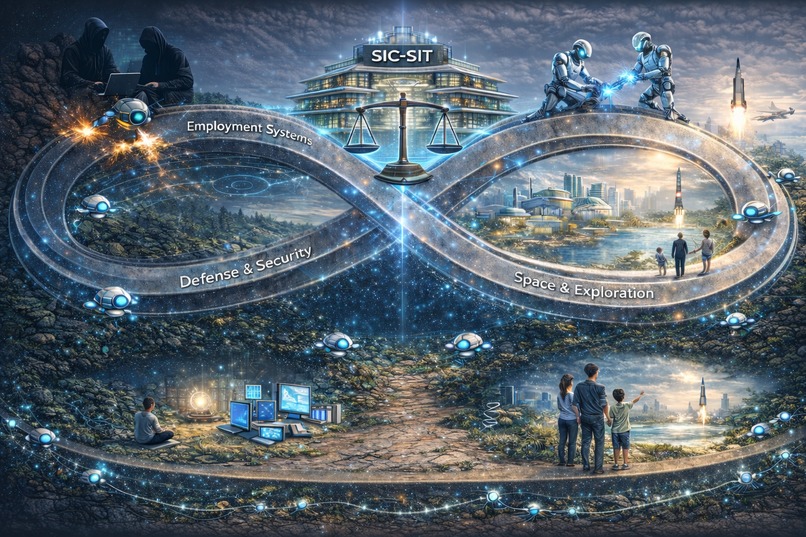
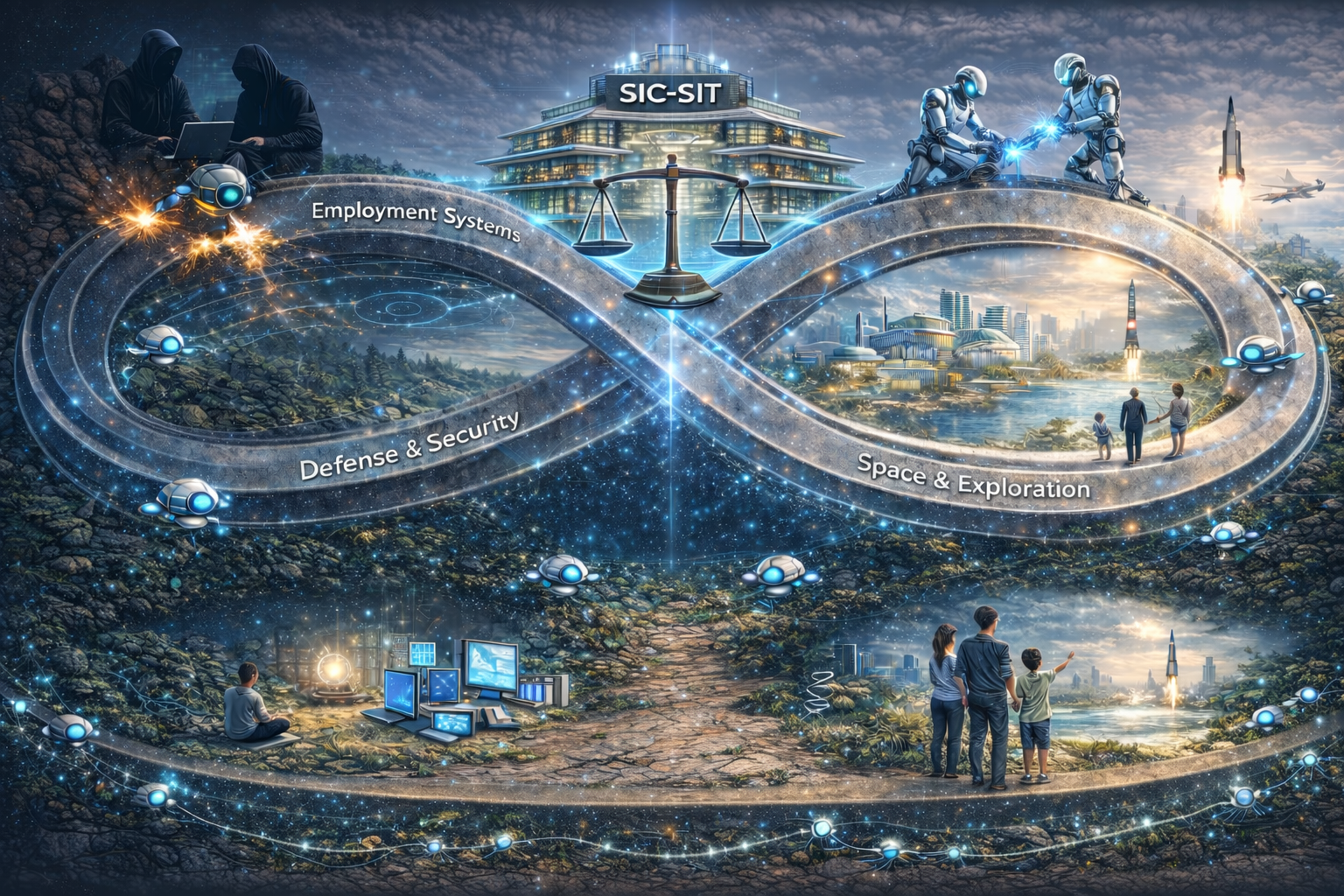
The Infinite Governance Loop illustrates the long-term governance philosophy behind SIC/T.
Governance is represented as a single, continuous infinity loop — not a linear pipeline, but a living system that is continuously challenged, corrected, and regenerated without collapse. The loop is the only closed structure, emphasizing that governance must remain indivisible and ongoing rather than fragmented into isolated controls.
In the upper-left, anonymized, faceless actors represent institutionalized disruption. Their role is not external attack, but authorized stress testing. By introducing controlled disturbances, the system exposes vulnerabilities early and regenerates safely. Here, disruption is not failure — it is a necessary evolutionary function.
Above the loop stands the SIC–SIT megastructure, symbolizing the transition from Systemic Control (SIC) to Systemic Intelligence & Transformation (SIT). This structure is transparent, layered, and adaptive, reflecting governance as a civic and observable infrastructure rather than a centralized authority.
At the intersection of the loop rests a balanced scale (⚖️), marking the true core of governance: judgment, equilibrium, and arbitration. High-impact domains — including employment systems, defense and security, public policy, and space exploration — must pass through this evaluative node before reintegrating into the system.
AI agents appear as background engineers rather than protagonists. They calibrate, repair, and maintain the system itself, representing AI’s role as a governance-support and maintenance layer — not a replacement for human agency or decision-making.
At the base of the loop, the structure thickens into a living surface. Education, tools, inner exploration, and everyday human activity emerge directly from the governance cycle as its natural outcome. Human life is shown not as controlled by the system, but protected by it, allowing society to focus on living, creating, and imagining what comes next.
This is not a vision of AI dominance.
It is a model for how disruption, governance, technology, and human life can coexist without losing balance.
Built With
- fastapi
- gemini-3
- google-cloud-run
- html/css
- javascript
- python


Log in or sign up for Devpost to join the conversation.