Inspiration
Air traffic control is one of the most complex and high-stakes professions in the world. Controllers must monitor dozens of aircraft simultaneously, interpret continuous streams of real-time data, and make split-second decisions using precise, standardized communication.
Instead of navigating multiple radar displays, flight strips, and decision-support tools, what if controllers could ask direct questions like “Which arrivals will conflict with runway 28 in the next 10 minutes?” or “Show me all aircraft descending through 10,000 feet in this sector” and get instant, context-aware answers?
This led to AI Traffic Control (AITC), an intelligent assistant that lets ATC controllers interact with real-time aviation data by asking questions like “Where is flight UAL123?” or “Show arrivals at JFK.” Instead of navigating complex dashboards, memorizing API parameters, and being overloaded with immense information, ATC controllers get instant answers with visual map overlays.
Our goal is to explore how AI agents can act as intelligent copilots for ATC that continuously monitoring live flight data, understanding controller intent, and surfacing relevant information at the moment it’s needed, without disrupting existing workflows.
What it does
AITC is a cross-platform desktop application that combines AI reasoning with live global flight tracking.
Natural language flight queries
- Find flight DLH456
- Show flights over California
- What are the arrivals at Frankfurt airport?
- Get the trajectory for AAL100
Real-time flight tracking (OpenSky Network API)
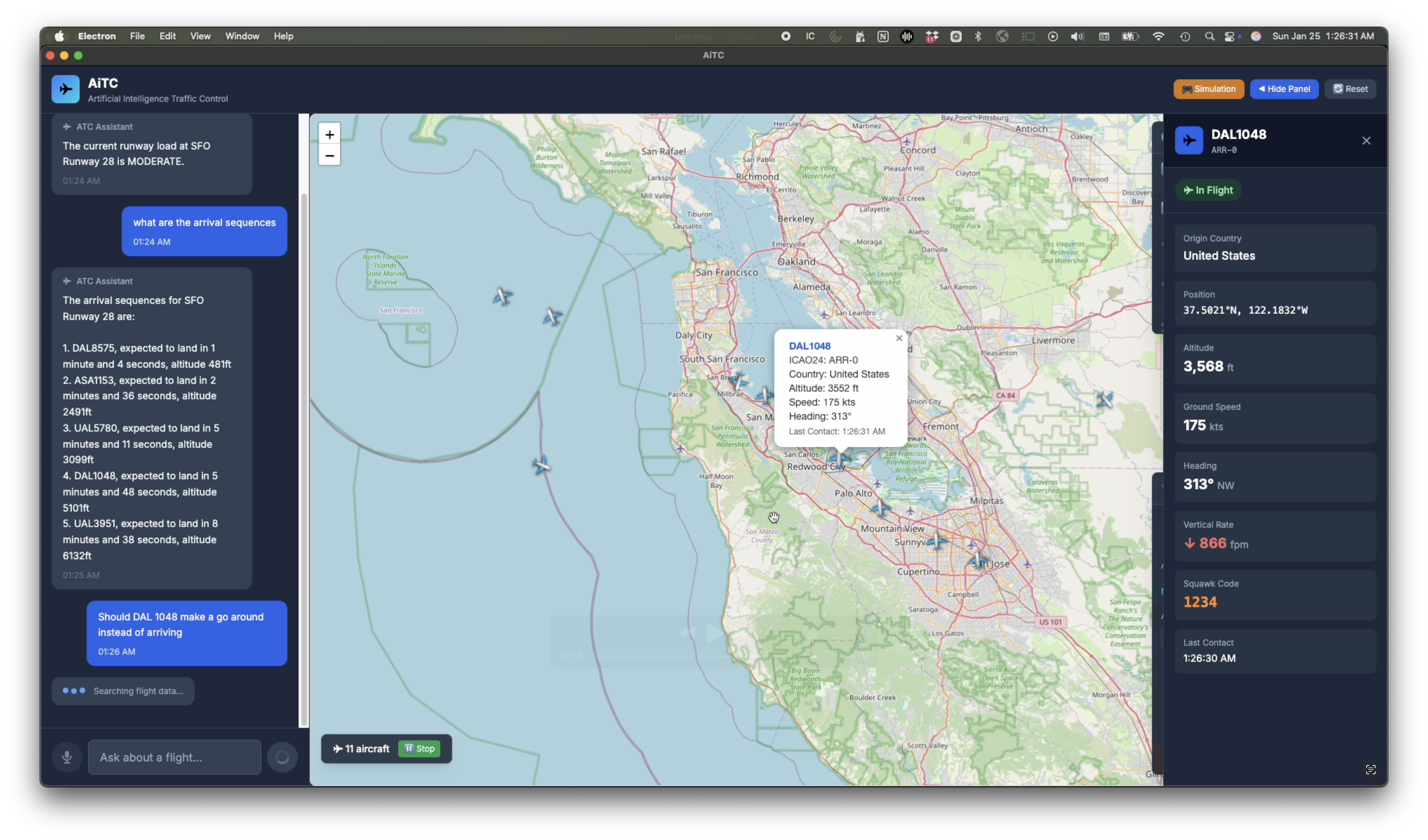
- Live position, altitude, velocity, vertical rate, and heading
- Callsign and ICAO24 identifier
- Origin country and squawk code
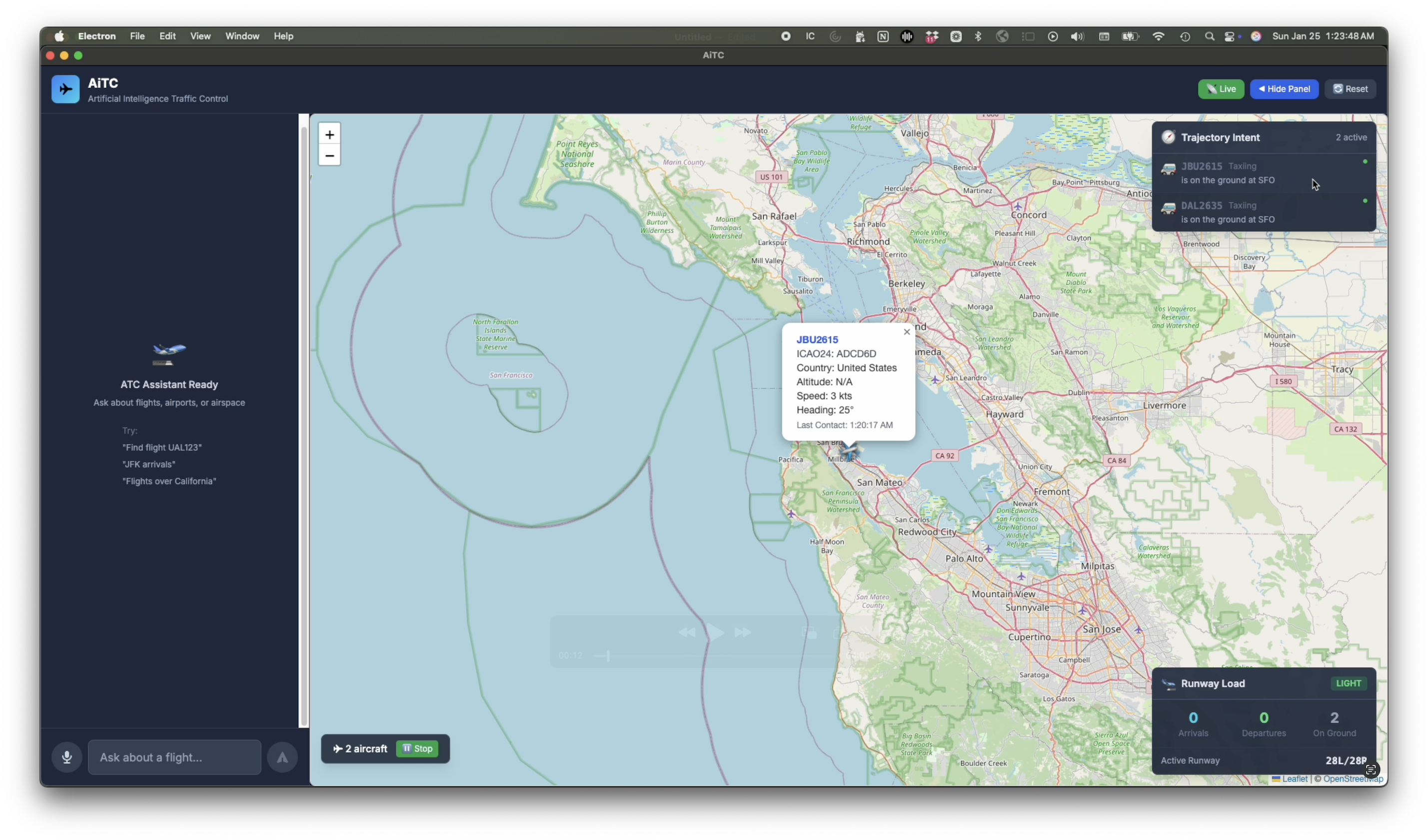
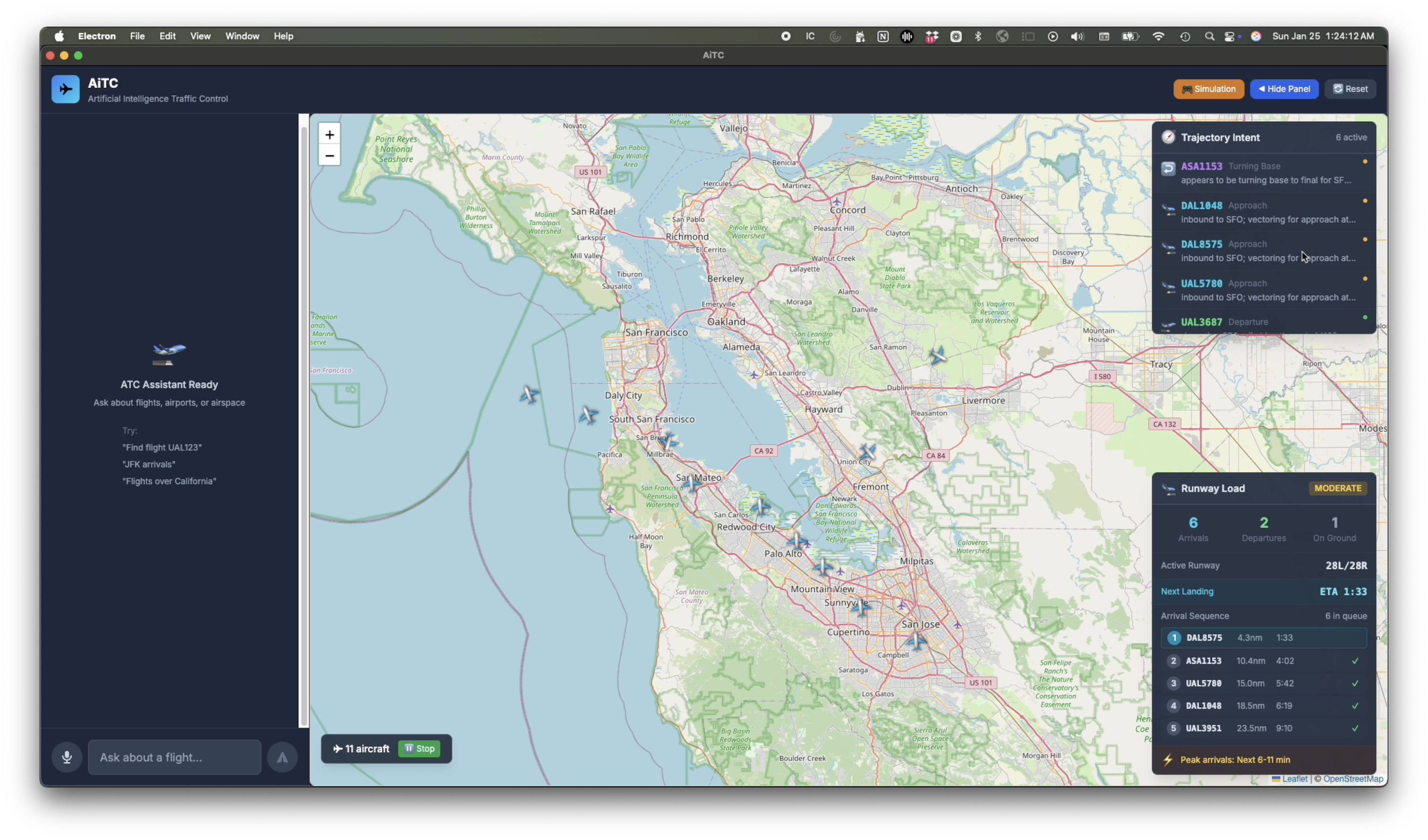
Interactive map visualization
- Leaflet-based world map with aircraft markers
- Airplane icons rotate based on heading
- Click-to-select aircraft for detailed information
- Historical trajectory overlays
AI-powered intelligence
- LangGraph-based agentic architecture
- Automatic tool selection based on query intent
- Context-aware responses with formatted flight data
- Supports both cloud (Gemini) and local (Ollama / Llama 3.2) LLMs
Airport operations
- Recent arrivals and departures at any airport
- Automatic ICAO airport code resolution (JFK → KJFK)
- Historical flight data up to 48 hours
How we built it
AITC is built as an Electron desktop application with a React frontend and a Python-based AI backend.
Frontend (React + TypeScript)
- Main dashboard layout
- Leaflet map for real-time aircraft visualization
- Chat interface and flight detail panels
- Natural language input component
AI backend (Python + LangGraph)
- Seven specialized tools:
search_flight_by_callsignget_current_flight_stateget_flights_in_areaget_aircraft_flight_historyget_airport_arrivalsget_airport_departuresget_aircraft_trajectory
- ReAct-style loop: interpret intent, select tool, execute, and synthesize results
Frontend–backend integration
- Electron spawns a Python subprocess for each query
- Natural language input is sent to the LangGraph agent
- Formatted results update the UI and map in real time
Privacy-first design
- Google Gemini for cloud inference
- Ollama (Llama 3.2) for fully local inference
Challenges we ran into
- API rate limiting required throttling, request queuing, caching, and fallback data
- Real-time map updates required careful synchronization and animation handling
- Natural language variability required regex-based intent parsing and airport aliases
- Reliable LLM tool calling required careful prompt and system message design
Accomplishments that we’re proud of
- Natural language interface for complex aviation data
- Live global flight visualization with trajectory overlays
- Dual support for cloud and fully local AI models
- Production-ready cross-platform desktop application
- Modular and extensible architecture
What we learned
- Building agentic AI systems with LangGraph
- Electron IPC and Python subprocess orchestration
- Aviation data standards (ICAO, squawk codes, state vectors)
- Designing around strict third-party API limits
- Real-time geospatial visualization with Leaflet
What’s next for AI Traffic Control (AITC)
- Voice input for hands-free queries
- Predictive alerts for emergencies and anomalies
- Multi-aircraft pinning and trajectory comparison
- Historical playback with timeline controls
- Weather overlays using METAR and TAF data
- Mobile companion app with React Native


Log in or sign up for Devpost to join the conversation.