Inspiration
In September 2015, 193 world leaders agreed to 17 Global Goals for Sustainable Development. If these Goals are completed, it would mean an end to extreme poverty, inequality and climate change by 2030, but it's the role of every one of us to ensure we help to deliver these goals. What's Missing? A quick and efficient way to generate ideas on how to deliver this goals.
Artificial Intelligence is frequently in the headlines these days, sometimes portrayed in apocalyptic terms as the technology that will take over our jobs or even our lives. But what if it could also become a valuable tool in the worldwide efforts to achieve the UN’s Sustainable Development Goals?
What it does
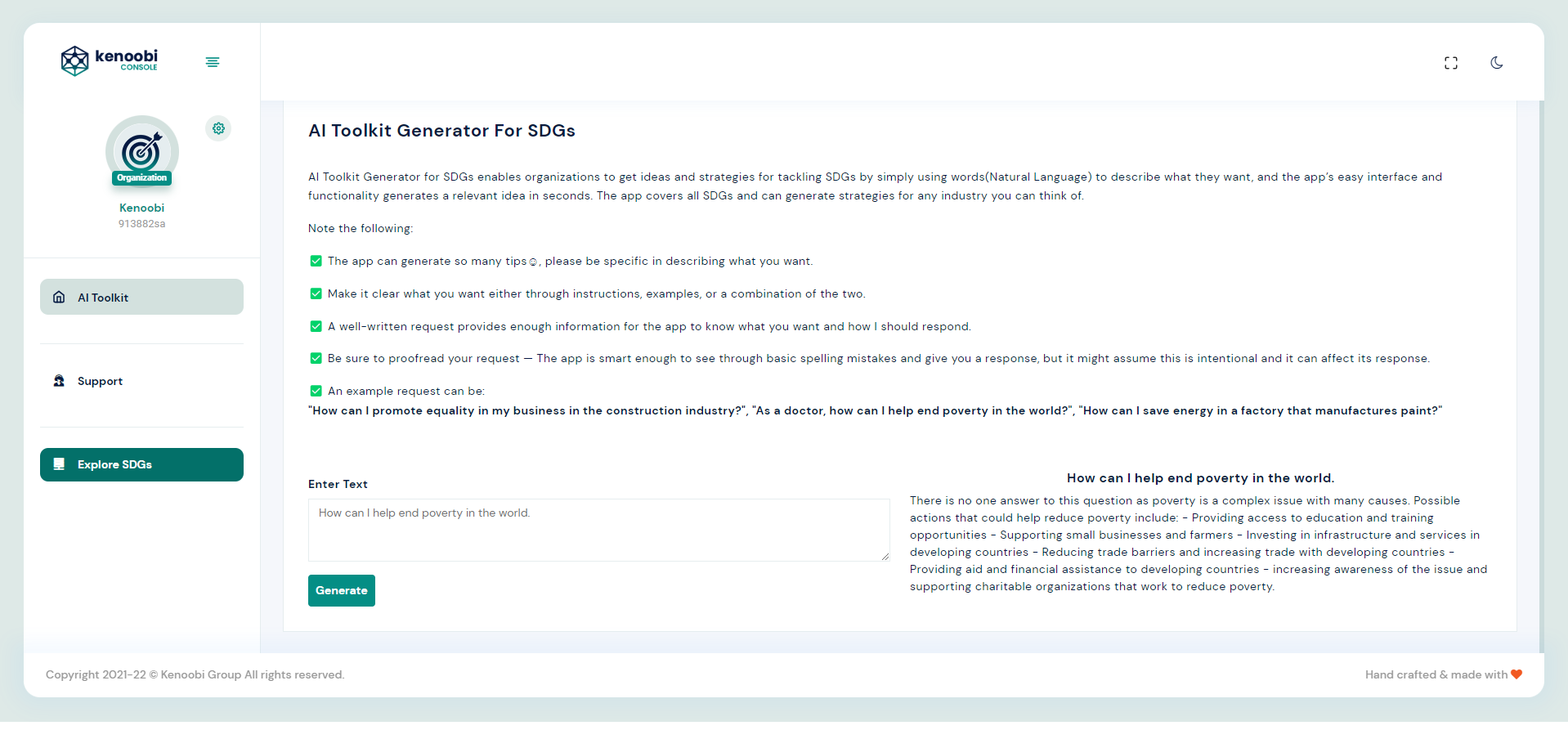
AI Toolkit Generator for SDGs enables organizations to get ideas and strategies for tackling SDGs by simply using words(Natural Language) to describe what they want, and the app’s easy interface and functionality generates a relevant idea in seconds. The app covers all SDGs and can generate strategies for any industry you can think of.
Note the following:
✅ The app can generate so many tips☺️, please be specific in describing what you want.
✅ Make it clear what you want either through instructions, examples, or a combination of the two.
✅ A well-written request provides enough information for the app to know what you want and how I should respond.
✅ Be sure to proofread your request — The app is smart enough to see through basic spelling mistakes and give you a response, but it might assume this is intentional and it can affect its response.
✅ An example request can be: "How can I promote equality in my business in the construction industry?", "As a doctor, how can I help end poverty in the world?", "How can I save energy in a factory that manufactures paint?"
AI is not a silver bullet for all of humanity’s problems. But it has the potential to be a formidable tool in the toolkit. For that to happen, we need to encourage the development of applications, and push for them to be used at scale in a responsible and thoughtful manner.
How we built it
We built it using Azure Open AI service to leverage Microsoft's large-scale, generative AI models with deep understandings of language and code to enable the app to respond in a very intelligent way. We used HTML5, Javascript and PHP for the interface.
Challenges we ran into
Getting the initial stack setup with Azure proved trickier and more time consuming than we thought. We investigated several solutions then we succeeded after going through the documentation.
On the product side, getting the AI model integration with SDGs right was also very challenging and took a number of iterations to get right.
Accomplishments that we're proud of
We are both very happy with the final design of AI Toolkit Generator for SDGs. It's incredibly simple, yet very powerful. We've also added support for all the 17 SDG making it useful for everyone.
On the technical side we are both proud of the Azure AI stack we've developed. The front-end will make it easy to port this app to mobile in the future and the cloud back-end stack will be an incredibly cost-effective way to host this app.
What we learned
Working on this app taught us a lot about the Azure AI stack and developing a scalable cloud application. We were worried that we could not achieve a fast development speed using Azure. After a few hours learning on how Azure AI stack works, these fears proved to be unfounded.
What's next for AI Toolkit Generator for SDGs
We will ask for user feedback directly in the product in a number of places. With our infrastructure adding more integrations is now incredibly simple and we'll be able to respond to these user suggestions within a couple of days and build a more fully featured product that will hopefully delight customers! We also want to add more AI integrations to really open up Azure to other systems in use out there.

Log in or sign up for Devpost to join the conversation.