-
-
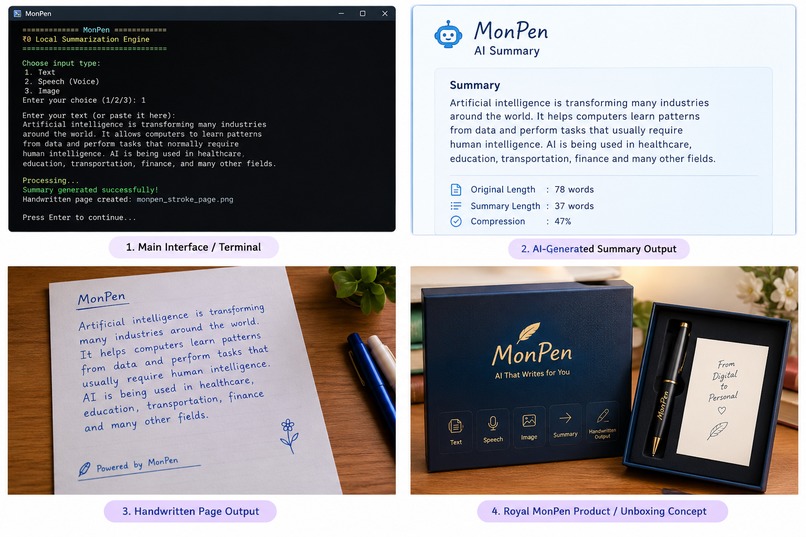
MonPen — From Digital Information to AI-Powered Handwritten Output
Inspiration
We were inspired by a simple question: what if AI could do more than generate text on a screen? Most AI assistants help users read, write, or summarize digitally, but the final result still remains inside a device.
MonPen was created to bridge that gap. We wanted to combine AI/ML with the familiar and personal experience of handwriting. The idea is to transform digital information into concise, meaningful handwritten content—making AI output feel more human, tangible, and useful.
What it does
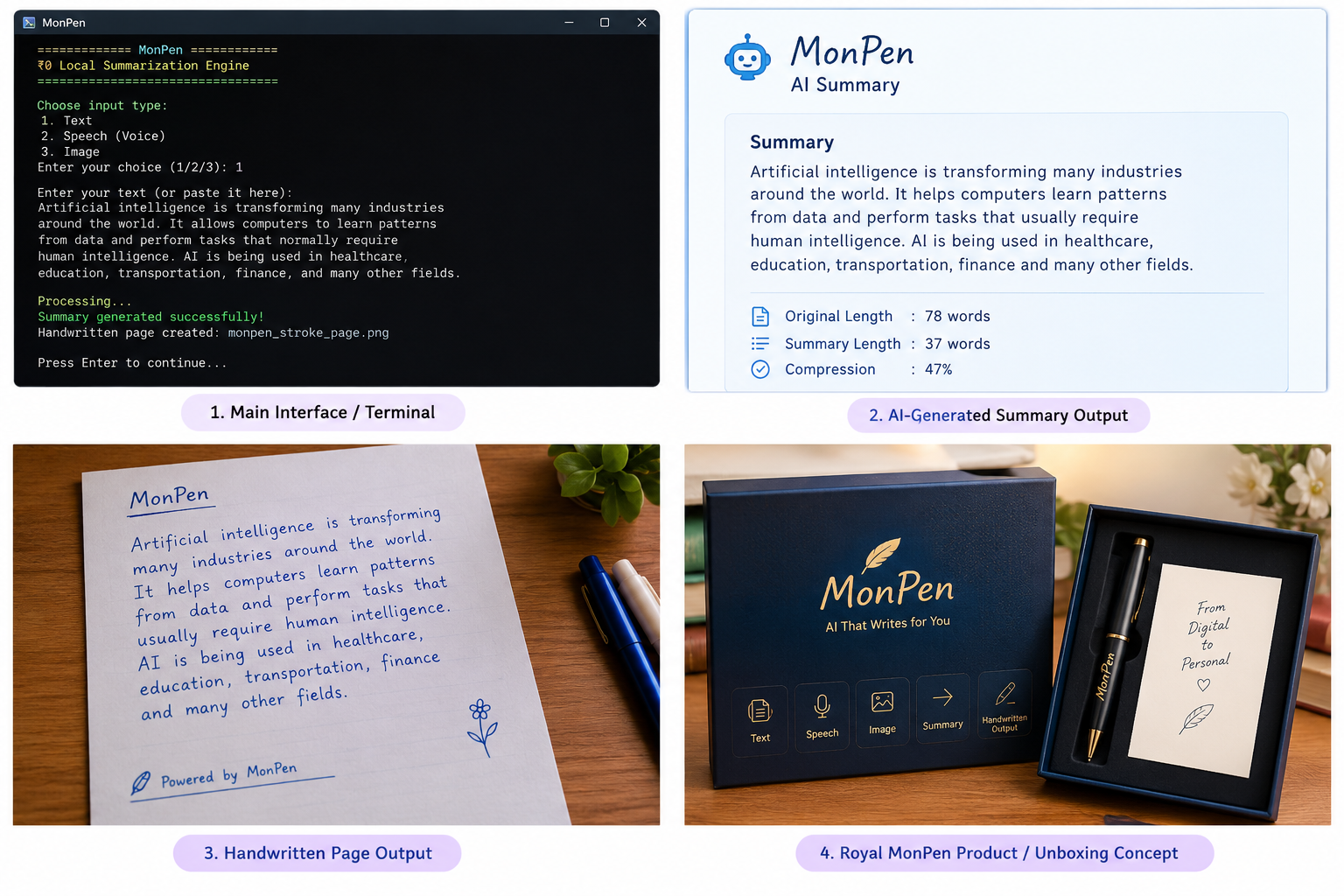
MonPen is an AI-powered writing assistant that accepts text, speech, or images as input. It extracts or understands the content, generates a concise summary using local AI/ML, checks the available writing space, and converts the final content into handwritten-style output.
Unlike typical AI tools that stop at generating text, MonPen takes the extra step of turning AI-generated understanding into a physical-writing experience through its procedural handwriting engine.
How we built it
We built MonPen as a modular Python-based AI/ML prototype. The pipeline combines SpeechRecognition for voice input, Tesseract OCR for image-to-text conversion, a local TF-IDF and sentence-scoring approach for extractive summarization, a space-monitoring module, and a custom procedural stroke engine for handwriting generation.
The modules are integrated through a single command-line application. The core prototype is designed to run locally with ₹0 AI API cost, making the system lightweight and accessible.
Challenges we ran into
One major challenge was building a complete pipeline instead of creating only an AI demo. Input processing, summarization, space checking, and handwriting generation all had to work together reliably.
Another challenge was generating handwriting procedurally while maintaining readable letter shapes and consistent output. We also had to design the prototype around a ₹0-cost local approach rather than depending on paid AI APIs.
Accomplishments that we're proud of
We are proud that MonPen evolved from an idea into a working end-to-end prototype.
It can accept multiple forms of input, summarize content locally, monitor writing-space requirements, and generate a complete handwritten-style page. Most importantly, we built something different from a conventional AI chatbot: MonPen connects AI/ML with the experience of handwriting and creates a tangible-style output from digital information.
What we learned
We learned that building an AI product is not only about choosing a model. The real challenge is designing the complete pipeline around the model and making different components work together.
We also learned about OCR, speech processing, extractive summarization, procedural graphics, modular Python architecture, and the importance of designing AI systems around real user needs rather than only demonstrating a model.
What's next for AI That Writes for You.
The next step is to connect MonPen's software intelligence with a physical writing mechanism. Future versions could support real pen movement, automatic page handling, personalized handwriting styles, multilingual writing, and smarter space optimization.
Our long-term vision is to make MonPen an autonomous writing assistant that can understand information, decide what is important, and reproduce it naturally as handwriting—bringing AI from the screen to the page.
Built With
- a
- and
- built-with:-python
- custom
- handwriting
- numpy
- pillow
- procedural
- scikit-learn
- speechrecognition
- tesseract-ocr

Log in or sign up for Devpost to join the conversation.