Inspiration
Hackathons are about building, but they often start with hours of wasted time. Finding a teammate through manual spreadsheets or endless scrolling is a major bottleneck. We wanted to create a "Virtual CTO" that could instantly scan a massive talent pool and architect the perfect team based on project intent, not just keyword matching.
What it does
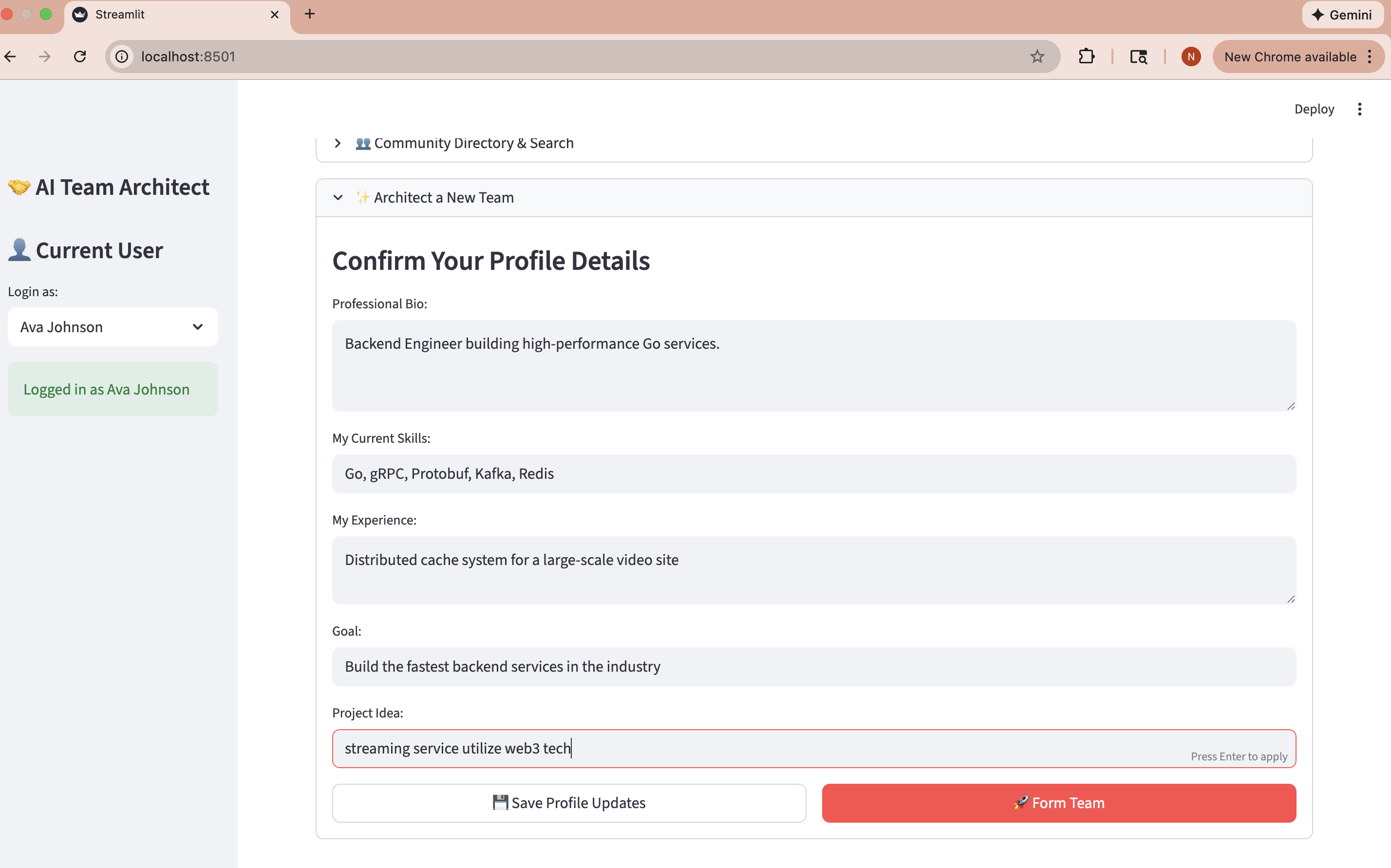
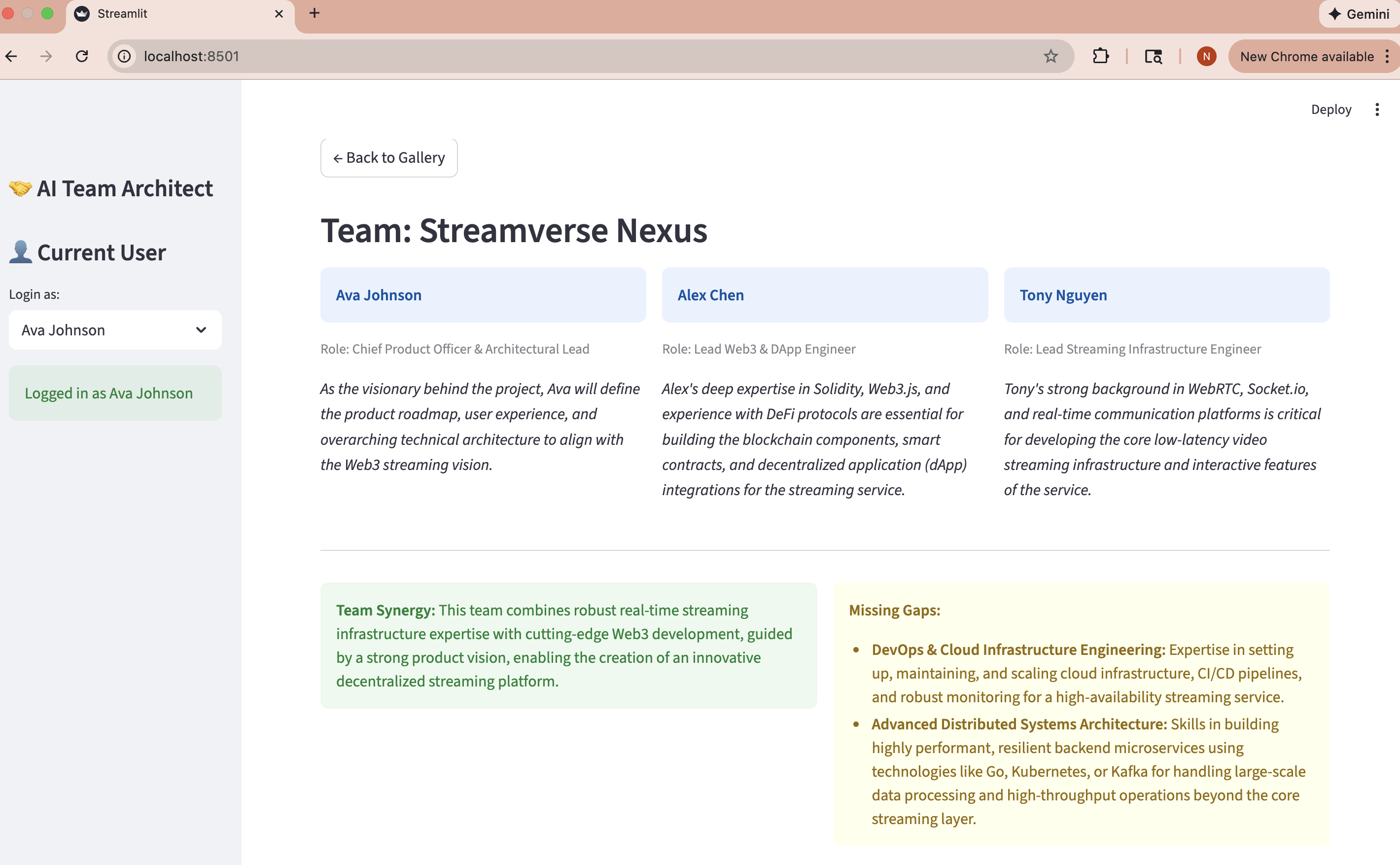
Whether for a hackathon, school project, or startup, the platform eliminates the hours spent manually scrolling through profiles. By inputting a project idea, the system identifies the most compatible teammates and provides a structured plan for how they should work together.
How we built it
We built a two-stage RAG (Retrieval-Augmented Generation) pipeline:
Database & Search: We stored 100+ hacker profiles in Snowflake. We utilized Snowflake Cortex Search to perform semantic vector retrieval.
Intelligence: We used the Gemini 2.5 Flash API to process the top candidates. It acts as the brain, assigning technical roles and evaluating team chemistry.
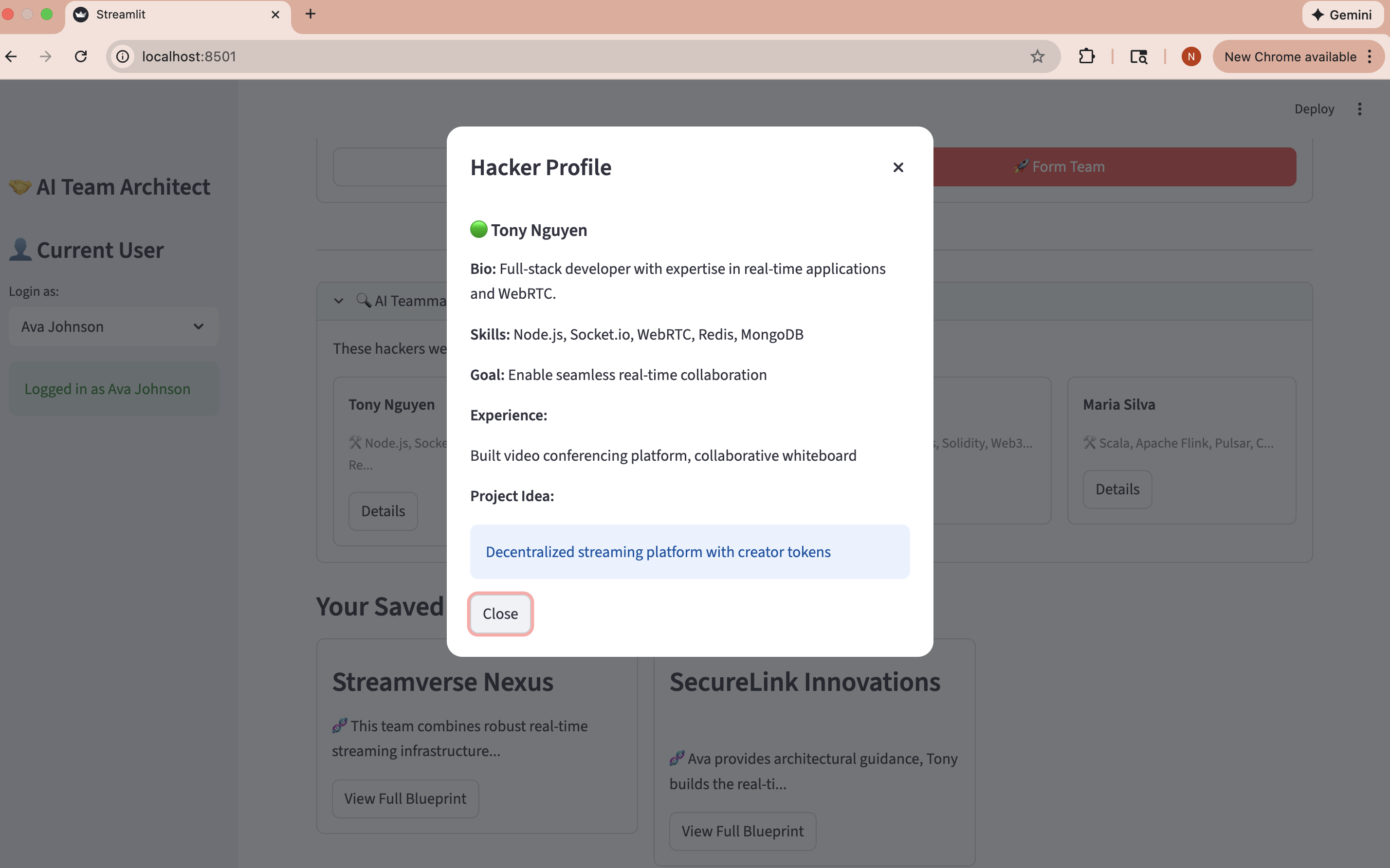
Frontend: A Streamlit dashboard with a persistent sidebar architect and a saved blueprint gallery.
Challenges we ran into
Time Management & The Learning Curve: As first-time users of Streamlit and Snowflake, the initial setup took longer than expected. We had to balance learning the nuances of Snowflake’s st.connection while simultaneously building out a complex UI and managing the Gemini API's JSON response handling.
The "Freshness" Lag Snowflake Cortex Search has a 1-minute indexing lag. This meant that if a user updated their skills and clicked "Form Team" immediately, the search would use their old data, resulting in poor matches during a fast-paced demo. The Solution: Context-Aware Retrieval We solved this by injecting the user's real-time UI inputs (Skills and Bio) directly into the search query string. Instead of just searching for the "Project Idea," we sent a "Semantic Super-Query" to Cortex. This bypassed the indexing delay entirely, ensuring instant, accurate matches based on the user's latest profile change
Accomplishments that we're proud of
100-Hacker Scale: We successfully scaled the application from a small test set to a robust database of 100+ unique, specialized hacker profiles. This allowed us to prove that the system can handle the "needle in a haystack" problem found in real-world communities.
The Two-Stage AI Pipeline: We are incredibly proud of our hybrid architecture. By using Snowflake Cortex for high-speed semantic retrieval and Gemini 2.5 Flash for deep reasoning, we built a system that is both fast and intelligent.
What we learned
First-Time Technical Wins: This was our first time working with both Streamlit and Snowflake. We learned how to bridge the gap between a high-performance data warehouse and a rapid-prototyping frontend. Learning to manage Snowflake connections and stream data into Streamlit’s session state was a rewarding "zero-to-one" experience.
What's next for AI Team Architect
Robust Data Self-Healing: Our next priority is implementing a "Dynamic Context Injection" layer. For users with incomplete profiles, we will use Snowflake Cortex to infer missing skills based on their past projects and goals.
From Blueprints to Reality: We plan to move beyond static plans by implementing a "Team Invite" system. Instead of just viewing a blueprint, users will be able to trigger automated invites, turning the AI's suggestion into an active workspace.
AI-Moderated Brainstorming: We want to integrate Gemini directly into a team chat feature. The AI won't just form the team; it will stay in the group to act as a Project Mediator, helping the newly formed trio brainstorm architecture and break down the project into initial tasks.
Predictive Success Modeling: By analyzing past hackathon winning teams, we hope to build a predictive model within Snowflake that calculates a "Success Probability" for any given trio based on historical data.
Built With
- gemini
- snowflake
- streamlit

Log in or sign up for Devpost to join the conversation.