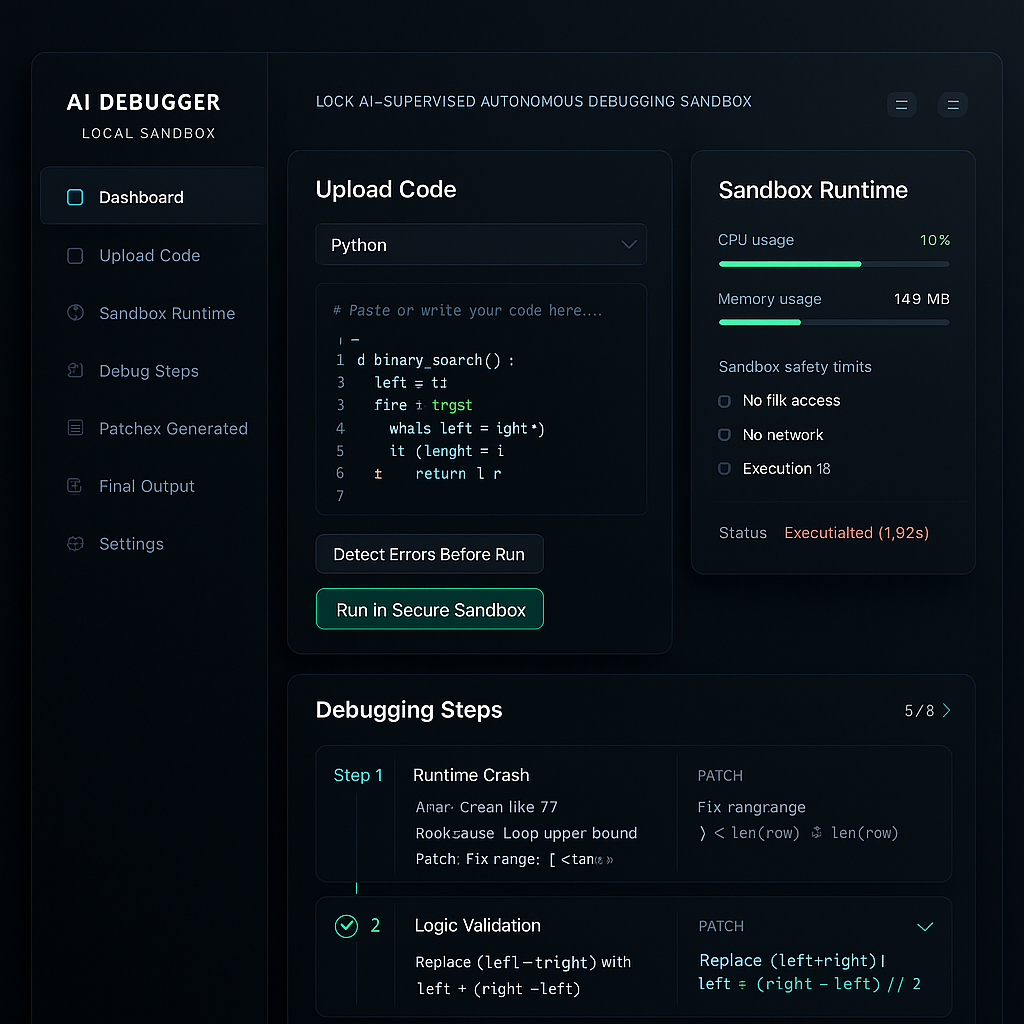
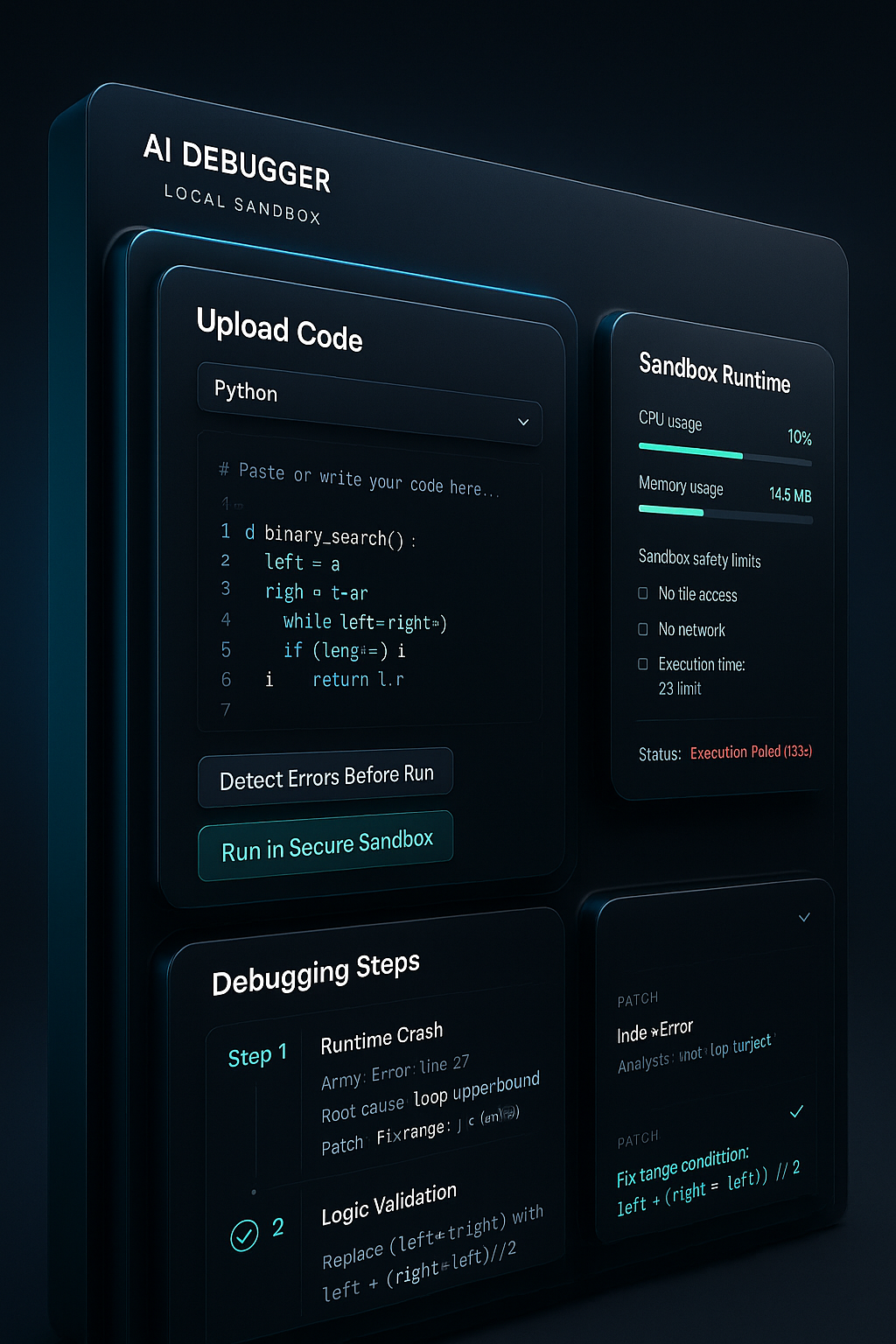
Software debugging remains one of the most time-consuming and mentally draining parts of development. Developers often spend more time locating the error than fixing it. We wanted to create a system that not only detects bugs automatically, but understands them, reasons about them, and fixes them with human-like clarity.
Our inspiration came from imagining a world where debugging is no longer a bottleneck — where AI continuously supervises, corrects, and teaches developers through transparent reasoning. The goal: reduce debugging time from hours to seconds while making the process educational rather than frustrating.
AI Autonous debugging sandbox
⚙️ What it does
The AI-Supervised Autonomous Debugging System is a fully automated pipeline that:
Accepts raw source code or prior execution logs
Runs the code inside a secure sandbox
Observes and extracts errors via Regex, AST analysis, and dependency graphs
Selects the optimal repair strategy dynamically (Edit Distance, CSP Solver, Pattern Clustering + Bayesian inference)
Generates precise patches with reasons and confidence scores
Applies the fix, re-executes the code, and repeats until success
Produces a complete debugging report that includes:
Final repaired code
All patches applied
Execution logs
Iteration-wise reasoning
In short: 👉 It autonomously debugs code with explainable, self-supervised corrections.
AI Autonous debugging sandbox
🛠️ How we built it
We structured the system into a tightly integrated 7-phase pipeline:
1️⃣ Input Phase — Structured Intake
Accepts raw code or stack traces
Prepares syntax checks or structured JSON error extraction via Regex + AST
2️⃣ Run Phase — Secure Execution
Executes code in an isolated sandbox
Captures errors, outputs, logs, and tracebacks
3️⃣ Observe Phase — Understanding the Error
AST-based mapping of failures to exact code nodes
Extracts error type, line numbers, root cause
Builds an Error Dependency Graph to prioritize multi-error scenarios
4️⃣ Patch Phase — Intelligent Repair Selection
Depending on the error type, the system picks the best algorithm:
Edit Distance → minor syntax or small logic corrections
Constraint Satisfaction Solver (CSP) → complex or interdependent errors
Pattern Clustering + Bayesian inference → recurring or high-probability bug classes Each patch includes: reasoning, confidence score, and expected iteration count. Optionally stored via a Merkle Tree for versioning.
5️⃣ Apply Phase — Code Modification
Applies diff or AST-based modifications
Maintains internal version history of fixes
6️⃣ Re-Run Phase — Verification Loop
Executes patched code again
Re-checks for remaining errors
Iterates automatically 3–5 cycles until the code is clean
7️⃣ Output Phase — Final Debug Package
Final corrected code
Patch logs and reasoning
Execution traces across iterations
Success/failure summary
This architecture makes the system modular, interpretable, and highly scalable.
AI Autonous debugging sandbox
🧗 Challenges we ran into
Mapping runtime errors to exact AST nodes without losing context
Designing a generic algorithm-selection engine that chooses the optimal repair tactic
Preventing cascading errors in multi-iteration debugging loops
Ensuring patches remain minimal and safe, not over-corrective
Recording version history efficiently using Merkle-style diff structures
Balancing automation with explainability — every fix needed a human-understandable reason
🏆 Accomplishments that we’re proud of
Built a complete end-to-end self-supervised debugging loop
Designed a rule-based algorithm selector that chooses the right repair method automatically
Achieved high precision patching using AST-aware modifications
Implemented an error dependency graph to solve multi-error programs intelligently
Created human-readable reasoning for every fix, making debugging educational
Ensured fully autonomous operation — no manual intervention required after code upload
📚 What we learned
The importance of structured debugging pipelines in autonomous systems
How ASTs and Regex complement each other for error extraction
How to build explainable AI systems that don't act like black boxes
That debugging isn’t just about fixing errors — it’s about understanding them
How small patches applied iteratively outperform one large speculative correction
The value of confidence scoring and patch metadata in trust-building with users
🔮 What’s next for AI-Supervised Learning System
Integrating LLM-powered semantic reasoning for deeper code understanding
Live debugging mode: evaluate code while the user types
Multi-file and multi-module debugging support
Incorporating unit test generation to validate patches automatically
Building a plug-and-play API for IDEs (VSCode, JetBrains, etc.)
Adding reinforcement learning to improve patch selection over time
Cloud-based deployment for scalable team use


Log in or sign up for Devpost to join the conversation.