-
-
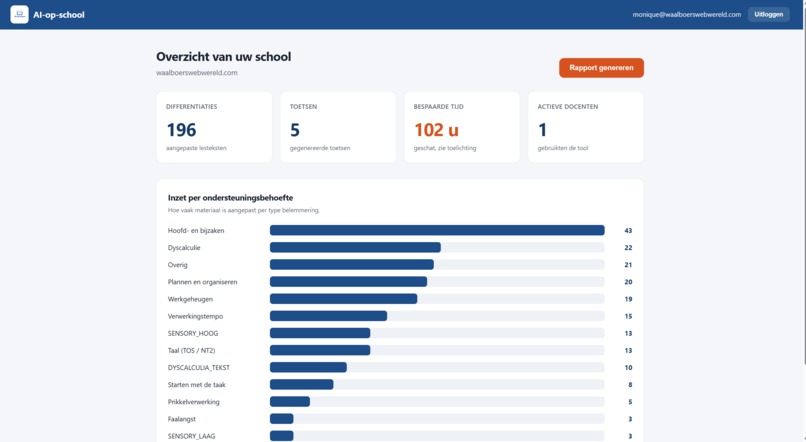
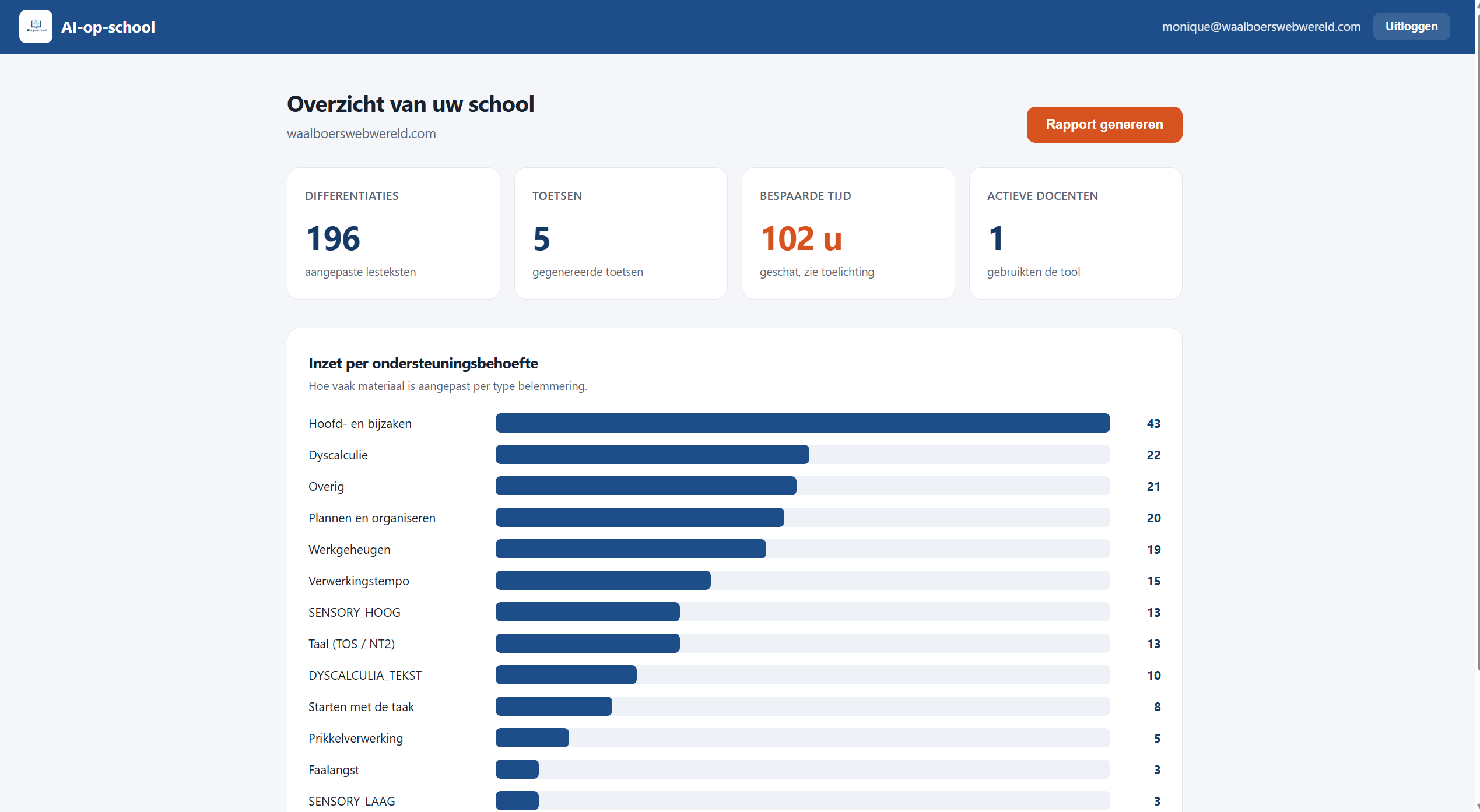
the dashboard for schoolboard
-
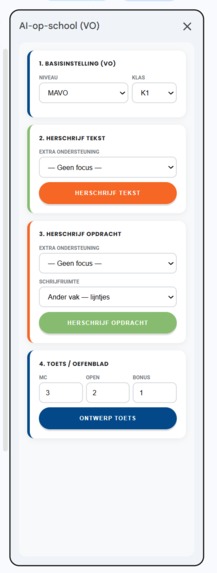
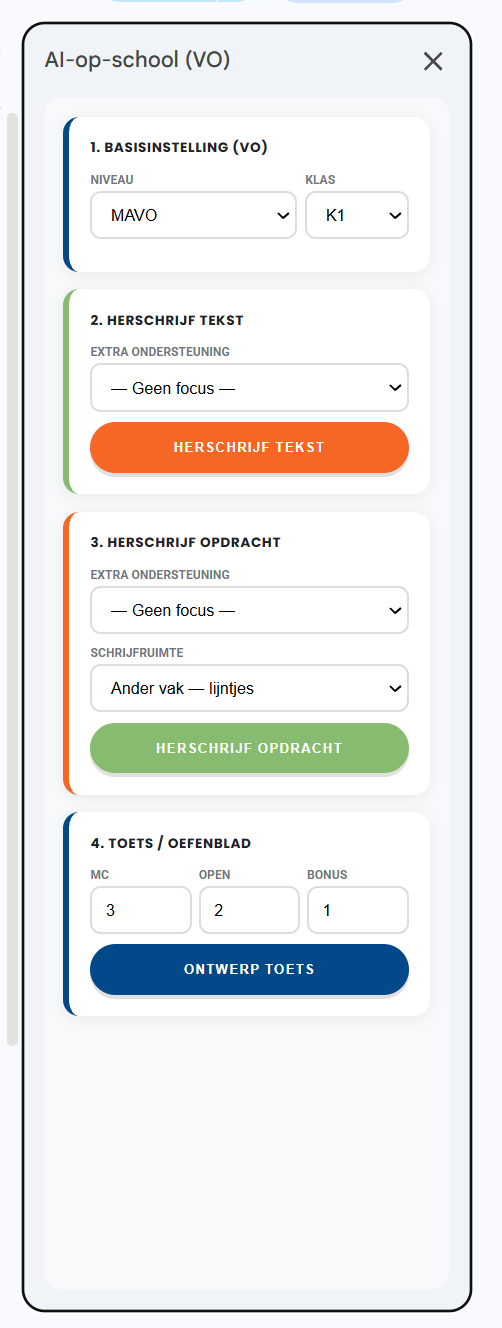
the side bar itself
-
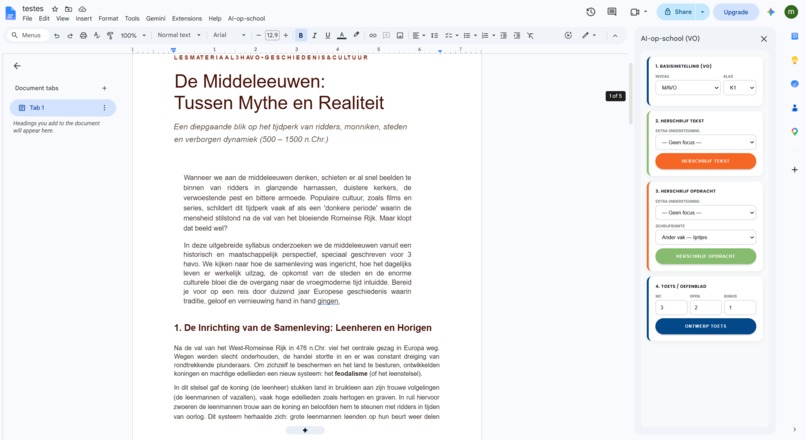
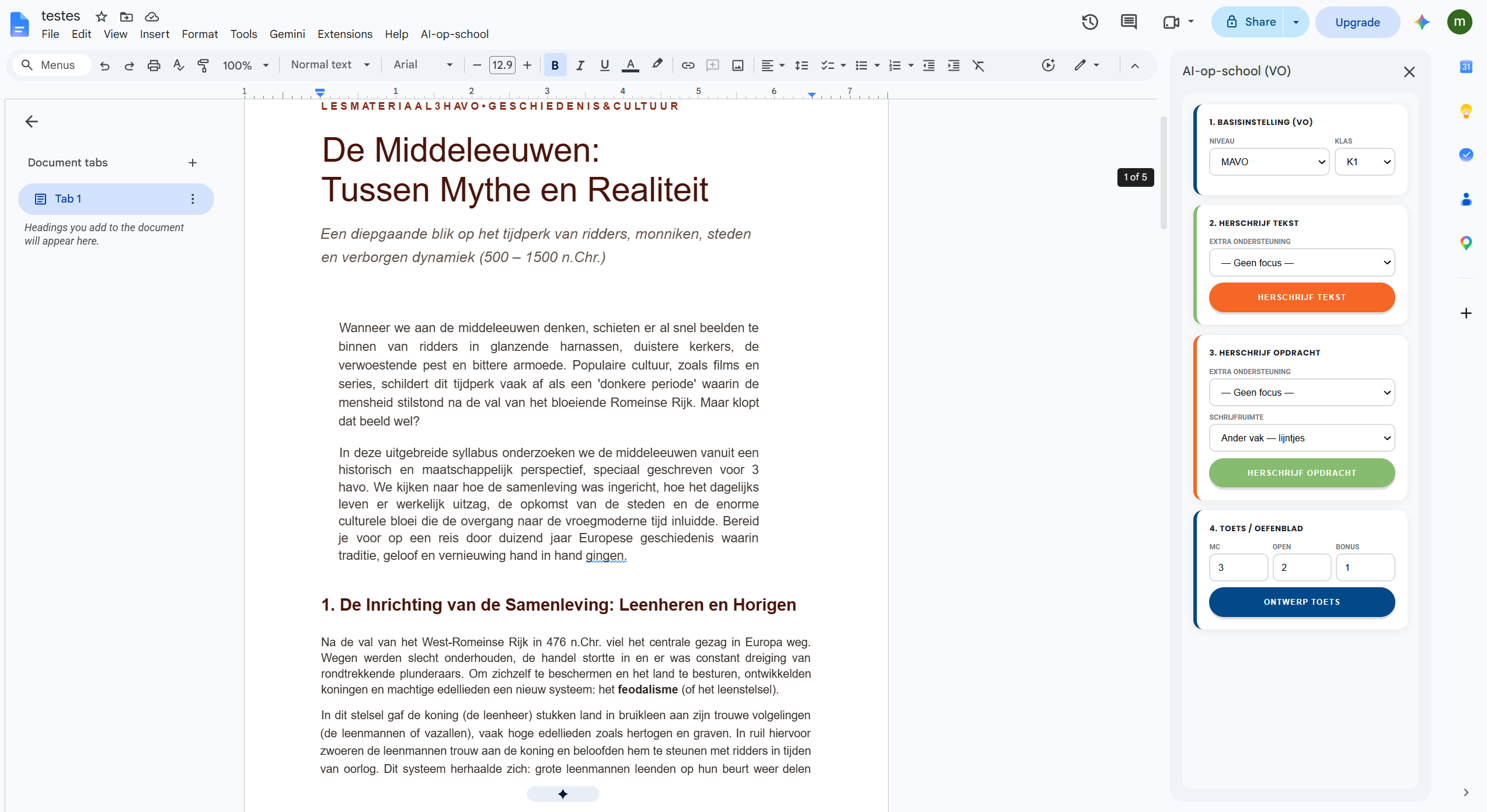
the sidebar in a document
AI-op-school — The Story
Inspiration
This idea did not start in a business plan. It started at my kitchen table. My sons bring their friends home, and I kept watching some of those kids struggle — not with the subject itself, but with the way the lesson material was put in front of them. The content was fine; the form was working against them. In the Netherlands, roughly one in five students needs material presented differently to reach the same level. To me these were never abstract statistics. They were children I know, sitting at my table, getting stuck on things they were perfectly capable of.
That is the entire reason AI-op-school exists: to change the form of the material without ever lowering the level, so the kids who need a different door still walk into the same room.
What it does
AI-op-school is a Google Workspace sidebar that works inside the document a teacher already has open. The teacher picks a learning-support profile — dyslexia, dyscalculia, working-memory limits, sensory sensitivities, slow processing, test anxiety, and more, up to eleven recognised barriers — and the AI rewrites the material for that specific need in seconds. It runs in two strict modes: Modus A adapts the learning material so the support need can fully assist the student, and Modus B adapts only the assignment, compensating for the barrier without ever giving answers or doing the student's thinking. The one rule that defines the whole product: it changes the form, never the level.
How we built it
I built this as a solo founder — but I did not build it alone. My "team" was AI. I worked with Google AI Studio and Claude, and I structured them like a real team with distinct roles: a development agent for the code, a marketing agent for positioning and outreach, and an agent whose whole job was to help me keep the overview — to hold the thread of where we were and what came next. After every working session I updated the system instructions with our current state, so each agent always started from where we actually stood instead of from scratch.
The product runs entirely on Google Cloud: Apps Script for the sidebar, Cloud Functions and Firestore for the engine, Firebase Authentication for licences, and the Gemini API for the differentiation itself. I taught myself how Apps Script works and built a working understanding of the Google Cloud Platform along the way — neither of which I knew when I started.
The unit economics stayed lean because of that design. At €10 per student per year, an average school of ~700 students is about €7,000 in annual revenue, while the AI running cost stays well under one euro per student:
$$\text{cost per student} = \frac{\text{Gemini + infrastructure per year}}{\text{students}} \approx \frac{\text{€570}}{700} \approx \text{€0.81}$$
Challenges we ran into
The hardest problems in the build were not the code — they were the constraints around it. Getting minimal authorization right meant rebuilding the whole architecture so the tool asks only for the narrowest possible permissions; that work is exactly what makes the product trustworthy enough for a school to install. Meeting Dutch privacy and AI-Act requirements as a one-person company meant learning a body of rules most startups hand straight to a legal team. And doing all of it solo meant being the developer, the compliance officer, the tester and the salesperson in the same week.
But the hardest challenge in the end was not technical at all: getting into schools. In the Netherlands, schools make almost all of their purchasing decisions around February, so trying to land a customer at the end of the school year is close to impossible. Despite having a finished, working, published product, I was not able to sign a paying school within the window of this hackathon. I want to be honest about that — I know I do not fully meet the revenue requirement.
I am submitting anyway, and on purpose. This competition was the push I needed to finally build and ship something I had carried in my head for a long time, and I want the tool seen. The timing of school buying cycles is a reason I fell short on revenue, not a reason the product does not work.
Accomplishments that we're proud of
- Shipped a real, published product to the Google Workspace Marketplace — as a solo founder.
- Rebuilt the architecture around minimal authorization and passed Google's OAuth verification, a bar most classroom AI tools never clear.
- Did the Dutch privacy and AI-Act compliance groundwork myself.
- Encoded a genuine pedagogical principle — the "Grondwet": form adapts, level never — into the AI so schools can actually trust it.
- Built the whole thing with AI as my team, proving one person can produce what used to need a funded engineering team.
What we learned
Three things changed how I work.
Prompting is the craft. The difference between a rewrite that respects a teacher's level and one that quietly dumbs it down lives almost entirely in the prompt. Getting the pedagogical rules precise enough that the AI would follow them every single time was the real engineering work.
I want to be the human in the loop. I deliberately do not let the AI check its own work. I review the output against real classroom documents myself, because on something that reaches children I am not willing to hand the final judgement to the model. Being in the loop is not a limitation I put up with; it is a choice I stand behind.
Keep the threads short. A small but hard-won lesson: don't let a working thread run too long. Progress is faster and cleaner when I keep sessions focused and carry the state forward through the system instructions rather than through one endless conversation.
What's next for AI-suite for schools
Once the sidebar also runs inside Microsoft Word, I am taking it international: first the German market, then Spanish. If I can keep this pace, AI-suite for schools will be available in five countries within a year. The goal stays exactly what it was at my kitchen table — reaching more of the students who need a different door into the same room.
Built With
- ai-team-/-build:-claude-(anthropic)
- cloud-functions
- cloud-load-balancing
- cloud-run
- cloud-storage-website:-cloud-storage
- css
- firebase-auth
- firebase-authentication
- firestore
- google-ai-studio-ai-model:-gemini-api-(gemini-2.5-flash)-on-vertex-ai-add-on-/-tool:-google-apps-script
- google-managed-https-platform:-google-cloud-platform-(project-ai-op-school-engine
- google-workspace-add-on-(marketplace)-leadership-dashboard:-cloud-functions
- html
- region-europe-west4)-languages:-javascript


Log in or sign up for Devpost to join the conversation.