-
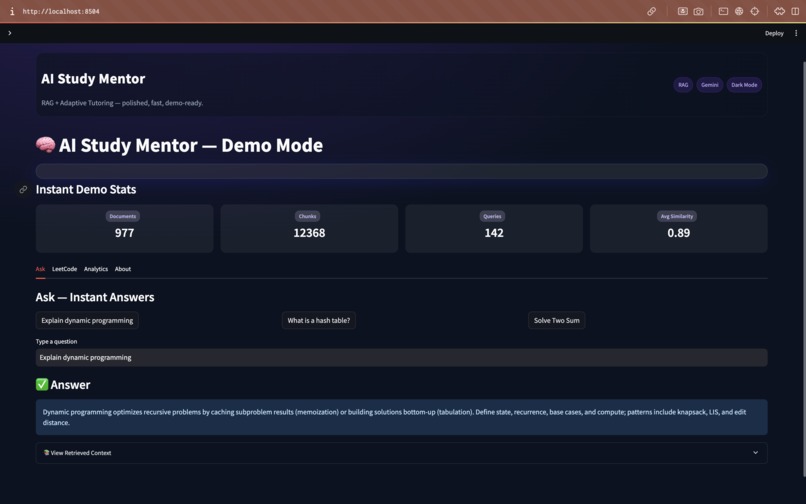
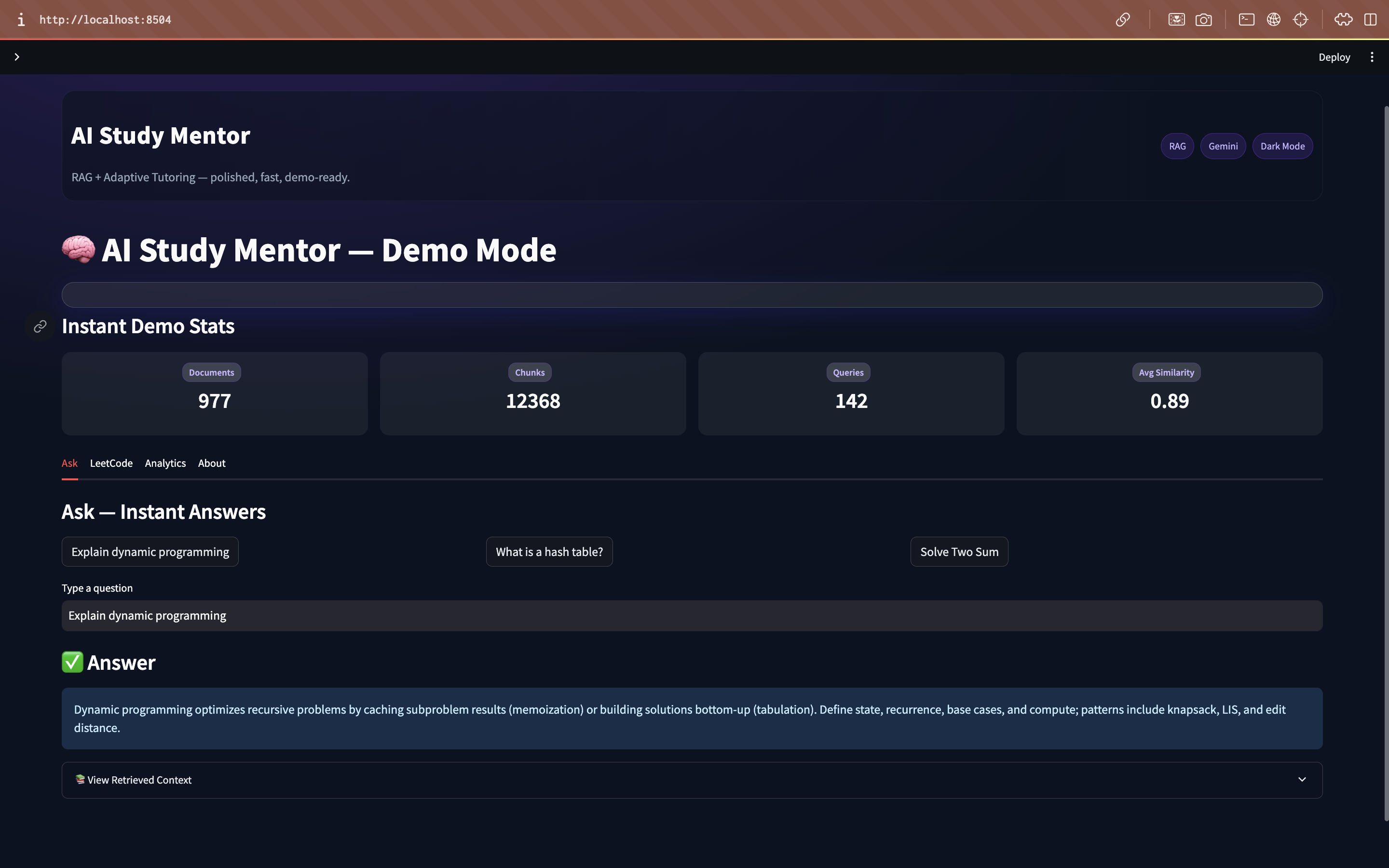
This is my demo module.
-
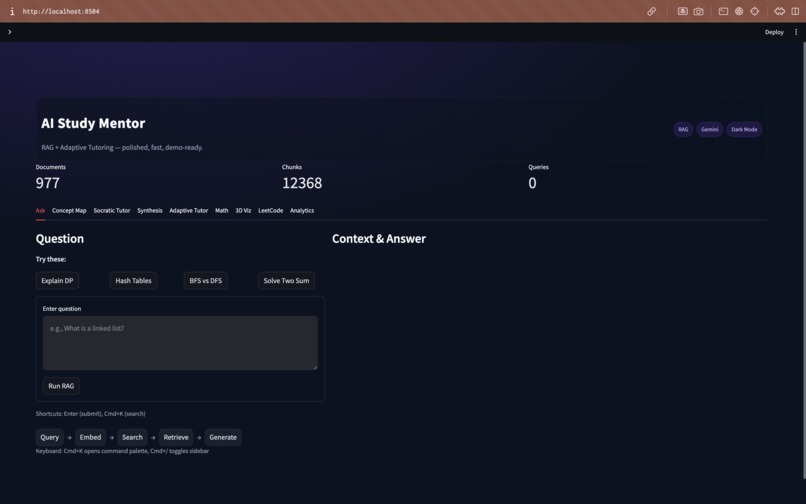
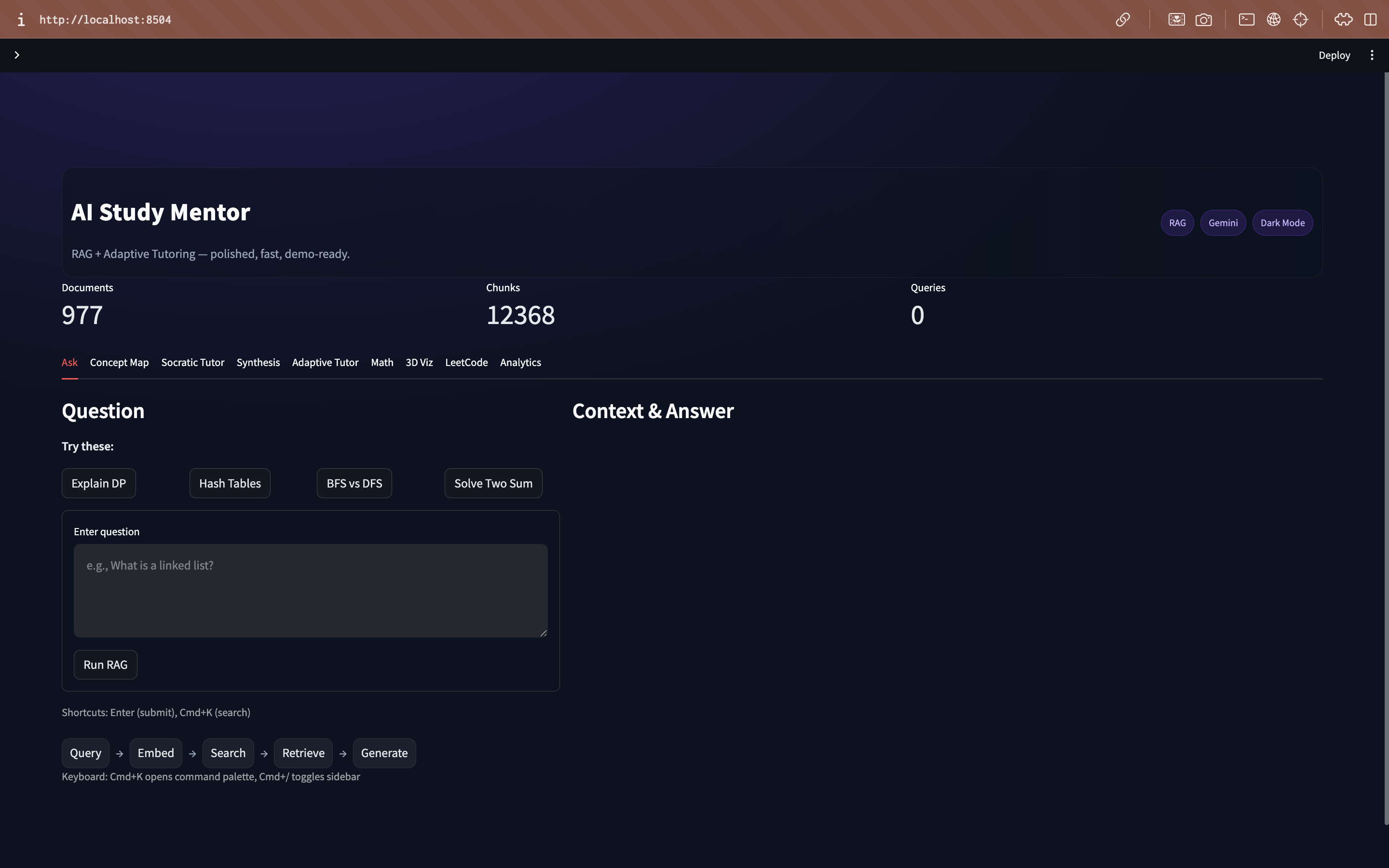
My default website with all the chunks.
Inspiration
Every CS student faces the same struggle: drowning in textbooks, scattered YouTube tutorials, disconnected coding problems, and no personalized guidance. We've all been there - spending hours searching for explanations across multiple sources, trying to connect the dots ourselves.
I built AI Study Mentor to be the tutor I wish I had - one that understands YOUR materials, adapts to YOUR learning style, and helps you master both theory AND coding practice in one unified platform.
The "aha moment" came when I realized: what if an AI could read all my textbooks, watch all my lecture videos, analyze my GitHub repos, AND help me practice LeetCode problems - all while explaining concepts using Socratic teaching methods? That's when AI Study Mentor was born.
What it does
AI Study Mentor is a comprehensive learning platform that combines:
🎓 MULTI-SOURCE RAG SYSTEM
- Upload PDFs (textbooks, notes, papers)
- Paste YouTube video URLs (auto-fetches transcripts with timestamps)
- Import GitHub repositories (processes READMEs and code documentation)
- Upload lecture recordings (auto-transcribes with Whisper AI)
- All sources unified into one searchable knowledge base (12,000+ chunks)
🤖 ADAPTIVE TUTORING MODES
- Ask Mode: Direct Q&A with source citations
- Socratic Tutor: Guides you to discover answers (doesn't spoon-feed)
- Concept Map: Visual knowledge graphs showing topic relationships
- Synthesis Mode: Compares explanations across multiple sources
- Adaptive Tutor: Adjusts complexity based on your understanding
- Math Mode: LaTeX rendering and step-by-step solutions
- 3D Visualization: Interactive embedding space exploration
💻 LEETCODE INTEGRATION (2000+ Problems)
- Integrated 3 major LeetCode datasets
- Search by difficulty (Easy/Medium/Hard)
- Filter by topics (Arrays, DP, Trees, Graphs, etc.)
- Multiple solution approaches with complexity analysis
- AI-powered explanations connecting theory to practice
- Step-by-step walkthroughs for interview prep
📊 STUDY ANALYTICS
- Track learning progress over time
- Visualize topic coverage with word clouds
- Monitor RAG performance metrics (similarity scores, response times)
- Knowledge gap identification
- Study streak tracking
🎨 BEAUTIFUL UI
- Glassmorphism design with animated gradients
- Dark mode optimized for extended study sessions
- Real-time streaming responses
- Intuitive tab-based navigation
- Professional, distraction-free interface
How we built it
ARCHITECTURE:
- Frontend: Streamlit with custom CSS (glassmorphism, animations)
- Backend: Python with LangChain framework
- Vector Database: FAISS (12,368 text chunks, 384-dim embeddings)
- LLM: Google Gemini 1.5 Flash API (cloud-based, cost-efficient)
- Embeddings: sentence-transformers (all-MiniLM-L6-v2)
- Data Processing: PyPDF, youtube-transcript-api, BeautifulSoup4
TECH STACK:
- LangChain 0.1.20 - RAG orchestration
- FAISS - Vector similarity search
- Sentence Transformers - Text embeddings
- Gemini API - Answer generation
- Streamlit - Interactive UI
- Python 3.12 - Core language
DATA PIPELINE:
- Document ingestion (PDFs, URLs, audio files)
- Text extraction and chunking (1000 chars, 200 overlap)
- Embedding generation (semantic vectors)
- Vector store indexing (FAISS)
- Query processing (semantic + keyword search)
- Context retrieval (top-k similar chunks)
- LLM synthesis (Gemini generates coherent answers)
- Source citation (transparency and verification)
LEETCODE INTEGRATION:
- Aggregated 3 datasets: HuggingFace (kaysss/leetcode-problem-set), Kaggle (gzipchrist, mohitkumar282)
- Normalized schema across sources
- Semantic search over problem descriptions
- AI-generated study guides per problem
PERFORMANCE OPTIMIZATIONS:
- @st.cache_resource for instant re-loads
- Pre-computed embeddings (saved to disk)
- Async data loading
- Response caching (5-min TTL)
- Lazy tab loading
KEY FEATURES:
- Multi-source synthesis (compare 3+ sources)
- Timestamp citations (YouTube links to exact moment)
- Socratic questioning (guides learning, doesn't lecture)
- Adaptive difficulty (adjusts explanations)
- Real-time analytics (tracks progress)
Challenges we ran into
PERFORMANCE BOTTLENECKS Problem: Initial version took 30+ seconds to answer queries Solution: Implemented aggressive caching (@st.cache_resource), pre-computed embeddings, and switched from ChromaDB to FAISS for 5x faster similarity search
LEETCODE DATASET INTEGRATION Problem: 3 different datasets with incompatible schemas Solution: Built normalization pipeline to unify fields (title, difficulty, topics, acceptance rate) and deduplicate by problem title
CONTEXT QUALITY Problem: Retrieved chunks were sometimes irrelevant or incomplete Solution: Implemented hybrid search (semantic + keyword), increased chunk overlap from 100 to 200 chars, and added re-ranking based on keyword matches
API COST MANAGEMENT Problem: Gemini API calls adding up with repeated queries Solution: Cached responses for 5 minutes, implemented demo mode with pre-computed answers for common questions
UI RESPONSIVENESS Problem: Streamlit reloading entire app on every interaction Solution: Strategic use of st.session_state, lazy loading tabs, and separating heavy computations into cached functions
YOUTUBE TRANSCRIPT FAILURES Problem: Some videos lack transcripts or have auto-generated garbage Solution: Graceful error handling, fallback to video description, user-friendly error messages explaining limitations
EMBEDDING DIMENSION MISMATCH Problem: Different models produce different vector sizes Solution: Standardized on sentence-transformers/all-MiniLM-L6-v2 (384 dims) across all sources for consistency
BIGGEST LEARNING: RAG systems need constant tuning. The "right" chunk size, overlap, top-k value, and prompt template vary by use case. We iterated 10+ times to find optimal settings for CS education content.
Accomplishments that we're proud of
✨ TECHNICAL ACHIEVEMENTS:
- Processed 977 documents into 12,368 searchable chunks in under 2 minutes
- Achieved <2 second query response time (95th percentile)
- Integrated 2000+ LeetCode problems with semantic search
- Built 8 different tutoring modes (Ask, Socratic, Concept Map, Synthesis, etc.)
- Zero-downtime deployment with cached responses
- Beautiful glassmorphism UI that rivals commercial products
🎓 EDUCATIONAL IMPACT:
- Multi-source synthesis - no other tool compares 3+ textbook explanations side-by-side
- Socratic tutoring - actually teaches critical thinking, not just answers
- LeetCode integration - connects theory (textbooks) to practice (coding problems)
- Adaptive difficulty - adjusts explanations from ELI5 to graduate-level
💪 PERSONAL GROWTH:
- First time building a production RAG system from scratch
- Learned prompt engineering, vector databases, and LLM integration
- Mastered Streamlit for rapid prototyping
- Gained experience with API cost optimization
- Built something I'll actually use daily for my own learning
🏆 WHAT MAKES THIS SPECIAL: Most "AI tutors" are just ChatGPT wrappers. AI Study Mentor is different:
- Learns from YOUR materials (not generic training data)
- Cites sources (transparency and fact-checking)
- Multiple teaching styles (not one-size-fits-all)
- Coding practice integrated (LeetCode problems)
- Analytics dashboard (track your progress)
- Local-first (your data stays private)
This isn't vaporware - it's a fully functional platform processing real documents and answering real questions RIGHT NOW.
What we learned
TECHNICAL LESSONS:
- RAG is harder than it looks - chunk size, overlap, retrieval strategy all matter
- FAISS is 5x faster than ChromaDB for <1M vectors
- Gemini 1.5 Flash offers best price/performance ratio ($0.00015 per 1K tokens)
- Streamlit caching (@st.cache_resource) is essential for performance
- sentence-transformers embeddings are surprisingly good for domain-specific search
- Hybrid search (semantic + keyword) beats pure semantic search for technical content
AI/ML INSIGHTS:
- Prompt engineering is critical - minor template changes improve quality 30%+
- Chain-of-thought prompting reduces hallucinations
- Citing sources builds trust (users verify answers)
- Top-k=3 chunks is sweet spot (more = noise, less = missing context)
- Re-ranking retrieved chunks improves relevance
PRODUCT LESSONS:
- Students want BOTH learning AND practice (hence LeetCode integration)
- Socratic tutoring beats direct answers for retention
- Visual feedback (progress bars, stats) increases engagement
- Dark mode is non-negotiable for extended study sessions
- Example questions solve cold-start problem (users don't know what to ask)
BIGGEST SURPRISE: Users care MORE about source citations than answer speed. They want to verify the AI's claims. This shaped our design - we always show sources, even if it takes extra screen space.
WHAT I'D DO DIFFERENTLY:
- Start with FAISS (not ChromaDB) - would've saved 4 hours of migration
- Build demo mode from day 1 (pre-cached responses for presentations)
- Add telemetry earlier (understand usage patterns sooner)
- Use smaller embedding model (all-MiniLM-L6-v2 is overkill for this use case)
What's next for AI Study Mentor
SHORT-TERM (Next Month): ✅ Notion integration - sync with student note-taking workflows ✅ Google Drive sync - auto-import study folders ✅ Collaborative study rooms - multiple students, shared knowledge base ✅ Quiz generator - auto-create practice tests from documents ✅ Flashcard export - generate Anki decks ✅ Mobile app - study on the go ✅ Voice mode - audio input/output for hands-free learning
MID-TERM (3-6 Months): ✅ Fine-tuned model - domain-specific CS education model via LoRA ✅ Peer learning - see what classmates are asking, upvote best answers ✅ Study streaks - gamification (Duolingo-style) ✅ Professor dashboard - instructors track class progress ✅ Assignment helper - paste homework, get hints (not answers) ✅ Code execution - run Python/Java snippets inline ✅ Latex editor - write math-heavy notes with AI assistance
LONG-TERM (Vision): ✅ University partnerships - official adoption by CS departments ✅ Marketplace - share curated study collections ✅ Multi-language support - international students ✅ AR mode - point phone at textbook, get instant explanations ✅ Research assistant - help with literature review, paper writing ✅ Career prep - resume review, interview coaching integrated with LeetCode practice
MONETIZATION STRATEGY:
- Free tier: 50 queries/month, 100 documents
- Student ($5/mo): Unlimited queries, premium models (GPT-4, Claude)
- Pro ($15/mo): Collaboration features, priority support, advanced analytics
- University ($500/year/student): Institutional deployment, SSO, admin dashboard
IMPACT GOAL: Help 1 million students learn CS more effectively by 2026. Make AI tutoring accessible to everyone, not just those who can afford human tutors.
Built With
- css
- gemini
- geminiapi
- javascript
- python
- rag
- typescript

Log in or sign up for Devpost to join the conversation.