-
-
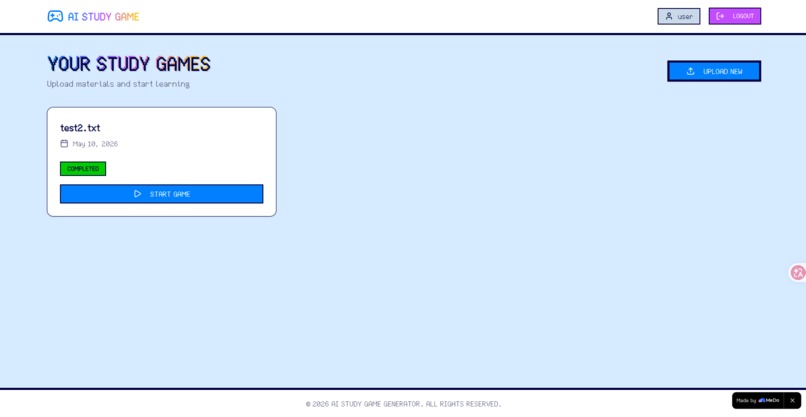
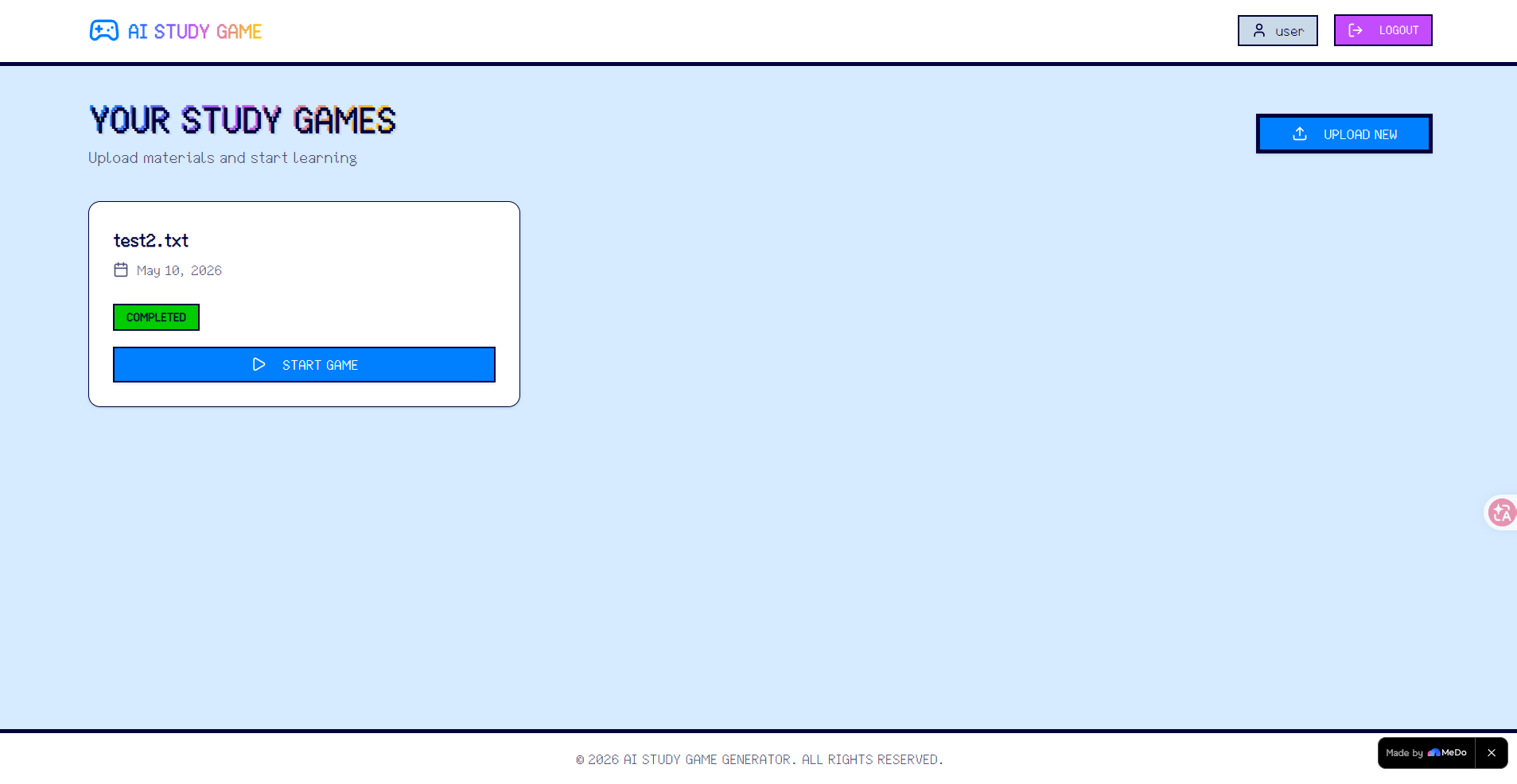
Home Page
-
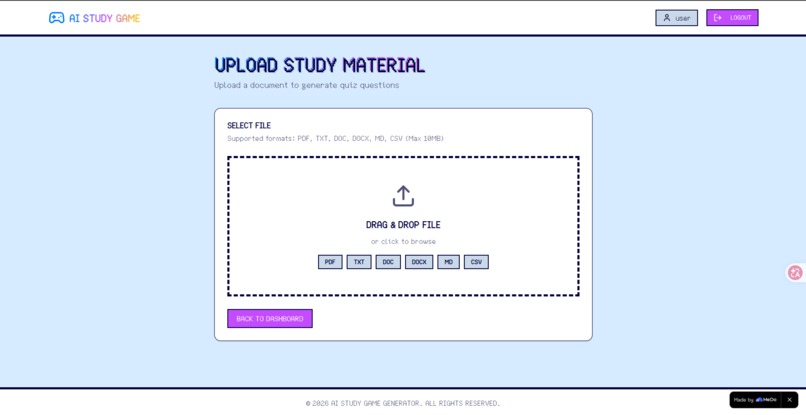
Upload Page
-
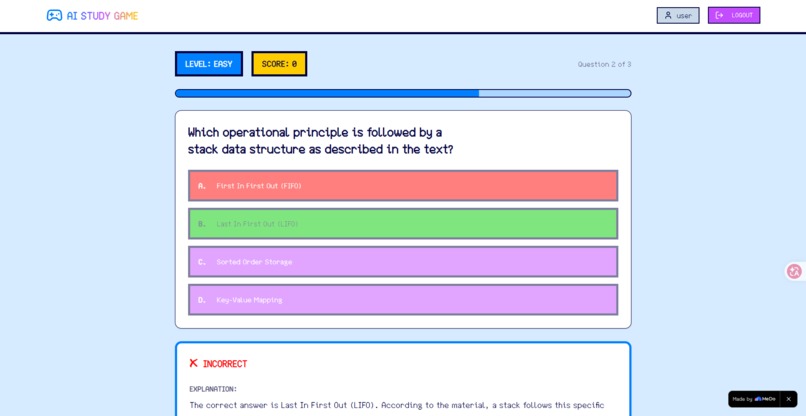
Game Page
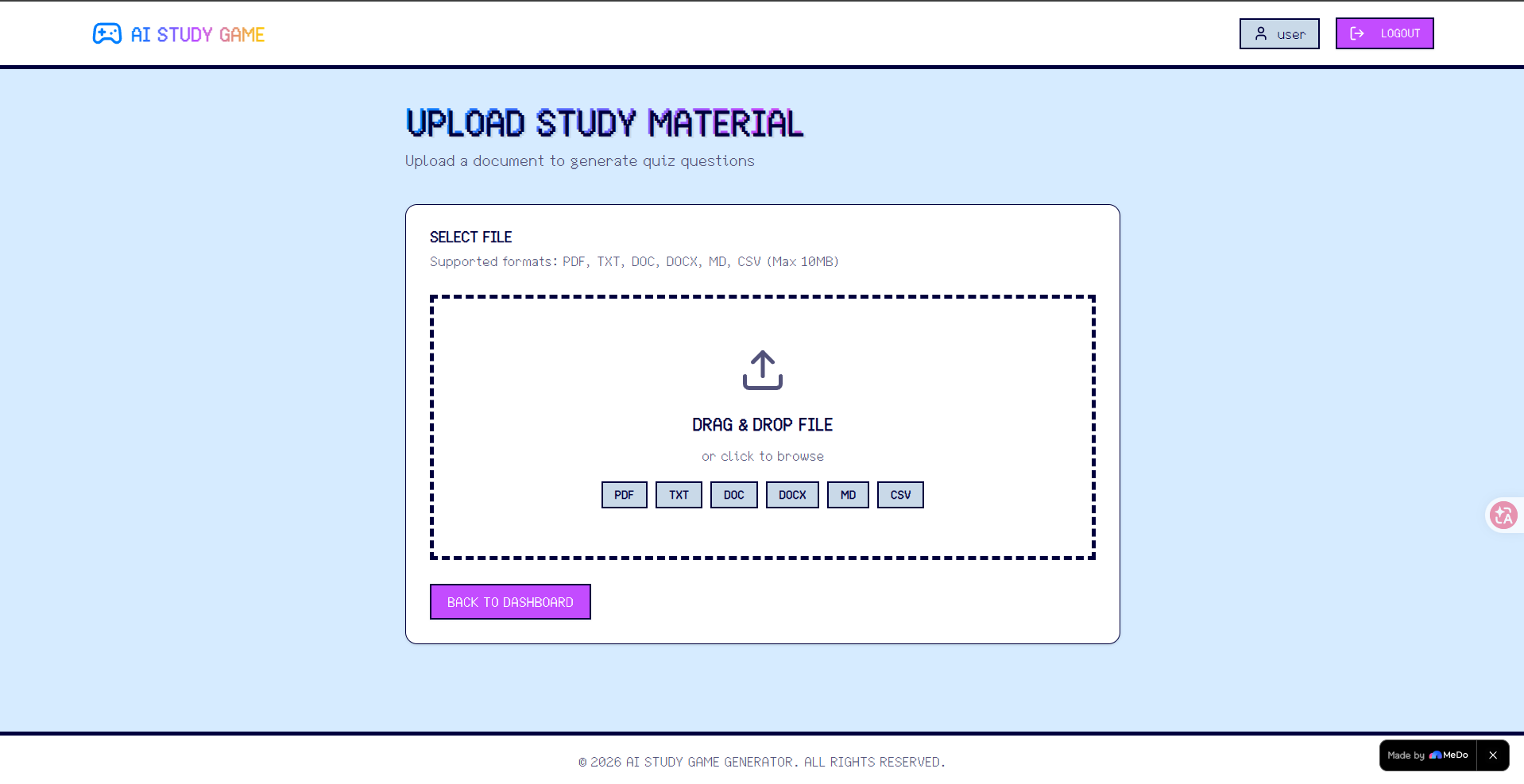
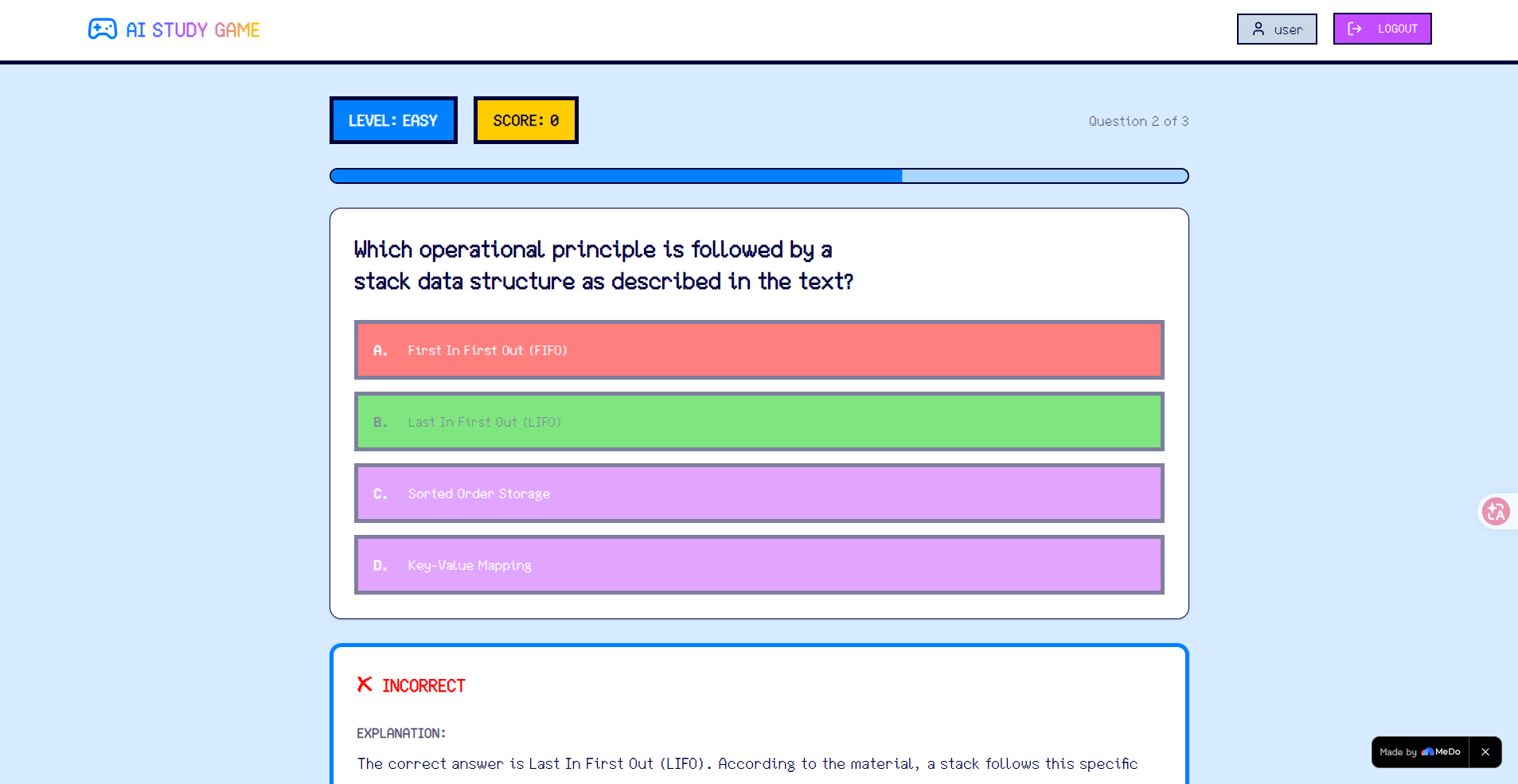
📚 About the Project — AI Study Game Generator
💡 Inspiration
As students, we constantly face the same problem: we spend hours reading notes, textbooks, and past exam papers, but still struggle to truly understand and retain the material.
Traditional revision is:
- passive
- repetitive
- often ineffective
What’s missing is active engagement — the ability to test understanding in a structured and meaningful way.
At the same time, creating good practice questions manually is time-consuming and requires skill.
This inspired us to ask:
What if any study material could instantly become an interactive learning experience?
🛠️ What We Built
We built an AI-powered Study Game Generator that transforms raw study materials into a progressive learning game.
Users can upload:
- Text files
- PDFs
- Images (future extensions)
The system then:
- Extracts and processes the content
- Uses AI to generate exam-level questions
- Organizes them into difficulty-based levels
- Creates an interactive game where users:
- answer questions
- receive feedback
- progress through levels
⚙️ How We Built It
We used MeDo as a full-stack AI co-developer, iterating through multiple structured prompts to build the system.
🧩 System Architecture
User Upload
   ↓
Text Extraction (PDF / OCR / TXT)
   ↓
AI Question Generation
   ↓
Validation & Structuring
   ↓
Game Engine (Levels + Feedback)
🔧 Key Components
Frontend
- Upload interface
- Game UI with levels, scoring, and feedback
Backend
- File processing pipeline
- AI integration for question generation
- Database storage
AI Integration
- Gemini API for generating:
- concept-based questions
- multiple-choice options
- detailed explanations
Database & Storage
- Supabase for:
- storing uploaded files
- managing generated questions
- tracking processing status
🧠 How We Used MeDo
MeDo was not just a tool — it acted as a co-developer.
We used multi-turn conversations to:
- Generate initial full-stack structure
- Identify weaknesses (e.g. shallow questions)
- Refine prompts to enforce:
- concept-based questions
- real exam-level difficulty
- explanation-driven learning
We iteratively improved:
- backend logic
- AI prompts
- UI/UX
This process turned a basic quiz generator into a smart learning system.
🚧 Challenges We Faced
1. Low-Quality AI Questions
Initially, the system generated shallow questions like:
- “What is the main topic?”
👉 This provided no real learning value.
Solution: We redesigned prompts to enforce:
- concept-based reasoning
- application-level questions
- strict grounding in the material
2. Ensuring Reliability
AI outputs can be inconsistent or malformed.
Solution:
Added validation layer:
- ensures 4 options
- checks correct answer
- verifies structure
Fallback strategies were redesigned to avoid low-quality output
4. Making It Feel Like a Game
A plain quiz is not engaging.
Solution:
- Introduced levels (easy → medium → hard)
- Added scoring and progression
- Provided instant feedback with explanations
📈 What We Learned
- Prompt engineering is critical — small changes drastically affect output quality
- AI is powerful, but requires strict constraints and validation
- Building with AI is not one-shot — it’s an iterative process
- User experience matters as much as technical functionality
We also learned how to:
- design AI-driven systems
- integrate APIs effectively
- structure full-stack applications quickly using MeDo
🎯 Impact
This project transforms learning from passive reading to active, game-based understanding
Instead of memorizing, users:
- engage
- think
- apply knowledge
🏆 Final Thought
This project shows how AI can move beyond content generation into:
creating personalized, interactive learning experiences
🔥 One-Liner
Turn any study material into an interactive learning game in seconds.
Built With
- googleaistudio
- medo

Log in or sign up for Devpost to join the conversation.