Inspiration
Many students don’t realize they are falling behind until it’s too late to easily recover. We were inspired by the idea that early awareness can change outcomes. Not every student has access to tutors or personalized academic support, so we wanted to build a system that gives students instant, data-driven feedback on their academic risk and shows them how to improve.
What it does
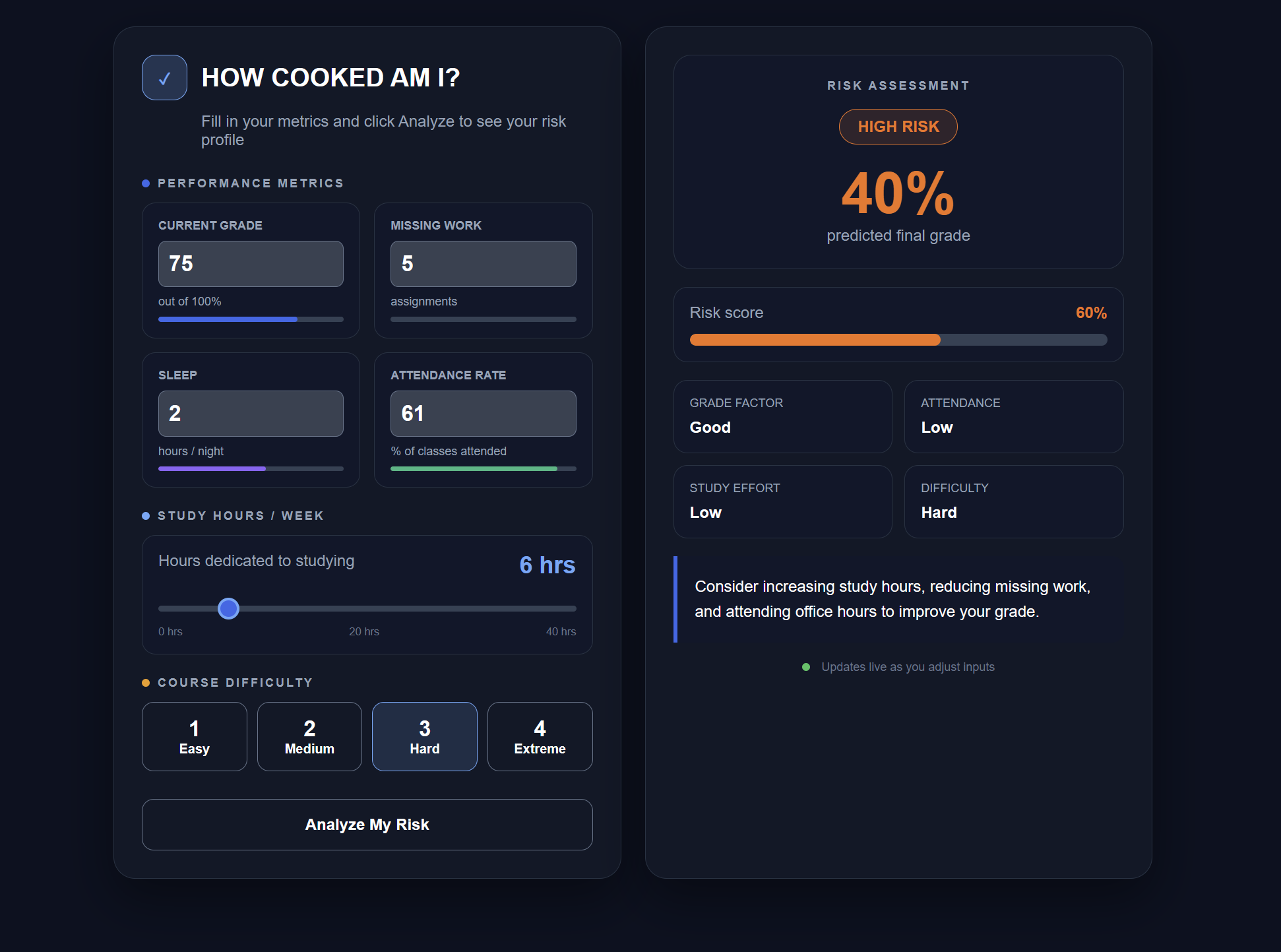
The Academic Risk Predictor System is an AI-powered tool that analyzes student habits and predicts future academic performance. Users input study hours, current grade, course difficulty, missing assignments, attendance, and sleep hours. The system outputs a predicted future grade, a risk level (Low, Moderate, High), and personalized recommendations. It also includes a what-if simulation that allows users to adjust inputs and instantly see how their outcomes improve.
How we built it
We built a full-stack application using HTML, CSS, and JavaScript for the frontend, Flask for the backend, and scikit-learn with NumPy for the machine learning model. We created a simulated dataset based on realistic academic assumptions and trained a linear regression model using model.fit(X, Y). The frontend sends user input to the Flask backend, which processes the data through the model and returns predictions in real time.
Challenges we ran into
One major challenge was data consistency, as our initial outputs didn’t align with our intended formula, leading to unrealistic predictions. We also encountered issues where the frontend was using a hardcoded formula instead of the machine learning model, causing mismatched results. Expanding the model to include more features like attendance, missing assignments, and sleep required restructuring the dataset and retraining the model. Additionally, we had to balance adding complexity while staying within the time constraints of the hackathon.
Accomplishments that we’re proud of
We are proud of building a complete machine learning-powered web application from scratch. We successfully integrated the frontend, backend, and ML model into a real-time system. We also developed an interactive what-if simulator that clearly demonstrates how changes in behavior can improve outcomes. Expanding the model to include multiple real-world academic factors and designing a clean, responsive UI were also key accomplishments.
What we learned
We learned how machine learning models learn from structured data and how important data consistency is for accurate predictions. We also gained experience connecting a frontend to a backend using APIs and designing systems with real-world impact. One key takeaway was that presentation and user experience are just as important as the technical implementation.
What’s next for Academic Risk Predictor System
Next, we want to train the model on real-world academic datasets to improve accuracy. We plan to enhance the model using more advanced algorithms and add features like user accounts and progress tracking. We also aim to provide subject-specific recommendations, build a mobile-friendly version, and integrate the system with school platforms for real-time academic data.

Log in or sign up for Devpost to join the conversation.