-
-
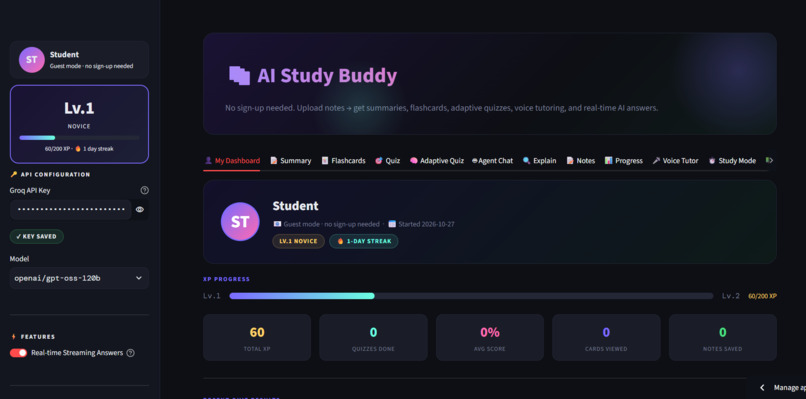
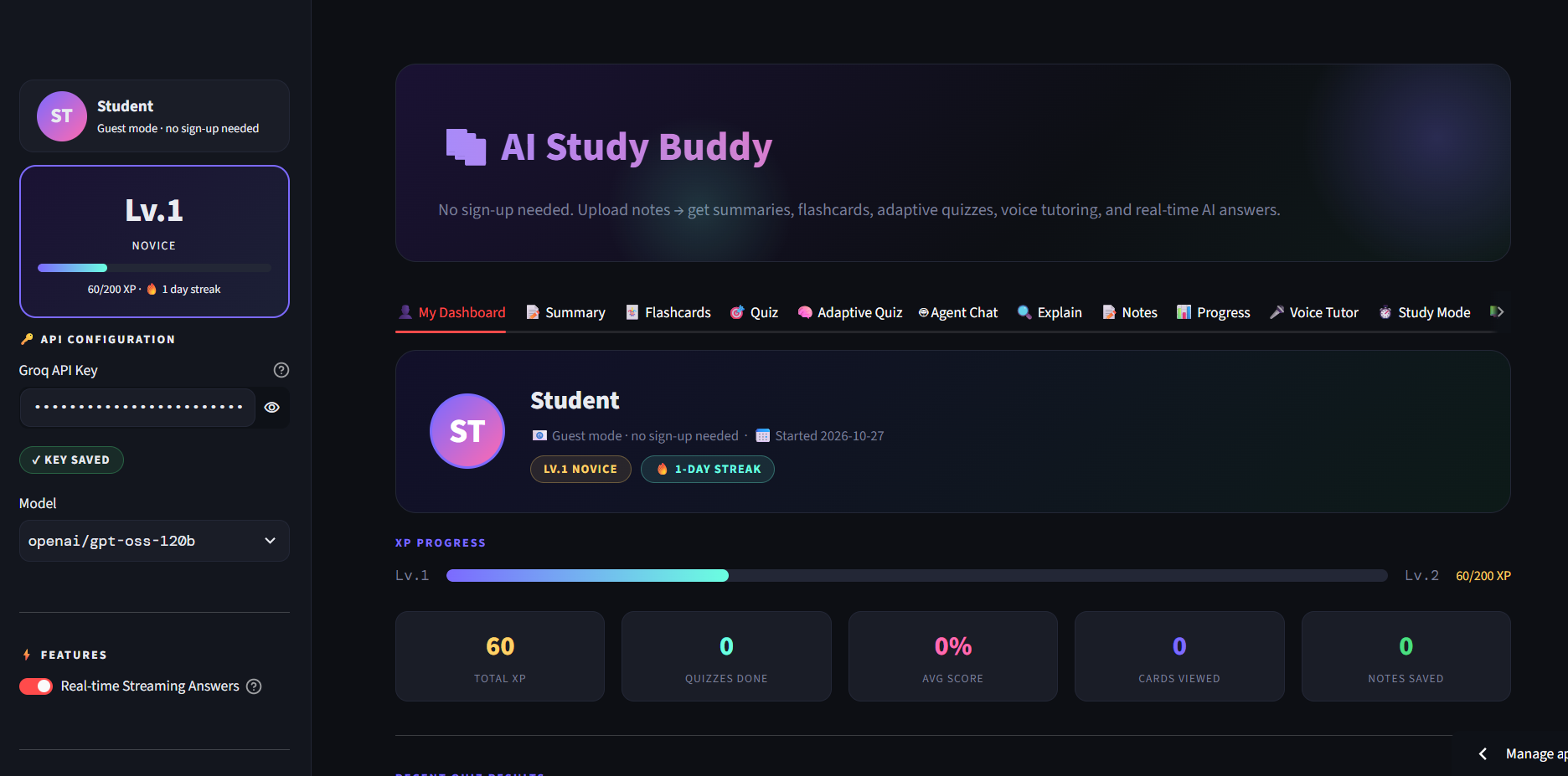
DashBoard
-
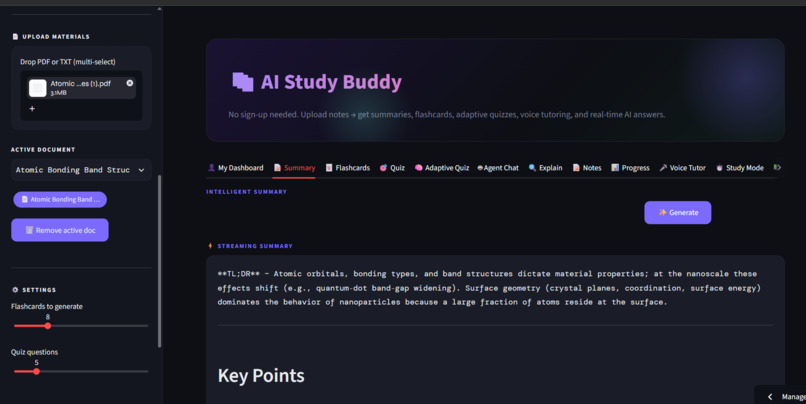
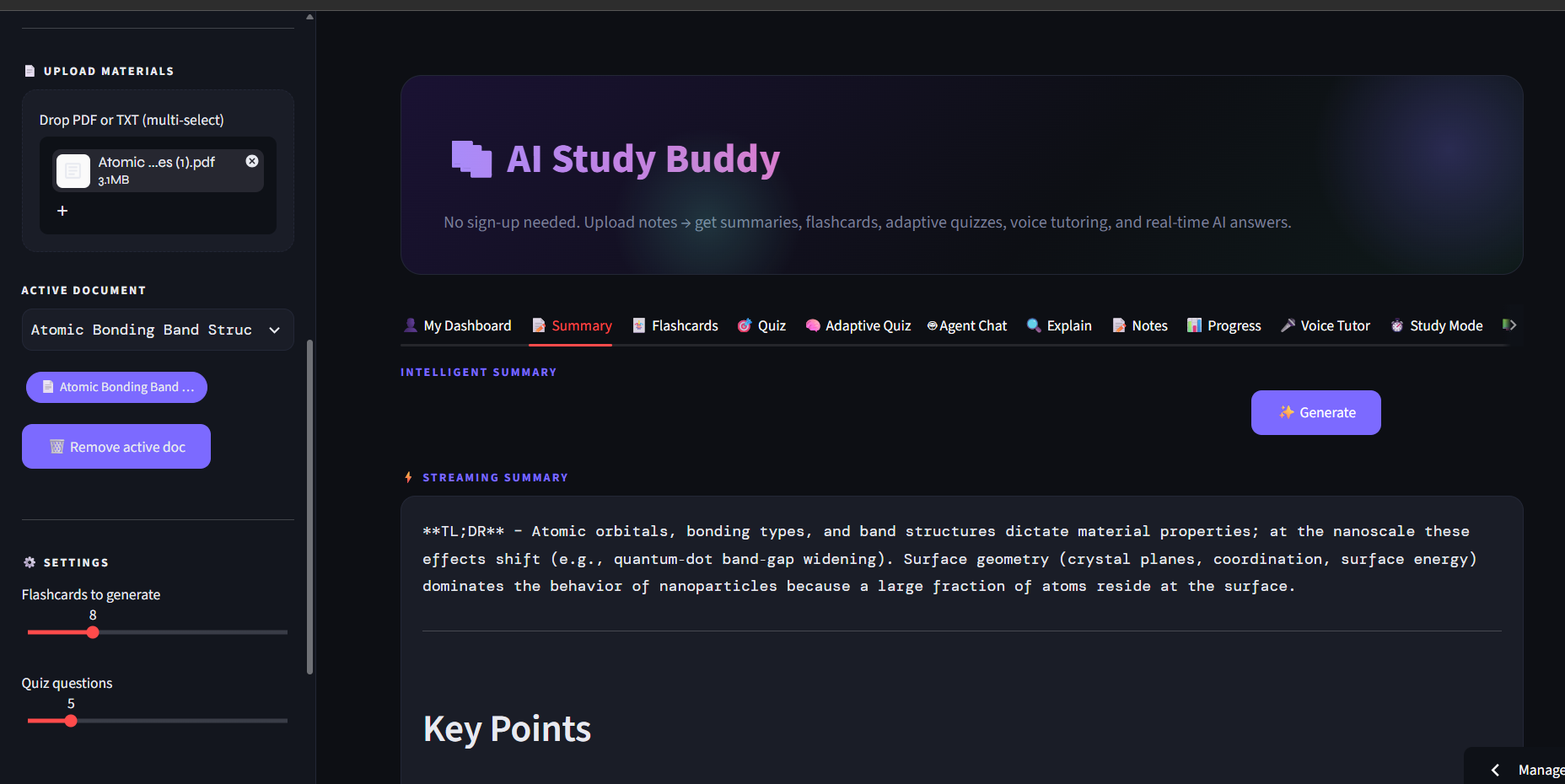
Summary of uploaded pdf
-
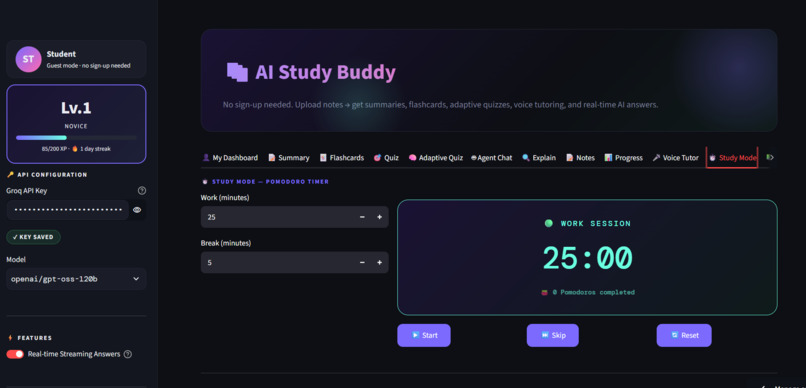
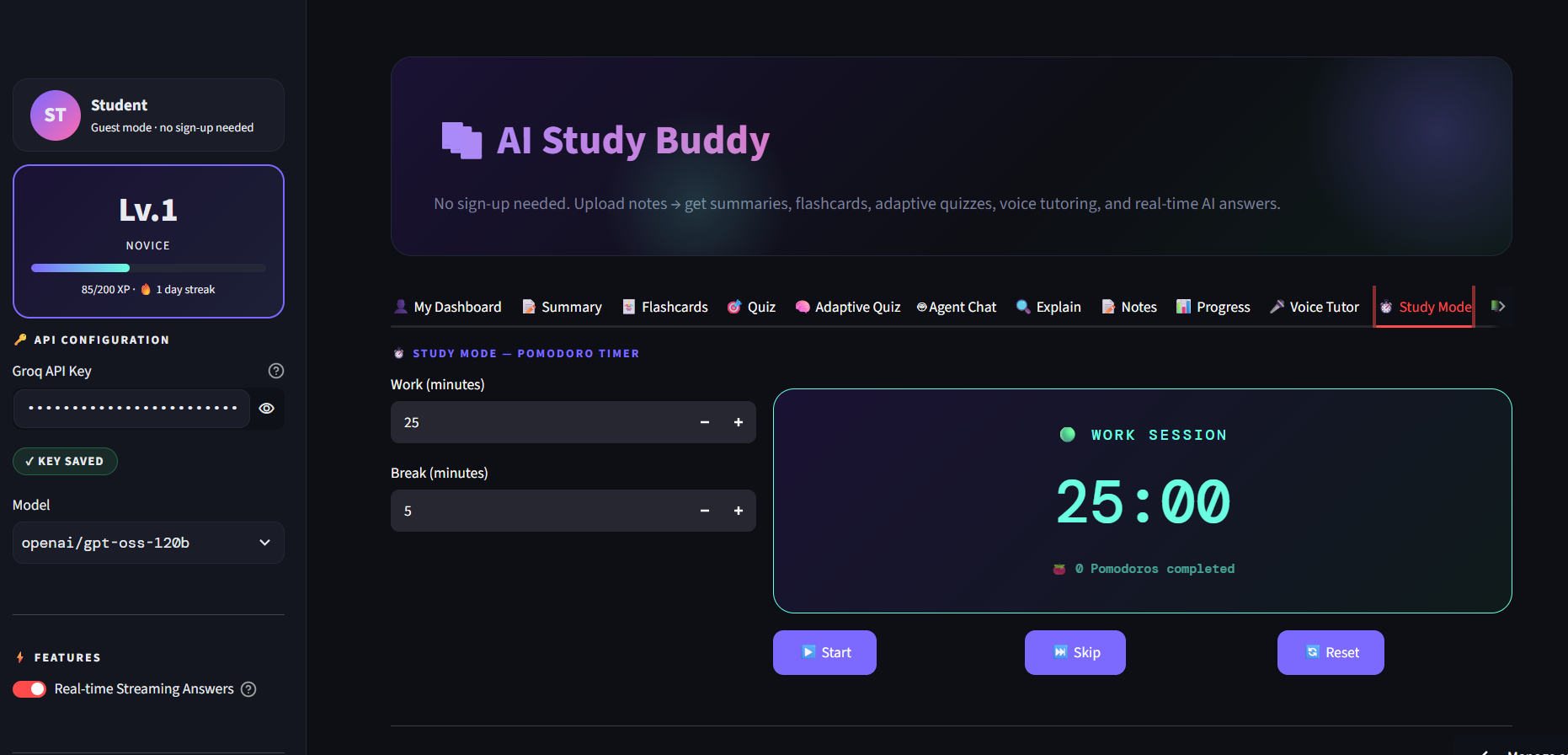
Monitoring work session
Inspiration
Personal tutoring is expensive, so most students study alone from their own notes. When they turn to a chatbot, they get answers nobody checks, from a model that has never seen their notes and doesn't know what they struggle with. We wanted a free study companion that learns from your material, double-checks itself, and focuses on your weak spots. This supports UN SDG 4: Quality Education.
Who it helps
School and college students who study alone, can't afford tutors, or only have scanned or handwritten notes.
What it does
AI Study Buddy turns any PDF or TXT (including scanned pages, via OCR) into a full study toolkit, with no sign-up:
- 🤖 Agent Chat: a LangGraph pipeline of Router → Tutor → Critic → Reviser. The critic fact-checks each answer against your notes and the reviser rewrites it if needed. A live trace shows every agent step.
- 🧠 Adaptive Quiz: questions target the concepts you got wrong before, and your weak and strong areas update after every attempt.
- 📝 Summaries, 🃏 flashcards, 🎯 quizzes, 🔍 five explain modes (Standard, ELI5, Expert, Analogy, Visual), 🗒️ revision notes, 📚 multi-document analysis, 🎤 a voice tutor, ⏱️ a Pomodoro timer
- 🏆 XP, levels, streaks and achievements, saved locally
How we built it
- Groq runs the LLM (
openai/gpt-oss-120b, withgpt-oss-20bandqwen/qwen3.6-27bselectable) for fast responses. - LangGraph orchestrates the agents, including the critic and reviser loop (up to 2 rounds).
- LangChain prompt chains power the other tabs, with JSON-parsed output for quizzes and flashcards.
- Streamlit with custom CSS makes the UI. pdfplumber and RapidOCR read text and scanned PDFs.
- Progress is saved to a local JSON file, so there are no accounts or database.
Challenges we ran into
- Models skipping tool calls: the router crashed on a simple "hello". We added a small-talk route, a JSON-parsing fallback and a safe default.
- Scanned PDFs returned empty text, so the AI said it received no material. We added an OCR fallback and clear error messages.
- Model deprecations: Groq retires models, so the model is configurable in the sidebar.
What we learned
Adding a critic and reviser loop improved answer quality for a small cost in speed. We also learned to design for failure: fallbacks, clear errors and graceful defaults matter as much as the happy path.
What's next (not implemented yet)
- True speech-to-text for the voice tutor (it currently uses browser speech input and read-aloud)
- A spaced-repetition scheduler
- Flashcard export to Anki
- Retrieval over large documents with embeddings
Credits and AI assistance
Built with Groq, LangChain, LangGraph, Streamlit, pdfplumber and RapidOCR. Parts of the code were scaffolded with AI assistance (Claude); the architecture, prompts, testing and iteration are ours.

Log in or sign up for Devpost to join the conversation.