-
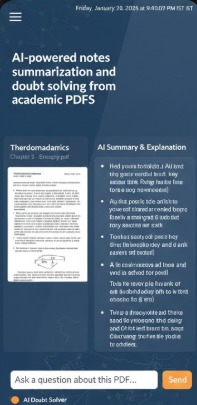
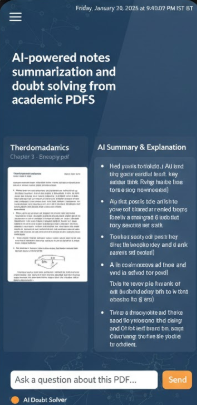
AI-powered notes summarization and doubt solving from academic PDFs
-
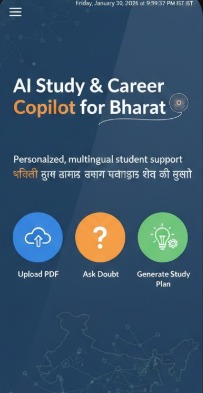
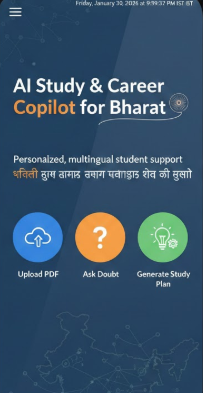
AI Study & Career Copilot for Bharat – Personalized, multilingual student support
Inspiration
College students in Bharat face a daily struggle with overloaded syllabi, last-minute exam preparation, language barriers, and limited access to personalized academic and career guidance. Most existing AI tools are expensive, English-only, or designed for students in Western education systems.
We were inspired by the reality of Tier-2 and Tier-3 college students who rely heavily on PDFs, recorded lectures, and self-study but lack structured planning and mentorship. This project was built to create an India-first AI copilot that is practical, affordable, multilingual, and usable even on low-bandwidth networks.
What it Does
Our platform acts as a personal AI study and career assistant for college students. It enables students to:
- Upload PDFs, PPTs, or video links and get concise, exam-ready summaries
- Ask doubts in simple English or Indian languages
- Generate adaptive study timetables based on exam dates and available time
- Track learning progress and automatically adjust missed schedules
- Upload resumes to receive ATS scores, skill gap analysis, and career guidance
- Prepare for interviews using AI-powered mock questions
The system is optimized for low-bandwidth usage and focuses on real academic and placement needs faced by Indian students.
How We Built It
The system uses LLM-powered natural language processing combined with a Retrieval-Augmented Generation (RAG) pipeline. Uploaded documents are chunked, embedded, and stored in a vector database, enabling accurate and context-aware responses.
A FastAPI backend manages content processing, scheduling logic, and AI inference. The frontend provides a lightweight, mobile-friendly interface focused on accessibility. Multilingual responses are supported through prompt engineering and language-aware inference.
The architecture was designed to be modular, scalable, and deployable on low-cost cloud infrastructure.
Challenges We Faced
- Ensuring accurate AI responses from long academic documents
- Designing study plans that feel realistic and stress-balanced
- Optimizing performance for low-bandwidth environments
- Supporting multiple languages without increasing system complexity
- Balancing AI capabilities with affordability and feasibility
Each challenge helped us refine the system to focus on reliability, usability, and real-world impact.
What We Learned
Through this project, we learned how to:
- Build practical AI systems beyond simple chatbots
- Apply RAG pipelines for academic use cases
- Design AI solutions for Indian infrastructure constraints
- Balance technical depth with user-centric design
- Align AI innovation with social impact
This project reinforced our belief that AI for Bharat must be inclusive, accessible, and grounded in real student needs.
Built With
- cloud
- deployment
- faiss-(rag)
- fastapi
- firebase-auth
- natural-language-processing
- openai-/-llama-based-llms
- pdf-&-youtube-content-parsing
- postgresql
- python
- react
- rest-apis