-
-
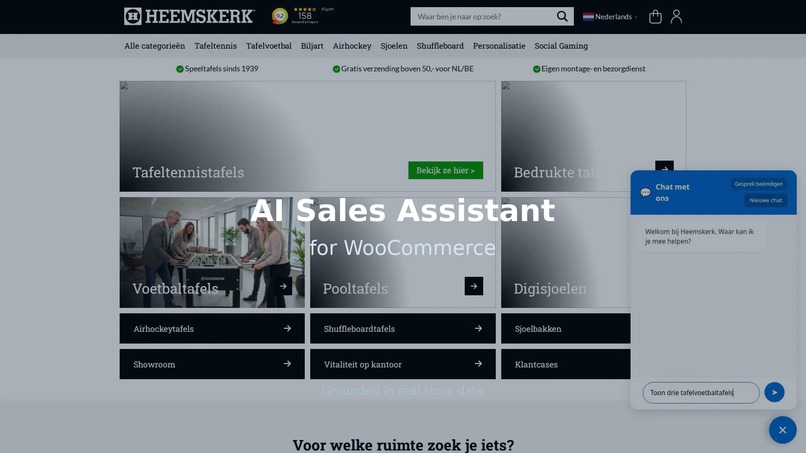
AI Sales assistant
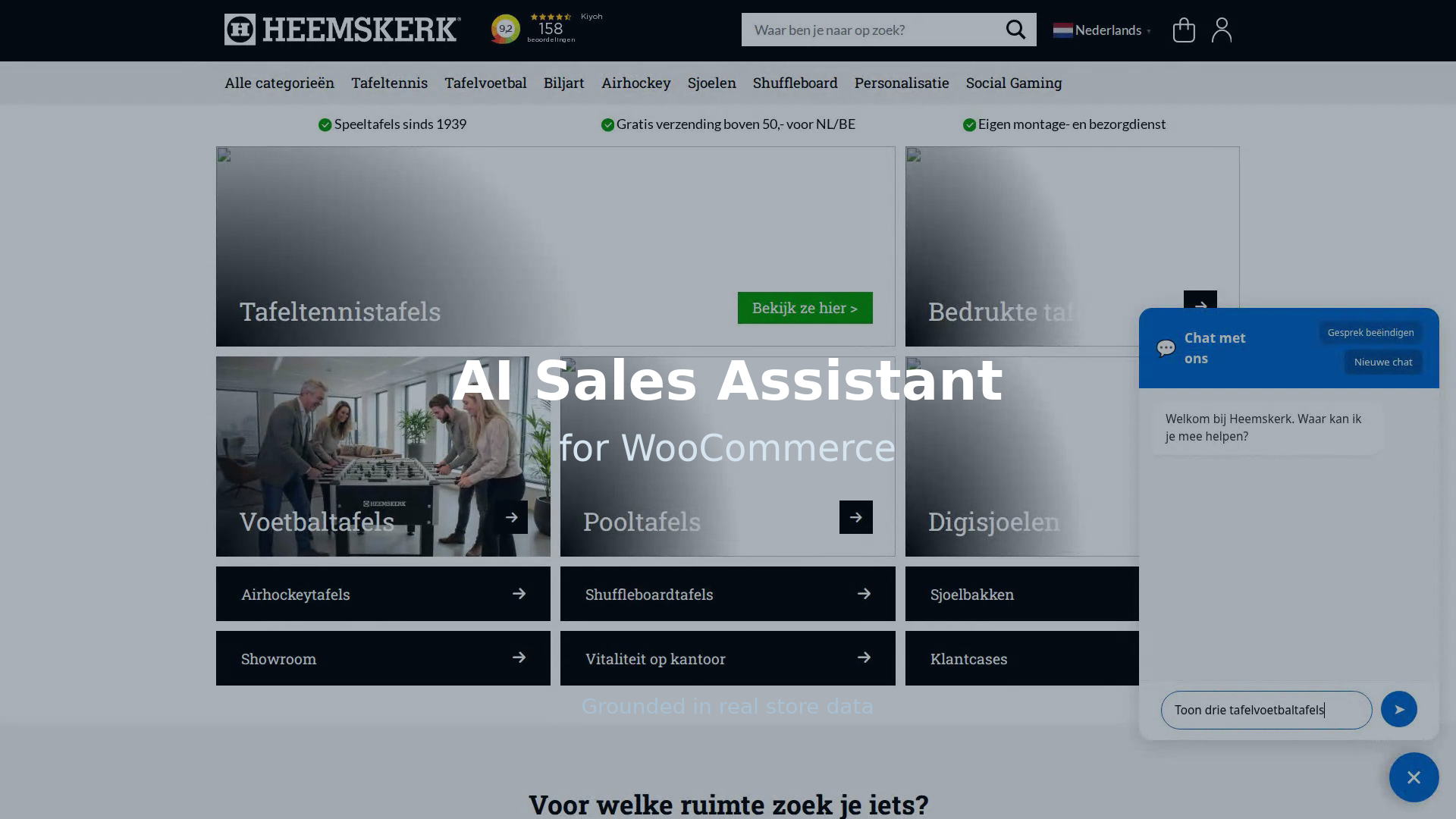
Gebruik deze definitieve versie:
# AI Store Assistant for WooCommerce

**Successfully deployed for a real WooCommerce merchant and currently entering production.**

## The idea

Online shopping is still surprisingly impersonal.

Customers often struggle to find the right product, compare alternatives, or ask the questions they would normally ask a knowledgeable salesperson in a physical store. Search bars and filters only solve part of that problem.

The goal of this project was to create an AI Sales Assistant that can understand an existing WooCommerce store and help customers shop naturally through conversation.

You do not deploy an empty chatbot. You deploy a knowledgeable AI salesperson that already understands the store.

---

## The problem

Most AI chatbots know very little about the webshop they are placed on.

They can hallucinate products, overlook important specifications, give generic advice, or recommend items that do not fit the customer's needs.

Creating a reliable assistant also usually requires extensive manual configuration, prompt writing, and knowledge-base maintenance.

I wanted to remove that friction while keeping recommendations grounded in real store data.

---

## The solution

The AI Store Assistant creates a knowledgeable sales assistant from an existing WooCommerce webshop.

It can:

- Connect to WooCommerce through its APIs.
- Import and structure the product catalogue.
- Crawl the public website for company information, FAQs, shipping terms, returns policies, and other relevant knowledge.
- Build an optimized AI knowledge index.
- Hold natural, context-aware conversations with customers.
- Ask relevant questions before recommending products.
- Recommend only products that actually exist in the catalogue.
- Store conversations so merchants can understand customer needs and improve the assistant.

The result feels closer to speaking with an experienced store employee than using a conventional search bar.

---

## Built with OpenAI

The project was built using the OpenAI Responses API and GPT-5.6, with Codex supporting development, debugging, testing, and iteration.

OpenAI models are used for:

- Natural conversation.
- Intent and context understanding.
- Product recommendation.
- Tool orchestration.
- Structured knowledge retrieval.
- Conversation evaluation.
- Response-quality improvement.

One of the main lessons was that building a useful AI assistant is not about finding one perfect prompt.

It requires designing an entire system around the model.

---

## The technical challenge

The difficult part was not making the model answer questions.

The difficult part was making it behave like a trustworthy sales employee.

Development focused on questions such as:

- When should the assistant ask another question?
- When should it show products?
- How can it distinguish browsing from buying intent?
- How can product recommendations remain grounded?
- How should structured WooCommerce data and unstructured website content work together?
- How can the assistant remain natural without inventing information?
- How can real conversations be used to improve future performance?

Many iterations were needed to balance conversational freedom with reliable product grounding.

---

## What makes this different?

This is not a generic chatbot that requires extensive manual training.

Its knowledge can be generated directly from:

- The WooCommerce product catalogue.
- Product categories and attributes.
- Public website content.
- Company information.
- Shipping and return policies.
- Controlled merchant knowledge.

Because the assistant can be prepared from APIs and publicly available website content, a working demonstration can be created before requiring full website administration access.

This makes it possible to show a merchant an AI Sales Assistant already working with their own products and information, rather than presenting only a slide deck or generic demo.

---

## Real-world validation

The assistant has been built for a real WooCommerce merchant and is now being handed over for production use.

The merchant has been involved throughout the process and is enthusiastic about the result.

Working with a real webshop exposed practical issues that synthetic demonstrations would not reveal, including:

- Recommending products too early.
- Asking too many or too few questions.
- Handling vague browsing requests.
- Rejecting unsupported product categories.
- Keeping terminology consistent with the store.
- Balancing concise answers with helpful advice.

These real-world observations significantly improved the product.

---

## Merchant insights

The assistant is also useful after the customer conversation ends.

Conversations are stored so the merchant can see:

- What customers are looking for.
- Which questions repeatedly occur.
- Where product information is unclear.
- Which needs are not covered by the current catalogue.
- Where the assistant gives weak or incomplete answers.

The assistant therefore functions as both a sales tool and a source of customer intelligence.

---

## Lessons learned

The largest lesson was simple:

Customers do not want an AI chatbot.

They want fast, relevant, and trustworthy advice that helps them make a buying decision.

The best AI experience should feel less like using technology and more like talking to someone who understands both the products and the customer.

---

## What's next?

Planned improvements include:

- Richer product comparison.
- Automatic conversation evaluation.
- Continuous catalogue and knowledge synchronization.
- Improved merchant analytics.
- Easier multi-store deployment.
- Automated demonstration generation.
- Support for ecommerce platforms beyond WooCommerce.
- Better measurement of conversions and assisted sales.

The long-term vision is simple:

Connecting a knowledgeable AI Sales Assistant to an online store should become as easy as installing analytics or a payment provider.


Log in or sign up for Devpost to join the conversation.