-
-
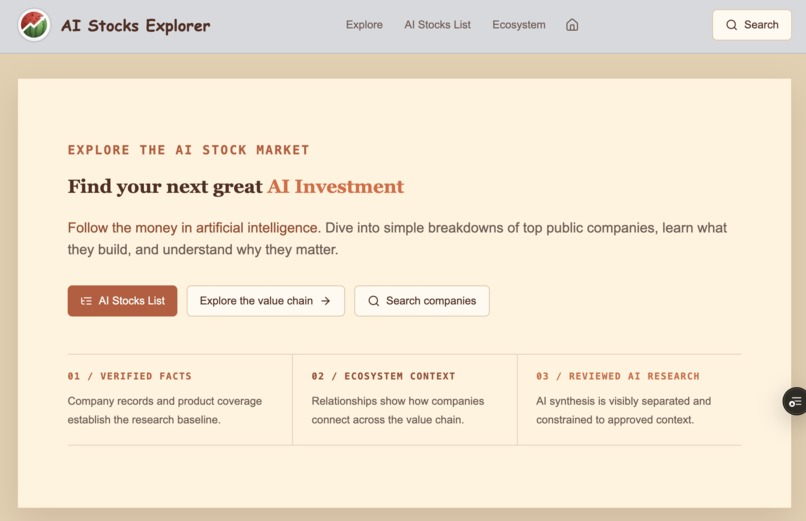
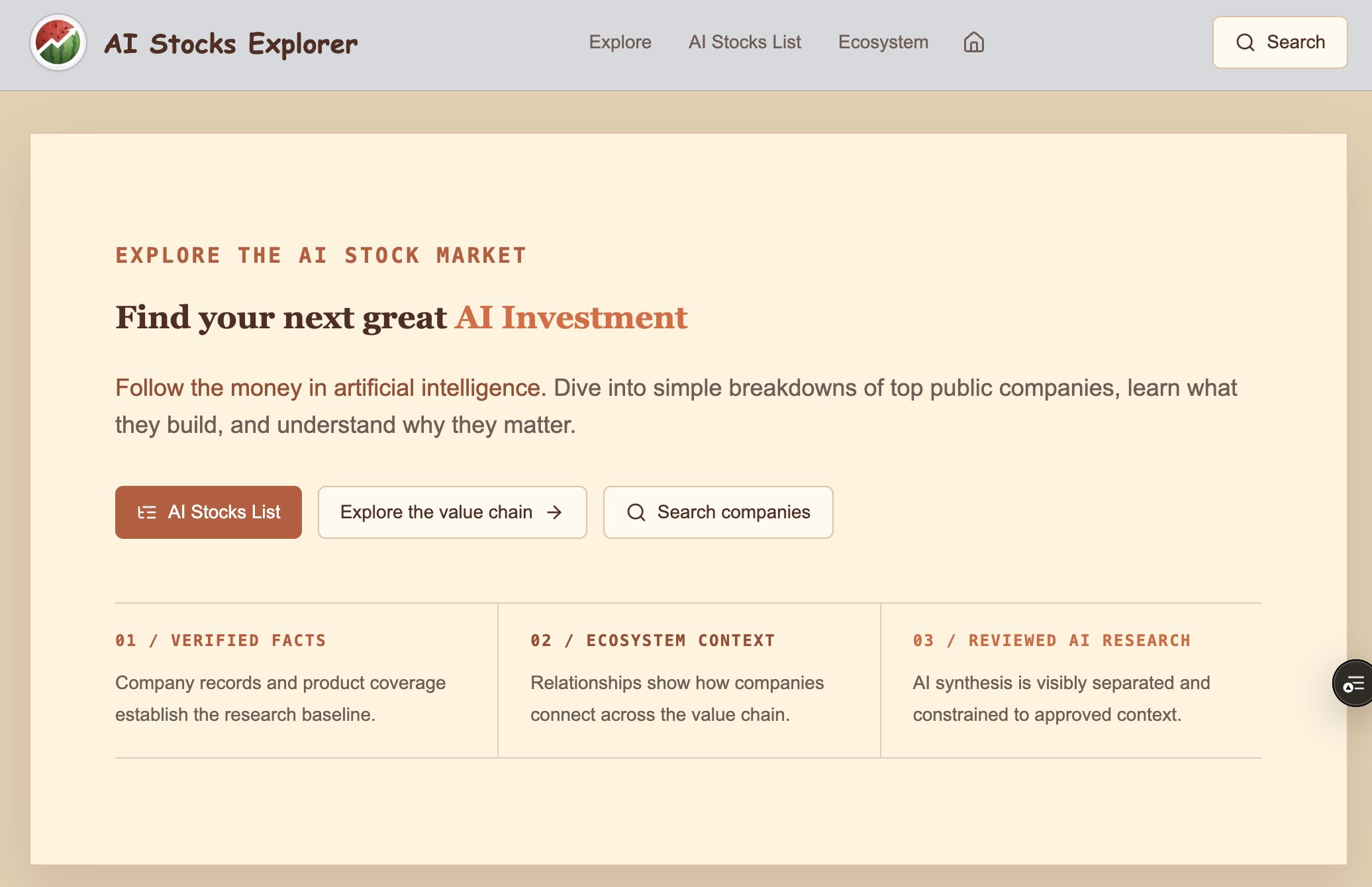
home Screen
-
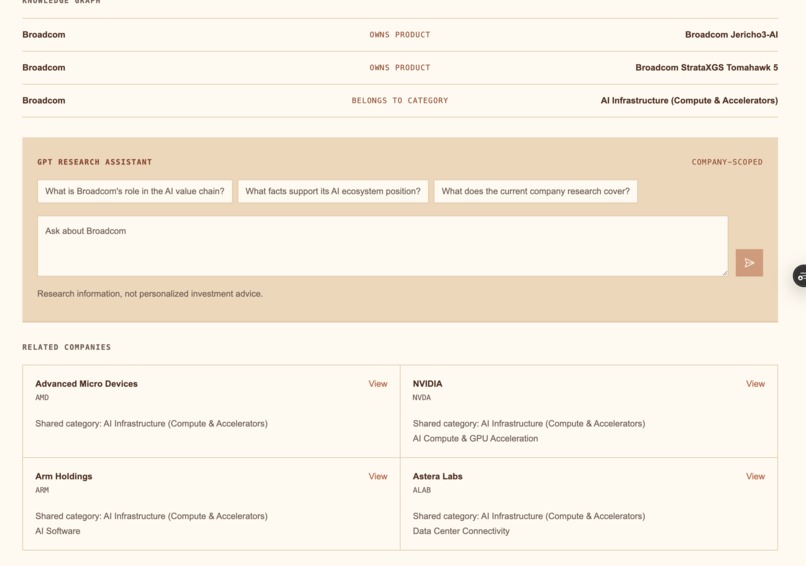
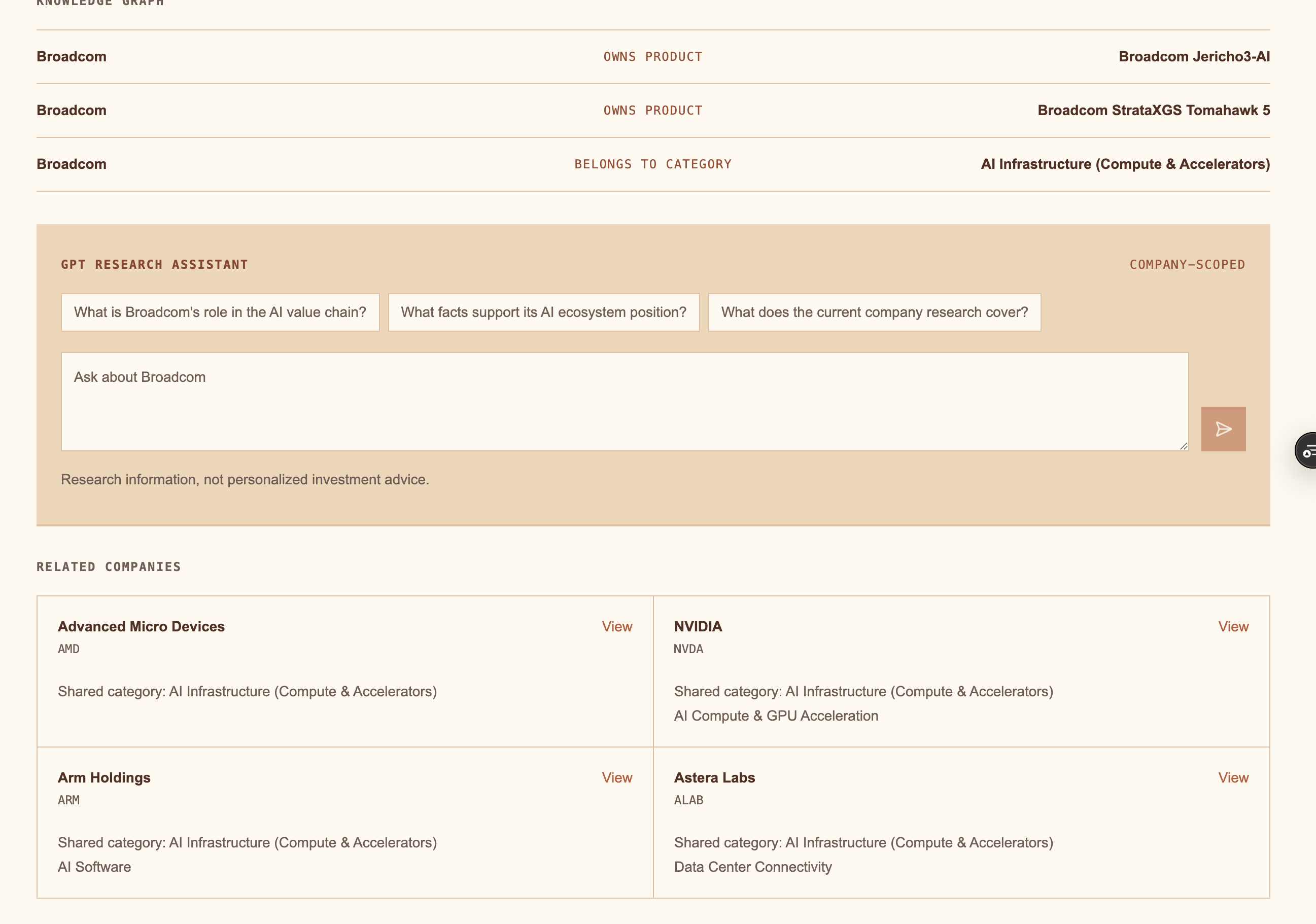
Chatbot in Individual Stock Research
-
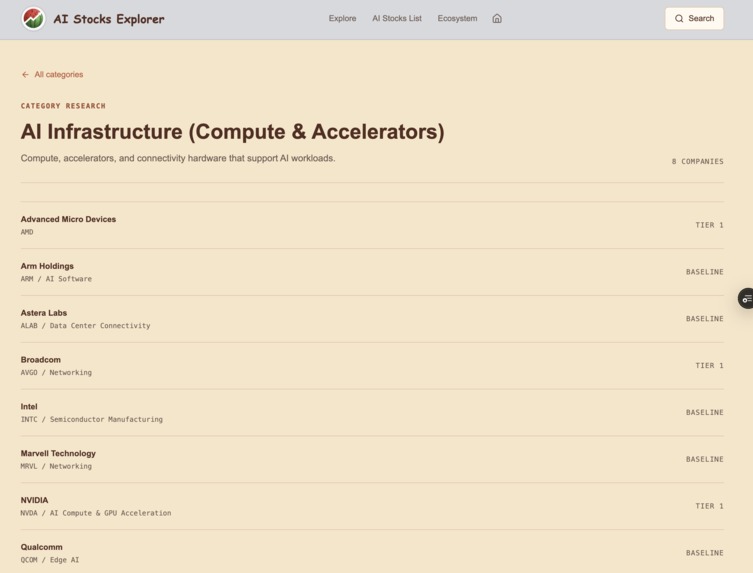
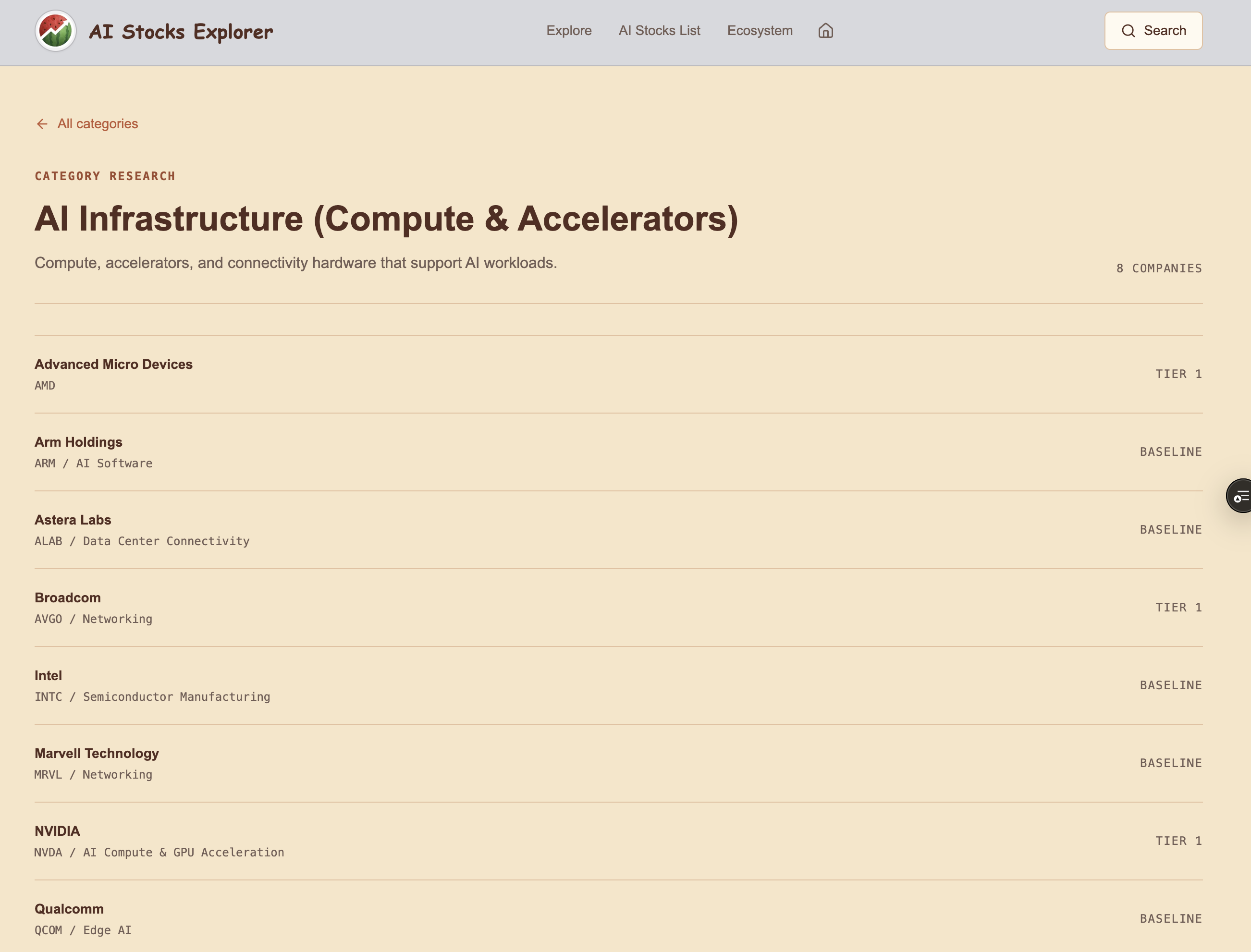
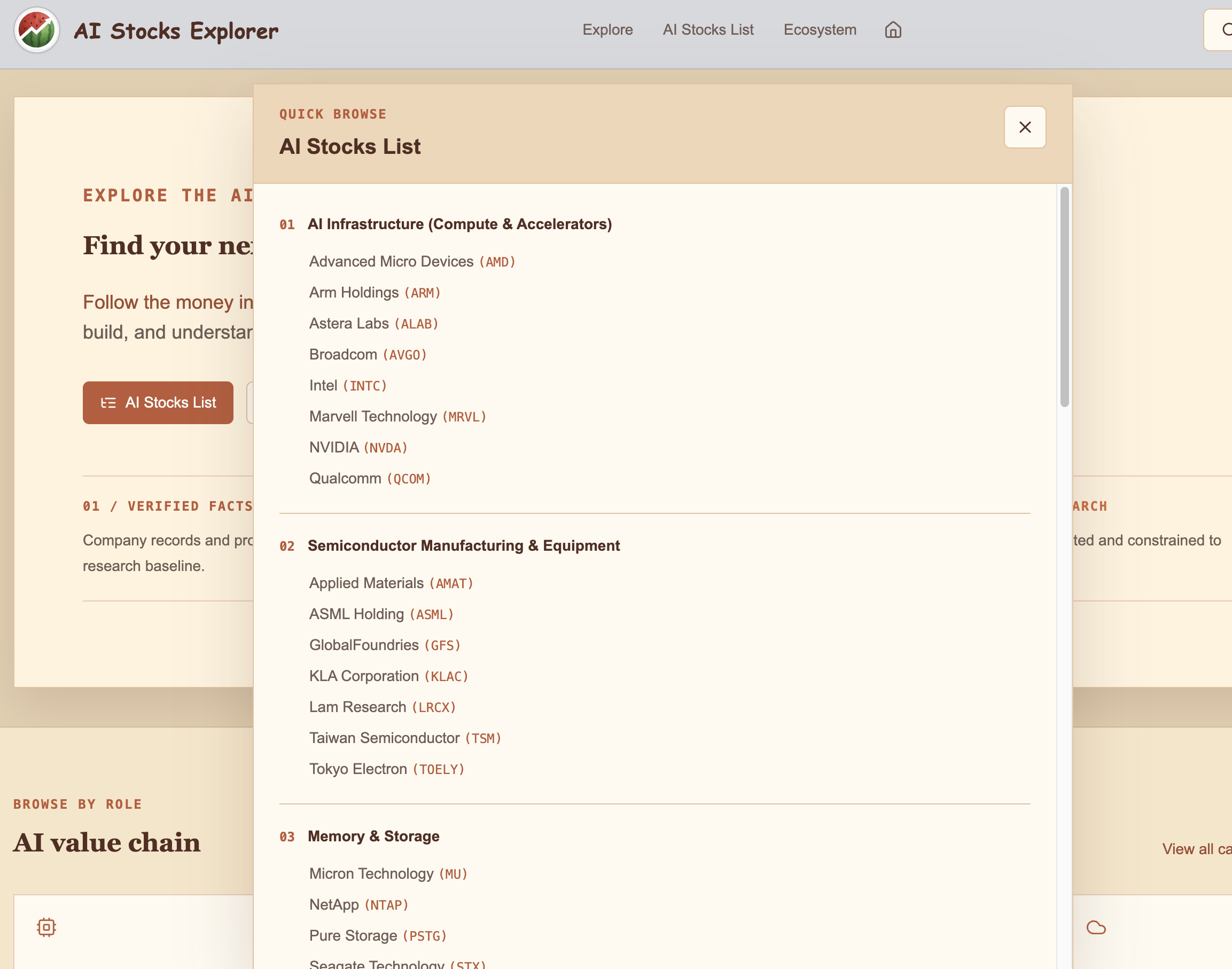
Stocks List under one of the category "Infrustracture"
-
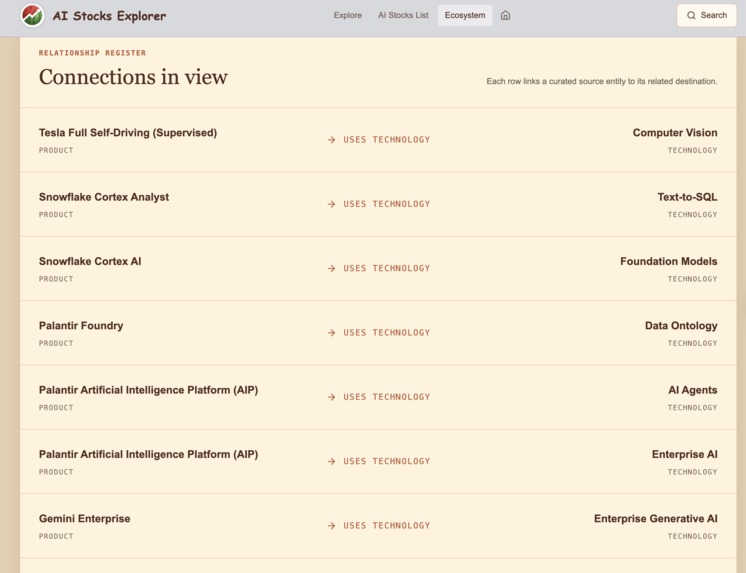
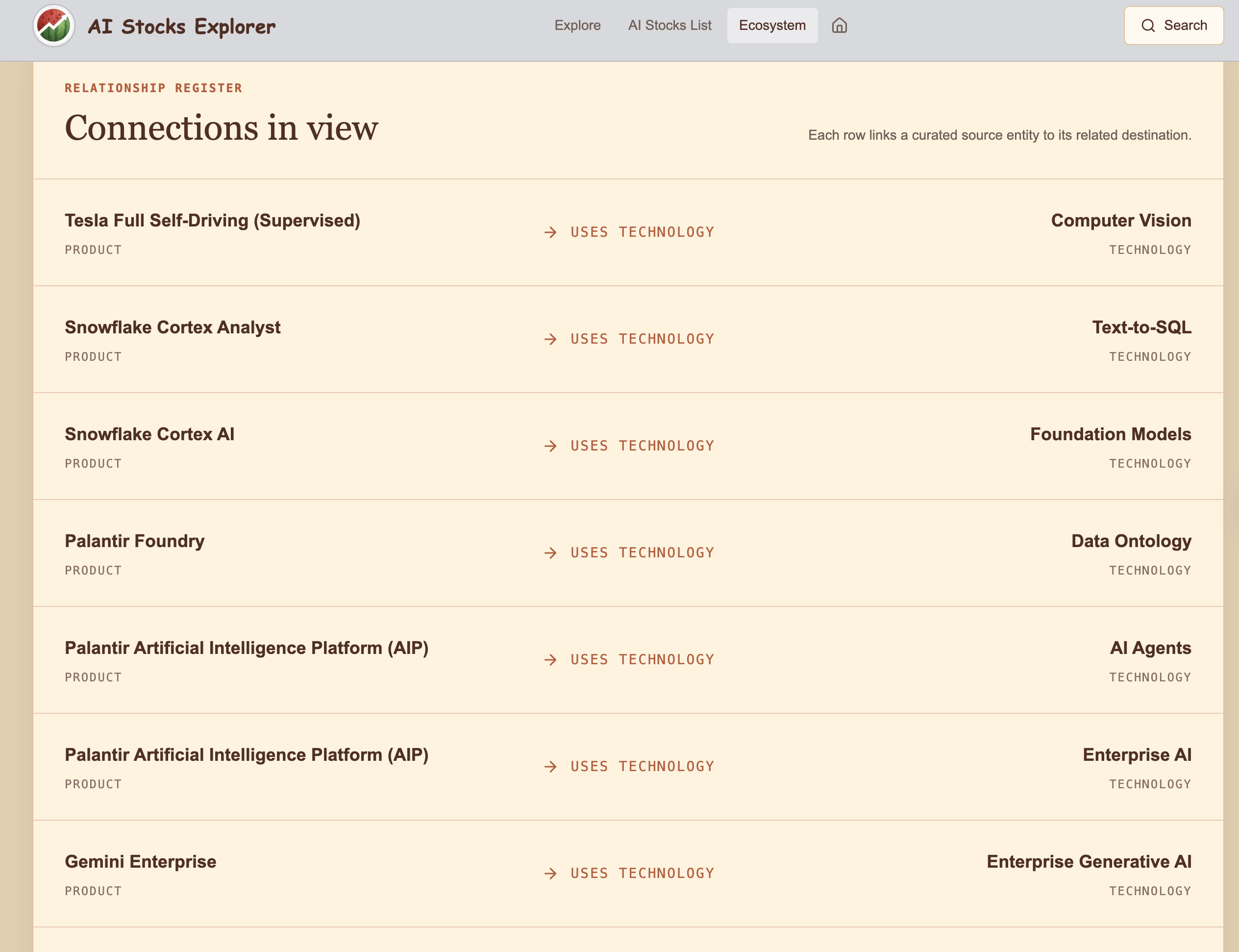
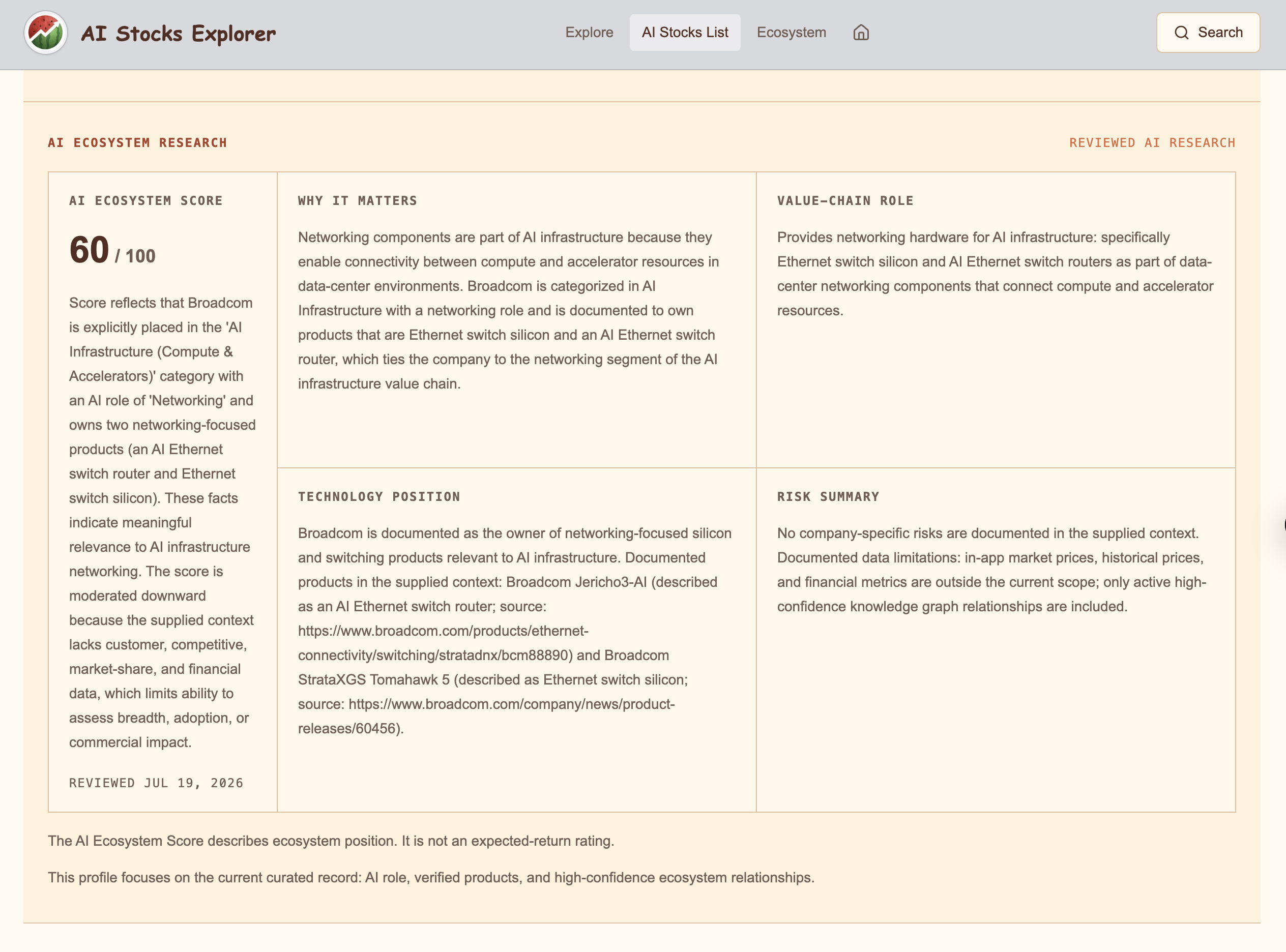
AI Stocks Ecosystem
-
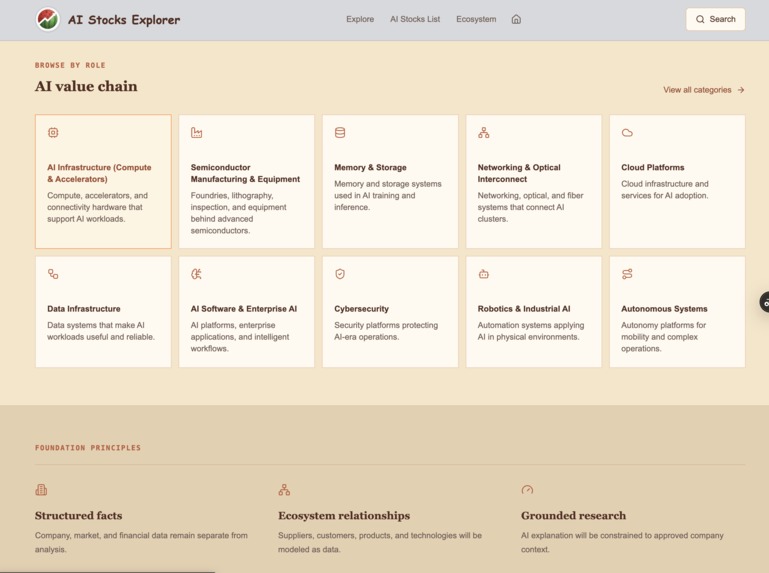
Catagory List
-
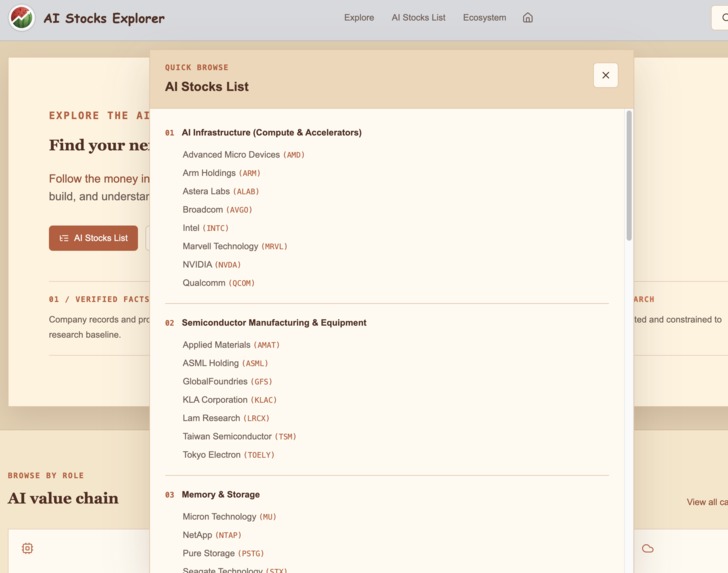
Stocks List
-
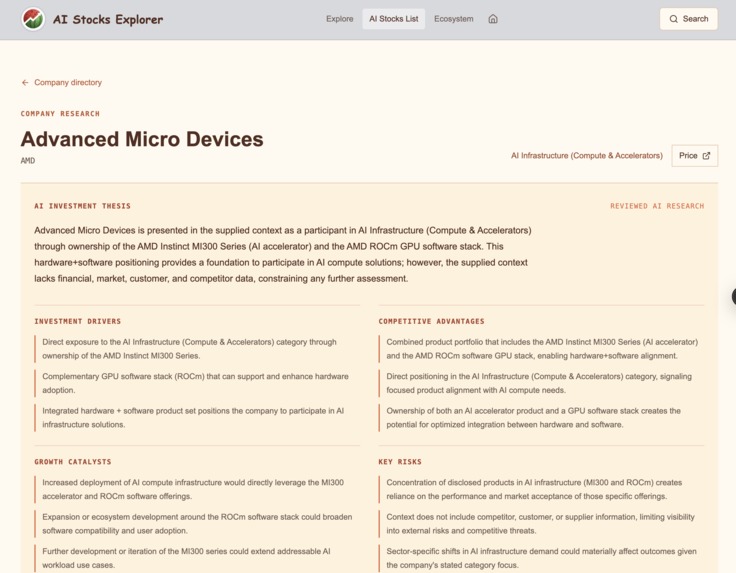
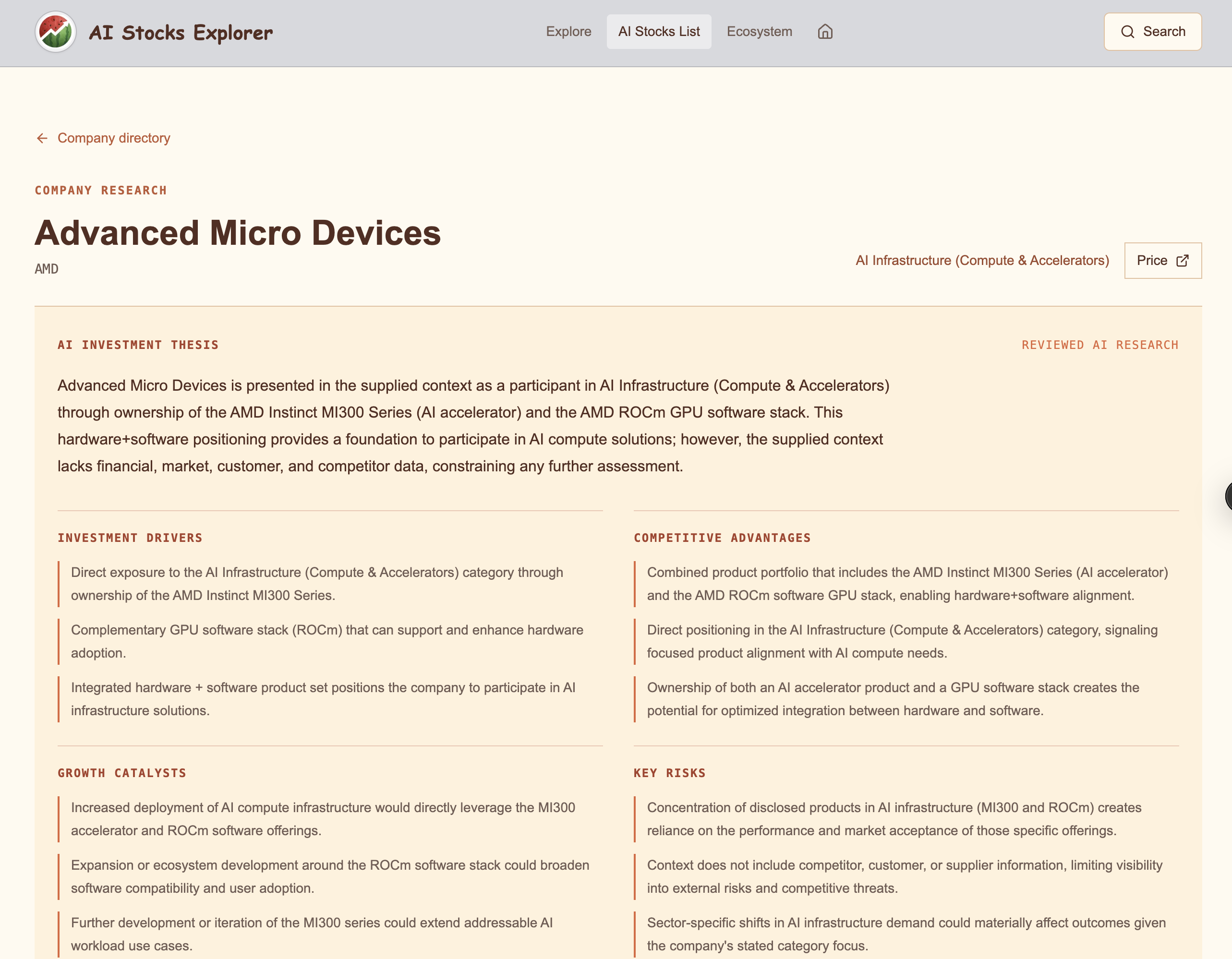
Individual Stock Research
-
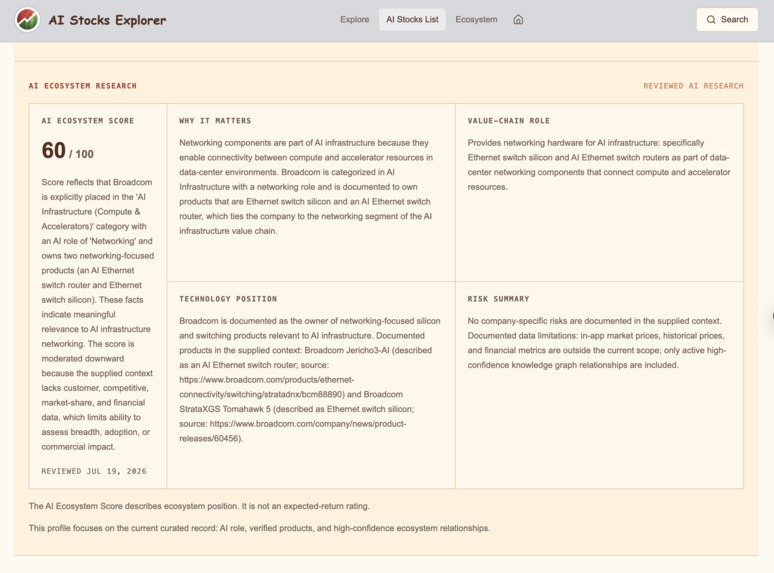
Individual Stock Research
Inspiration
Artificial intelligence is transforming nearly every industry, but investing in AI is surprisingly difficult.
Most investors know companies like NVIDIA, Microsoft, and Google, but they often don't know how the rest of the AI ecosystem fits together. Questions like these are common:
- Which companies build AI chips?
- Who manufactures those chips?
- Which companies provide memory, networking, cloud infrastructure, or AI software?
- How are these companies connected?
- If one company grows, who else might benefit?
I realized there wasn't a simple place where investors could explore the entire AI ecosystem in one experience. Existing financial websites focus on stock prices and financial metrics, but they rarely explain why a company matters in AI.
That inspired me to build AI Stocks Explorer—a platform that helps investors discover, understand, and research the companies building the future of AI.
What the Project Does
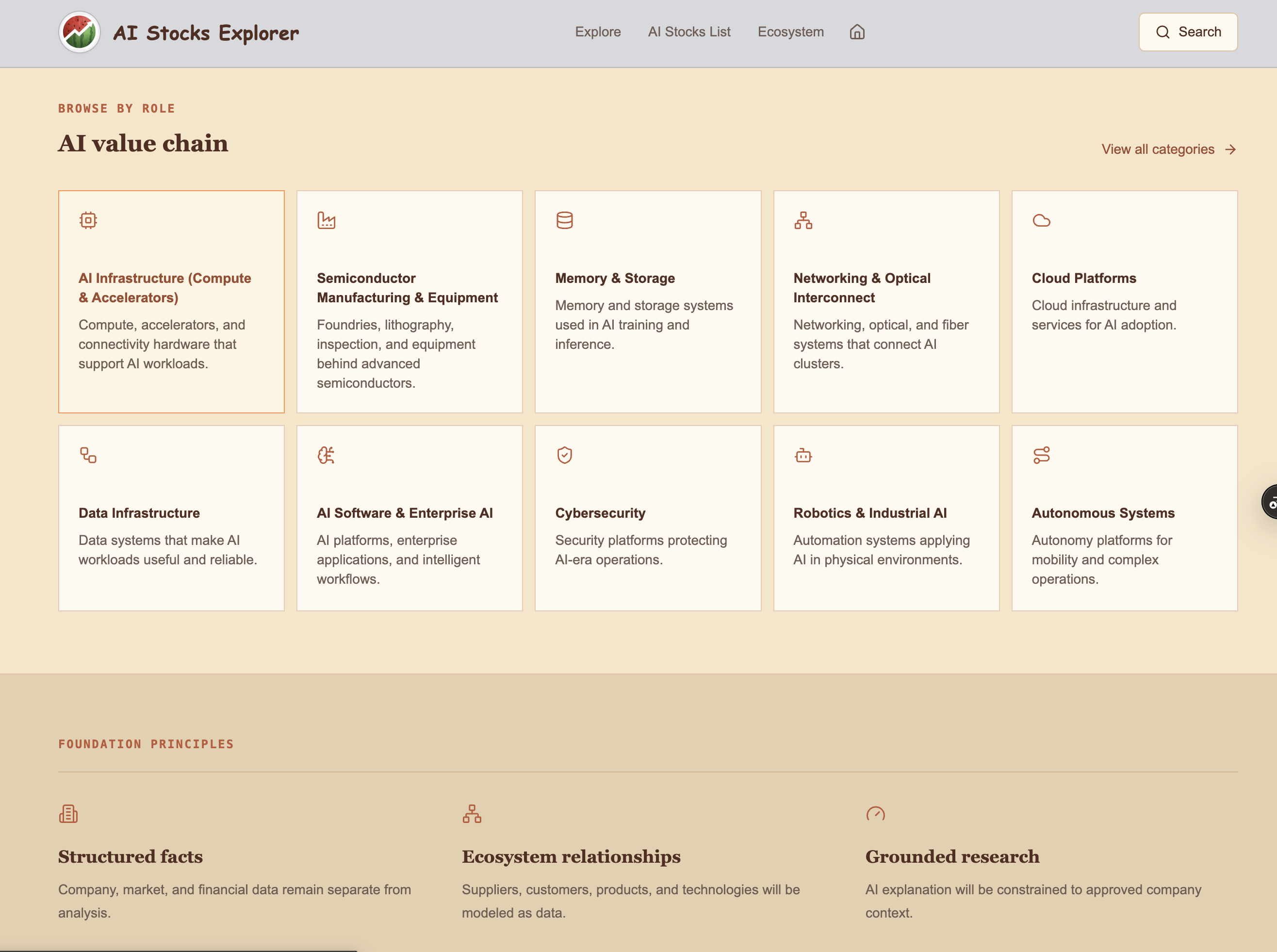
AI Stocks Explorer organizes public companies by their role in the AI value chain.
Instead of showing a long list of stocks, the platform groups companies into categories such as:
- AI Infrastructure
- Semiconductor Manufacturing
- Memory & Storage
- Networking
- Cloud Platforms
- Data Infrastructure
- AI Software
- Cybersecurity
- Robotics
- Autonomous Systems
- Healthcare AI
- Edge AI
Each company page combines market data with AI-generated research to help investors quickly understand:
- What the company does
- Why it is important to AI
- Its products and technologies
- Its role in the AI ecosystem
- Related companies
- An AI investment thesis
The goal is to help investors spend less time searching across multiple websites and more time understanding the AI landscape.
How I Built It
The project is built with a modern web stack:
- Next.js 15
- React 19
- TypeScript
- Tailwind CSS
- shadcn/ui
- Supabase for the database
- OpenAI API for AI-generated research
- Twelve Data API for market data
One design decision I made early was to separate facts from AI insights.
Market data, company information, and categories come from structured data sources, while AI is responsible for generating explanations and investment insights. This helps reduce hallucinations and makes the application more trustworthy.
I also designed the project with a modular architecture so that data providers, AI models, and future features can be added without major changes.
Challenges
One of the biggest challenges wasn't writing code—it was designing the product.
The AI ecosystem is huge, and deciding how to organize companies required a lot of research. Many companies fit into multiple categories. For example, NVIDIA is a semiconductor company, but investors primarily think of it as AI infrastructure. I had to create a taxonomy that reflects how people understand the AI industry rather than traditional market sectors.
Another challenge was balancing AI with reliable data.
I wanted AI to explain complex concepts, but I didn't want it to invent financial facts. Separating structured data from AI-generated analysis became one of the most important architectural decisions in the project.
Finally, creating a polished user experience took several iterations. I wanted the interface to feel approachable for individual investors while still providing enough depth for more experienced users.
What I Learned
This project taught me that building an AI application is about much more than integrating an LLM.
The real work is designing good data structures, creating clear user experiences, defining boundaries for AI, and making information easy to understand.
I also gained a much deeper understanding of the AI industry itself. Researching dozens of companies showed me how interconnected the ecosystem is—from semiconductor equipment and memory manufacturers to cloud providers, enterprise software companies, and robotics firms.
Perhaps the biggest lesson was that great AI products combine reliable data with intelligent explanations. AI is most valuable when it helps people understand information rather than replacing the information itself.
What's Next
This hackathon version is just the beginning.
Future plans include:
- Expanding the platform to cover 70+ AI companies across the full AI value chain.
- Building an interactive AI Knowledge Graph to visualize relationships between companies.
- Adding AI-powered stock comparison and screening tools.
- Creating personalized watchlists and AI research summaries.
- Providing deeper insights into supply chains, partnerships, and competitive landscapes.
My long-term vision is for AI Stocks Explorer to become the easiest place for investors to understand the companies shaping the future of artificial intelligence.
Final Thoughts
Building AI Stocks Explorer has been an exciting journey. It combined my interests in investing, technology, and product design into one project.
I hope it helps investors better understand one of the most important technology shifts of our time—and makes researching AI companies a little easier, a little faster, and a lot more enjoyable.
Built With
- ai-ecosystem
- ai-research
- codex
- github
- gpt5.6
- investment-research
- knowledge-graph
- next.js
- node.js
- openai-api
- postgresql
- react
- responsive-design
- rest-api
- server-side-rendering
- stock-market
- supabase
- tailwind-css
- typescript
- vercel
- vitest

Log in or sign up for Devpost to join the conversation.