-
-
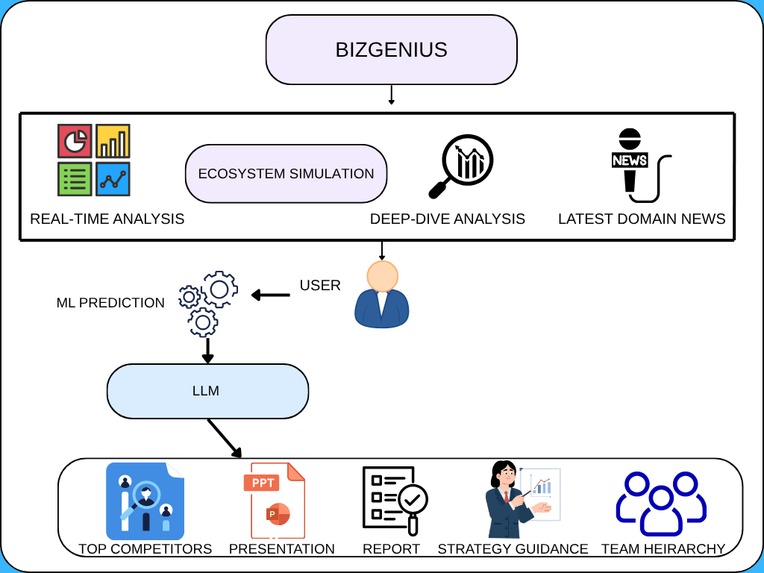
Overview of BizGenius
-
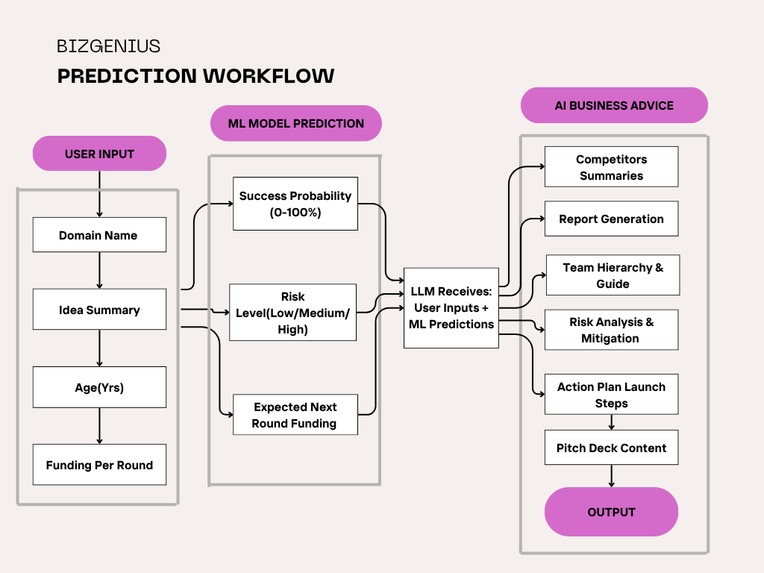
System Design of BizGenius
Inspiration
Every day, thousands of students and first-time founders have brilliant startup ideas but most never know if those ideas are actually viable. We've seen friends and classmates pour months of effort into ventures that could have been validated (or redirected) much earlier with the right data. We asked ourselves: What if an early-stage founder could get the same quality of analysis that a VC analyst provides instantly, for free, powered by AI? That question became BizGenius.
What it does
BizGenius is an AI-powered startup validation platform that tells founders within minutes whether their business idea has real potential. A user simply enters their startup details:
🏢 Business domain & idea description 📅 Company age & funding history 👥 Team size & number of investors 💰 Funding per round
BizGenius then delivers a complete startup intelligence report across 5 key outputs:
Success Prediction Using a Random Forest Classifier trained on 3,000 startup records, the system predicts whether the startup falls into one of three categories: Success Uncertain Failure Along with a confidence probability score for each category.
Funding Estimation A Gradient Boosting Regressor predicts how much funding the startup is likely to raise in its next round, with a prediction error of just 2.27% MAPE.
3.Ecosystem Analysis Load synthetic dataset Generate: startup distribution graphs city-wise success rates funding trend analysis
Competitor Analysis Using a RAG (Retrieval-Augmented Generation) system powered by ChromaDB, BizGenius finds semantically similar startups from its database and benchmarks the user's idea against real market patterns.
AI Strategic Insights LLaMA 3.3 (via Groq) processes the ML predictions and competitor data to generate:
Risk factors & mitigation strategies Competitive differentiation advice Step-by-step 30-day action plan Investor-ready narrative summary
- Automated Report & Pitch Deck With one click, BizGenius generates:
A downloadable PDF business report A professional PPTX investor pitch deck
Ready to share with investors no design skills needed.
Our Data Foundation Unlike tools that rely purely on generic or synthetic data, BizGenius is grounded in real startup intelligence:
Crunchbase : funding rounds, investor data, company stages Wikipedia : company histories, founding details, market domains Other public startup directories : geographic and sector data
The scraped dataset of ~300 real startup records was then statistically augmented to 3,000 records using log-normal, Poisson, and exponential distributions preserving real-world correlations while solving the problem of startup data scarcity.
How we built it
BizGenius is a multi-layer AI platform built entirely in Python, designed to help startups validate and optimize their business ideas using data-driven intelligence. The platform uses React for the frontend interface, Scikit-learn models such as Random Forest, Gradient Boosting, and XGBoost for predictive analytics, LLaMA 3.3 via the Groq API for advanced language intelligence, and ChromaDB as a vector database for Retrieval-Augmented Generation (RAG). It also automates professional report generation in PDF and PPTX formats.
The machine learning pipeline was trained on a hybrid dataset consisting of nearly 300 real startup records collected through web scraping and expanded synthetically to around 3,000 records using statistical distributions like log-normal, Poisson, and exponential distributions. For startup success prediction, the Random Forest classification model achieved 97% accuracy with a macro F1-score of 0.96. For predicting future funding rounds, the Gradient Boosting regression model achieved an R² score of 0.9699 with a Mean Absolute Percentage Error (MAPE) of just 2.27%.
To enhance decision-making capabilities, BizGenius integrates a RAG-based intelligence layer using ChromaDB and LLaMA 3.3 through Groq API. This layer transforms raw machine learning outputs into actionable strategic insights, including risk analysis, competitor benchmarking, investor pitch recommendations, and personalized 30-day business action plans for startup founders.
Challenges we ran into
Challenges We Faced Data scarcity: We scraped dataset from varous sites like wikipedia,crunchbase etc so dataset was less. Class imbalance: Successful startups are rare in datasets. We used SMOTE to balance classes before training. LLM prompt engineering: Getting LLaMA to generate specific, grounded business advice (not generic text) required careful prompt design and RAG context injection. Automated report generation: Producing professional PDF and PPTX outputs programmatically from AI-generated content was surprisingly complex.
Accomplishments that we're proud of
Published Research Paper
- We're incredibly proud that our work was officially published in the International Journal of Engineering Development and Research (IJEDR) Volume 14, Issue 1, February 2026 — with a Google Scholar Impact Factor of 9.37. "Intelligent Startup Evaluation Platform" Paper ID: IJEDR2601339
Getting peer-reviewed and published as final-year undergraduate students is something we're truly proud of.
- 97% Classification Accuracy Our Random Forest Classifier achieved a remarkable 97% accuracy with a Macro F1-Score of 0.96 across all three classes that is Success, Failure, and Uncertain on real-world scraped startup data.
3.Seamlessly Connecting ML + RAG + LLM One of our biggest technical achievements was building a smooth end-to-end pipeline that connects three very different AI systems:
Structured ML predictions → RAG-based competitor retrieval from ChromaDB → LLaMA 3.3 generating grounded, specific business insights
Making these three systems talk to each other reliably without hallucinations or broken outputs was a significant engineering challenge that we solved.
- Building Our Own Startup Dataset There is no perfect, free, labeled startup dataset out there. So we built our own scraping data from Crunchbase, Wikipedia, and other public startup directories, cleaning and structuring it, then augmenting it statistically to 3,000 records while preserving real-world correlations. This dataset itself is a contribution we're proud of.
What we learned
How to build a full end-to-end AI pipeline that connects structured ML predictions with generative AI reasoning The importance of data augmentation when real-world startup datasets are scarce How RAG grounding significantly reduces LLM hallucinations in domain-specific applications Turning technical model outputs into actionable business language is just as hard as building the models themselves
What's next for AI Startup Idea Validation & Success prediction system
Integration with Real-Time Market Data: Connect BizGenius with live startup and funding databases (e.g., Crunchbase, AngelList) for up-to-date insights. Enhanced Financial Forecasting: Incorporate deep learning models (LSTM, Prophet) to predict future revenue and valuation trends. User Dashboard & Authentication: Add personalized dashboards for continuous startup tracking and comparison. Automated Investor Matching: Match promising startups with potential investors using AI-based profiling. Multi-Language Support: Expand accessibility by enabling support for regional and international languages.
Built With
- chromadb
- collab
- groq
- llm
- machine-learning
- python
- rag
- react
- sckitlearn
- vscode


Log in or sign up for Devpost to join the conversation.