Inspiration
Creating an original song usually means learning music theory, playing instruments, using production software, or paying for studio time. Finding background music brings another problem: the right track may not fit the project, and licensing terms can be difficult to understand.
We built AI Song Creator to give more people a practical way to make music. A creator can start with a mood, a scene, or a few lines of lyrics and turn that idea into a complete track without needing a studio or prior production experience.
What it does
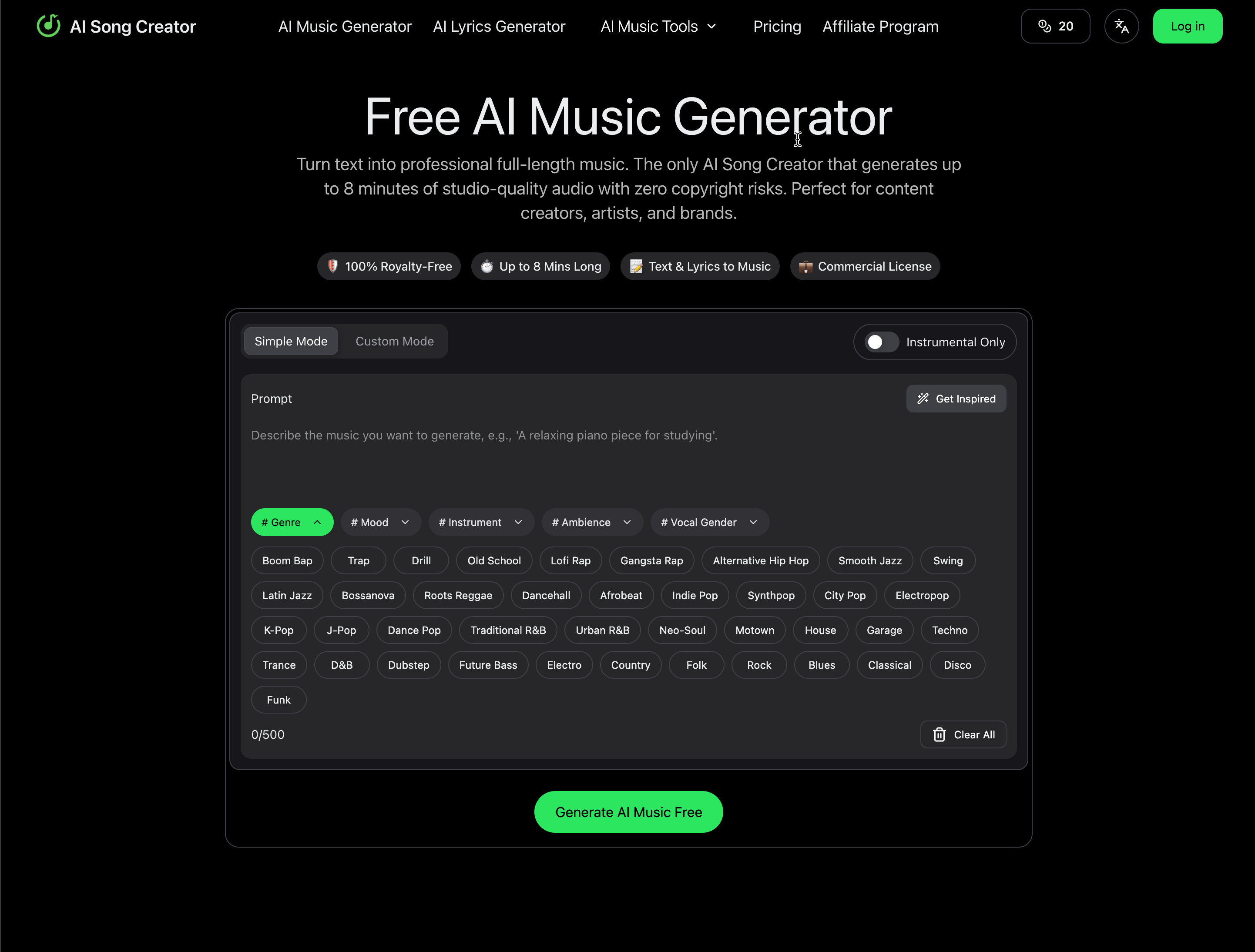
AI Song Creator turns text prompts or lyrics into original songs up to eight minutes long.
Users can:
- Describe a genre, mood, instrument, ambience, or creative scene
- Write their own lyrics or generate lyrics with AI
- Create songs with vocals or choose instrumental-only tracks
- Preview completed tracks and download them as MP3 or WAV
- Make music for videos, podcasts, games, ads, demos, and social content
- Explore dedicated generators for styles such as Pop, Rock, Jazz, EDM, Rap, R&B, Country, Folk, Ambient, and Techno
The platform also brings supporting music tools into one browser-based workspace, including AI mastering, a vocal remover, four-part stem separation, singing-voice generation, song covers, BPM and key detection, audio-to-MIDI conversion, a MIDI editor, and an MP3 tag editor.
How we built it
AI Song Creator is built with Next.js, React, TypeScript, and Tailwind CSS. PostgreSQL and Drizzle ORM manage users, music tasks, credits, subscriptions, and project data.
The backend coordinates asynchronous music-generation and audio-processing jobs, tracks their status, processes webhooks, and stores finished audio in S3-compatible object storage. OpenAI supports lyrics workflows, while Replicate and other specialized AI services power voice, cover, stem-separation, and music-generation tasks. Stripe handles subscriptions and credit purchases, and the application is prepared for deployment on Cloudflare.
Challenges we ran into
The hardest part was making a long-running AI music workflow feel simple and dependable. Music generation is asynchronous, so the product must keep task state accurate while handling webhooks, retries, failed uploads, previews, and downloads.
We also had to balance control with ease of use. Experienced creators want to shape genre, mood, instruments, ambience, vocals, lyrics, and song structure, while first-time users need a clear path from one idea to a playable result.
Another challenge was combining generation, editing, analysis, and export tools without making the experience feel like a collection of unrelated utilities.
Accomplishments that we're proud of
We created an end-to-end workflow that takes a user from a short prompt or a set of lyrics to a complete song in the browser.
Creators can generate vocal songs or instrumentals, produce tracks up to eight minutes long, download MP3 or WAV files, and continue working with lyrics, mastering, stems, BPM, key, MIDI, and metadata tools in the same product.
We are especially proud that the platform supports both quick experimentation and more detailed creative direction without requiring instruments, a DAW, or music-production experience.
What we learned
We learned that music generation is only one part of the creative process. Users also need to preview, organize, refine, analyze, and export their work before it becomes useful in a real project.
We also learned that clear controls matter more than adding endless options. A small set of understandable choices for style, mood, instruments, vocals, and lyrics gives creators useful direction without slowing them down.
What's next for AI Song Creator
Next, we plan to improve prompt control, expand genre coverage, and make generated songs easier to refine section by section.
We also want to strengthen mastering, stem-separation, singing-voice, song-cover, and MIDI workflows so creators can move from an initial idea to a polished, shareable track without leaving AI Song Creator.
Built With
- next.js
- postgresql
- react
- tailwind
- typescript
