Inspiration
In India, waste segregation at the source is still a major challenge. Mixed waste disposal, lack of citizen motivation, and manual monitoring can lead to pollution, health hazards, overflowing bins, and inefficient recycling.
We were inspired to build a smart waste management solution that combines AI, IoT, and a reward-based system to make proper waste disposal easier and more engaging for users.
What We Built
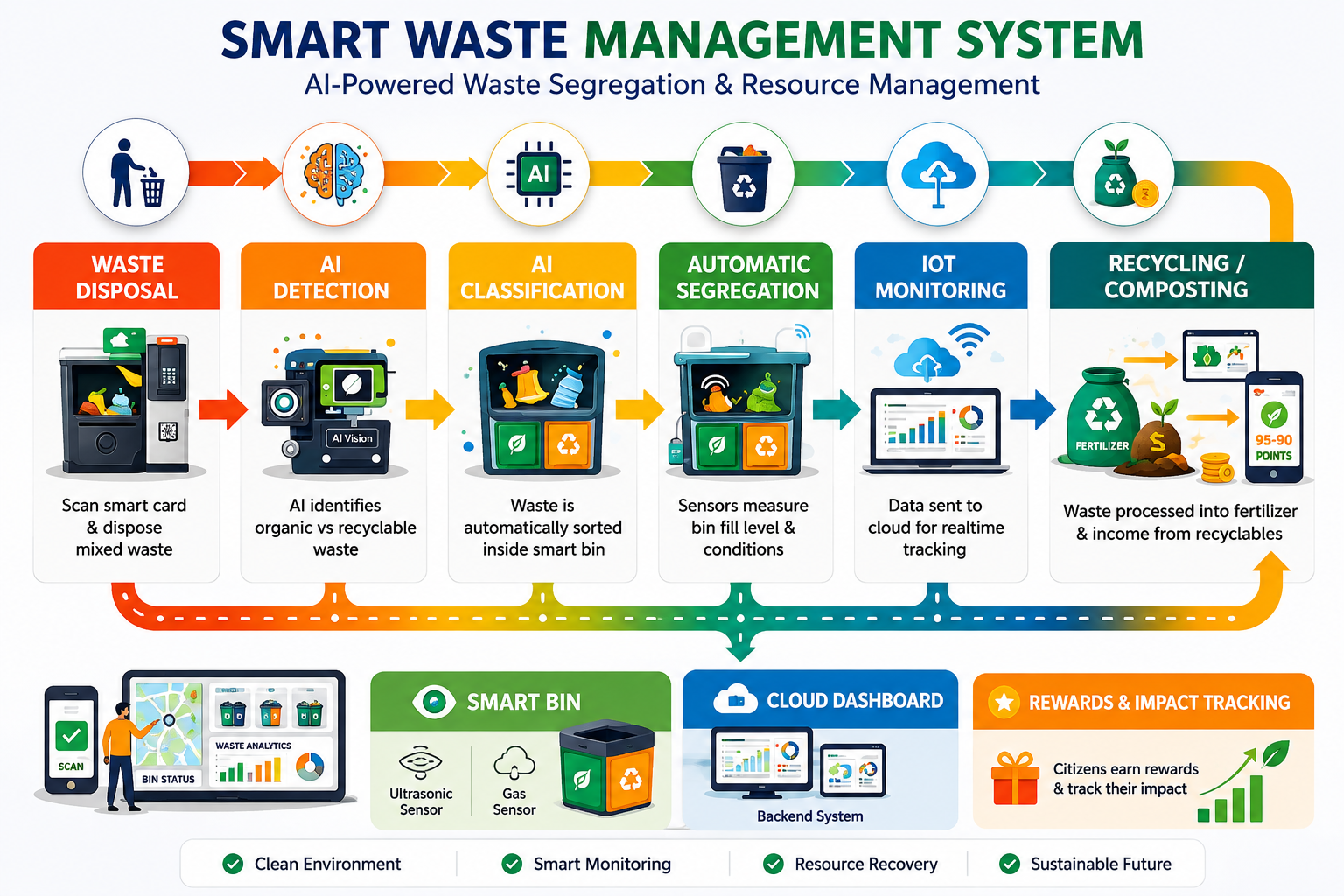
We developed an AI and IoT-enabled Smart Waste Segregation and Resource Management System.
The user first displays a QR code through the mobile app. The smart dustbin scans and verifies the user, then automatically opens the waste-disposal gate.
A camera captures the waste image, and the AI system classifies it into categories such as Organic, Recyclable, or Mixed waste. Sensors are used to measure waste weight, monitor the bin's fill level, and detect harmful gas levels.
The collected data is sent to the cloud, where users and authorities can monitor the system.
Reward System
The system measures the weight of waste using a load cell. Based on the waste contribution, reward points are generated for the user.
Users can view and redeem their points through the mobile application. This incentive system is designed to encourage citizens to participate in proper waste segregation.
How It Works
- User opens the mobile application.
- User displays the QR code.
- Smart dustbin verifies the user.
- The dustbin gate opens automatically.
- User disposes of waste.
- Camera captures the waste image.
- AI classifies the waste.
- Load cell measures the waste weight.
- Ultrasonic sensor monitors bin level.
- Gas sensor monitors harmful gases.
- Reward points are calculated.
- Data is sent to the cloud dashboard.
- Segregated waste can be transported for further processing.
Technology
The system uses Raspberry Pi, camera module, AI/ML, Python, OpenCV, IoT sensors, QR authentication, cloud database, Flask/Node.js, and a mobile/web dashboard.
Challenges
One challenge is AI classification accuracy, especially when waste is mixed or very small. Internet connectivity can also affect real-time data transmission.
To address these issues, the system can continuously improve the AI model using real-world waste data and store data locally during connectivity problems before synchronizing it when the network becomes available.
What We Learned
Through this project, we learned how to integrate AI, IoT sensors, cloud services, user authentication, reward systems, and dashboards into a single smart waste management solution.
Future Scope
The system can be deployed in residential communities, educational institutions, public places, commercial buildings, and smart cities. With continuous AI model training and wider deployment, it can support more efficient recycling, waste collection, and data-driven waste management.
Built With
- ai
- camera-module
- cloud-computing
- firebase
- flask
- gas-sensor
- iot
- load-cell
- machine-learning
- mobile
- mysql
- node.js
- opencv
- python
- qr-code
- raspberry-pi
- ultrasonic-sensor


Log in or sign up for Devpost to join the conversation.