-
-
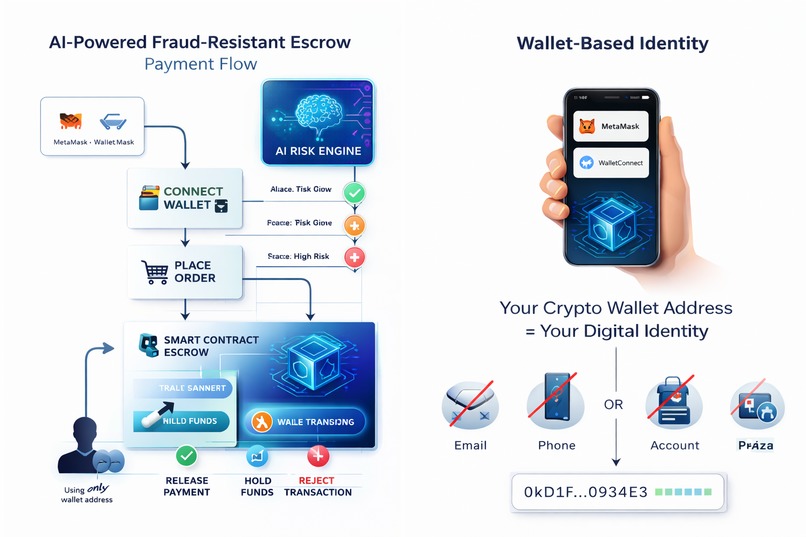
Payment Flow
-
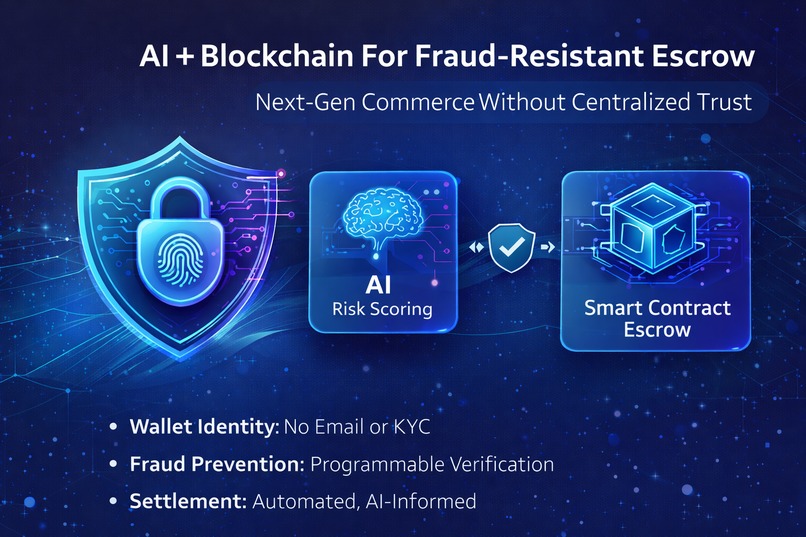
Architecture
Inspiration
Digital commerce today runs on centralized trust.
Every transaction requires users to share personal information — email, phone number, card details — and trust platforms to protect that data. At the same time, fraud detection systems remain reactive, manual, and opaque.
Coming from a background deeply interested in AI, system design, and decentralized technologies, I wanted to explore a simple but powerful idea:
Can we replace centralized trust with programmable trust?
This project was inspired by the intersection of:
Machine learning–based fraud detection
Smart contract–based escrow
Wallet-based identity
Privacy-first architecture
The goal was not just to build another Web3 app, but to design an intelligent commerce infrastructure layer.
What it does
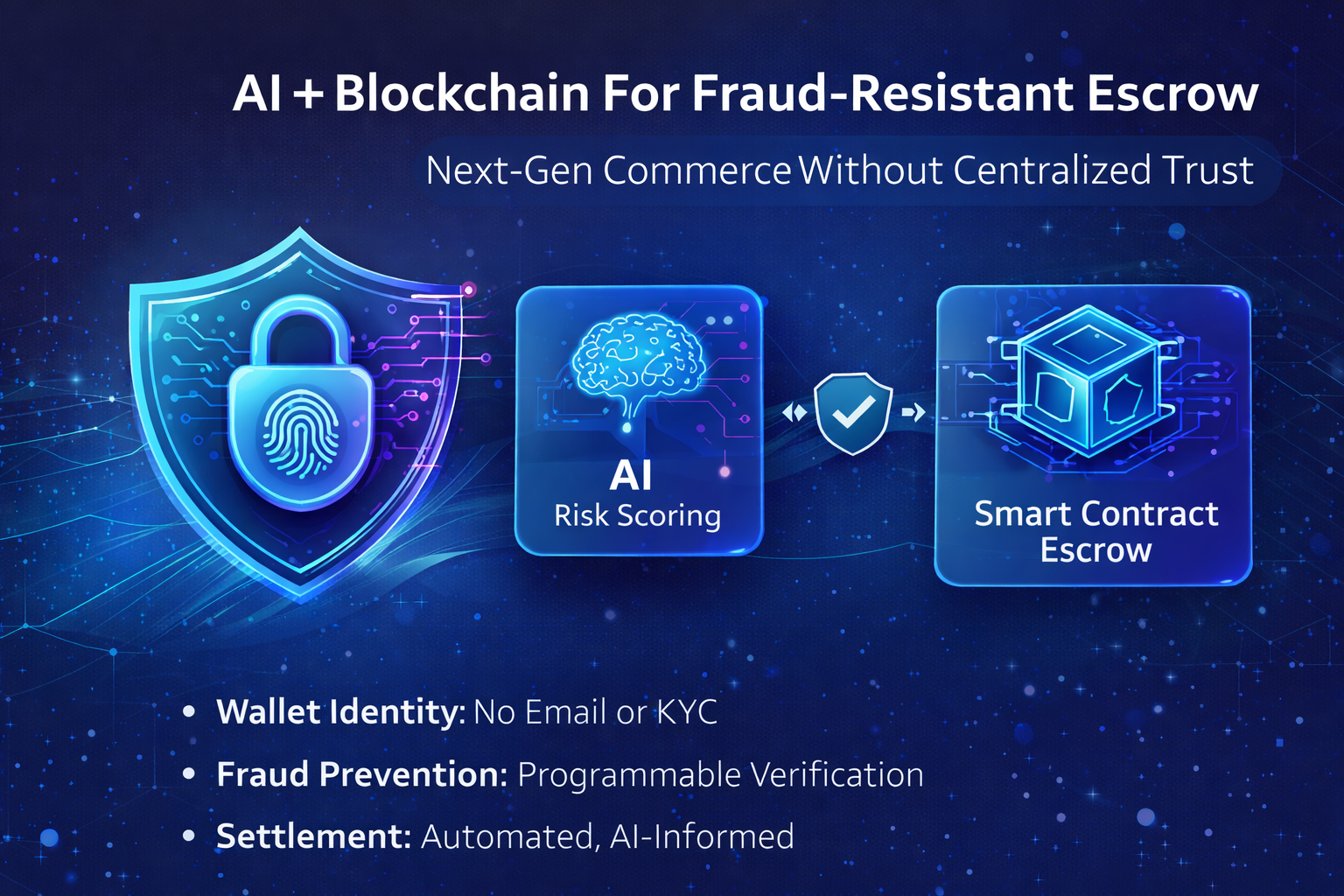
AI Smart Escrow for Digital Commerce is a fraud-resistant escrow system that combines AI risk assessment with blockchain-based settlement.
It:
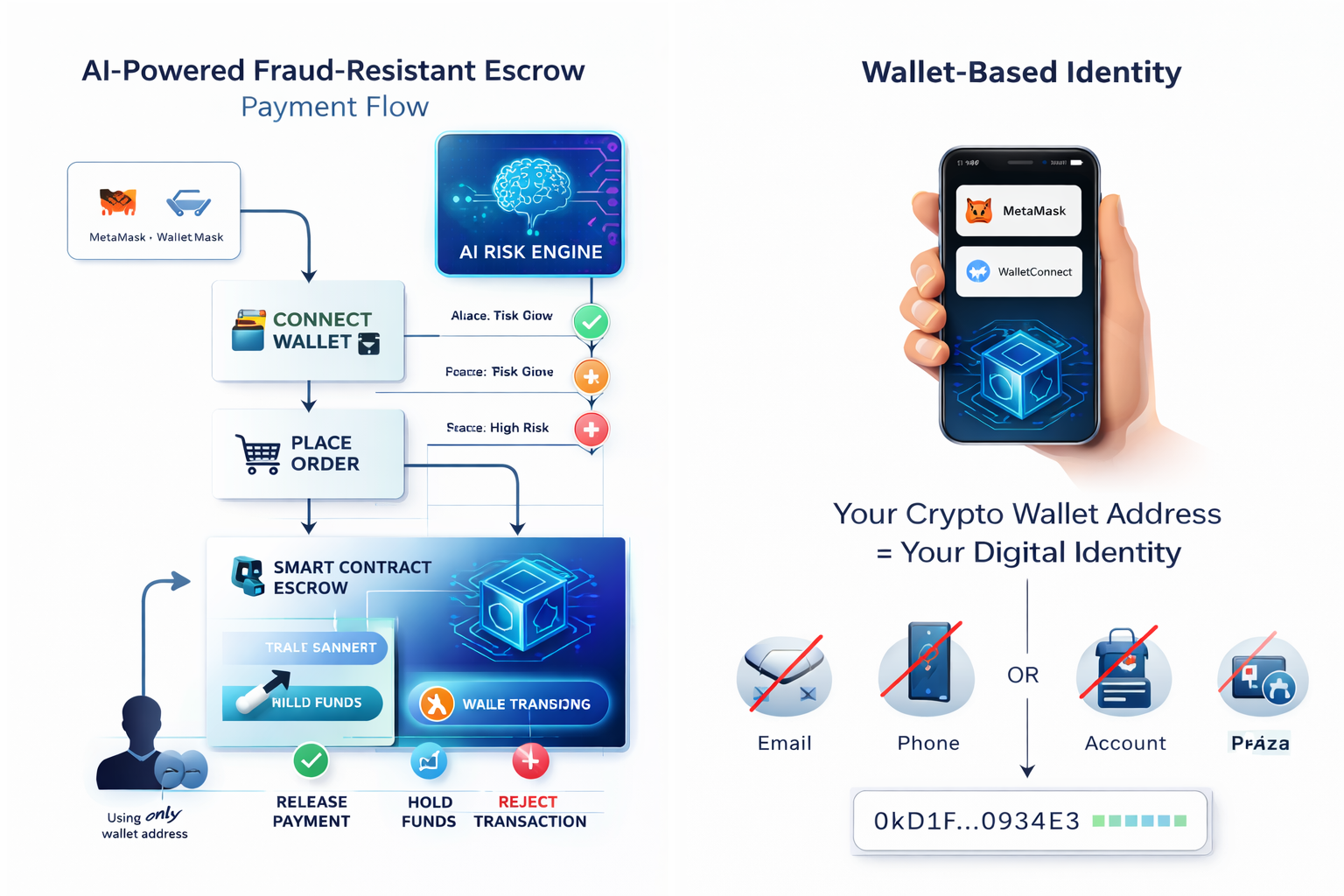
Uses wallet address as identity (no signup, no personal data)
Evaluates every transaction using an ML risk model
Classifies risk into:
Low → Auto release
Medium → Hold in escrow
High → Reject
Locks funds inside a smart contract escrow
Automates settlement logic based on AI output
The decision pipeline can be summarized as:
RiskScore=f(order_amount,user_history,refunds,disputes,behavioral_signals) Where the classification result directly determines settlement state: SettlementState∈{Release,Hold,Reject}
This transforms escrow from a passive contract into an intelligent financial control layer.
How we built it
The system follows a modular architecture:
1️⃣ Frontend Layer
React (Vite)
Ethers.js
MetaMask / WalletConnect
Responsible for:
Wallet connection
Order submission
Escrow interaction
2️⃣ Backend Orchestration Layer
Node.js (Express)
Handles:
Order metadata routing
Communication with AI service
Smart contract interaction logic
3️⃣ AI Risk Engine
Python
FastAPI
Scikit-learn / XGBoost
Serialized trained model
The AI service runs independently as a microservice and returns risk classifications in real time.
4️⃣ Blockchain Layer
Solidity Smart Contracts
Hardhat deployment
Escrow + ERC-20 token
Etherlink-compatible testnet
The smart contract enforces deterministic settlement rules.
This separation ensures:
Scalability
Service isolation
Production-style deployment
Clean architecture boundaries
Challenges we ran into 🔹 Smart Contract + AI Coordination
Ensuring that off-chain AI decisions reliably influenced on-chain escrow logic required careful sequencing and validation.
We had to ensure:
Deterministic state transitions
Proper transaction ordering
No double settlement risks
🔹 Risk Model Design
Designing meaningful fraud features without storing personal identity data was challenging.
We relied on:
Behavioral signals
Transaction frequency
Refund patterns
Historical activity metadata
🔹 Web3 UX Complexity
Wallet interactions and blockchain confirmations can slow down user flow.
Balancing:
Security
Transparency
Usability
required multiple refinements.
Accomplishments that we're proud of
Built a working end-to-end AI + blockchain escrow system
Successfully integrated a real-time ML inference service
Designed modular microservice architecture
Eliminated centralized user data storage
Demonstrated programmable fraud resistance
Created a deployable prototype suitable for scaling
Most importantly, this project shows that:
AI can enhance trust — not exploit data.
What we learned
This project reinforced several key insights:
1️⃣ AI + Blockchain is Complementary
AI provides probabilistic intelligence. Blockchain provides deterministic execution. Together, they create intelligent automation.
2️⃣ Privacy-First Design is Possible
Fraud detection does not require storing identity. Behavioral metadata can be sufficient.
3️⃣ Infrastructure Thinking Matters
Instead of building a marketplace, we built a reusable infrastructure layer.
This mindset shift made the system more scalable and impactful.
What's next for AI Smart Escrow for Digital Commerce
The next phase focuses on transforming this prototype into a scalable infrastructure product:
📊 Fraud analytics dashboard
📈 Dynamic risk score visualization
🔗 Multi-chain compatibility
🏪 Marketplace plug-in integration
🧠 Continuous learning risk model
🏛️ DAO-governed dispute override mechanism
🌍 Enterprise API for marketplace platforms
Long term vision:
A decentralized, AI-powered commerce layer where:
Identity is self-sovereign
Fraud detection is automated
Settlement is programmable
Privacy is preserved by design
Built With
- erc-20
- etherlink
- ethers.js
- express.js
- hardhat
- metamask
- node.js
- smart-contract
- solidity
- xgboost

Log in or sign up for Devpost to join the conversation.